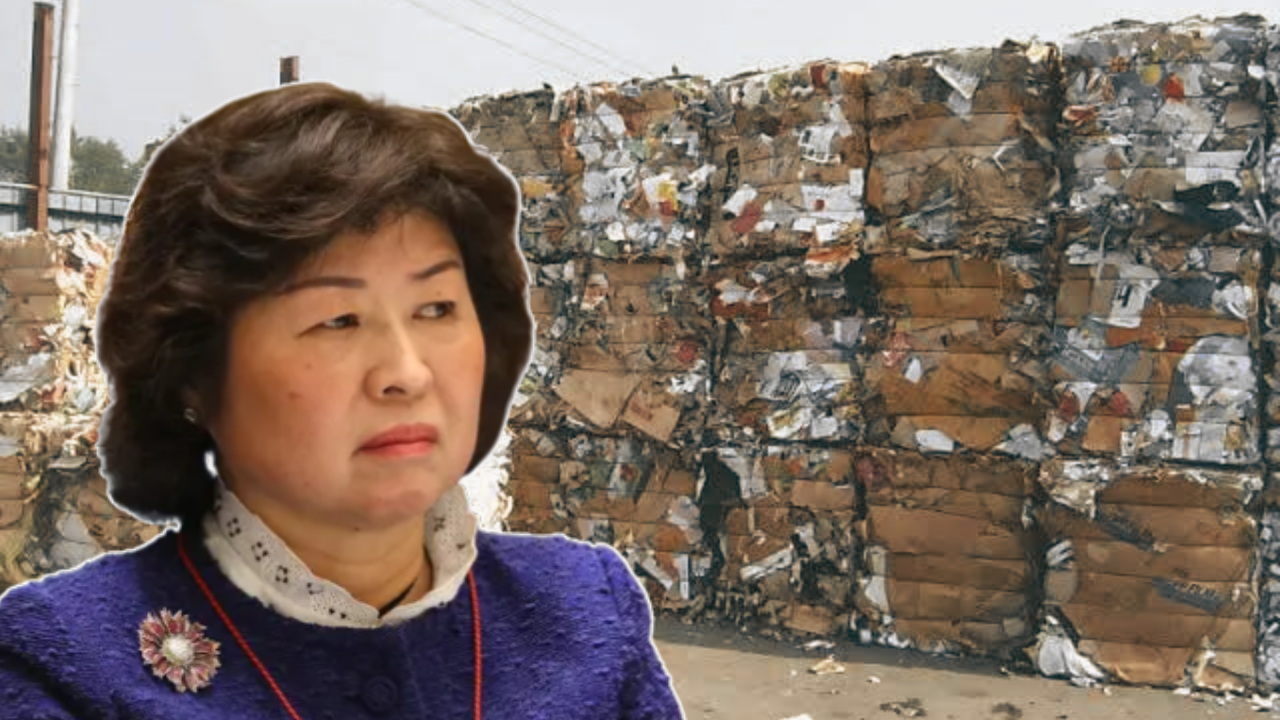
Photo via Times of India

She turned America’s waste paper into Chinese packaging: How Zhang Yin built her billion-dollar empire

Read the original at Times of India ↗
Cite

TOI Lifestyle Desk. (2026, September 23). She turned America’s waste paper into Chinese packaging: How Zhang Yin built her billion-dollar empire. Times of India. https://timesofindia.indiatimes.com/world/rest-of-world/in-1985-she-started-a-paper-business-with-with-3800-us-dollars-21-years-later-she-became-chinas-richest-person-how-zhang-yin-turned-americas-waste-paper-into-a-paper-empire/articleshow/134442077.cms

Dated when The Aporia collected the article, usually within hours of publication. Check the original for its exact date and byline.

Times of India · collected 2026-09-23 · by TOI Lifestyle Desk

Quick Summary

Zhang Yin started a paper-trading business in Hong Kong with 30,000 yuan ($3,800) in 1985. By 2006, her fortune had grown to $3.4 billion, making her China's richest person according to the Hurun Rich List. Zhang built her empire by collecting waste paper from the United States and shipping it to China for manufacturing into cardboard used in exports. Initially facing language barriers and starting with just herself and her husband, she overcame challenges like high shipping costs by securing deals with Chinese ships returning empty from America, thus using their unused space for her cargo.
Written by AI on 2026-09-23, from this article's own text only (the story summary below draws on all the coverage).

AI analysis

Story summary

In 1985, Zhang Yin established a paper-trading business in Hong Kong with an initial investment of about 30,000 yuan (around $3,800). By the mid-2000s, her company had grown exponentially. In 1990, she moved to Los Angeles and began collecting waste paper there, shipping it back to China where it was used to produce cardboard for the country's expanding export industries. More than two decades later, in 2006, Zhang was named China’s richest person with an estimated fortune of $3.4 billion on the Hurun Rich List. Her success stemmed from her ability to see value in waste paper discarded by others and turning it into a raw material for paper and packaging products.

Written for “Zhang Yins Recycling Empire” on 2026-11-03, grounded in this article and the 0 other(s) covering the same event.

Story

📰 Zhang Yins Recycling Empire
Economy/Business · 1 article(s) covering the same event.

Compared with similar articles

Nothing to compare against. No article is close enough to this one for the pipeline to have linked or judged the pair.
How this article was measured signals, leaning charts, publisher record, byline, topics and claims

Signals How these are calculated →

Claims extracted
62
sentences that state something as happening or true
Uncertain
15%
9 of 62 hedged ("reportedly", "may", "according to")
Leaning
not political
takes no side on a contested political question
Publisher signals
59/100
Times of India's corrections and hedging, across everything collected from it. Not a measure of accuracy.
Outlets on this story
1
Economy/Business
Same framing elsewhere
1
articles that frame the event the way this one does
Analyzed 2026-09-23 · how these are computed

How this is being covered How these are calculated →

Article leaning vs. publisher reliability
Source leaning vs. consistency

Publisher

Times of India · 3982 article(s) · 3 correction(s) detected
Running correction rate · 3 correction(s)

Who wrote this

TOI Lifestyle Desk
79 article(s) here · 1 carrying a prediction
🔮 The organisation, which was founded in 2019, has spent much of this time studying the conditions around City Island to understand whether native oysters could survive and eventually establish a self-sustaining reef.
🔮 On October 29, 2026, the New Hampshire Fish and Game Department announced that 20 acres of Great Bay would be closed to shellfish harvesting from November 1, 2026, through October 31, 2031.
🔮 That might be one of the reasons why people find their life's solutions in a book written thousands of years ago.
🔮 How children became parcels When the US Postal Service introduced its Parcel Post service on January 1, 1913, Americans could suddenly send packages weighing more than four pounds through the mail.
🔮 The funding will allow the Suwannee River Water Management District to purchase the Suwannee Sandhill Tract-Drew Property in Suwannee County, which includes approximately 1.5 miles of river frontage.
🔮 Yet, he captured their essence in a way few artists could.
🔮 A soft flower would probably be the last thing to come to mind, but nature has its own version of Dracula, and these are not creatures hiding deep inside dark forests, but rather some strange-looking flowers found in the cloud forests of South America.
🔮 Apart from their symbolic significance, the small objects could also produce sounds when they moved, acting as rattles that helped adults keep track of young children.
🔮 Located approximately three miles upstream from Lake Okeechobee, the proposed wetland system will capture and treat water from parts of the watershed that consistently record some of the highest phosphorus concentrations and pollution loads.
Wire or desk byline, not an individual reporter.
Also by TOI Lifestyle Desk
Nothing else under this byline is closely related to this article, so these are simply their most recent.
All 79 articles by TOI Lifestyle Desk →

Topics

China Hong Kong Los Angeles The New York Times the United States

Subjects

Zhang PERSON · 11× China GPE · 10× the United States GPE · 6× Hong Kong GPE · 5× America Chung Nam ORG · 3× America GPE · 2× Chinese NORP · 2× Los Angeles GPE · 2× The New York Times ORG · 1× Zhang Yin PERSON · 1×

Narrative

In 1990, she moved to Los Angeles The waste paper was used to make cardboard needed by the country's growing export industries. As reported by The LA Times, Zhang began collecting waste paper in Los Angeles in 1990 and shipping it to China, where it was used to make cardboard needed by the country's growing export industries.
framing: assertive · carried by 1 article(s) · first seen 2026-09-23
🔮 More than two decades later, she would be named China's richest person, with an estimated fortune of $3.4 billion on the 2006 Hurun Rich List.

Claims (62 extracted, 9 hedged)

In 1985, business tycoon Zhang Yin started a paper-trading business in Hong Kong with about 30,000 yuan, or 3,800 US dollars. asserted
Yin → start → yuan
More than two decades later, she would be named China's richest person, with an estimated fortune of $3.4 billion on the 2006 Hurun Rich List. asserted
she → name → List
The material at the centre of her business was something most people had already thrown away: waste paper. asserted
people → throw → business
Zhang eventually built a business that collected recovered paper in the United States, shipped it to China and used it as raw material for paper and packaging products. asserted
that → build → products
She saw value in something others discarded According to a 2007 profile in The New York Times, Zhang entered the paper trade when China was facing a shortage of paper-making raw material and its manufacturing industry was beginning to expand. uncertain
industry → see → material
In Hong Kong, she learned about the waste-paper business. asserted
she → learn → business
Zhang recalled advice she had received from a man in the industry. asserted
she → recall → industry
Paper recycles itself, generation after generation,” she told the NY Times. asserted
she → recycle → Times
She later arrived in Hong Kong from Guangdong in 1985 and started her own company with 30,000 yuan after turning down a job offer. asserted
She → arrive → offer
She began buying scrap paper through intermediaries in the United States. asserted
She → begin → States
The business soon showed her that Hong Kong alone would not be enough. asserted
Kong → show → her
China's growing manufacturing sector needed cardboard and packaging, while the United States had a much larger supply of used paper. asserted
States → grow → paper
So Zhang looked towards America. asserted
Zhang → look → America
In 1990, she moved to Los Angeles The waste paper was used to make cardboard needed by the country's growing export industries. As reported by The LA Times, Zhang began collecting waste paper in Los Angeles in 1990 and shipping it to China, where it was used to make cardboard needed by the country's growing export industries. asserted
it → move → industries
Her company, America Chung Nam, was already on track to ship about 3 million tons of waste paper in 2002, almost all of it to China. asserted
company → ship → China
Zhang and her husband had driven around the United States in a used Dodge minivan, approaching garbage dumps for scrap paper. asserted
Zhang → drive → paper
The couple had formed their US recycling company in the 1990s to collect paper and ship it to China. asserted
couple → form → China
Zhang later described how difficult those early years were. asserted
years → describe → ?
Speaking to reporters in Hong Kong in November 2006, she said: “I had to learn from scratch. asserted
I → speak → scratch
The business was just my husband and me, and I didn’t speak a word of English.” asserted
I → speak → English
“It was my hard work that helped me achieve my success,” she added. asserted
she → help → success
The shipping problem had an unusual solution asserted
problem → have → solution
There was one major difficulty with Zhang's business: waste paper was bulky and had to travel from the US to China. asserted
paper → be → China
But the existing trade between the two countries offered an opportunity. asserted
trade → exist → opportunity
Chinese ships were carrying manufactured goods to the United States. asserted
ships → carry → States
Some vessels had considerable unused space on their return journey. asserted
vessels → have → journey
According to The Economic Times, Rupert Hoogewerf, publisher of the Hurun Report, said Zhang secured low shipping rates because many vessels were almost empty after unloading their cargo in the US. uncertain
vessels → accord → US
That helped make the long-distance movement of waste paper commercially viable. asserted
movement → help → paper
The basic chain was straightforward: recovered paper collected in America went to China, where paper manufacturers could process it into new packaging material. uncertain
manufacturers → recover → material
Chinese container ships commonly unloaded goods in US ports and returned to China carrying American waste paper. asserted
ships → unload → paper
'America Chung Nam' became a major exporter The company Zhang built in the United States was ‘America Chung Nam.’ asserted
Zhang → become → States
It reported that America Chung Nam had sales of $238 million in 2001 and that its export volume had put it at the top of the Journal of Commerce's list of the nation's biggest exporters. asserted
volume → report → exporters
The company maintained that position for 18 consecutive years. asserted
company → maintain → years
By then, Zhang had identified a much larger opportunity. asserted
Zhang → identify → opportunity
She did not want to remain only the company collecting and exporting the raw material. asserted
She → want → material
She wanted to manufacture the paper herself. asserted
She → want → paper
She moved from recycling into manufacturing Her companies were now involved in both sides of the process: sourcing recovered paper and manufacturing packaging paper in China. asserted
companies → move → China
In 1995, Dongguan Nine Dragons was established to manufacture containerboard in Dongguan, Guangdong, according to Nine Dragons' own listing documents filed with the Hong Kong Stock Exchange. uncertain
Dragons → establish → Exchange
The company's first paper machine began production in July 1998. asserted
machine → begin → July
Nine Dragons' listing document says a second paper machine, with a design capacity of 400,000 tonnes a year, began production in June 2000. asserted
machine → say → June
…and 22 more, not listed.

💬Give feedback
🕘History 🎫Support