
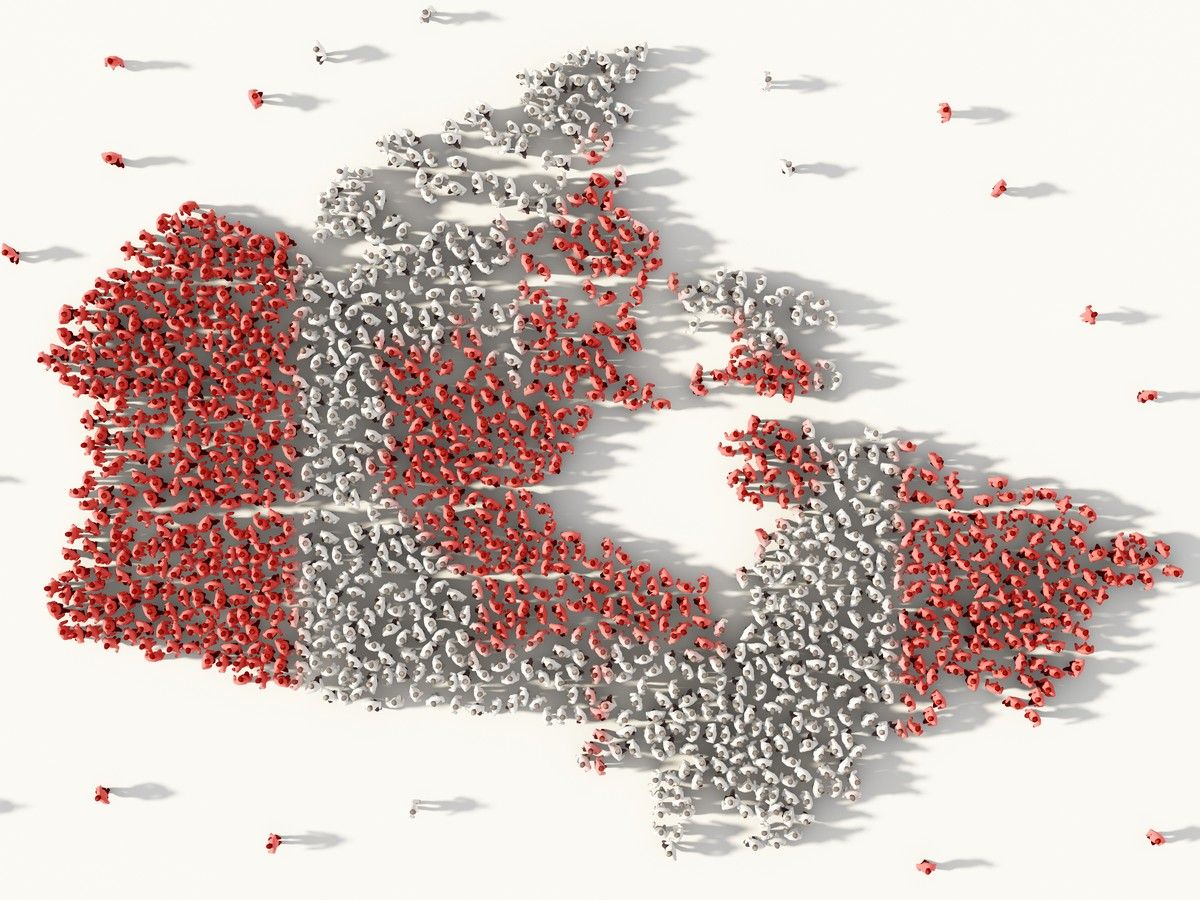
Photo via Global News

Canada’s population growth continues its decline, StatCan says

Read the original at Global News ↗
Cite

Rana, U. (2026, September 23). Canada’s population growth continues its decline, StatCan says. Global News. https://globalnews.ca/news/12070197/canada-population-growth-july-2026/

Dated when The Aporia collected the article, usually within hours of publication. Check the original for its exact date and byline.

Global News · collected 2026-09-23 · by Uday Rana

Quick Summary

Statistics Canada reported that Canada's population grew by 189,425 people or 0.5% from July 1, 2025, to July 1, 2026, reaching a total of 41,798,407. This growth rate is the lowest since 1944/1945 and largely attributed to declining migration trends, particularly in non-permanent residents such as students and workers. The average age of Canadians increased to 42.1 years, with provinces like Alberta experiencing faster growth compared to British Columbia, which saw minimal change.
Written by AI on 2026-09-23, from this article's own text only (the story summary below draws on all the coverage).

AI analysis

Story summary

Statistics Canada reported that Canada’s population reached 41,798,407 people by July 1, 2026, marking an increase of 189,425 people from the previous year. This growth rate of 0.5%, however, is the lowest since 1944/1945 and represents a significant decline from the peak of 2.8% in 2023/2024. The agency attributed this slowdown largely to changing international migration trends, noting that Canada’s average age has also increased over the past two years due to these shifts.

The Trudeau government had previously set ambitious immigration targets, raising annual numbers from an average of 617,800 between 2000 and 2015 to approximately 1.4 million for 2016 to 2024, which contributed significantly to population growth. However, in response to public concerns about housing affordability, the Carney government introduced a new immigration plan in 2025 that aims for more moderate levels while maintaining focus on economic immigration growth.

In the second quarter of 2026 alone, Canada's population increased by 80,343 people or 0.2%, marking another low point since the height of the COVID-19 pandemic in 2020 when migration had been severely restricted.
Written for “Canadian Population Growth Slows” on 2026-11-02, grounded in this article and the 1 other(s) covering the same event.

Story

📰 Canadian Population Growth Slows
Economy/Business · 2 article(s) covering the same event. See how they differ ↓

Compared with similar articles

This article reads unscored and hedges 6% of its claims. Each row says how that neighbour differs.
National Post
⚖️ Leans right Hedges 1 of 29 claims Outlet record 60/100
How this article was measured signals, leaning charts, publisher record, byline, topics and claims

Signals How these are calculated →

Claims extracted
18
sentences that state something as happening or true
Uncertain
6%
1 of 18 hedged ("reportedly", "may", "according to")
Leaning
not political
takes no side on a contested political question
Publisher signals
63/100
Global News's corrections and hedging, across everything collected from it. Not a measure of accuracy.
Outlets on this story
2
Economy/Business
Same framing elsewhere
1
articles that frame the event the way this one does
Analyzed 2026-09-23 · how these are computed

How this is being covered How these are calculated →

Article leaning vs. publisher reliability
Source leaning vs. consistency

Publisher

Global News · 2650 article(s) · 11 correction(s) detected
Running correction rate · 11 correction(s)

Who wrote this

Uday Rana
32 article(s) here · 0 carrying a prediction
🔮 A poor showing could end the 77-year-old’s lengthy career on a bitter note and open the door to a new era in Israeli politics.
🔮 While large data centre projects will require around 100 megawatts of power per building, there “may be some smaller ones” as well, he added.
🔮 He urged the Houthis and Saudi-backed government forces to avoid using explosive weapons in areas where they could hit civilians and civilian infrastructure.
🔮 Some employees would be offered transfers, but many would be out of work.
🔮 Member states of the International Energy Agency, including Canada, will release 20 million barrels of diesel “as soon as possible” into the global market to ease the pressure on fuel costs, the agency said in a statement.
🔮 “We don’t need them, but they need us,” Trump said, adding that Canada would be “doing something just like Greenland.”
🔮 Canadians shopping for a home say they are willing to live with mom and dad just to be able to afford a home, a new poll by the Royal Bank of Canada has found.
🔮 A 2025 Stanford University research paper found that in some cases, AI chatbots may introduce biases that could have potentially dangerous consequences.
🔮 Canadians will decide the future of Canada, not “large tech firms that think they can tell us what to do,” Prime Minister Mark Carney said on Thursday, responding to Elon Musk’s comments that three Canadian provinces “should separate” from Canada.
🔮 While many start a side hustle out of financial stress, it could also be an entrepreneurial opportunity, said Ownr CEO Jordan Casey.
Also by Uday Rana
Nothing else under this byline is closely related to this article, so these are simply their most recent.
All 32 articles by Uday Rana →

Topics

Alberta Canada Canadian Canadians Statistics Canada

Subjects

Canada GPE · 12× Statistics Canada ORG · 3× Canadians NORP · 2× Alberta GPE · 1× British Columbia GPE · 1× Canadian NORP · 1× the Northwest Territories GPE · 1×

Narrative

Statistics Canada credited “changing international migration trends” with not only the slowdown in the population growth rate, but also with the average age in Canada increasing over the past two years.
framing: assertive · carried by 1 article(s) · first seen 2026-09-23
2026-09-23 · Global News
Canada’s population growth continues its decline, StatCan says · assertive framing

Claims (18 extracted, 1 hedged)

Canada’s population growth rate continues to decline, largely owing to declining migration trends, Statistics Canada said on Wednesday. asserted
Canada → continue → Wednesday
The population of Canada reached an estimated 41,798,407 people on July 1, 2026, an increase of 189,425 people or 0.5 per cent from July 1, 2025. asserted
population → reach → July
This marked the lowest July-to-July growth in total population size since 1944/1945 and the lowest July-to-July percentage increase since 1915/1916, the agency added. asserted
agency → mark → 1915/1916
Canada’s population growth rate for July peaked at 2.8 per cent in 2023/2024, but has been steadily slowing on an annual basis since then. asserted
rate → peak → basis
The growth rate has more than halved compared to July 2024/2025, when it was 1.1 per cent. asserted
it → halve → July
In the second quarter of the year, from April 1 to July 1, Canada saw its population increase by 80,343 people or 0.2 per cent. asserted
population → see → people
This was the lowest growth in a second quarter since the second quarter of 2020, when the COVID-19 pandemic had all but halted immigration levels. asserted
pandemic → halt → levels
Statistics Canada credited “changing international migration trends” with not only the slowdown in the population growth rate, but also with the average age in Canada increasing over the past two years. asserted
age → credit → years
The number of non-permanent residents in Canada dropped by 154,614 people from July 2025 to reach 2,779,774 on July 1, 2026, or 6.7 per cent of the total population. asserted
number → drop → population
This was mostly led by a massive decline in the number of study permit holders (declined by 140,827) and work-and-study permit holders (81,163 drop). asserted
This → lead → 140,827
The two segments that saw the largest declines in population were people between 20 and 24 years (2.4 per cent) and people between 25 and 29 (3.1 per cent). asserted
that → see → 25
Canada welcomed 99,148 immigrants in the second quarter of 2026, according to Statistics Canada. uncertain
Canada → welcome → Canada
Canadians over 65 now form 20 per cent of the population, an increase of 0.6 per cent, while Canadians aged 0 to 14 form 15 per cent of the population, a decline of 0.1 per cent. asserted
Canadians → form → cent
Alberta had the fastest growing population (1.5 per cent), while British Columbia had the slowest rate of growth (0.1 per cent). asserted
Columbia → have → growth
The only province or territory to register a decline in population was the Northwest Territories, where the population declined by 0.3 per cent. asserted
population → register → cent
The fertility rate has been steadily declining in Canada since 2009. asserted
rate → decline → 2009
The drops got sharper between 2017 and 2023, except for 2021 when an increase was recorded. asserted
increase → get → 2021
In 2025, 43.8 per cent of mothers who gave birth in Canada were born in other countries, up from 32.7 per cent in 2021. asserted
who → give → 2021
💬Give feedback
🕘History 🎫Support