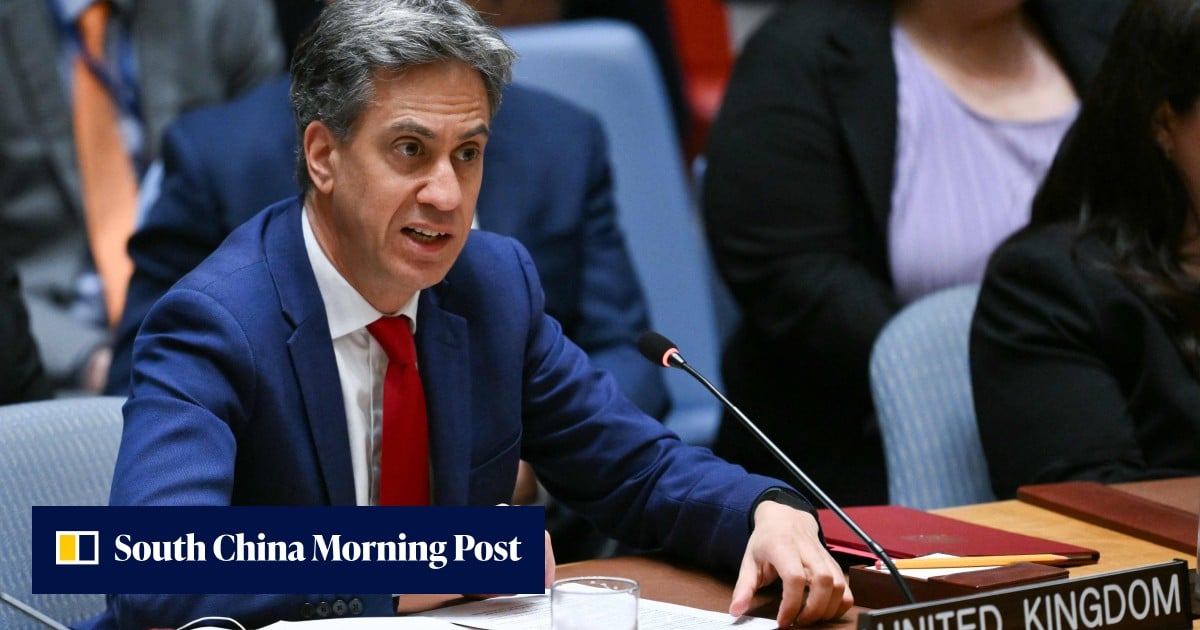
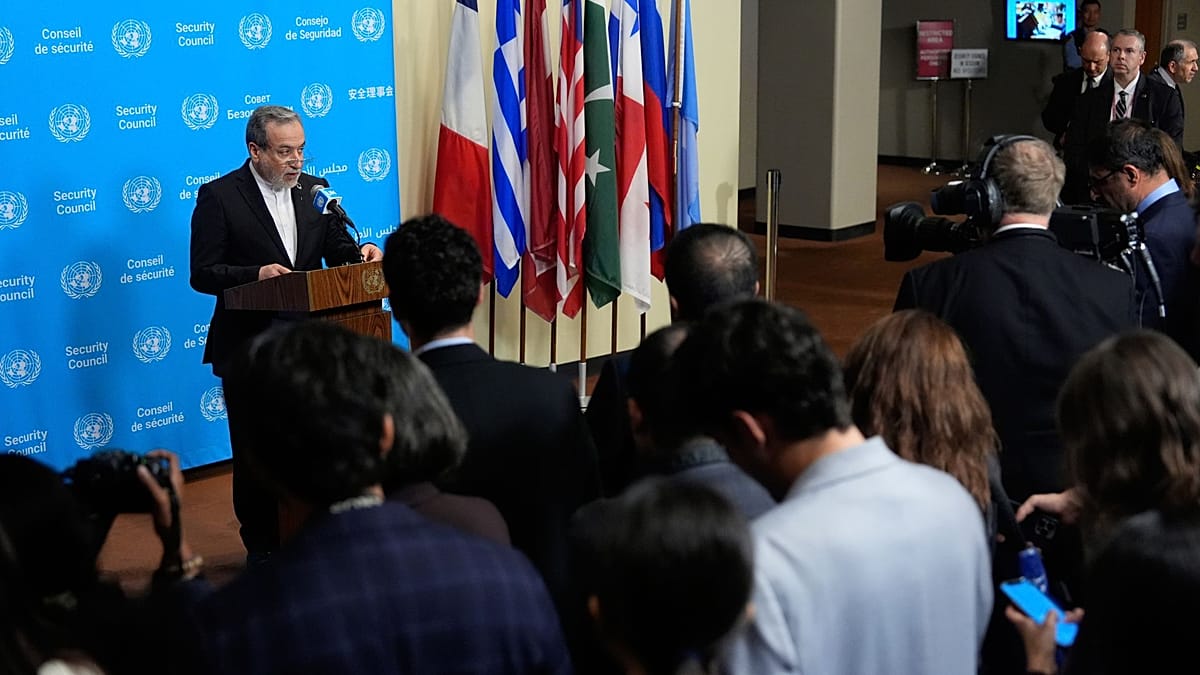
Photo via The Guardian

Ed Miliband meets Iran’s foreign minister as Tehran gives US ultimatum on strait of Hormuz

Read the original at The Guardian ↗
Cite

York, P. W. i. N. (2026, September 24). Ed Miliband meets Iran’s foreign minister as Tehran gives US ultimatum on strait of Hormuz. The Guardian. https://www.theguardian.com/world/2026/sep/24/ed-miliband-meets-iran-foreign-minister-us-ultimatum-strait-hormuz

Dated when The Aporia collected the article, usually within hours of publication. Check the original for its exact date and byline.

The Guardian · collected 2026-09-24 · by Patrick Wintour in New York

Quick Summary

Ed Miliband met with Iran’s foreign minister Abbas Araghchi in New York amid tensions over the strait of Hormuz, where Iran has given the US four to five days to meet its conditions for reopening the waterway. Mohsen Rezaei, a senior Iranian official, stated that if the US fails to comply, Tehran will take unspecified actions. Meanwhile, Brent crude oil prices were around $107 per barrel. Miliband stressed the UK’s commitment to maintaining freedom of navigation and expressed concern over Iran's behavior towards British citizens and Jewish communities in the UK.
Written by AI on 2026-09-24, from this article's own text only (the story summary below draws on all the coverage).

AI analysis

Story summary

As of October 2, 2026, Donald Trump rejected Iran's offer to reopen the Strait of Hormuz within seven days, deeming it "simply not enough." This proposal was made by Iranian President Masoud Pezeshkian in an effort to ease tensions and open dialogue. However, Trump warned that military action against Tehran could resume after the U.S. midterm elections, suggesting ongoing hostility despite Iran's willingness to negotiate. The offer came amidst international pressure for a resolution to the conflict; Russian President Vladimir Putin expressed hope that the strait would reopen, while also noting Russia’s proposal to receive enriched uranium from Iran remains on the table.

The U.S. has imposed new sanctions on Iranian carmakers and rail operators in response to Tehran's threats and actions. In parallel, Trump dismissed previous claims suggesting his administration was preparing to provide significant concessions to Iran, instead emphasizing a strategy focused on economic pressure through sanctions that have severely impacted Iran’s currency, with the rial trading at an unprecedented 2.5 million to the dollar.

The situation remains tense, with multiple international stakeholders advocating for dialogue and peace but facing resistance from both sides, particularly as the U.S. continues its aggressive stance towards Iran despite diplomatic efforts by other nations like Russia. Ed Miliband, UK Foreign Secretary, also met with his Iranian counterpart in New York during the UN General Assembly to discuss reopening the Strait of Hormuz and address threats posed by Iranian-linked groups on British soil. However, Miliband reiterated that Britain will not tolerate any form of intimidation or hostile activity linked to Iran. This complex diplomatic scenario underscores the challenges in achieving a peaceful resolution without further escalation.

Written for “Trump's Iran Policy And Pardons Talks” on 2026-10-31, grounded in this article and the 132 other(s) covering the same event.

Story

📰 Trump's Iran Policy And Pardons Talks
Politics · 133 article(s) covering the same event. See how they differ ↓

Compared with similar articles

This article reads unscored and hedges 12% of its claims. Each row says how that neighbour differs.
The Hindu
Hedges 4 of 26 claims Outlet record 60/100
“The articles describe different parts of an ongoing situation, with Article A reporting on Iranian Parliament's stance and conditions by Ghalibaf on September 20th, while Article B reports Ed Miliband meeting Iran’s foreign minister about Tehran's ultimatum to the US given later on September 24th.”
Dawn
Hedges 0 of 12 claims Outlet record 71/100
“The articles describe different meetings involving different officials from Iran and another country (Interior Minister Naqvi in Article A versus Foreign Secretary Miliband in Article B) on separate dates.”
South China Morning Post
Hedges 0 of 2 claims Outlet record 64/100
BBC News
⚖️ Leans left Hedges 1 of 25 claims Outlet record 69/100
Al Jazeera
Hedges 0 of 2 claims Outlet record 60/100
The Guardian
Hedges 1 of 20 claims Outlet record 66/100
“The articles describe related diplomatic events involving Iran and the US but refer to different stages or separate occurrences around negotiations over the strait of Hormuz.”
Euronews
Hedges 3 of 29 claims Outlet record 60/100
“The articles describe different stages or responses to the Iran-US standoff over the strait of Hormuz, with Article A reporting Ed Miliband's meeting and Iran's ultimatum, while Article B details Trump's rejection of an Iranian plan.”
Fox News
Hedges 0 of 21 claims Outlet record 70/100
“The articles describe different aspects of Iran's economic and geopolitical situation but do not report on the same specific incident.”
Al Jazeera
Hedges 0 of 2 claims Outlet record 60/100
“The articles describe different events occurring on separate days, involving different individuals and contexts.”
How this article was measured signals, leaning charts, publisher record, byline, topics and claims

Signals How these are calculated →

Claims extracted
24
sentences that state something as happening or true
Uncertain
12%
3 of 24 hedged ("reportedly", "may", "according to")
Leaning
not political
takes no side on a contested political question
Publisher signals
66/100
The Guardian's corrections and hedging, across everything collected from it. Not a measure of accuracy.
Outlets on this story
133
Politics
Same framing elsewhere
1
articles that frame the event the way this one does
Analyzed 2026-09-24 · how these are computed

How this is being covered How these are calculated →

Article leaning vs. publisher reliability
Source leaning vs. consistency

Publisher

The Guardian · 1841 article(s) · 6 correction(s) detected
Running correction rate · 6 correction(s)

Who wrote this

Patrick Wintour in New York
6 article(s) here · 1 carrying a prediction
🔮 The US threat to impose sanctions on the international criminal court (ICC) as an institution, not just its leading judges, could fundamentally disrupt its operation and needed to be resisted, a coalition of countries to defend international law heard at the United Nations on Friday.
🔮 Iran’s seven-day timetable to reopen the strait of Hormuz and start talks on its nuclear programme has been pitched as a deal that could rapidly extricate Donald Trump from a political crisis but requires the US president to make difficult concessions.
🔮 The previously unknown apparent deadline was specified by Mohsen Rezaei, the secretary of the supreme national security council, in a TV interview on Wednesday evening, and it is unclear what action Tehran will take if the US does not respond to Iran’s preconditions for reopening the vital waterway.
🔮 In a defiant speech to the UN general assembly in New York, his first since the US and Israel launched an all-out war on Iran, Pezeshkian repeatedly vowed that Tehran would never bend the knee to America.
🔮 Iran set seven preconditions before returning to talks, and in a new development over the past 48 hours said the crucial strait of Hormuz could be reopened within seven days if those conditions were met.
🔮 He said there would a further meeting in the very near future.
Also by Patrick Wintour in New York
Nothing else under this byline is closely related to this article, so these are simply their most recent.
All 6 articles by Patrick Wintour in New York →

Topics

Iran Iranian New York Tehran the supreme national security council

Subjects

Iran GPE · 9× Iranian NORP · 6× Araghchi PERSON · 4× Tehran GPE · 4× New York GPE · 3× Rezaei PERSON · 3× Hormuz GPE · 2× IRGC ORG · 2× Miliband PERSON · 2× Yemen GPE · 2×

Narrative

Domestically, Pezeshkian’s defiant message to the UN general assembly on Wednesday was deemed a success overall in that it balanced a refusal to bend the knee to “the US bully” with a willingness to seek diplomatic talks. He also proposed a new security architecture for the future in partnership with Gulf states, including those it has been bombarding in an effort to dislodge the US from its military bases.
framing: assertive · carried by 1 article(s) · first seen 2026-09-24
🔮 The previously unknown apparent deadline was specified by Mohsen Rezaei, the secretary of the supreme national security council, in a TV interview on Wednesday evening, and it is unclear what action Tehran will take if the US does not respond to Iran’s preconditions for reopening the vital waterway.

Claims (24 extracted, 3 hedged)

The UK foreign secretary, Ed Miliband, has met his Iranian counterpart, Abbas Araghchi, for the first time in New York amid warnings from senior Iranian security officials that the US has four to five days to respond to its conditions for reopening the strait of Hormuz. asserted
US → meet → Hormuz
The previously unknown apparent deadline was specified by Mohsen Rezaei, the secretary of the supreme national security council, in a TV interview on Wednesday evening, and it is unclear what action Tehran will take if the US does not respond to Iran’s preconditions for reopening the vital waterway. uncertain
US → specify → waterway
A faction inside Iran is arguing that Tehran should seek to escalate the conflict with a vulnerable US president, rather than let the crisis drift in its current deadlock. asserted
crisis → argue → deadlock
Brent crude was trading at about $107 (£81) a barrel on Thursday. asserted
crude → trade → Thursday
Araghchi and the US’s special envoy Steve Witkoff met earlier this week on the sidelines of the general assembly to discuss Iran’s terms for reopening the strait and the speed at which that may happen, as well as the time the US had been given to respond. uncertain
US → meet → which
Rezaei, a recently promoted hardliner, said Iran’s president, Masoud Pezeshkian, and Araghchi had flown to New York to convey Iran’s internally agreed terms, not to negotiate new ones. asserted
president → promote → ones
“There has been no discussion whatsoever that these conditions should change, that a new condition should be removed or added,” he said. asserted
he → change → ?
The big change appears to be that Tehran now insists Washington act first. asserted
Washington → appear → ?
Now we must act,” Rezaei said. asserted
Rezaei → act → ?
He warned that if the US did “not fulfil the conditions, we will neither open the strait of Hormuz nor is there any negotiation on the table”. asserted
we → warn → table
Rezaei said the seven conditions must be implemented “completely and all at once”, adding that the US had been given “four or five days” to do so. asserted
US → say → days
After that, he said, Iran would determine its “next step”, without specifying what that would entail. asserted
that → say → what
The meeting between Miliband and Araghchi, one of an exhaustive round of bilaterals undertaken by the Iranian foreign minister, is the first meeting between UK and Iranian ministers for a year and the first exchange since the UK in July proscribed the Islamic Revolutionary Guards Corps (IRGC) as a terrorist organisation, a move that has worsened the already sour relations between the two countries. asserted
that → undertake → countries
Miliband made clear that the UK was committed to freedom of navigation in the strait and wanted a diplomatic solution, also stressing support for Saudi Arabia, a UK ally in Yemen. asserted
committed → make → Yemen
He warned Iran about its behaviour in the UK, including threats to Jewish communities, and called for the UK to be given consular access to the British couple sentenced to 10 years’ imprisonment in Tehran. Overall, European diplomats have not sensed a US-Iran breakthrough in New York. asserted
diplomats → warn → York
The US secretary of state, Marco Rubio, also said it would be wrong to characterise the Witkoff talks with Iran as a major breakthrough. asserted
it → say → breakthrough
It is understood that Araghchi, speaking largely through a Qatari mediator, set out to him the seven preconditions to be met before it is willing to reopen the strait, including the lifting of US sanctions and an end to war on all fronts, a reference to Israeli military activity in south Lebanon. asserted
it → understand → Lebanon
Some IRGC officers have also linked the strait of Hormuz issue to the closure of the Bab al-Mandab strait, the narrow waterway close to the south-west of Yemen now under control of Iranian-backed Houthis. asserted
officers → link → Houthis
Maj Gen Rahim Safavi, a senior Iranian military figure, said: “If the Americans start a new war, a new front centred on the Red Sea and the Bab al-Mandab strait may open before their eyes. uncertain
front → say → eyes
Are they ready to enter the battle on this front? asserted
they → enter → front
This is a question that they should pay more attention to.” asserted
they → pay → attention
Domestically, Pezeshkian’s defiant message to the UN general assembly on Wednesday was deemed a success overall in that it balanced a refusal to bend the knee to “the US bully” with a willingness to seek diplomatic talks. He also proposed a new security architecture for the future in partnership with Gulf states, including those it has been bombarding in an effort to dislodge the US from its military bases. asserted
it → deem → bases
Maj Gen Ahmad Vahidi, commander-in-chief of the IRGC, praised Pezeshkian’s speech, saying: “We are not afraid of war. asserted
We → praise → war
It is the loud and firm call of the Iranian nation – a call that resonated from the United Nations podium, through the words of the esteemed president, and reached the ears of the world.” asserted
that → resonate → world
💬Give feedback
🕘History 🎫Support