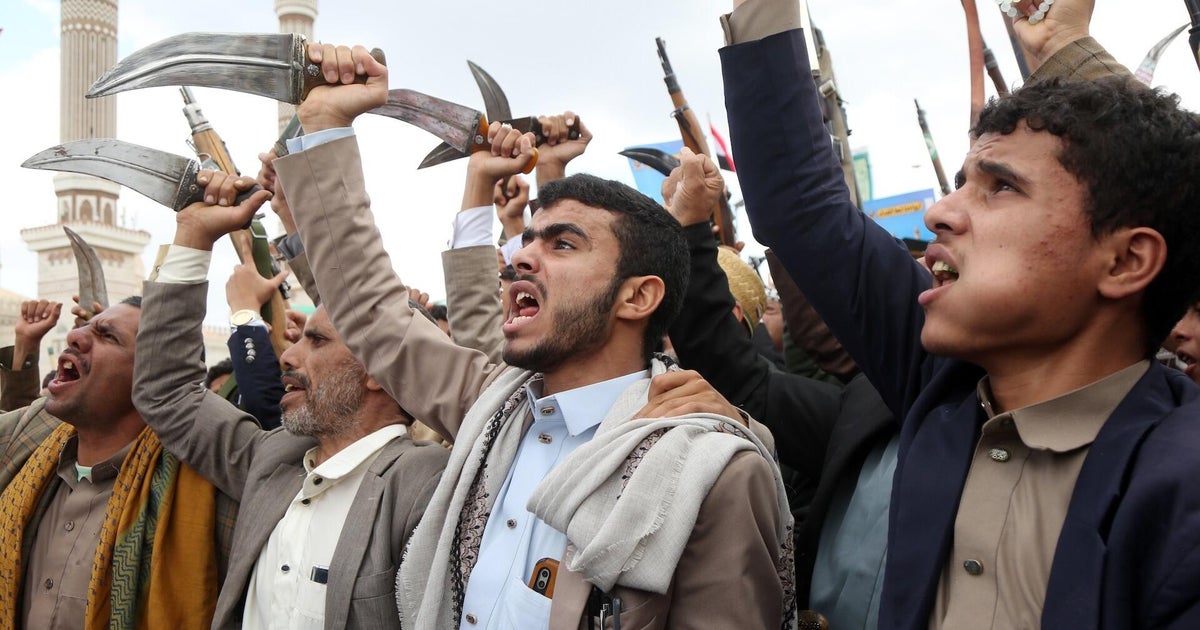
Photo via Washington Examiner

The West thinks Iran is winning the Red Sea. Trump is

Read the original at Washington Examiner ↗
Cite

Nye, W. (2026, September 25). The West thinks Iran is winning the Red Sea. Trump is. Washington Examiner. https://www.washingtonexaminer.com/op-eds/4740646/houthis-iran-isnt-winning-red-sea-trump-is/

Dated when The Aporia collected the article, usually within hours of publication. Check the original for its exact date and byline.

Washington Examiner · collected 2026-09-25 · by William Nye

Quick Summary

An article argues that recent advances by the Houthi rebels in Yemen do not signal Iranian dominance but rather reflect the desperation of a regime under severe sanctions from President Trump's administration. It highlights how these sanctions have forced Iran to intensify its support for the Houthis, even though historically this relationship has been limited and complex. The piece cites expert opinions suggesting that while there is coordination between Iran and the Houthis, Tehran does not exert full control over the group due to reluctance to escalate tensions directly with Saudi Arabia.
Written by AI on 2026-09-25, from this article's own text only (the story summary below draws on all the coverage).

AI analysis

Story summary

In an interview with France 24, Thomas Juneau, a University of Ottawa professor and expert on the Houthi-Iran relationship, challenged the notion that the Houthis are mere puppets of Iran. He argued that recent advances by the Houthis in Yemen do not indicate Iranian dominance but rather reflect desperation from the Iranian regime under Donald Trump-era sanctions. These sanctions have cost Iran hundreds of millions of dollars daily, forcing it to increase support for the Houthis beyond its usual limited backing. As a result, the Houthis are now blocking Red Sea ports and shipping lanes, disrupting Saudi Arabia's oil supply routes after the closure of the Strait of Hormuz. This move highlights Iran’s desperation rather than its strength, as it relies on an ally that is barely under its control to compensate for economic losses.

Written for “Iran In Red Sea Conflict” on 2026-11-04, grounded in this article and the 0 other(s) covering the same event.

Story

📰 Iran In Red Sea Conflict
Politics · 1 article(s) covering the same event.

Compared with similar articles

This article reads leans strongly right and hedges 6% of its claims. Each row says how that neighbour differs.
Washington Examiner
Hedges 2 of 16 claims Outlet record 69/100
“The articles discuss different aspects of the situation involving Trump's stance on the Houthis and Iran but do not describe the same specific incident or occurrence.”
The Guardian
⚖️ Leans left further left than this Hedges 2 of 41 claims Outlet record 66/100
“The articles discuss different aspects related to Iran under Trump's presidency but do not describe the same specific incident or occurrence.”
Fox News
⚖️ Leans strongly right Hedges 3 of 54 claims Outlet record 68/100
“The articles discuss different aspects of Iran's situation and Trump's policies, with Article A focusing on the Houthis' advance and economic sanctions, while Article B covers warnings about Iran miscalculating in light of upcoming U.S. midterms.”
Semafor
Hedges 0 of 4 claims Outlet record 59/100
“The articles discuss different aspects of the ongoing tensions between Iran, the US, and other regional players, rather than a single specific incident.”
New York Post
⚖️ Leans strongly right Hedges 2 of 30 claims Outlet record 66/100
“While both articles discuss President Trump's strategy against Iran, they describe different aspects of it over time with different emphases and outcomes.”
Al Jazeera
⚖️ Leans strongly right Hedges 9 of 59 claims Outlet record 60/100
“The articles describe different time periods and contexts related to Iran's actions, with Article A focusing on the Houthis' advance in Yemen as a result of Trump-era policies, while Article B discusses Iran's offer for de-escalation at the UN General Assembly.”
Dawn
Hedges 6 of 38 claims Outlet record 72/100
“The articles discuss different time periods and contexts related to U.S. and Iranian relations, not a single specific incident.”
CBS News
Hedges 0 of 3 claims Outlet record 65/100
“While both articles discuss Houthi attacks on Saudi Arabia in relation to Iran's actions and President Trump's stance, they appear to describe different narratives or analyses rather than the exact same specific incident.”
Al Jazeera
⚖️ Leans left further left than this Hedges 6 of 32 claims Outlet record 60/100
“The articles describe different perspectives on the ongoing conflict in Yemen involving Houthis and Saudi-backed forces, rather than a single specific incident or time frame.”
Toronto Star
⚖️ Leans right further left than this Hedges 3 of 58 claims Outlet record 64/100
“The articles describe different perspectives on the same general events (Houthi advances and Iranian involvement), but they are not clearly reporting on one single specific incident or occurrence.”
How this article was measured signals, leaning charts, publisher record, byline, topics and claims

Signals How these are calculated →

Claims extracted
36
sentences that state something as happening or true
Uncertain
6%
2 of 36 hedged ("reportedly", "may", "according to")
Leaning
Leans strongly right
of the writing, not the subject · beta estimate
Publisher signals
69/100
Washington Examiner's corrections and hedging, across everything collected from it. Not a measure of accuracy.
Outlets on this story
1
Politics
Same framing elsewhere
1
articles that frame the event the way this one does
Analyzed 2026-09-25 · how these are computed

How this is being covered How these are calculated →

Article leaning vs. publisher reliability
Source leaning vs. consistency

Publisher

Washington Examiner · 4199 article(s) · 8 correction(s) detected
Running correction rate · 8 correction(s)

Who wrote this

William Nye
1 article(s) here · 1 carrying a prediction
🔮 This might sound crazy compared to the popular Western narrative.
2026-09-25 · assertive framing · The West thinks Iran is winning the Red Sea. Trump is
The only article under this byline in the corpus.

Topics

Houthis Iran Iranian Saudi Arabia Yemen

Subjects

Houthis NORP · 17× Iran GPE · 11× Iranian NORP · 6× U.S. GPE · 4× Saudi Arabia GPE · 3× Yemen GPE · 3× Trump PERSON · 2× Donald Trump PERSON · 1× Hezbollah ORG · 1× Yanbu Port GPE · 1×

Narrative

In an interview with France 24, Thomas Juneau, a University of Ottawa professor and leading researcher on the Houthi-Iran relationship, explained, “I’ve written a lot over the years to reject the view that the Houthis are a puppet of Iranian foreign policy, that the Houthis are an arm of Iranian foreign policy that merely obeys or executes Iran’s orders.
framing: assertive · carried by 1 article(s) · first seen 2026-09-25
🔮 This might sound crazy compared to the popular Western narrative.
2026-09-25 · Washington Examiner
The West thinks Iran is winning the Red Sea. Trump is · assertive framing

Claims (36 extracted, 2 hedged)

The Houthis‘ advance doesn’t mean Iran is winning. asserted
Iran → mean → ?
It means President Donald Trump is. asserted
Trump → mean → ?
This might sound crazy compared to the popular Western narrative. uncertain
This → sound → narrative
In fact, the escalation exposes a decaying regime. asserted
escalation → expose → regime
It is the act of a panicked, paralyzed regime on the brink of falling. asserted
It → fall → falling
Recent Trump-era blockades and sanctions have drained Iran of hundreds of millions of dollars daily, pushing the regime to increase its support for the Houthis despite its previously skeptical and limited backing. asserted
blockades → drain → backing
This sudden cash injection has enabled the Houthis to block Red Sea ports and shipping lanes, effectively preventing Saudi Arabia from diverting oil to Yanbu Port after the Strait of Hormuz was closed. asserted
Strait → enable → Hormuz
This is no typical Iranian tentacle wrapping itself further around the Middle East. asserted
This → wrap → East
It is a panicked plot by a cornered regime calling on a faction that should be its last resort. asserted
that → call → faction
In an interview with France 24, Thomas Juneau, a University of Ottawa professor and leading researcher on the Houthi-Iran relationship, explained, “I’ve written a lot over the years to reject the view that the Houthis are a puppet of Iranian foreign policy, that the Houthis are an arm of Iranian foreign policy that merely obeys or executes Iran’s orders. asserted
that → lead → orders
I think the relationship is much more complicated than that.” asserted
relationship → think → that
Asked about recent events, Juneau said, “What we’ve been seeing in the last few days in Yemen has absolutely been done in close coordination with Iran and has to be seen in the context of developments in the Persian Gulf.” asserted
seeing → ask → Gulf
Although the Houthis may now look like a proxy, coordination does not mean control. uncertain
coordination → look → control
In Iran’s eyes, the Houthis offer a poor return on investment compared with other regional militant groups, particularly because Tehran does not want to risk a direct, costly escalation with Saudi Arabia. asserted
Tehran → offer → Arabia
The gap in scale tells the true story. asserted
gap → tell → story
Saudi Arabia poured at least $4 billion into Yemen from 2012 to 2022 alone. asserted
Arabia → pour → 2022
By contrast, a 2015 U.N. Security Council report traced Iranian arms shipments to the Houthis back to 2009, including a 2011 seizure of 900 Iranian rockets. asserted
report → trace → rockets
It found that American officials estimated Iran’s historical assistance consisted merely of small arms and “several million dollars in cash.” asserted
assistance → find → cash
The backing was so minimal that in 2014, both the United Nations and the United States explicitly stated that the Houthis were not an Iranian proxy but a group receiving limited support. asserted
Houthis → state → support
Michael Mulroy, a former deputy assistant secretary of defense for the Middle East and co-founder of the Lobo Institute, offers the sharpest counter. asserted
Mulroy → offer → counter
“The Houthis are the most effective proxy for Iran,” Mulroy said. asserted
Mulroy → say → Iran
“They have essentially pledged allegiance to the new supreme leader and have actively joined this conflict, compounding the economic pressure Iran is putting on the world energy market. asserted
Iran → pledge → market
The U.S. will have to deal with them decisively if this conflict is to come to an end favorably to the U.S. and the region. asserted
conflict → have → U.S.
Although the Houthis’ expansion has negative ramifications for the world energy market, it also raises a question about how they should be treated: If the Houthis are truly Iran’s proxy arm, the only viable outcome for the U.S. is direct intervention to clamp down on Iran. asserted
outcome → have → Iran
That doesn’t fully add up, however, given that U.S. officials met directly with the Houthis in Oman on Sunday. asserted
officials → add → Sunday
Trump said of the secret meeting, “The Houthis called us, and they don’t want to fight with us. asserted
they → say → us
They don’t want me to go after them.” asserted
me → want → them
When asked for further comment on the recent escalation, a State Department spokesperson said, “Iran’s support for the Houthis is nothing new — it has armed, funded, and trained the terrorist group for over a decade, enabling the Houthis to sow chaos in Yemen and beyond and interfere with freedom of navigation in the Red Sea.” asserted
it → ask → Sea
Asked how the Trump administration plans to tackle the Houthis, the spokesperson added, “The Trump administration has clearly demonstrated its resolve and commitment to confront Iran and its proxies throughout the region, and we will not hesitate to use all available tools to counter the full range of Iran’s destabilizing actions.” asserted
we → ask → actions
This puts the U.S. in a position of ultimate strength. asserted
This → put → strength
Washington is twisting Iran’s hand toward imminent economic collapse, and Tehran’s financial ability to feed its regional network will naturally evaporate. asserted
ability → twist → network
That will weaken its hold on the Houthis, particularly against Trump’s peace-through-strength pragmatism. asserted
That → weaken → pragmatism
As Iran’s economy deteriorates, its ability to sustain the Houthis weakens, allowing Yemen’s internationally recognized government, which actively combats the group, to deal with the aftermath rather than the U.S. Tehran thought deploying the Houthis would be a smart last-ditch effort, a counterpunch to inflict harm on the U.S. and its allies. asserted
deploying → deteriorate → U.S.
What it forgot is who it is facing, and the message this sends: Iran is losing, and not just slightly. asserted
Iran → forget → who
William Nye is a Brisbane-based Australian student and op-ed columnist covering global and domestic politics, culture, economics, and international affairs, with a strong focus on U.S. politics. asserted
Nye → base → politics
His work has appeared in the Spectator Australia and the Washington Examiner. asserted
work → appear → Spectator

💬Give feedback · no sign-in needed

No sign-in needed for now. Your note is sent without a name, so it cannot be answered.

🕘History 🎫Support