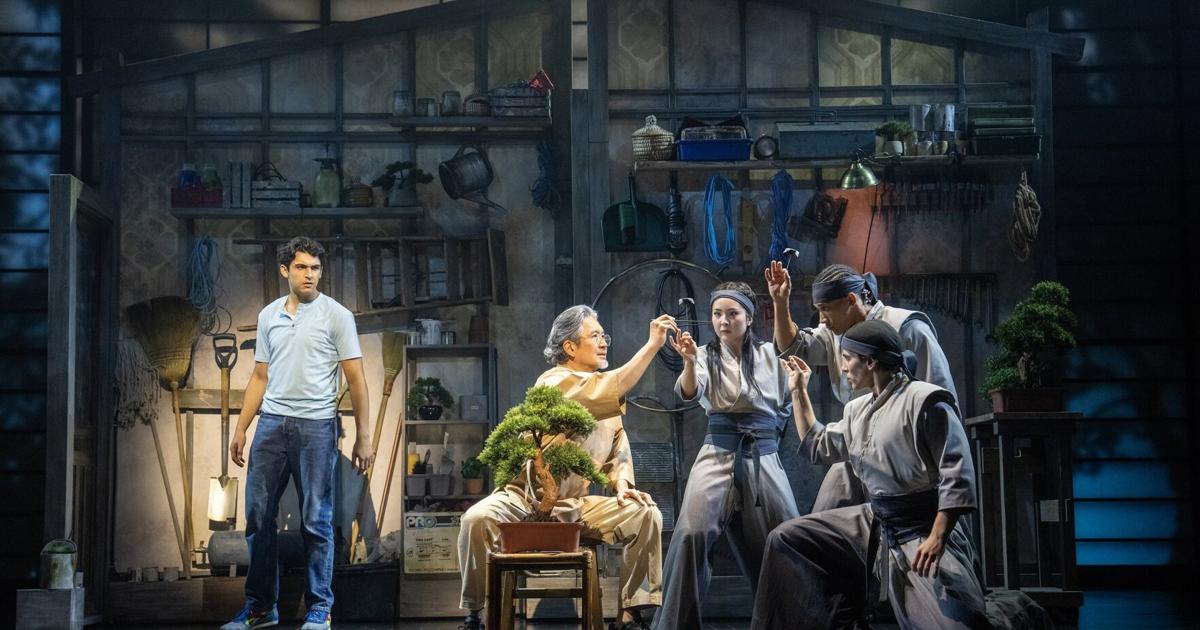
Photo via Toronto Star

A long-neglected Black classic opens Canadian Stage with a quiet, shattering look at race and misogyny

Read the original at Toronto Star ↗
Cite

Sumi, G. (2026, September 26). A long-neglected Black classic opens Canadian Stage with a quiet, shattering look at race and misogyny. Toronto Star. https://www.thestar.com/entertainment/stage/a-long-neglected-black-classic-opens-canadian-stage-with-a-quiet-shattering-look-at-race-and-misogyny/article_9a75fc36-f6c7-4390-97b3-beb4dafa4fa6.html

Dated when The Aporia collected the article, usually within hours of publication. Check the original for its exact date and byline.

Toronto Star · collected 2026-09-26 · by Glenn Sumi

Quick Summary

Canadian Stage is launching its season with Alice Childress' 1969 play "Wine in the Wilderness," which explores themes of misogyny and internalized racism within the Black community. Set against the backdrop of the Harlem Riots of 1964, the story revolves around Bill, a painter working on a series about Black womanhood, and his encounter with Tommy, a woman displaced by the riots who challenges his prejudices. The play critiques societal beauty standards and racial dynamics, featuring performances by Mazin Elsadig as Bill and Virgilia Griffith as Tommy.
Written by AI on 2026-09-26, from this article's own text only (the story summary below draws on all the coverage).

AI analysis

Story summary

Canadian Stage launched its season with the rediscovery of Alice Childress' 1969 play "Wine in the Wilderness," previously neglected despite being set against the backdrop of the Harlem Riots of 1964. The drama focuses on quieter but deeply destructive themes such as misogyny, classism, and internalized racism within the Black community rather than overt racial conflict. Among the characters are Bill (a divorced painter), Sonny-Man (a writer), Cynthia (a social worker), Tommy (a factory worker), and Oldtimer (Andrew Moodie). The play highlights a pivotal moment when Bill acknowledges "Black is beautiful," reflecting the cultural shift in empowering Black identity against pervasive European beauty standards.

Written for “Black Classic Play Performs Canada” on 2026-10-31, grounded in this article and the 0 other(s) covering the same event.

Story

📰 Black Classic Play Performs Canada
Entertainment · 1 article(s) covering the same event.

Compared with similar articles

Nothing to compare against. No article is close enough to this one for the pipeline to have linked or judged the pair.
How this article was measured signals, leaning charts, publisher record, byline, topics and claims

Signals How these are calculated →

Claims extracted
24
sentences that state something as happening or true
Uncertain
0%
0 of 24 hedged ("reportedly", "may", "according to")
Leaning
Leans left
of the writing, not the subject · beta estimate
Publisher signals
64/100
Toronto Star's corrections and hedging, across everything collected from it. Not a measure of accuracy.
Outlets on this story
1
Entertainment
Same framing elsewhere
1
articles that frame the event the way this one does
Analyzed 2026-09-26 · how these are computed

How this is being covered How these are calculated →

Article leaning vs. publisher reliability
Source leaning vs. consistency

Publisher

Toronto Star · 10784 article(s) · 28 correction(s) detected
Running correction rate · 28 correction(s)
2026-10-26
Correction
2026-10-24
Correction
2026-10-07
Correction
2026-09-24
Correction

Who wrote this

Glenn Sumi
2 article(s) here · 1 carrying a prediction
🔮 Simmons’ preppy villain Johnny is so villainous, he might as well sport a moustache and be twirling it.
🔮 At a later time, Bill says “Black is beautiful,” mouthing the catch phrase that would become an empowering movement in the 1960s, a reaction to the European beauty standards that were — and let’s face it, still are — pervasive.
Also by Glenn Sumi
Nothing else under this byline is closely related to this article, so these are simply their most recent.

Topics

American Black Canadian Stage Shaw Stratford

Subjects

Bill PERSON · 8× Tommy PERSON · 7× Black NORP · 6× Childress PERSON · 3× Cynthia PERSON · 2× Griffith PERSON · 2× Sonny-Man PERSON · 2× Alice Childress PERSON · 1× American NORP · 1× Shaw PERSON · 1×

Narrative

What follows is an intriguing look at a cross section of Black humanity at that particular time, with educated, middle-class bohemians like Bill, Sonny-Man (a writer) and Cynthia (a social worker) breaking bread with factory worker Tommy and a fifth character, Oldtimer (Andrew Moodie), a hard-drinking neighbourhood fixture who’s shown up at Bill’s apartment with a bag he’s scavenged from thieves who fled the looted stores.
framing: assertive · carried by 1 article(s) · first seen 2026-09-26
🔮 At a later time, Bill says “Black is beautiful,” mouthing the catch phrase that would become an empowering movement in the 1960s, a reaction to the European beauty standards that were — and let’s face it, still are — pervasive.

Claims (24 extracted, 0 hedged)

One of the great joys of being a theatregoer lately has been witnessing the rediscovery of the Black American writer Alice Childress, whose plays “Trouble in Mind” (1955) and “Wedding Band” (1966) have added historical and cultural breadth to the Shaw and Stratford Festivals in the past few years. asserted
plays → witness → years
Now Canadian Stage launches its season with Childress’ 1969 play “Wine in the Wilderness,” another major work that — until recently — has been largely neglected. asserted
that → launch → neglected
What’s notable about this play is that, despite the fact that it’s set against the Harlem Riots of 1964, which began after a white police officer shot and killed an unarmed Black boy in the Bronx, the main themes concern something quieter but no less destructive: namely, misogyny, classism and internalized racism within the Black community. asserted
themes → ’ → community
Bill (Mazin Elsadig) is a divorced painter who’s working on a triptych about Black womanhood for an upcoming exhibition. asserted
who → work → exhibition
His first panel shows an adorable picture of a young Black girl. asserted
panel → show → girl
The second illustrates a magnificent, proud Nubian goddess, in full flower. asserted
second → illustrate → flower
His third canvas is bare, but he knows what he wants to capture: a “messed-up chick,” someone who, in his words, is “unfeminine, coarse, rude and vulgar.” asserted
who → know → words
During the riots, his friends Sonny-Man (Jamar Adams-Thompson) and Cynthia (L.A. Sweeney) call him from a bar, telling him that they’ve found a potential subject for the painting. asserted
they → call → painting
And soon they show up at his door with Tommy (Virgilia Griffith), who’s sporting tacky, mismatched clothes (her home was burned in the riots), a cheap wig and seems more interested in securing a good meal and meeting an available single man than in posing for some painting. asserted
home → show → painting
What follows is an intriguing look at a cross section of Black humanity at that particular time, with educated, middle-class bohemians like Bill, Sonny-Man (a writer) and Cynthia (a social worker) breaking bread with factory worker Tommy and a fifth character, Oldtimer (Andrew Moodie), a hard-drinking neighbourhood fixture who’s shown up at Bill’s apartment with a bag he’s scavenged from thieves who fled the looted stores. asserted
who → follow → stores
But that earlier play didn’t have to deal with the differences between the N-word (which Tommy flings around a lot) and the phrase that Bill prefers, “Afro American.” asserted
Bill → have → that
Childress also doesn’t hold back in making Bill unsympathetic, having him begin many pronouncements with the phrase, “The problem with Black women is…” asserted
problem → hold → women
He speaks it so many times I’m surprised the opening night audience didn’t shout back at him in protest. asserted
audience → speak → protest
At a later time, Bill says “Black is beautiful,” mouthing the catch phrase that would become an empowering movement in the 1960s, a reaction to the European beauty standards that were — and let’s face it, still are — pervasive. asserted
’s → say → it
Tommy has a great comeback: “So how come it is I don’t feel beautiful when you talk to me?” asserted
you → have → me
Director Jordan Laffrenier, who handled the nuances of race and sex brilliantly in last year’s “Slave Play,” does similarly fine work here, especially with the actors. asserted
who → handle → actors
Moodie has a hoot as the earthy, seen-it-all elder, who brings comic relief and a great physicality to his scenes. asserted
who → have → scenes
Adams-Thompson and Sweeney make a believable groovy couple who aren’t quite aware of how condescending they’re being to Tommy. asserted
they → make → Tommy
And Elsadig’s Bill, aloof to the riots happening outside his apartment, captures the artist’s anger and disdain — perhaps for the world around him, but directed at women — with chilling effectiveness. asserted
Bill → happen → effectiveness
But it’s Griffith who gets the most intriguing role, and she takes it and squeezes hard. asserted
she → ’ → it
Childress doesn’t romanticize Tommy — whose name stands for “Tomorrow Marie” — but rather gives her solid, grounded details that Griffith latches onto and owns with both tenacity and a delicate vulnerability. asserted
Griffith → romanticize → tenacity
Scott Penner’s crowded loft-like set and colourful costumes situate us beautifully at a particular time, without being self-conscious and overdone. asserted
set → situate → time
And Olivia Wheeler’s sound design helps establish the riots and era (nice use of a Nina Simone song) efficiently, although there’s one early moment when Bill answers the phone and the outside noises quieten down that seems odd. asserted
that → help → phone
Filled to the brim with a rich, complex nectar, this “Wine” goes down smoothly and casts a warm, tender glow in its final, life-affirming tableau. asserted
Wine → fill → tableau

💬Give feedback
🕘History 🎫Support