Photo via The Guardian

Australian backlash to datacentres is faux import from US, officials say: ‘We are not the United States’

Read the original at The Guardian ↗
Cite

Josh Taylor Technology reporter. (2026, September 26). Australian backlash to datacentres is faux import from US, officials say: ‘We are not the United States’. The Guardian. https://www.theguardian.com/australia-news/2026/sep/26/australia-datacentre-backlash

Dated when The Aporia collected the article, usually within hours of publication. Check the original for its exact date and byline.

The Guardian · collected 2026-09-26 · by Josh Taylor Technology reporter

Quick Summary

Australian officials and business leaders are countering growing public resentment towards AI datacenters by asserting that the backlash is an imported issue from the United States rather than a homegrown concern. They argue that despite similar developments, Australia's datacenter growth is more regulated and smaller in scale compared to the U.S., where debates have been inflamed through social media. In July 2026, Victoria’s former minister for economic growth, Steve Dimopoulos, noted that while his state was second only to New South Wales in terms of datacenters, much of the public opposition stemmed from American social media influence rather than local conditions. Belinda Dennett, head of Data Centres Australia, emphasized that the U.S., with 5,400 datacenters totaling 53.7 gigawatts of capacity, operates at a different scale and under distinct market rules compared to Australia's 252 centers with 1.4 gigawatts total capacity.
Written by AI on 2026-09-26, from this article's own text only (the story summary below draws on all the coverage).

AI analysis

Story summary

In Australia, politicians and business leaders argue that growing public resentment towards AI datacentres is an imported issue from the United States, rather than a locally driven concern. Despite similar community backlash to the construction of massive datacenters as seen in the US last year, Australian officials claim their buildout is on a smaller scale and more regulated. This year, 2026, the debate has intensified across Australia, with calls for a national moratorium, protests, and three government inquiries. State frameworks are being developed and the federal government is moving to establish rules governing datacenter construction and resource consumption. While state governments have generally welcomed these investments due to economic benefits, they acknowledge concerns about energy and water usage.

Written for “Australia Datacenter Debate” on 2026-11-03, grounded in this article and the 0 other(s) covering the same event.

Story

📰 Australia Datacenter Debate
Politics · 1 article(s) covering the same event.

Compared with similar articles

This article reads leans right and hedges 8% of its claims. Each row says how that neighbour differs.
The Guardian
Hedges 1 of 8 claims Outlet record 66/100
“The articles discuss different topics: one about public resentment towards AI datacentres, and the other about a Medicare hack announcement.”
The Sydney Morning Herald
⚖️ Leans left further left than this Hedges 3 of 55 claims Outlet record 61/100
“Article A discusses a general backlash towards AI datacentres in Australia, while Article B describes a specific incident where residents successfully opposed a $1.2 billion data centre project in Lane Cove West.”
Semafor
Hedges 0 of 9 claims Outlet record 59/100
“The articles discuss similar themes but cover different specific events and contexts, with one focusing on Nvidia's executive stance in a U.S. context and the other on Australian officials responding to imported sentiments from the U.S.”
The Sydney Morning Herald
⚖️ Leans strongly left further left than this Hedges 2 of 19 claims Outlet record 61/100
“The articles discuss different aspects of AI regulation and public sentiment in Australia, but do not describe the same specific incident.”
South China Morning Post
⚖️ Leans left further left than this Hedges 1 of 3 claims Outlet record 62/100
“Article A discusses a general trend of backlash against AI datacentres in Australia, while Article B reports on a specific instance where an Australian firm drops its plan for a US$842 million Sydney data centre due to public opposition.”
How this article was measured signals, leaning charts, publisher record, byline, topics and claims

Signals How these are calculated →

Claims extracted
40
sentences that state something as happening or true
Uncertain
8%
3 of 40 hedged ("reportedly", "may", "according to")
Leaning
Leans right
of the writing, not the subject · beta estimate
Publisher signals
66/100
The Guardian's corrections and hedging, across everything collected from it. Not a measure of accuracy.
Outlets on this story
1
Politics
Same framing elsewhere
1
articles that frame the event the way this one does
Analyzed 2026-09-26 · how these are computed

How this is being covered How these are calculated →

Article leaning vs. publisher reliability
Source leaning vs. consistency

Publisher

The Guardian · 2889 article(s) · 6 correction(s) detected
Running correction rate · 6 correction(s)

Who wrote this

Josh Taylor Technology reporter
11 article(s) here · 1 carrying a prediction
🔮 In oral arguments before the high court on Tuesday, Reddit’s counsel, Perry Herzfeld SC, argued in the years leading up to the ban legislation, a 2021 parliamentary inquiry on social media had not recommended introducing a ban, with the eSafety commissioner warning the inquiry at the time it would be a “blunt force approach”.
🔮 Australia’s world-leading under-16s social media ban will face its first major legal challenge on Tuesday, as Reddit and an advocacy group headed by a libertarian politician seek to overturn the law in the high court.
🔮 Some reported AI had enabled them to take on work that would have previously been uneconomical (18%).
🔮 In July, Anthony Albanese said it would be “theft” if artists did not retain control over whether their work was used to build and train AI, and what they were paid for its use.
🔮 Australian adults will be able to access Pornhub once again after the site brought in age-checking on Apple devices in response to legal requirements that initially saw the site block users.
🔮 OpenAI will use an appearance before a parliamentary committee to apologise again to Australia about the hack on Medicare last month, on the same day media and entertainment organisations argue weakening Australian copyright law for AI model training would leave artists as “roadkill”.
🔮 OpenAI says its review in response to the Medicare and Hugging Face agent attacks is costing the company more than US$500,000 per day, as it deploys AI to examine data that would take a human 66m years to read.
🔮 In its defence against a high court challenge of the ban, the government has also argued its proposed digital duty of care legislation, allowing users to opt out of social media features such as algorithms, would ultimately have the same effect as the ban, if implemented.
🔮 OpenAI has apologised to Australians for its agent attack on Medicare, and will front parliament next week, as the tech company revealed more details about its June hack of Australian government websites.
🔮 “Having considered emerging federal and state policy, Goodman has concluded that it will not progress with the development application.”
Also by Josh Taylor Technology reporter
Nothing else under this byline is closely related to this article, so these are simply their most recent.
All 11 articles by Josh Taylor Technology reporter →

Topics

Australia Australian New South Wales Victoria the United States

Subjects

Australia GPE · 9× Australian NORP · 5× the United States GPE · 4× Dennett PERSON · 3× America GPE · 2× Belinda Dennett PERSON · 1× Data Centres Australia ORG · 1× New South Wales GPE · 1× Steve Dimopoulos PERSON · 1× Victoria GPE · 1×

Narrative

In 2026, though, it has exploded into national conversation across the country, leading to calls for a national moratorium, community protests, three government inquiries, state frameworks being developed and the Australian government moving to set the rules for how the datacentres can be built, and how they consume energy and water.
framing: assertive · carried by 1 article(s) · first seen 2026-09-26
🔮 “Because when it’s on your phone, you think it’s right here, or you think it might just come here.”

Claims (40 extracted, 3 hedged)

Australian politicians and business leaders are arguing that their populace’s growing resentment of AI datacentres is an inauthentic import from the United States. asserted
resentment → argue → States
Like the US, Australia is seeing community resentment grow in response to a surge in the construction of massive AI datacentres. asserted
resentment → see → datacentres
However, pro-datacentre officials and executives argue the scale of Australia’s buildout is smaller, more regulated and therefore less damaging than that in the US. asserted
scale → argue → US
They say the burgeoning negative reaction is being tainted and inflamed by a heated US debate that has arrived down under via social media feeds. asserted
that → say → feeds
When the backlash began in earnest in the United States last year, it echoed slowly in Australia. asserted
it → begin → Australia
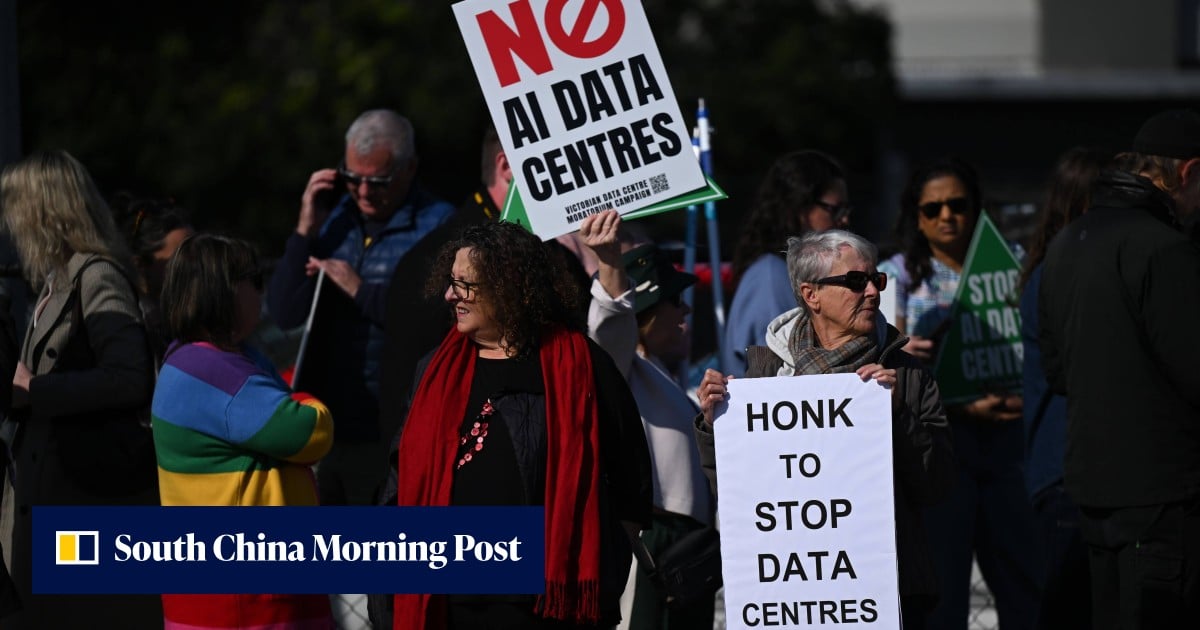
In 2026, though, it has exploded into national conversation across the country, leading to calls for a national moratorium, community protests, three government inquiries, state frameworks being developed and the Australian government moving to set the rules for how the datacentres can be built, and how they consume energy and water. asserted
they → explode → energy
Australian state governments, desperate for economic growth, have been broadly welcoming of the investment for the new centres, in some cases overriding local council approval processes, given the size of the projects being developed. asserted
governments → override → projects
In July, Victoria’s then-minister for economic growth, Steve Dimopoulos, boasted that his state was second only to New South Wales in terms of datacentres, and was outstripping Australia’s most populous state in growth for new centres. asserted
state → boast → centres
He expressed concern that the growing resentment toward new developments was a result of US social media influence. asserted
resentment → express → influence
“We’re seeing some US states move to ban new large datacentres. asserted
states → see → datacentres
And those campaigns and mega-developments in the US shape public opinion in Australia,” he said. asserted
he → shape → Australia
“Because when it’s on your phone, you think it’s right here, or you think it might just come here.” uncertain
it → ’ → phone
The minister declared: “We are not the United States. asserted
We → declare → ?
Our planning, energy and water systems are much more carefully monitored, managed and regulated.” asserted
systems → monitor → ?
Leaders in the datacentre sector have also complained about the backlash, calling it misleading and disingenuous. asserted
Leaders → complain → it
“Australia’s datacentre debate is being fought on America’s facts,” Belinda Dennett, the head of the peak lobby group for the sector, Data Centres Australia, declared in a speech in March. asserted
Dennett → fight → March
Dennett said reactions to datacentres from everyday people range from curiosity to confusion and fear, and the news around the sector was “alarming”. asserted
news → say → sector
“The industry is depicted as energy vampires, water hogs and job killers,” she said. asserted
she → depict → vampires
“The problem is that most of those headlines originate in the United States, where the industry is operating at a completely different scale, under completely different market rules. asserted
industry → originate → rules
They are being transplanted wholesale into Australian debates as though the contexts were interchangeable.” asserted
contexts → transplant → debates
Dennett said the US has 5,400 datacentres, with 53.7 gigawatts of total capacity, compared with 252 in Australia with 1.4 gigawatts of capacity. asserted
US → say → capacity
Measurements of the number of US datacentres vary. asserted
Measurements → vary → datacentres
“When people read about datacentres straining the grid, driving up bills and consuming vast amounts of water, they are reading about America’s challenges, applied uncritically to an Australian market that bears almost no resemblance to it,” she said. asserted
she → read → it
What Dennett omitted was that Australia, with a population of 28 million, has just under one datacentre per 100,000 people, compared with 1.5 per 100,000 people in the US, population 342.7 million. asserted
Australia → omit → US
The pace of datacentre construction is increasing rapidly in Australia, with several large datacentres with 1 gigawatts or more capacity in the planning. asserted
pace → increase → planning
Trending videos on TikTok and Instagram highlight major local community concerns including a 2.4 gigawatt centre planned for outer Melbourne, and a 2 gigawatt gas-powered centre in the Northern Territory. asserted
videos → trend → Territory
That is the equivalent of 2m households’ annual electricity consumption, said Rob Nicholls, professor and senior research associate in digital policy at the University of Sydney. asserted
Nicholls → say → Sydney
The Australian government – seeing the US gas boom fueled by datacentres’ demand for power – has planned to override states and ban gas being used to power centres. asserted
boom → see → centres
New rules would require datacentres’ operators to bring as much new renewable energy into the system as the centre would otherwise take. asserted
centre → require → system
Some experts find the backlash justified in following the US example. asserted
backlash → find → example
“The social media input from the US is very vocal and rationally based: ‘It’s going to increase the cost of electricity and it’s going to increase the cost of water and I don’t get a benefit from it.’ asserted
I → base → it
And that’s a rational position,” said Nicholls. asserted
Nicholls → ’ → ?
Nicholls said the hurdle facing the Australian government is explaining to its constituents how the issues faced in the United States differ from local ones. asserted
issues → say → ones
Legislation for the framework is unlikely to arrive until next year, and has led to calls for Australia to follow the lead of New York and implement a moratorium on new development until proper rules are in place. asserted
rules → arrive → place
Many of Australia’s datacentres are US-owned. asserted
Many → own → datacentres
The federal assistant minister for technology, Andrew Charlton, said that Australians may be cynical about datacentres in their communities because many of the companies that operate the facilities are not Australian. uncertain
that → say → facilities
Microsoft and Amazon operate several, and OpenAI and Anthropic are eyeing their own developments. asserted
OpenAI → operate → developments
“Simply building datacentres in Australia does not necessarily mean that Australia captures the economics of AI,” he said in a speech this week. asserted
he → build → speech
“We can supply the land, we can supply the electricity, we can host the machines, and still find that much of the value – and many of the economic rents – flow offshore.” asserted
much → supply → rents
Charlton called for datacentre providers who want to build in Australia to enable access to compute for Australian start-ups, researchers and not-for-profits, on favourable terms, and flagged that Australia could build its own local AI capability based on open-weight models. “We risk becoming dependent on imported intelligence itself,” Charlton said. uncertain
Charlton → call → intelligence

💬Give feedback
🕘History 🎫Support