Photo via The Sydney Morning Herald

‘Too much heat’: How residents beat a $1.2b data centre

Read the original at The Sydney Morning Herald ↗
Cite

Swan, D. (2026, September 29). ‘Too much heat’: How residents beat a $1.2b data centre. The Sydney Morning Herald. https://www.smh.com.au/technology/too-much-heat-how-residents-beat-a-1-2b-data-centre-20260929-p611a7.html?ref=rss&utm_medium=rss&utm_source=rss_feed

Dated when The Aporia collected the article, usually within hours of publication. Check the original for its exact date and byline.

The Sydney Morning Herald · collected 2026-09-29 · by David Swan

Quick Summary

Residents in Lane Cove West successfully halted Goodman Group's $1.2 billion plan for a 90-megawatt data center after six months of community campaigning against the project. The proposal faced strong opposition due to concerns about noise pollution, fire risks from diesel storage, and proximity to homes and schools. Community groups argued that data centers are unsuitable for light-industrial zones, emphasizing environmental impacts and regulatory changes as key factors in their victory. This win follows similar defeats of other data center projects in Perth and the Blue Mountains, highlighting growing resistance to such facilities despite industry demand.
Written by AI on 2026-09-29, from this article's own text only (the story summary below draws on all the coverage).

AI analysis

Story summary

Goodman Group, an Australian industrial property developer, scrapped its $1.2bn Project Mars data center plan in Lane Cove, Sydney, citing evolving federal and state policies and significant community opposition. The project, proposed in March 2025, aimed for a 90-megawatt facility near residential areas and within 160 meters of a school. In August, the NSW government introduced a "fast-track" framework to assess data center applications within 75 days if they meet certain principles, including minimal environmental impact and community costs. However, growing public concerns over noise pollution, energy consumption, and proximity to residential areas led to 374 public submissions, with only nine in favor of the project. Following these developments and community feedback, Goodman decided not to proceed with the development application due to regulatory changes and local resistance.

Written for “Sydney Data Centre Plan Scrapped” on 2026-11-03, grounded in this article and the 2 other(s) covering the same event.

Story

📰 Sydney Data Centre Plan Scrapped
Technology · 3 article(s) covering the same event. Compare every outlet's account →

Compared with similar articles

This article reads leans left and hedges 5% of its claims. Each row says how that neighbour differs.
The Guardian
⚖️ Leans left Hedges 2 of 16 claims Outlet record 66/100
South China Morning Post
⚖️ Leans left Hedges 1 of 3 claims Outlet record 62/100
The Guardian
⚖️ Leans right further right than this Hedges 3 of 40 claims Outlet record 66/100
“Article A discusses a general backlash towards AI datacentres in Australia, while Article B describes a specific incident where residents successfully opposed a $1.2 billion data centre project in Lane Cove West.”
ABC News (AU)
Hedges 10 of 35 claims Outlet record 68/100
“The articles discuss different data center projects in separate locations.”
Washington Examiner
⚖️ Leans right further right than this Hedges 0 of 14 claims Outlet record 70/100
“The articles describe different events: one is about Ken Paxton's stance on data centers in Texas, while the other reports on a local community successfully opposing a data center project in Australia.”
Daily Mail
⚖️ Leans left Hedges 1 of 46 claims Outlet record 69/100
“The articles describe different events in separate locations, one in Lane Cove West involving a decision by Goodman Group to abandon plans for a data centre due to community opposition and regulatory changes, the other in Yarraville where residents physically blocked construction of power poles.”
ABC News (AU)
⚖️ Leans right further right than this Hedges 0 of 15 claims Outlet record 68/100
“The articles describe different government actions regarding data centers in different states of Australia.”
The Sydney Morning Herald
Hedges 16 of 202 claims Outlet record 61/100
“Article A reports on Goodman Group's withdrawal of Project Mars data center due to public opposition, while Article B discusses broader resident resistance against AI data centers and includes a personal profile of an 82-year-old activist unrelated to the specific event.”
How this article was measured signals, leaning charts, publisher record, byline, topics and claims

Signals How these are calculated →

Claims extracted
55
sentences that state something as happening or true
Uncertain
5%
3 of 55 hedged ("reportedly", "may", "according to")
Leaning
Leans left
of the writing, not the subject · beta estimate
Publisher signals
61/100
The Sydney Morning Herald's corrections and hedging, across everything collected from it. Not a measure of accuracy.
Outlets on this story
3
Technology
Same framing elsewhere
1
articles that frame the event the way this one does
Analyzed 2026-09-29 · how these are computed

How this is being covered How these are calculated →

Article leaning vs. publisher reliability
Source leaning vs. consistency

Publisher

The Sydney Morning Herald · 5957 article(s) · 15 correction(s) detected
Running correction rate · 15 correction(s)

Who wrote this

David Swan
17 article(s) here · 1 carrying a prediction
🔮 A Finnish satellite maker says it could help Australia build its own alternative to Elon Musk’s Starlink, made locally and owned by Australians.
🔮 CBA economists estimated this week that the local data centre build-out could attract about $260 billion in investment by the mid-2030s.
🔮 Michelle Simmons, founder and chief executive of Silicon Quantum Computing, was asked at the John Monash Foundation oration on Thursday evening whether Australia could produce a quantum equivalent of OpenAI or Anthropic.
🔮 If no better offer emerges, the company has told the court its platform “will be wound down”.
🔮 Telstra’s nationwide mobile outage in July wiped an estimated $552 million from the Australian economy, according to new modelling that consumer advocates will put before senators this week.
🔮 OpenAI, Anthropic, Microsoft, and Google all put Canberra on notice – Australia’s copyright rules will dictate whether they train their flagship models on local soil.
🔮 The data centre start-up withdrew its $43.7 billion sharemarket float, which would have been the largest on the ASX since Telstra in 1997, after big investors refused to pay its price.
🔮 OpenAI, Anthropic, Microsoft, and Google all put Canberra on notice - Australia’s copyright rules will dictate whether they train their flagship models on local soil.
🔮 Aylo, the Montreal-based company behind Pornhub, said on Wednesday that age-verified iOS users in Australia would now be served “a standard adult user experience”.
🔮 Her team’s research, released in August, found that in Instagram videos where women appeared not to know they were being filmed, about 60 per cent of the interactions could be classed as potential harassment.
Also by David Swan
Nothing else under this byline is closely related to this article, so these are simply their most recent.
All 17 articles by David Swan →

Topics

Australia Goodman NSW Senate Sydney

Subjects

Australia GPE · 5× Goodman PERSON · 4× America GPE · 2× NSW GPE · 2× Senate ORG · 2× Sydney GPE · 2× Titchkosky PERSON · 2× Goodman Group’s ORG · 1× GreenSquare ORG · 1× Perth GPE · 1×

Narrative

At the federal Senate inquiry’s first public hearing last week, Liberal senator Sarah Henderson told Goodman’s general manager of developments Ben McGilp that the proposal showed “contempt for local residents” and asked him to withdraw it on the spot.
framing: assertive · carried by 1 article(s) · first seen 2026-09-29
🔮 It told the NSW planning department it would no longer pursue Project Mars, a 90-megawatt facility that would have sat about 20 metres from the nearest home and 160 metres from Lane Cove West Public School.
2026-09-29 · The Sydney Morning Herald
‘Too much heat’: How residents beat a $1.2b data centre · assertive framing

Claims (55 extracted, 3 hedged)

Goodman Group’s plan for a $1.2 billion data centre in Lane Cove West drew 374 public submissions. asserted
plan → draw → submissions
On Monday, Australia’s biggest listed property company gave up. asserted
company → give → Monday
It told the NSW planning department it would no longer pursue Project Mars, a 90-megawatt facility that would have sat about 20 metres from the nearest home and 160 metres from Lane Cove West Public School. asserted
that → tell → School
Goodman’s letter said the policy and regulatory environment for large data centres had “evolved significantly”, and that it had weighed those changes against the views of the local community. asserted
it → say → community
Project Mars is the third data-centre proposal withdrawn in Australia in five months. asserted
Mars → withdraw → months
Community campaigns sank the $600 million GreenSquare project in the Perth suburb of Hazelmere in May, and a proposal in Katoomba in the Blue Mountains in June. uncertain
campaigns → sink → June
Meanwhile, other developers are digging in: AirTrunk is actively scaling up its planned 1.2-gigawatt campus at Kemps Creek in Sydney’s west, despite similar community backlash. asserted
AirTrunk → dig → backlash
Sydney alone has 41 state-significant data centre projects in the pipeline, 18 already approved. asserted
Sydney → have → pipeline
Anthropic is negotiating a $21 billion commercial deal with private developers to make Australia a regional hub for running its AI inference models. asserted
Australia → negotiate → models
The computing infrastructure to power artificial intelligence the industry wants has to be built next to someone. asserted
industry → power → someone
If the neighbours can now stop it, where it goes has suddenly become a multibillion-dollar national problem. asserted
goes → stop → it
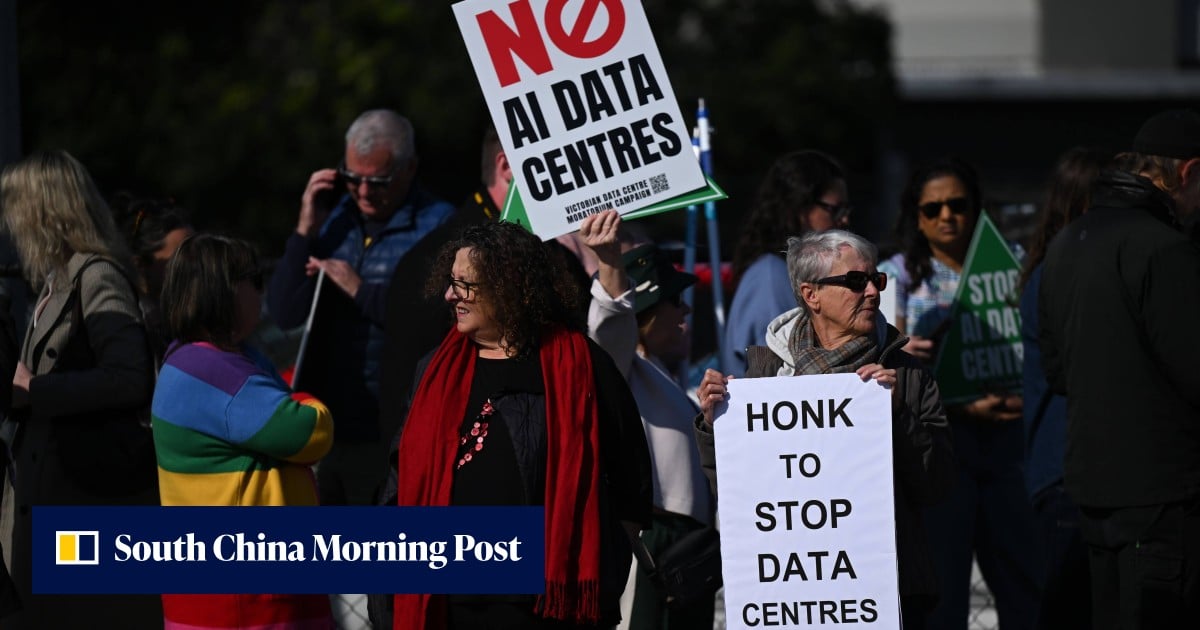
Sasha Titchkosky, a spokeswoman for the Lane Cove Responsible Planning Group, said she was “ecstatic”. asserted
she → say → Group
She credited six months of campaigning, a run of bad press for Goodman, a shareholder resolution the group lodged last week, and the Senate hearing that followed. asserted
that → credit → Goodman
“Last week was really the straw that broke the camel’s back,” she told this masthead. asserted
she → break → masthead
The campaign had been building since at least May, when the group’s petition passed 1134 signatures and its members gave evidence to the NSW parliament’s data centre inquiry. uncertain
members → build → inquiry
Stefano Lauria, one of the residents who first contacted this masthead, wrote then that he worked in AI himself. asserted
he → contact → AI
The group was not opposed to data centres in principle, he said, only to this site. asserted
he → oppose → site
At the federal Senate inquiry’s first public hearing last week, Liberal senator Sarah Henderson told Goodman’s general manager of developments Ben McGilp that the proposal showed “contempt for local residents” and asked him to withdraw it on the spot. asserted
proposal → tell → spot
Goodman withdrew it five days later. asserted
Goodman → withdraw → it
The state’s utilities also had their doubts. asserted
utilities → have → doubts
Sydney Water said it could not support the project without more detail on its water demand. uncertain
it → say → demand
Ausgrid raised electrocution and fire risks. asserted
Ausgrid → raise → risks
The plans included a million litres of diesel stored on site. asserted
plans → include → site
Titchkosky said the business park was built for light industry, and data centres are nothing of the sort. asserted
centres → say → sort
They run diesel back-up generators and emit noise “24 hours a day, seven days a week”, she said. asserted
she → run → noise
For most of this year the industry has argued that Australian anger is borrowed. asserted
anger → argue → year
Belinda Dennett, chief executive of Data Centres Australia, said in a March speech that the local debate was being fought on America’s facts. asserted
debate → say → facts
The US has about 5400 data centres; Australia has 252. asserted
Australia → have → 252
Titchkosky called the industry’s early response, that there was “nothing to see here” because Australia had always had data centres, “really disingenuous”. asserted
Australia → call → centres
Dennett struck a different note on Tuesday. asserted
Dennett → strike → Tuesday
“The policies under which developers commenced approval processes are changing. asserted
developers → commence → processes
Community expectations are also changing,” she told this masthead. asserted
she → change → masthead
Community backlash against data centres has already reached fever pitch in the US. asserted
backlash → reach → US
A Gallup poll in March found 70 per cent of Americans opposed a new AI data centre in their own neighbourhood. asserted
cent → find → neighbourhood
In July, New York Governor Kathy Hochul imposed the first statewide pause on large data centre permits. asserted
Hochul → impose → permits
Texas followed in August, freezing new approvals until its grid is audited. asserted
grid → follow → approvals
Dennett warned that until governments settle the rules, more data centre customers, investors and developers are likely to “adopt a wait-and-see approach to Australia”. asserted
customers → warn → Australia
Her group supports a national approach to regulation, more engagement with communities, and faster approvals. asserted
group → support → communities
“But data centres’ customers and investors have choices, and many countries are actively encouraging investment,” she said. asserted
she → have → investment
Wherever there’s a power connection Victoria is moving to require 150-metre buffers between data centres and homes. asserted
Victoria → ’ → centres
…and 15 more, not listed.

💬Give feedback
🕘History 🎫Support