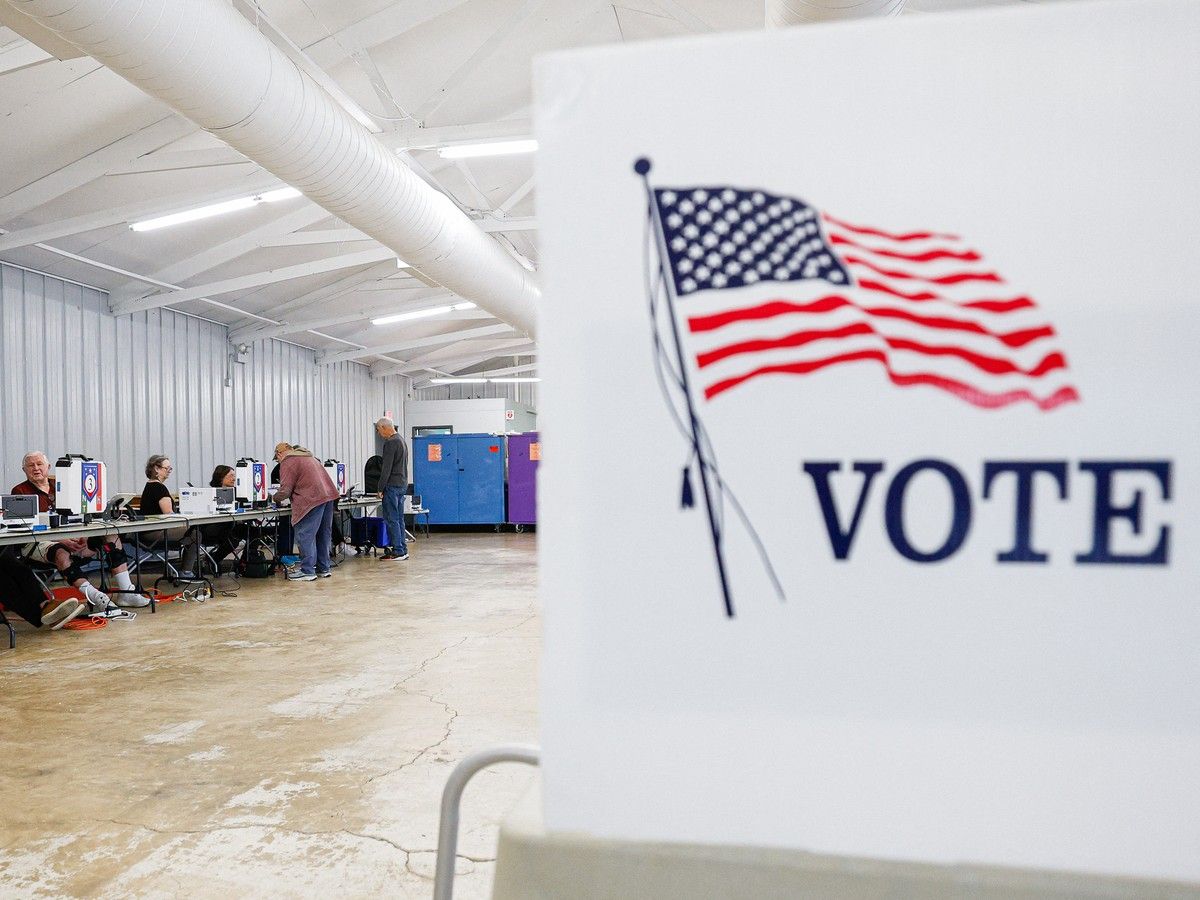
Photo via National Post

J.D. Tuccille: Americans have only bad choices in the midterms

Read the original at National Post ↗
Cite

Jerema, C. (2026, September 27). J.D. Tuccille: Americans have only bad choices in the midterms. National Post. https://nationalpost.com/opinion/j-d-tuccille-americans-have-only-bad-choices-in-the-midterms

Dated when The Aporia collected the article, usually within hours of publication. Check the original for its exact date and byline.

National Post · collected 2026-09-27 · by Carson Jerema analysis

Quick Summary

J.D. Tuccille argues in an opinion piece that American voters face unpalatable choices between controlling political parties in the upcoming midterm elections. He suggests that both Republicans, particularly under Donald Trump's influence, and Democrats, such as Alexandria Ocasio-Cortez and Zohran Mamdani, advocate for greater government control, whether economically or through social policies. Tuccille cites recent examples of federal incentives tied to corporate ownership and political rhetoric indicating a shift towards more interventionist stances by both parties, leaving little room for candidates who support individual liberty and less state control.
Written by AI on 2026-09-27, from this article's own text only (the story summary below draws on all the coverage).

AI analysis

Story summary

In July, U.S. Department of Commerce announced plans to provide $874 million in federal incentives under the CHIPS and Science Act, requiring companies to accept a minority, non-controlling equity stake from the government as a condition for receiving funds. This move highlights how both major political parties—Republicans led by Donald Trump and Democrats like Alexandria Ocasio-Cortez—are increasingly favoring greater government control over economic activities. The author argues that this trend leaves voters with few choices if they seek candidates who advocate for personal freedom and limited government intervention. Alternative parties are largely excluded from the political system, leaving Americans facing unpalatable options in the upcoming midterm elections.

Written for “Midterm Elections Critique” on 2026-11-03, grounded in this article and the 0 other(s) covering the same event.

Story

📰 Midterm Elections Critique
Politics · 1 article(s) covering the same event.

Compared with similar articles

This article reads leans strongly left and hedges 3% of its claims. Each row says how that neighbour differs.
Washington Examiner
⚖️ Leans left further right than this Hedges 5 of 28 claims Outlet record 70/100
“The articles discuss different aspects of political concerns and strategies leading up to midterm elections, without describing the same specific incident.”
Fox News
⚖️ Leans strongly right further right than this Hedges 1 of 30 claims Outlet record 69/100
“The articles discuss different perspectives on midterm elections but do not describe the same specific incident or occurrence.”
New York Post
⚖️ Leans strongly right further right than this Hedges 1 of 44 claims Outlet record 66/100
“The articles discuss general political sentiment leading up to midterm elections but describe different themes and arguments.”
Toronto Star
⚖️ Leans right further right than this Hedges 18 of 48 claims Outlet record 64/100
“The articles discuss different aspects of upcoming midterm elections; one focuses on voter choice and political control, while the other highlights the fight for state political power with implications for Trump's agenda.”
How this article was measured signals, leaning charts, publisher record, byline, topics and claims

Signals How these are calculated →

Claims extracted
34
sentences that state something as happening or true
Uncertain
3%
1 of 34 hedged ("reportedly", "may", "according to")
Leaning
Leans strongly left
of the writing, not the subject · beta estimate
Publisher signals
60/100
National Post's corrections and hedging, across everything collected from it. Not a measure of accuracy.
Outlets on this story
1
Politics
Same framing elsewhere
1
articles that frame the event the way this one does
Analyzed 2026-09-27 · how these are computed

How this is being covered How these are calculated →

Article leaning vs. publisher reliability
Source leaning vs. consistency

Publisher

National Post · 1242 article(s) · 2 correction(s) detected
Running correction rate · 2 correction(s)

Who wrote this

Carson Jerema
61 article(s) here · 1 carrying a prediction
🔮 If California’s proposed wealth tax is defeated next week — polling now finds Prop. 40 underwater with voters — it will represent less a failure of economic arguments than of political activism given academic gloss.
🔮 B.C. Conservative leader Lorne Doerkson will become the 38th premier after leading the party to a triumph in the provincial election.
🔮 One can see what they wish in the results, which will not be final until Friday afternoon, when all votes will be tallied.
🔮 She told the court she went off social media in the wake of the allegations so that she could focus on her publishing requirements, but that it was “difficult to miss what was going on.”
🔮 Indeed, the scale and magnitude of Eby’s misreading of the B.C. electorate in calling his early snap election cannot be understated and it may well be the greatest political blunder in Canadian history.
🔮 The Conservatives are projected to win 62 seats to the NDP’s 29 as of 9 p.m. local time.
🔮 The destruction we are now seeing in Europe will inevitably become more pervasive until it, too, manifests into violence by way of terrorism, if not armed insurrection.
2026-10-23 · assertive framing · Avi Benlolo: Why Toronto’s mayoralty race matters
🔮 The empty chair said more than any speech could.
🔮 Sharma refused to issue a ban, which she said would violate the open courtroom principle and was an “extreme measure,” but noted that media present in the courtroom could observe the woman’s request.
🔮 Given the riots’ aesthetic and demographic makeup, politicians on the right may feel increasingly emboldened to issue statements of this kind — which reflect the existential tenor with which the unrest has been received among right-wing populists the world over; as well as the enormous stakes voters of all hues will feel going into the presidential elections in April.
Also by Carson Jerema
Nothing else under this byline is closely related to this article, so these are simply their most recent.
All 61 articles by Carson Jerema →

Topics

Americans Arizona COTTONWOOD Democrats Republicans

Subjects

Republicans NORP · 4× Trump PERSON · 4× Mamdani PERSON · 3× Alexandria Ocasio-Cortez PERSON · 2× DSA ORG · 2× Democrats NORP · 2× Vance PERSON · 2× Arizona ORG · 1× COTTONWOOD GPE · 1× Robert A. Heinlein PERSON · 1×

Narrative

At the end of July, the U.S. Department of Commerce announced “the signing of 7 letters of intent to provide $874 million in federal incentives under the CHIPS and Science Act” in return for “a minority, non-controlling equity stake in each company as a condition for receiving the funds.”
framing: assertive · carried by 1 article(s) · first seen 2026-09-27
🔮 With few major-party candidates willing to consider leaving people alone, and alternative parties almost completely locked out of the political system, voters who want to run their own lives face almost entirely unpalatable choices.
2026-09-27 · National Post
J.D. Tuccille: Americans have only bad choices in the midterms · assertive framing

Claims (34 extracted, 1 hedged)

The author and thinker Robert A. Heinlein once wrote, “the human race divides politically into those who want people to be controlled and those who have no such desire.” asserted
who → write → desire
With midterm elections approaching, the problem for Americans is that our ossified two-party system increasingly delivers us a choice between flavors of control freaks: Donald Trump’s Republicans and Democrats led by the likes of Alexandria Ocasio-Cortez and Zohran Mamdani. asserted
system → approach → Cortez
With few major-party candidates willing to consider leaving people alone, and alternative parties almost completely locked out of the political system, voters who want to run their own lives face almost entirely unpalatable choices. asserted
who → consider → choices
Trump’s Republicans have drifted far from their nominally market-oriented roots towards greater government control of the economy. asserted
Republicans → drift → economy
At the end of July, the U.S. Department of Commerce announced “the signing of 7 letters of intent to provide $874 million in federal incentives under the CHIPS and Science Act” in return for “a minority, non-controlling equity stake in each company as a condition for receiving the funds.” asserted
Department → announce → funds
The announcement came on top of earlier government acquisitions of stakes in Intel, USA Rare Earth, and other companies in fields the administration considers critical. asserted
administration → come → fields
“What is remarkable is that federal corporate ownership is becoming routine under a Republican administration,” the Cato Institute’s Tad DeHaven commented last month. asserted
DeHaven → become → administration
“Republicans warning that communists are taking over the Democratic Party might first ask why their own administration is so eager to have the government acquire pieces of private companies.” uncertain
government → warn → companies
That taste for top-down direction of the economy — apparent in the president’s tariff fetish and mercantilism — is unlikely to disappear when the current White House resident departs. asserted
resident → disappear → fetish
With a nod to the late, unlamented communist guerrilla Che Guevara, economic historian Phil Magness has taken to referring to the vice president and GOP heir-apparent as “Che D. Vance.” asserted
Magness → take → Vance
Magness focuses on Vance’s long history of hostility to individualism and attacks on free-market ideas. asserted
Magness → focus → ideas
In a 2019 article for First Things, Vance criticized libertarians for emphasizing “free choices” over coercion and for being “uncomfortable with political power” to accomplish what he considers to be “public goods” — and never mind that not everybody shares the same sense of what’s good. asserted
what → criticize → sense
If Republicans are discovering a taste for socialism and for state direction over individual liberty, Democrats are embracing full commitment to those ideas. asserted
Democrats → discover → ideas
Alexandria Ocasio-Cortez, a Democratic member of Congress from New York, was only the first of a wave of open socialists to rise to prominence in that party (Vermont’s Sen. Bernie Sanders is still technically independent). asserted
Sanders → rise → party
Preparatory to a run for president, she recently rejoined the Democratic Socialists of America (DSA), the party within a party that organizes and coordinates the efforts of many radicals. asserted
that → rejoin → radicals
The DSA isn’t a caucus for government-run health care; it favours full state direction of the economy. asserted
it → run → economy
The group’s program invites people to “imagine taking a day off from work in a future without capitalism” in which “food, education, energy, medicine, and transportation … are common goods and utilities. asserted
food → invite → which
Tellingly, President Trump and Mayor Mamdani, while representing opposing political parties, enjoy something of a mutual admiration society. asserted
Trump → represent → society
In a demonstration of horseshoe theory, the two met last year at the White House and showed few signs of discord. asserted
two → meet → discord
“Trump and Mamdani answered questions from reporters, both striking a remarkably cordial tone, with the president indicating he agreed with many of the mayor-elect’s ideas,” The Hill reported. asserted
Hill → answer → ideas
This week, the two met again at the mayor’s invitation and Trump voiced his hopes for Mamdani to be a “great one.” asserted
Mamdani → meet → hopes
Perhaps those most at risk of suffering the heavy hand of government under either of the major parties are Jews. asserted
those → suffer → parties
Renewed hostility to the world’s most traditional group of scapegoats is well-entrenched in the Democratic Party with a rebranding as “anti-Zionism,” but it’s also creeping unrevised into the GOP. asserted
it → renew → GOP
“For many Jewish Democrats, the Democratic Party is just the latest institution that welcomed us and is turning hostile,” agreed Howard Wolfson, a prominent Democratic strategist, when asked about the problem by Axios. asserted
Wolfson → welcome → Axios
With regard to the Republican Party, Texas Sen. Ted Cruz cautioned in March that “I have seen more antisemitism in the last 18 months on the right than at any point in my lifetime.” asserted
I → caution → lifetime
He added that the ancient hatred is “gaining real purchase, especially with young people.” asserted
hatred → add → people
Bigotry, it should be noted, is a negation of the individualism at the core of the liberalism (in the old sense, not the current nanny-knows-best usage) on which modern western civilization is founded. asserted
civilization → note → which
To treat people as members of a group and to despise them for a collective identity is to reject the value of individuals on which our liberty and prosperity is built. asserted
liberty → treat → which
Both major U.S. political parties, in favoring “public goods” over private choices and touting the “warmth of collectivism” leave the door open for the revival of prejudices we had hoped were dead and buried. asserted
we → favor → prejudices
“A true liberal … believes that, as much as possible, no one should push people around, standing over them with a gun or a fist to force them to do his will,” the economist Deirdre McCloskey wrote in her 2019 book, Why Liberalism Works. asserted
Liberalism → believe → book
But the country’s main political parties both reject that concept and insist they do Americans a favour by advocating for an order where the dictates of the collective, as interpreted and enforced by the state, prevail over individual liberty. asserted
dictates → reject → liberty
It’s true that the rot isn’t as deep in the U.S. as it is in many peer countries, where authoritarian parties of the right and left reject markets and individualism. asserted
parties → ’ → markets
But it’s bad enough. asserted
it → ’ → ?
As the midterms approach, those of us who refuse to be controlled have few good options. asserted
who → approach → options

💬Give feedback
🕘History 🎫Support