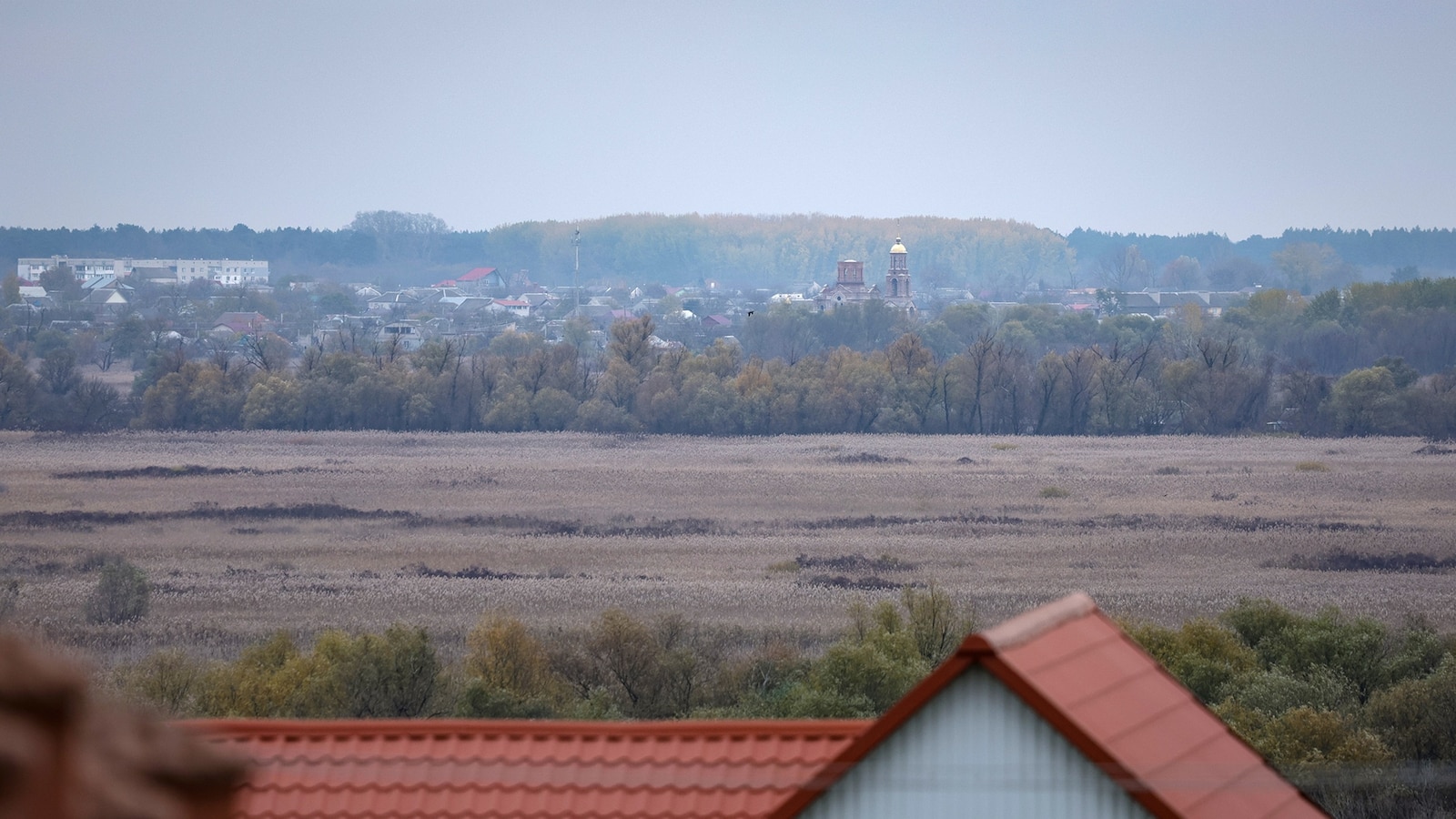
Photo via The Guardian

‘Hell on earth’: last residents eat weeds to survive in Russian-occupied Oleshky

Read the original at The Guardian ↗
Cite

Beaumont, P., & Mazhulin, A. (2026, September 27). ‘Hell on earth’: last residents eat weeds to survive in Russian-occupied Oleshky. The Guardian. https://www.theguardian.com/world/2026/sep/27/hell-on-earth-last-residents-eat-weeds-to-survive-in-russian-occupied-oleshky

Dated when The Aporia collected the article, usually within hours of publication. Check the original for its exact date and byline.

The Guardian · collected 2026-09-27 · by Peter Beaumont, Artem Mazhulin

Quick Summary

In occupied Oleshky, Ukraine, residents report severe famine after their food supply has run out entirely. A woman who initially had 110kg now weighs just 67kg due to starvation. Civilians are surviving on minimal rations of soup made from weeds and vegetables grown in flower boxes, eating only one meal a day. Ukrainian officials describe the situation as a humanitarian catastrophe, blaming Russia for blocking evacuations and food supplies, while Moscow accuses Ukraine of obstructing aid delivery.
Written by AI on 2026-09-27, from this article's own text only (the story summary below draws on all the coverage).

AI analysis

Story summary

In Oleshky, a city under Russian occupation since February 2022 in southern Ukraine, thousands of remaining residents face starvation and dire living conditions. Ukrainian officials estimate around 6,000 people remain in the area, including about 200 children, with food supplies running critically low by May this year. Reports indicate that locals have resorted to foraging weeds for sustenance. Humanitarian organizations and Ukrainian authorities are struggling to provide aid due to Russian interference; attempts to deliver four tonnes of food via drones met resistance from occupying forces, who shoot down delivery drones or confiscate supplies. The situation is described as "hell on earth" with concerns over imminent humanitarian catastrophe, prompting calls for immediate evacuation by Ukrainian officials like Andrii Sybiha and Oleksandr Prokudin.

Written for “Ukraine Oleshky Crisis” on 2026-11-05, grounded in this article and the 3 other(s) covering the same event.

Story

📰 Ukraine Oleshky Crisis
Politics · 4 article(s) covering the same event. Compare every outlet's account →

Compared with similar articles

This article reads unscored and hedges 9% of its claims. Each row says how that neighbour differs.
ABC News (US)
Hedges 4 of 91 claims Outlet record 67/100
Euronews
⚖️ Leans strongly left Hedges 2 of 37 claims Outlet record 60/100
CBC News
Hedges 4 of 34 claims Outlet record 60/100
“Article A describes civilians in Oleshky running out of food and resorting to eating weeds, while Article B reports on Ukraine's use of drones to drop aid into the city. These are two separate events occurring at different times.”
How this article was measured signals, leaning charts, publisher record, byline, topics and claims

Signals How these are calculated →

Claims extracted
45
sentences that state something as happening or true
Uncertain
9%
4 of 45 hedged ("reportedly", "may", "according to")
Leaning
withheld
no quote in the article backed the model's score
Publisher signals
66/100
The Guardian's corrections and hedging, across everything collected from it. Not a measure of accuracy.
Outlets on this story
4
Politics
Same framing elsewhere
1
articles that frame the event the way this one does
Analyzed 2026-09-27 · how these are computed

How this is being covered How these are calculated →

Article leaning vs. publisher reliability
Source leaning vs. consistency

Publisher

The Guardian · 2996 article(s) · 6 correction(s) detected
Running correction rate · 6 correction(s)

Who wrote this

Peter Beaumont
6 article(s) here · 1 carrying a prediction
🔮 “This escalation validates our fears that the arrest and continued detention of the six Matsadaash journalists would signal a crackdown of unprecedented magnitude,” said Bahgat.
🔮 Exit polls published on Tuesday evening suggested that the opposition bloc of parties led by the former chief of staff of the Israel Defense Forces, Gadi Eisenkot, would win most seats in the Knesset by a slight margin, edging out Benjamin Netanyahu’s right and far-right coalition despite the prime minister’s Likud emerging as the largest party.
🔮 The IDF statement follows previous efforts by Israeli politicians to dismiss NAZA – a military acronym euphemistically used by Israeli intelligence to indicate the number of civilians that it expects will be killed in an airstrike – which have accompanied death threats against the film’s directors, Yuval Abraham and Rachel Szor, and calls by the country’s prime minister, Benjamin Netanyahu, for them to be stripped of their Israeli citizenship. It also echoed previous complaints by some Israeli critics – including journalists – that the film’s military sources were anonymised, despite the fact that source protection in media investigations is commonplace and regarded by much of the media as an ethical requirement.
🔮 Until May, food supplies were still getting through to residents of a city that had once been home to 24,000.
🔮 The film’s title comes from an Israeli military acronym used euphemistically to refer to the civilians expected to be killed in a military attack.
🔮 A report by the International Institute for Strategic Studies in May reached a similar conclusion: “The recent deterioration of maritime security followed a prolonged period of relative calm in the waters off the Somali coast, which resulted in the redeployment of international anti-piracy fleets and the relaxation of commercial risk-management practices.
Also by Peter Beaumont
Nothing else under this byline is closely related to this article, so these are simply their most recent.
All 6 articles by Peter Beaumont →
Artem Mazhulin
1 article(s) here · 1 carrying a prediction
🔮 Until May, food supplies were still getting through to residents of a city that had once been home to 24,000.
The only article under this byline in the corpus.

Topics

Oleshky Russia Russian Ukraine Ukrainian

Subjects

Oleshky GPE · 8× Ukrainian NORP · 7× Russian NORP · 6× Guardian ORG · 2× Russia GPE · 2× Sybiha PERSON · 2× Ukraine GPE · 2× Andrii Sybiha PERSON · 1× Kherson GPE · 1× Ukrainians NORP · 1×

Narrative

In a statement published on Monday, Sybiha warned of a “humanitarian catastrophe” and called for an immediate evacuation, accusing Russia of standing as “the only obstacle”. “Russia is deliberately making life there impossible,” Sybiha said in an address during the general assembly.
framing: assertive · carried by 1 article(s) · first seen 2026-09-27
🔮 Until May, food supplies were still getting through to residents of a city that had once been home to 24,000.

Claims (45 extracted, 4 hedged)

The phone message sent out of Russian-occupied Oleshky was grimly matter of fact: food for the 2,000 or so civilians still remaining in the city and its surrounding villages had finally run out. asserted
food → send → city
“We’re in Oleshky [and] we can’t get out. asserted
we → ’re → Oleshky
We’re going hungry … asserted
We → go → ?
Right now, I’ve got absolutely nothing to eat,” read the message, from a woman in the besieged city, who was waiting to be evacuated by the occupying forces. asserted
who → get → forces
Before the war, she weighed 110kg (17 stone); now she weighs just 67, she wrote. asserted
she → weigh → 67
“At first I was glad [to lose some weight], but now I realise I’ll die without proper protein-rich food. asserted
I → lose → food
It’s very hard. asserted
It → ’ → ?
The house where we stayed last winter was also destroyed and burned down. asserted
we → stay → ?
We’re still alive.” asserted
We → ’re → ?
Oleshky, across Dnipro River from the southern city of Kherson, has become “a hell on earth”, according to Ukrainians familiar with conditions there. uncertain
Oleshky → become → conditions
Accounts of the dire conditions in the city emerged as the Ukrainian foreign minister, Andrii Sybiha, raised the situation in Oleshky at the UN general assembly in New York. asserted
minister → emerge → York
A “Save Oleshky” banner was lifted at a Ukraine-Hungary Nations League football match on Friday. asserted
banner → save → Friday
In a statement published on Monday, Sybiha warned of a “humanitarian catastrophe” and called for an immediate evacuation, accusing Russia of standing as “the only obstacle”. “Russia is deliberately making life there impossible,” Sybiha said in an address during the general assembly. asserted
Sybiha → publish → assembly
“They are starving them to death.” asserted
They → starve → death
The Kremlin spokesperson, Dmitry Peskov, this month acknowledged the “critical situation” in Oleshky but accused Ukrainian forces of blocking humanitarian supplies intended for its residents. asserted
spokesperson → acknowledge → residents
Until May, food supplies were still getting through to residents of a city that had once been home to 24,000. uncertain
that → get → 24,000
But since May, as the occupying Russian forces expanded minefields and drone cover, the trickle of supplies has entirely halted. Compounding the issue for civilians is the fact that Ukraine’s highly successful summer drone campaign against Russian supply lines has also caused shortages for the invading forces’ frontline troops – who in turn steal what little food Ukrainian civilians have managed to save. uncertain
civilians → occupy → food
In messages shared with the Guardian, residents said they were down to one meal a day: soup without potato, made with courgette grown in what once were the flower boxes of the city’s apartment houses, sometimes with the addition of foraged purslane, an edible weed. asserted
what → share → purslane
“We’re running out of everything,” said a resident early in the summer. asserted
resident → run → summer
And come autumn, we’ll definitely die. asserted
we → come → ?
I’m already dying. asserted
I → die → ?
I’m getting weaker by the day.” asserted
I → get → day
On 1 September a food convoy heading to the city was attacked. asserted
convoy → head → city
Moscow blamed the Ukrainian armed forces for the attack, while Kyiv blamed Russian troops. asserted
Kyiv → blame → troops
Ukrainian officials say attempts to drop food by drones have done little to help: the supplies are seized by Russian soldiers and in at least one case the intended recipient was arrested. asserted
recipient → say → case
According to Tetiana Hasanenko, a Ukrainian official serving from the western side of the Dnipro as the head of the Oleshky military administration, issues began in earnest late last year as access to the city from the Russian side for Ukrainian civilians became ever more difficult. “The density of the minefields has become very high,” she told the Guardian. uncertain
she → accord → Guardian
“From December onwards, food deliveries became much less frequent because vehicles were hitting mines and being targeted by drones. asserted
vehicles → become → drones
By winter, supplying food had already become very difficult. asserted
supplying → supply → food
Oleshky isn’t functioning. asserted
Oleshky → function → ?
“People used to grow food in their vegetable plots before the war. asserted
People → use → war
There was not only enough for themselves but they used to sell it to Crimea and Kherson City. asserted
they → be → Crimea
Now they cannot even grow it for themselves.” asserted
they → grow → themselves
Hasanenko described another reported incident where a 74-year-old man was digging out a cellar that had been flooded with mud after Russia blew up the Kakhovka dam in 2023, looking for stored food. asserted
Russia → describe → food
Refusing to allow the soldiers into the cellar he was excavating, he was murdered by the soldiers. asserted
he → refuse → soldiers
“Some people have been digging out these cellars looking for canned vegetables, pickled vegetables and canned meat that people were storing up for winter,” she said. asserted
she → dig → winter
Despite the horrific conditions in the city, Ukrainian officials believe the occupying forces are dragging their feet with the evacuation of the remaining civilians in order to discourage a Ukrainian counterattack. asserted
forces → believe → counterattack
“The Russians are afraid that an offensive [against Oleshky] will start from Kherson city and they are just keeping people, civilians, as human shields,” said Hasanenko. asserted
Hasanenko → start → shields
“It’s an old city,” adds Hasanenko. asserted
Hasanenko → ’ → ?
“It has existed for almost a thousand years – and in all this time, people never lived in such horrible conditions, in such a hell like they do now. asserted
they → exist → hell
They’re just lying there because you cannot pick up the dead body. asserted
you → lie → body
…and 5 more, not listed.

💬Give feedback · no sign-in needed

No sign-in needed for now. Your note is sent without a name, so it cannot be answered.

🕘History 🎫Support