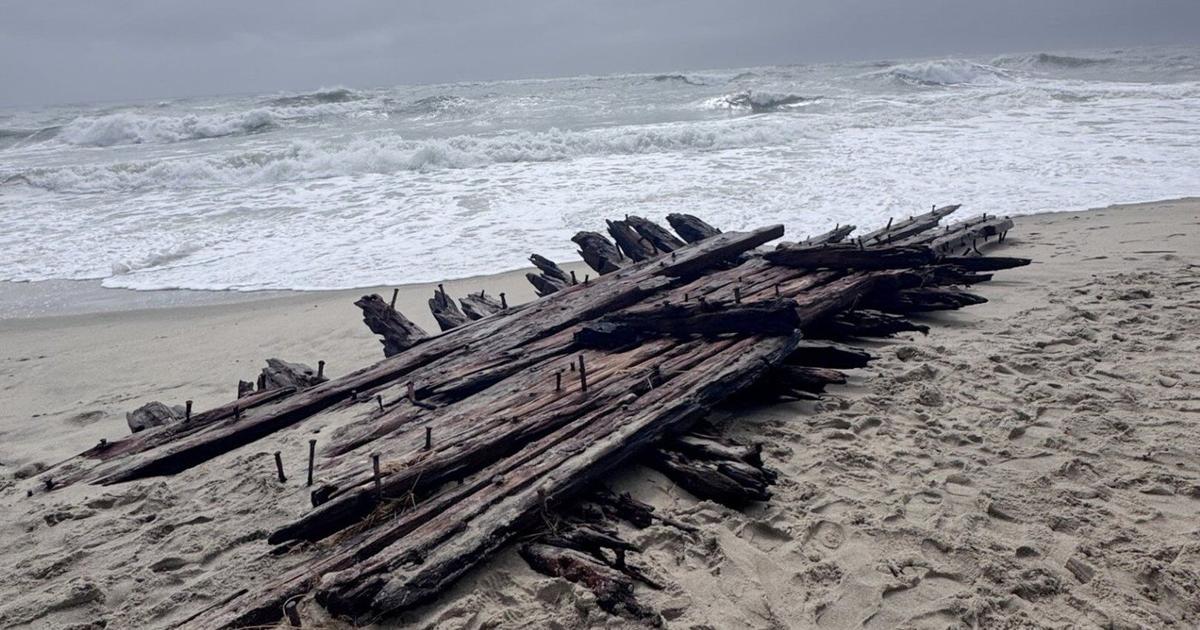
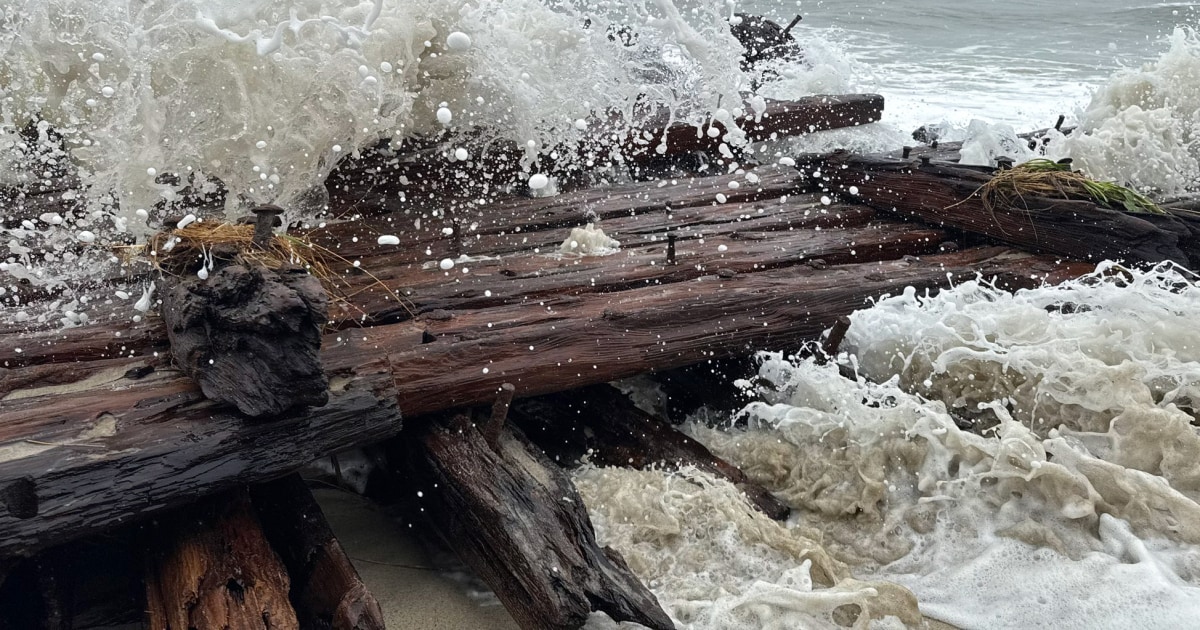
A maritime expert planned to visit a Nantucket beach Monday to inspect weathered wooden beams exposed by the weekend’s powerful nor’easter, possibly the remnants of a 19th-century shipwreck buried beneath the island’s southern shore.
uncertain
expert → plan → shore
The Egan Maritime Institute said its exhibits and collections manager would survey the site and send a report to state underwater archaeologists, who then will work with the institute to determine which vessel the wreckage came from.
asserted
wreckage → say → vessel
The splintered timbers, fastened together by rusted iron, emerged near an area where remains believed to be from the Warren Sawyer, a wooden schooner lost in 1884, have been found before.
asserted
remains → fasten → 1884
Officials from Egan, a nonprofit that operates the Nantucket Shipwreck & Lifesaving Museum, cautioned Monday that the newly exposed wreckage has not been identified with certainty.
asserted
wreckage → operate → certainty
The slow-moving nor’easter battered the Northeast coastline over the weekend with heavy rain, strong winds and dangerous surf, flooding low-lying communities from New Jersey to New England and knocking out power to more than 100,000 customers at times Sunday.
asserted
nor’easter → move → times
The storm also raised concerns about coastal erosion as waves crashed into beaches and seawalls.
asserted
waves → raise → beaches
The Warren Sawyer ran aground on Dec. 22, 1884, while carrying 1,115 bales of cotton and 28 tons (25.4 metric tonnes) of scrap iron from New Orleans to Boston, according to the Massachusetts Board of Underwater Archaeological Resources.
uncertain
Sawyer → run → Resources
Its captain and seven-member crew were ultimately rescued.
asserted
captain → rescue → ?
The schooner remained intact on the island’s Miacomet Beach for two weeks, allowing islanders to save 700 bales of cotton using skids and teams of oxen.
asserted
islanders → remain → oxen
Then, on Jan. 6, 1885, another storm tore the ship apart, scattering pieces of its hull, remaining cargo and cordage across more than half a mile (0.80 kilometers) of beach.
asserted
storm → tear → beach
More than a century later, remains believed to be from the ship have continued to emerge from the sand.
asserted
remains → believe → sand
Jason Graziadei, who has lived on the island for two decades and is editor of the online news site the Nantucket Current, said he went out to the beach Saturday amid heavy winds with his 8-year-old son after he got a tip about possible wreckage on the island’s south shore.
asserted
he → live → shore
He and his son found the wooden beams on a drive-on beach by the town’s wastewater facility that everyone calls the “Sewer Beds.”
asserted
everyone → find → that
He said they had to park their car and walk down to the beach because erosion from the storm had formed a steep drop-off.
asserted
erosion → say → off
The location made the discovery even more remarkable to him: It was directly beneath a route beachgoers had been driving all summer.
asserted
beachgoers → make → route
“Given where it was and where it emerged, it means that everyone who was driving onto the beach this summer was just directly over this,” Graziadei said.
asserted
Graziadei → give → this
“I just think it is so funny and so cool.”
asserted
it → think → ?
Graziadei said his son was excited by the discovery and began asking what had happened to the people aboard the ship and why it had run aground.
asserted
it → say → ship
The two could walk right up to the exposed wreckage.
uncertain
two → walk → wreckage
“It’s amazing to think from, you know, over 100 years old that it’s still there,” Graziadei said.
asserted
Graziadei → ’ → ?
State archaeologists inspected a roughly 42-foot (12.8-meter) section of hull exposed on Miacomet Beach in late 2022 and concluded it was likely part of the Warren Sawyer.
asserted
it → inspect → Sawyer
A roughly 15-foot-square (4.6-meter-square) section of the lower stern appeared nearby in February 2023, but shifting sands buried it again before state archaeologists could return to document it.
uncertain
archaeologists → appear → it
Nantucket is one of the areas known as the “graveyards of the Atlantic,” with more than 750 wrecks estimated in the surrounding waters.
asserted
wrecks → know → waters
The institute urged visitors not to disturb the newly exposed wreckage.
asserted
institute → urge → wreckage
Massachusetts law prohibits removing, damaging or displacing underwater archaeological resources.
asserted
law → prohibit → resources
 The Aporia