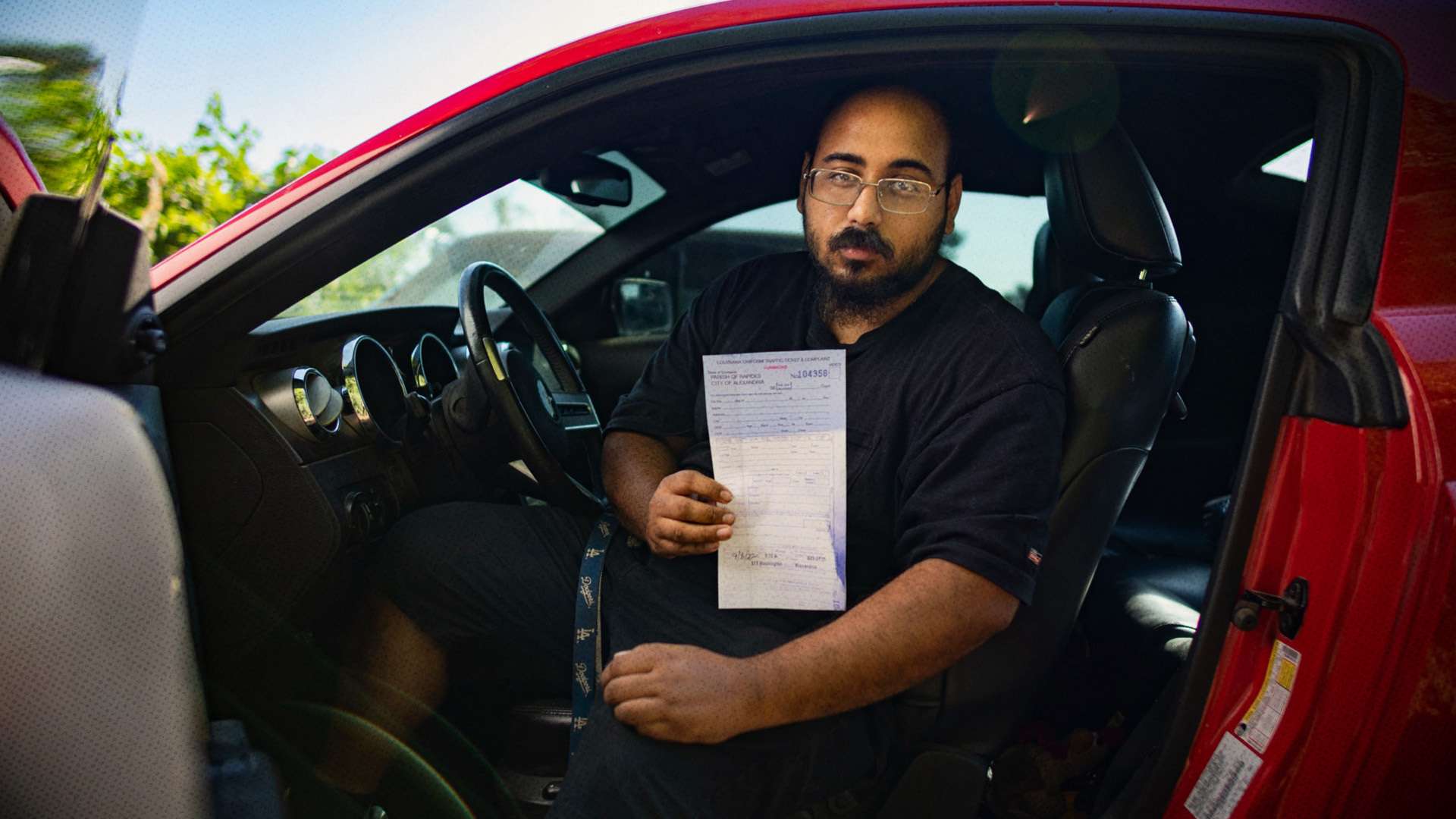
Around 5 p.m. on a Wednesday in June 2022, Mario Rosales was driving his red Mustang on Jackson Street in Alexandria, Louisiana, waiting to turn left onto Dorchester Drive, when a police SUV pulled up behind him.
asserted
SUV → drive → him
After the traffic light turned green and Rosales made his turn, Officers Samuel Terrell and Jim Lewis activated their lights and pulled him over.
asserted
Terrell → turn → him
The officers later claimed Rosales had "failed to signal" his turn.
asserted
Rosales → claim → turn
But as dashcam video showed, that was not true: The Mustang's left-turn signal was blinking as Rosales waited at the intersection.
asserted
Rosales → show → intersection
And after stopping Rosales and his girlfriend, Gracie Lasyone, who was sitting in the front passenger seat, Terrell and Lewis detained them for 21 minutes, during which the cops asked if there was anything illegal in the car, grilled them about drug use, frisked Rosales, instructed him to empty his pockets, and gave him and Lasyone the Miranda warning that typically accompanies an arrest.
asserted
that → stop → arrest
Rosales and Lasyone sued Terrell and Lewis in federal court that November, arguing that the officers had violated their Fourth Amendment rights under color of law.
asserted
officers → sue → law
Terrell and Lewis claimed they were protected by qualified immunity, a doctrine that bars such lawsuits unless they allege violations of "clearly established" law.
asserted
they → claim → law
A federal judge disagreed, and last week the U.S. Court of Appeals for the 5th Circuit upheld that decision, concluding that Rosales and Lasyone's allegations were sufficient to defeat qualified immunity at this stage of the case.
asserted
allegations → disagree → case
That ruling by a unanimous three-judge panel is striking for two reasons.
asserted
ruling → strike → reasons
It illustrates the limits of the broad leeway that the Supreme Court has given police officers to stop and interrogate motorists.
asserted
Court → illustrate → motorists
It also illustrates the limits of qualified immunity, which in many cases has prevented victims of outrageous police misconduct from pursuing constitutional claims because they were unable to cite sufficiently specific precedents.
uncertain
they → illustrate → precedents
In the 1968 case Terry v. Ohio, the Supreme Court ruled that police may stop someone when they reasonably suspect he is involved in criminal activity and may frisk him if they reasonably suspect he is "armed and dangerous."
uncertain
he → rule → him
Three decades later in Whren v. United States, the Court said reasonable suspicion of a traffic violation is enough to justify stopping a car, even when that allegation is a pretext for an unrelated criminal investigation.
asserted
allegation → say → investigation
And when a traffic stop is legally justified, the Court has held in other cases, police may question the driver about unrelated matters and may order both the driver and any passengers out of the car in the interest of officer safety.
uncertain
police → justify → safety
The impact of those rulings was clear when Terrell and Lewis pulled over Rosales and Lasyone.
asserted
Terrell → pull → Rosales
The cops ordered both of them to exit the car, and they interrogated them about their places of residence, itineraries, criminal histories, and personal habits.
asserted
they → order → residence
Rosales, whose car was registered in New Mexico, explained that he was originally from Roswell, that he was planning a move to Louisiana, that he worked for Atlas Home Service in Alexandria, and that he stayed with Lasyone's sister in Dry Prong while in Louisiana but was hoping to buy a home there.
asserted
he → register → home
He said he and Lasyone had just gotten off work, had stopped at a bank, and were on their way to buy a car part that had been advertised on Facebook.
asserted
that → say → Facebook
Lasyone gave the same account.
asserted
Lasyone → give → account
When asked if he was armed, Rosales said he had a Taurus pistol in a bag in the backseat but declined to let Terrell fetch it, saying, "I don't want anybody searching my vehicle."
asserted
anybody → ask → vehicle
Terrell frisked Rosales and found no weapons.
asserted
Terrell → frisk → weapons
Despite that search, Lewis asked Rosales to empty his pockets and place the contents—a wallet and keys—on the hood of the police SUV.
asserted
Lewis → ask → SUV
When Rosales said that was all he was carrying, Lewis asked, "Do you mind if I check?"
asserted
I → say → ?
After Rosales noted that Terrell had already frisked him, Terrell explained that "I just patted you down" but didn't "search you."
asserted
I → note → you
Lewis asked Rosales about drugs.
asserted
Lewis → ask → drugs
Rosales answered no to each query, saying he did not use illegal drugs.
asserted
he → answer → drugs
He also said he had never been arrested and had "a clean record."
asserted
he → say → record
Lasyone fielded similar questions, saying she had never been arrested and did not use illegal drugs.
asserted
she → field → drugs
When Lasyone wondered why the cops were asking all these questions, Terrell said they were "just curious."
asserted
they → wonder → questions
Unsatisfied by that explanation, Lasyone asked, "You just pull people over because you're curious?"
asserted
you → ask → people
Well, not exactly, Terrell said: "He failed to signal, so that's why I pulled you over, and then once we started talking, I got curious."
asserted
I → say → you
Lewis gave Rosales a similar explanation.
asserted
Lewis → give → explanation
"You know a traffic stop is a legal detainment, right?" he said.
asserted
he → know → ?
"You were detained on a traffic stop."
asserted
You → detain → stop
He explained that he was "just letting you know" because "you seem like a constitutionalist to me."
asserted
you → explain → me
He improbably added that "I'm a lot a constitutionalist."
asserted
I → add → ?
When records checks found no criminal histories or outstanding warrants, Lewis was disappointed.
asserted
Lewis → find → histories
"Aaaw," he said.
asserted
he → say → ?
Terrell and Lewis had a drug-sniffing dog but decided not to deploy it.
asserted
Terrell → have → it
"I really didn't see a whole lot of indicators of him [Rosales] not being completely truthful," Lewis explained.
asserted
Lewis → see → indicators
…and 25 more, not listed.
 The Aporia