Photo via The Straits Times

Polar oceans transformed as warming melts ice habitats: Research

Read the original at The Straits Times ↗
Cite

The Straits Times. (2026, September 30). Polar oceans transformed as warming melts ice habitats: Research. The Straits Times. https://www.straitstimes.com/world/europe/polar-oceans-transformed-as-warming-melts-ice-habitats-research

Dated when The Aporia collected the article, usually within hours of publication. Check the original for its exact date and byline.

The Straits Times · collected 2026-09-30 · by The Straits Times

Quick Summary

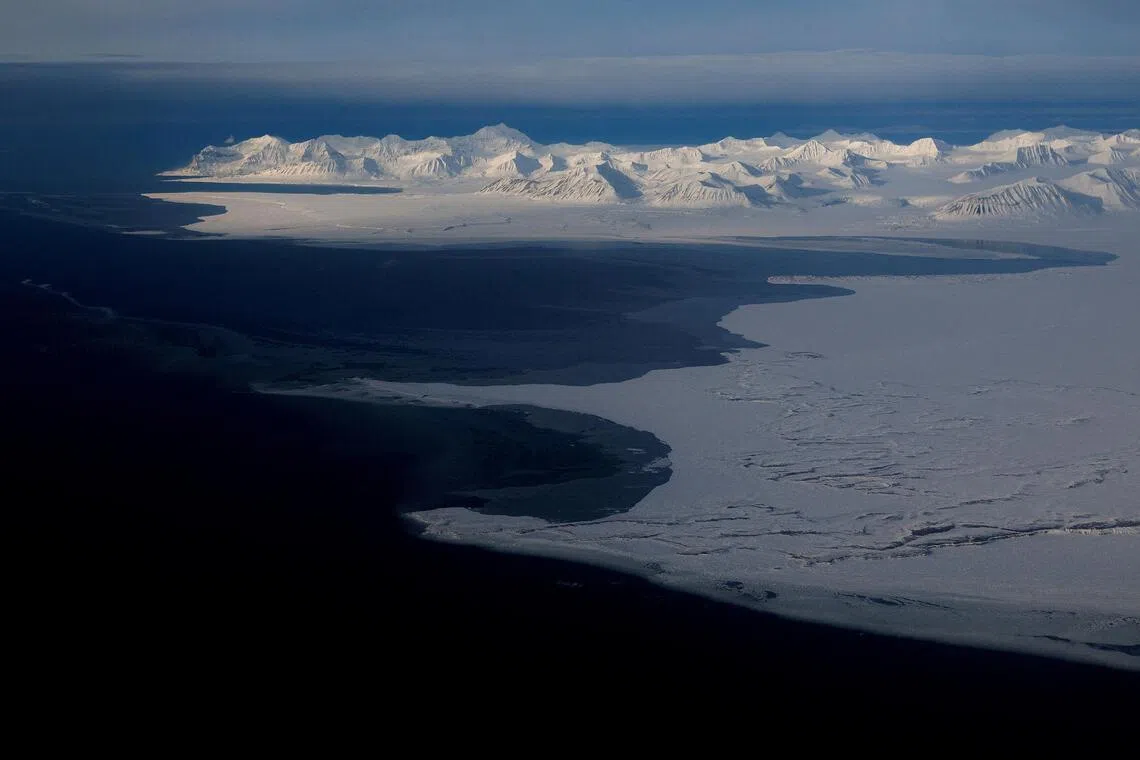
Climate change is rapidly transforming polar oceans, as evidenced in a recent report from Mercator Ocean International’s Copernicus Marine Service. The Arctic has seen a surface temperature increase of 4.2 degrees Celsius between 1982 and 2024, with the Kara Sea north of Siberia experiencing an even more dramatic rise of 6.7 degrees Celsius per decade since 1982. This warming is causing significant ice loss; Arctic sea ice has decreased by nearly half a million square kilometers each decade since 1979, putting coastal communities and wildlife like emperor penguins at risk due to habitat destruction and increased vulnerability to environmental threats.
Written by AI on 2026-09-30, from this article's own text only (the story summary below draws on all the coverage).

AI analysis

Story summary

PARIS - Climate change is rapidly transforming polar oceans, with Arctic waters warming and sea ice shrinking dramatically. According to the Copernicus Ocean State Report released on September 30, the Arctic's combined sea surface and sea-ice temperature has risen by 4.2 degrees Celsius between 1982 and 2024, which is about 1 degree Celsius per decade, nearly ten times faster than the global average increase of 0.12 degrees Celsius per decade.

Karina von Schuckmann, director of the oceans report, warned that with around 60% of coastal infrastructure now vulnerable to erosion and sea level rise, Arctic coastlines are increasingly exposed to destructive waves due to melting ice habitats. Moreover, predictions suggest that more than 90 percent of emperor penguin colonies could face near-extinction by 2100 if current rates of sea ice loss continue. These changes highlight the urgent need for adaptation and mitigation strategies in coastal communities and infrastructure worldwide.

Written for “Polar Ice Melt Impacts Oceans” on 2026-10-30, grounded in this article and the 0 other(s) covering the same event.

Story

📰 Polar Ice Melt Impacts Oceans
Environment · 1 article(s) covering the same event.

Compared with similar articles

Nothing to compare against. No article is close enough to this one for the pipeline to have linked or judged the pair.
How this article was measured signals, leaning charts, publisher record, byline, topics and claims

Signals How these are calculated →

Claims extracted
14
sentences that state something as happening or true
Uncertain
14%
2 of 14 hedged ("reportedly", "may", "according to")
Leaning
not political
takes no side on a contested political question
Publisher signals
66/100
The Straits Times's corrections and hedging, across everything collected from it. Not a measure of accuracy.
Outlets on this story
1
Environment
Same framing elsewhere
1
articles that frame the event the way this one does
Analyzed 2026-09-30 · how these are computed

How this is being covered How these are calculated →

Article leaning vs. publisher reliability
Source leaning vs. consistency

Publisher

The Straits Times · 4019 article(s) · 5 correction(s) detected
Running correction rate · 5 correction(s)

Who wrote this

The Straits Times
2506 article(s) here · 1 carrying a prediction
🔮 "In no case will there be a family photo with European partners and Mr. Lavrov together because ... there is no normalcy with Russia," German Foreign Minister Johann Wadephul told reporters earlier on Friday.
🔮 The two parties are set to unveil a series of deals – from critical minerals to artificial intelligence – and lay the groundwork for a broader alliance open to other democracies seeking to better navigate global trade tensions.
🔮 The restaurant flap is the latest offbeat detour in a campaign in which Trump has warned darkly about communism, commented on the physique of men's bodies and joked that the $5,000 payments he is promising Americans if Republicans keep Congress would barely cover a meal at his Mar-a-Lago club in Florida.
🔮 Neither side wants to be blamed by Trump for something going wrong in Oleshky, an event that could burnish his self-professed credentials as a peacemaker before US midterm legislative elections. But the two sides remain far apart on potential terms for ending the conflict in Ukraine, and there appears to be no immediate prospect of it ending.
🔮 In a statement announcing the demolitions, Israel's military said it would "continue to operate proactively and offensively" to thwart attacks in the West Bank and "protect residents in the area".
🔮 He registered to vote in Illinois under his birth name Robert Francis Prevost and requested a ballot on October 3, the Chicago Sun-Times reported on Thursday, citing the Will County Clerk's office.
🔮 Meta, TikTok and X argued the notices create unprecedented regulatory burdens, with X claiming that what it described as “the most burdensome information request X has received from any regulator” would cost it millions of pounds.
🔮 President Trump loves his supporters, and in addition to nearly 20 tele-rallies, he will hold back-to-back rallies in Kansas and Iowa on Sunday," the official said, speaking on condition of anonymity.
🔮 Over the past decade or so, G-7 countries would at least “have agreed a coordinated platform before they came to the G-20, but now we don’t even really have that,” she added.
🔮 Given the web of interconnected conflicts in the Horn of Africa, with neighbouring countries and powers further afield backing their respective proxies, experts have warned that war in Ethiopia could trigger a broader conflict in the region.
Also by The Straits Times
Nothing else under this byline is closely related to this article, so these are simply their most recent.
All 2506 articles by The Straits Times →

Topics

Copernicus Marine Service Mercator Ocean International PARIS oceans the European Union’s

Subjects

AFP ORG · 1× Copernicus Marine Service ORG · 1× IUCN ORG · 1× Karina von Schuckmann PERSON · 1× Mercator Ocean International ORG · 1× PARIS GPE · 1× Pierre Bahurel PERSON · 1× Spain GPE · 1× oceans ORG · 1× the European Union’s ORG · 1×

Narrative

The retreating ice exposes Arctic coastlines to waves, worsening coastal erosion and raising risks for coastal communities and infrastructure, the report warned. “The Arctic sea ice has been declining since the early 80s, leaving around 60 per cent of coastal infrastructure vulnerable to erosion and sea level rise,” Karina von Schuckmann, director of the oceans report, said in a media briefing.
framing: assertive · carried by 1 article(s) · first seen 2026-09-30
🔮 More than 90 perc ent of emperor penguin colonies could be near-extinct by 2100 if sea ice loss persists at its current rate.
2026-09-30 · The Straits Times
Polar oceans transformed as warming melts ice habitats: Research · assertive framing

Claims (14 extracted, 2 hedged)

Polar oceans transformed as warming melts ice habitats: Research AI generated PARIS - Climate change is increasingly reshaping the polar oceans, with Arctic waters warming rapidly, sea ice shrinking and wildlife losing habitat at both ends of the planet, an annual report said on Sept 30. asserted
report → transform → Sept
The Copernicus Ocean State Report depicts profound changes across the world’s seas, from record-breaking heatwaves in the Mediterranean and Black seas to shifts in marine ecosystems and increasingly acidic waters. asserted
Report → depict → ecosystems
The ocean is changing rapidly,” said Pierre Bahurel, director general of Mercator Ocean International, which runs the European Union’s Copernicus Marine Service. asserted
which → change → Service
Some of the more dramatic effects from global warming are taking place in the poles, which occupy around 20 per cent of the global ocean surface. asserted
which → take → surface
The Arctic’s combined sea surface and sea-ice surface temperature rose 4.2 deg C between 1982 and 2024, or around 1 deg C per decade, according to the 10th annual oceans report. uncertain
temperature → combine → report
By comparison, global sea surface temperatures have been increasing by 0.12 deg C per decade. asserted
temperatures → increase → decade
In the Kara Sea north of Siberia, temperatures have climbed by 6.7 deg C since 1982, or 1.68 deg C per decade. asserted
temperatures → climb → decade
As temperatures rise, Arctic sea ice has shrunk by nearly half a million square kilometres per decade since 1979, equivalent to losing an area the size of Spain every 10 years. asserted
ice → rise → Spain
The retreating ice exposes Arctic coastlines to waves, worsening coastal erosion and raising risks for coastal communities and infrastructure, the report warned. “The Arctic sea ice has been declining since the early 80s, leaving around 60 per cent of coastal infrastructure vulnerable to erosion and sea level rise,” Karina von Schuckmann, director of the oceans report, said in a media briefing. asserted
Schuckmann → retreat → briefing
Ice loss in Antarctica, meanwhile, is threatening penguin populations on the frozen continent. asserted
loss → threaten → continent
Record-low Antarctic sea ice in 2022 coincided with the first-ever recorded large-scale breeding failure of emperor penguins, the report said. asserted
report → coincide → penguins
Emperor penguins rely on stable sea ice to live, hunt and breed and their chicks can perish if they fall in freezing water before developing waterproof feathers. asserted
they → rely → feathers
In April, emperor penguins were upgraded from “near threatened” to “endangered” by the IUCN, the global authority on threatened wildlife. asserted
penguins → upgrade → wildlife
More than 90 perc ent of emperor penguin colonies could be near-extinct by 2100 if sea ice loss persists at its current rate. uncertain
loss → persist → rate
💬Give feedback
🕘History 🎫Support