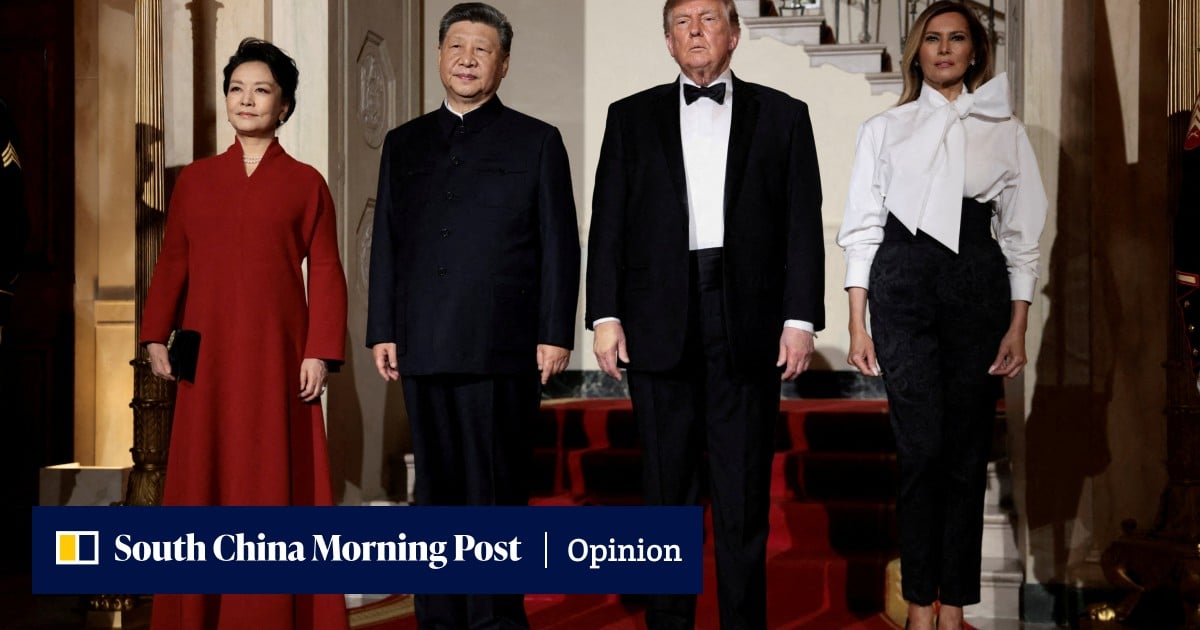
Photo via South China Morning Post

US-China conflict doesn’t have to become a self-fulfilling prophecy

Read the original at South China Morning Post ↗
Cite

Gorombolyi, D. (2026, September 30). US-China conflict doesn’t have to become a self-fulfilling prophecy. South China Morning Post. https://www.scmp.com/opinion/china-opinion/article/3369128/us-china-conflict-doesnt-have-become-self-fulfilling-prophecy?utm_source=rss_feed

Dated when The Aporia collected the article, usually within hours of publication. Check the original for its exact date and byline.

South China Morning Post · collected 2026-09-30 · by David Gorombolyi

Quick Summary

The article discusses the potential for conflict between the United States and China during a period of shifting power dynamics but argues that such conflicts are not inevitable. It suggests there are historical examples where significant power transitions did not lead to war, highlighting these cases as possible models for peaceful resolution.
Written by AI on 2026-09-30, from this article's own text only (the story summary below draws on all the coverage).

AI analysis

Story summary

The potential for US-China conflict looms large as both nations navigate a shift in global power dynamics. Despite historical examples where such shifts led to warfare, experts argue there are instances of peaceful transitions that can serve as models for coexistence. Analysts like David Gorombolyi suggest that neither country is fated to clash and they have the opportunity to learn from past successful resolutions to avoid conflict. The ongoing tension between these superpowers does not inherently predict a military confrontation; instead, it highlights the need for strategic dialogue and cooperation to prevent misunderstandings from escalating into war.

Written for “Us China Conflict” on 2026-11-05, grounded in this article and the 0 other(s) covering the same event.

Story

📰 Us China Conflict
Politics · 1 article(s) covering the same event.

Compared with similar articles

This article reads leans left and hedges 33% of its claims. Each row says how that neighbour differs.
Dawn
Hedges 2 of 24 claims Outlet record 72/100
“The articles discuss different aspects of US-China relations and do not describe the same specific incident or meeting.”
South China Morning Post
Hedges 0 of 1 claims Outlet record 62/100
“The articles discuss different aspects of US-China relations and do not refer to a single, specific event or dialogue.”
Washington Examiner
⚖️ Leans right further right than this Hedges 3 of 40 claims Outlet record 69/100
“The articles discuss different aspects of US-China relations without specifically referring to the same summit or incident.”
Daily Mail
⚖️ Leans right further right than this Hedges 2 of 9 claims Outlet record 69/100
“The articles discuss different aspects of US-China relations and do not describe the same specific incident or occurrence.”
South China Morning Post
Hedges 2 of 2 claims Outlet record 62/100
“The articles discuss different aspects of US-China relations and do not describe the same specific incident or occurrence.”
South China Morning Post
⚖️ Centre further right than this Hedges 0 of 3 claims Outlet record 62/100
“The articles discuss different perspectives on US-China relations and do not describe the same specific incident or occurrence.”
The Hindu
Hedges 0 of 8 claims Outlet record 60/100
“Article A discusses general trends and possibilities of US-China conflict, while Article B reports on a specific summit between Trump and Xi Jinping.”
How this article was measured signals, leaning charts, publisher record, byline, topics and claims

Signals How these are calculated →

Claims extracted
3
sentences that state something as happening or true
Uncertain
33%
1 of 3 hedged ("reportedly", "may", "according to")
Leaning
Leans left
of the writing, not the subject · beta estimate
Publisher signals
62/100
South China Morning Post's corrections and hedging, across everything collected from it. Not a measure of accuracy.
Outlets on this story
1
Politics
Same framing elsewhere
1
articles that frame the event the way this one does
Analyzed 2026-09-30 · how these are computed

How this is being covered How these are calculated →

Article leaning vs. publisher reliability
Source leaning vs. consistency

Publisher

South China Morning Post · 3815 article(s) · 8 correction(s) detected
Running correction rate · 8 correction(s)

Who wrote this

David Gorombolyi
1 article(s) here · 1 carrying a prediction
🔮 However, it is the exceptions – the ones that did not result in war – that could have real lessons to offer.
The only article under this byline in the corpus.

Topics

China

Subjects

China GPE · 2×

Narrative

The US and China have every opportunity to avoid conflict We are reminded seemingly daily of the great power transitions that ended in conflict.
framing: mixed · carried by 1 article(s) · first seen 2026-09-30
🔮 However, it is the exceptions – the ones that did not result in war – that could have real lessons to offer.
2026-09-30 · South China Morning Post
US-China conflict doesn’t have to become a self-fulfilling prophecy · mixed framing

Claims (3 extracted, 1 hedged)

US-China conflict doesn’t have to become a self-fulfilling prophecy Power shifts are dangerous, but their outcomes are not predetermined. asserted
outcomes → have → ?
The US and China have every opportunity to avoid conflict We are reminded seemingly daily of the great power transitions that ended in conflict. asserted
that → have → conflict
However, it is the exceptions – the ones that did not result in war – that could have real lessons to offer. uncertain
that → result → lessons
💬Give feedback · no sign-in needed

No sign-in needed for now. Your note is sent without a name, so it cannot be answered.

🕘History 🎫Support