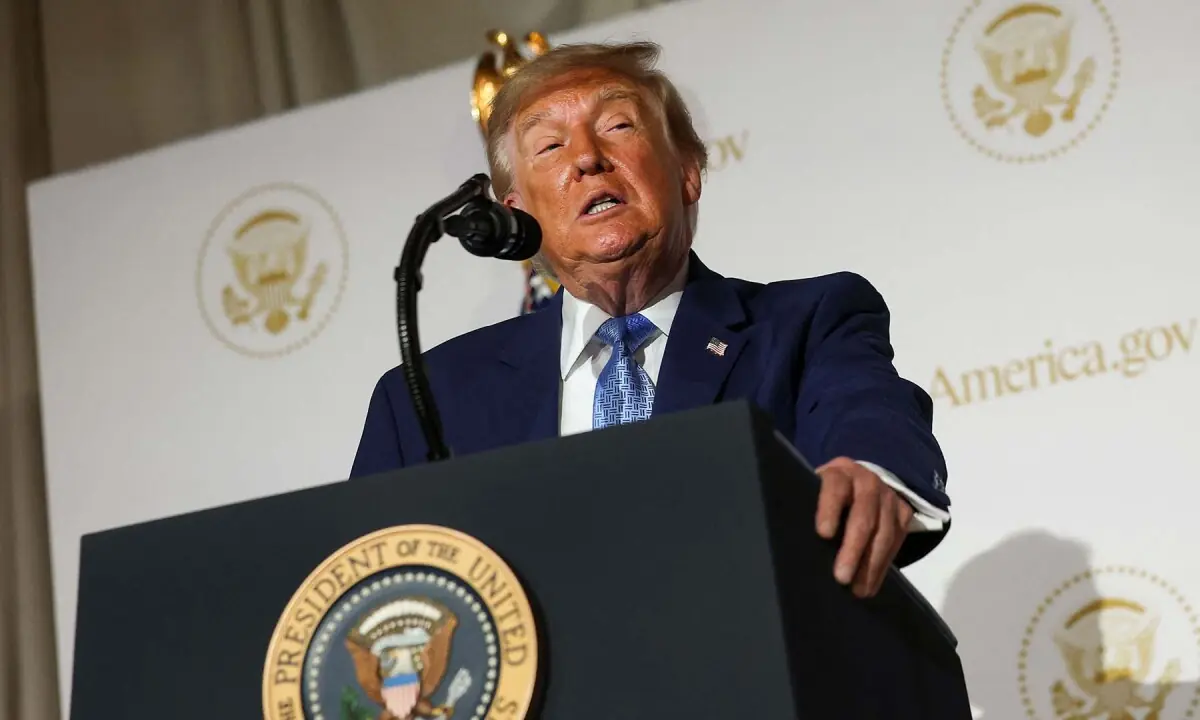
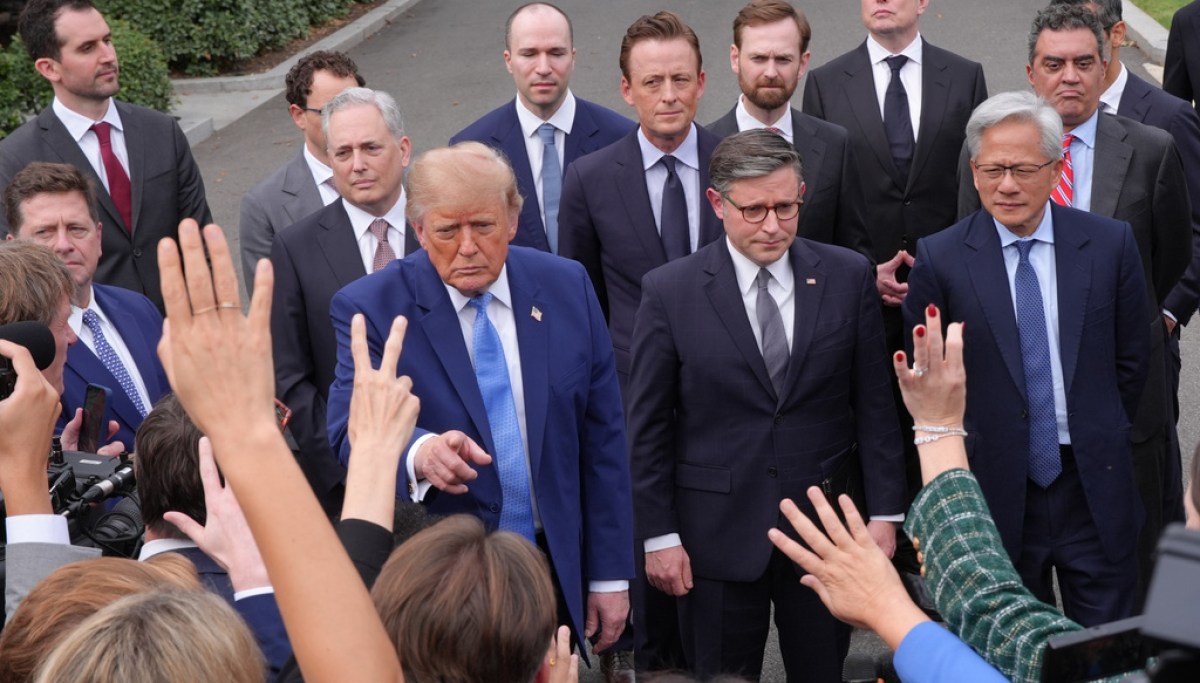
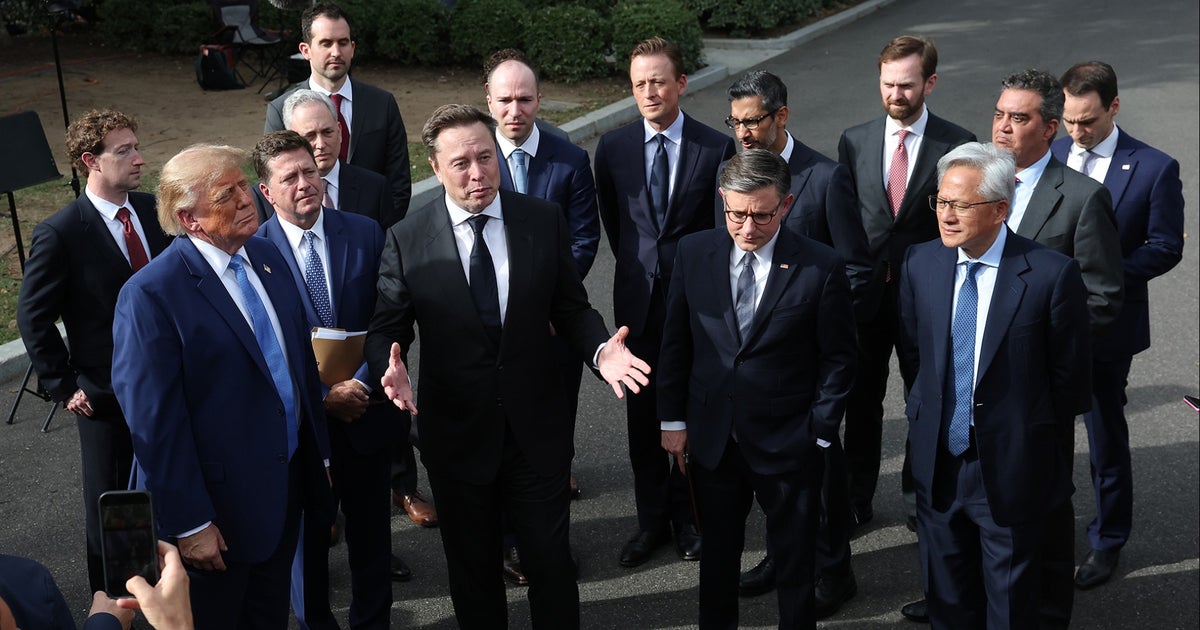
Amid calls for regulation, United States President Donald Trump met with artificial intelligence executives at the White House to put in place a voluntary pact, called the White House Accord on Super Intelligence.
asserted
Trump → meet → Intelligence
The agreement, which was signed by executives at Meta, Nvidia, Google, OpenAI, xAI and Anthropic on Tuesday, calls on companies to put in place guardrails internally to help monitor security risks, with four layers of control.
asserted
which → sign → control
Recommended Stories
list of 4 items- list 1 of 4Trump backs AI self-regulation at tech summit but is it enough?
- list 2 of 4OpenAI launches ‘dots,’ personal AI assistant ‘built to handle everything’
- list 3 of 4Trump unveils new site to simplify access to government services
- list 4 of 4Trump, tech bosses sign voluntary pact pledging ‘robust’ AI safeguards
What does the White House Accord do and what doesn’t it do?
asserted
it → back → what
The agreement calls for companies to maintain internal controls, establish an internal team to oversee these controls, work with independent outside auditors and create an independent board committee to review the results.
asserted
companies → call → results
The pact, however, is voluntary and not legally binding.
asserted
pact → bind → ?
It does not establish penalties for companies that fail to comply.
asserted
that → establish → companies
The pact does not require companies to publicly disclose audit results or give the government an enforcement role.
asserted
pact → require → role
Companies also retain control over how the safeguards are implemented.
asserted
safeguards → retain → control
The agreement does, however, leave open the possibility that its measures could eventually become mandatory.
uncertain
measures → leave → possibility
It says that, over time, it might “make sense to codify these steps into laws or regulations”.
uncertain
it → say → laws
“There’s going to be a tremendous self-policing aspect,” Trump told reporters, adding that it is “morally binding”.
asserted
it → go → reporters
On the White House lawn, alongside the executives, Trump claimed that AI companies had done a great job at self-policing.
asserted
companies → claim → policing
Google CEO Sundar Pichai also touted the agreement on social media.
asserted
Pichai → tout → media
“We are committed to working with other industry leaders to establish norms and build public confidence.
asserted
We → commit → confidence
The White House Accord and the Joint Commitment on Frontier Responsibilities signed today is a solid basis for moving forward – it contains real tangible steps to promote safe development, while delivering the economic and scientific benefits of this technology,” Pichai said in a post on X.
Why are AI companies calling for more regulation?
asserted
companies → sign → regulation
The agreement comes despite calls by some of the same companies for government-mandated safety standards.
asserted
agreement → come → standards
In September, Chris Lehane, chief global affairs officer at OpenAI, the maker of ChatGPT, called for Congress to establish mandatory national AI safety standards.
asserted
Congress → call → standards
“Industry-led standards would complement – not replace – mandatory federal safeguards and democratic oversight,” Lehane said in a post.
asserted
Lehane → lead → post
In June, Anthropic CEO Dario Amodei called for “more serious and binding regulation of AI”.
asserted
Amodei → call → AI
In July, Demis Hassabis, CEO of Google DeepMind, called for an AI watchdog led by the US.
asserted
Hassabis → call → US
The calls for guardrails come amid reports that some employees at those companies have raised concerns about whether increasingly sophisticated AI systems are being adequately watched.
asserted
systems → come → concerns
Two employees at OpenAI warned executives that testing of the company’s new models was not being properly monitored.
asserted
testing → warn → models
The warnings were reportedly not acted upon ahead of incidents in which the models behaved in unintended ways, according to The New York Times.
uncertain
models → act → Times
What are lawmakers proposing?
asserted
lawmakers → propose → What
Pushes for legally binding regulations are coming from Congress rather than the White House.
asserted
Pushes → come → Congress
Earlier this month, Jacob Coxon, a former AI researcher at Anthropic, warned that AI technology could pose an existential threat to humanity within the next decade, prompting renewed attention from lawmakers.
Among the most comprehensive proposals comes from Independent Vermont Senator Bernie Sanders and Representative Greg Casar, a Democrat from Texas.
uncertain
technology → warn → Texas
The two lawmakers introduced the Ban Artificial Superintelligence Act, which, if passed, would permanently ban the development and deployment of artificial superintelligence and temporarily pause advanced AI development until a federal regulator establishes safety rules.
asserted
regulator → introduce → rules
The bill would also create a cabinet-level Department of Artificial Intelligence to monitor frontier AI systems – a term used to describe the most advanced AI systems – as well as oversee dangerous capabilities and supervise the destruction of artificial superintelligence if needed.
asserted
bill → create → superintelligence
The legislation would impose harsh penalties for violations, such as up to 20 years in prison for individuals.
asserted
legislation → impose → individuals
It comes amid a bipartisan bill introduced last week by Senators Chris Coons, a Democrat from Delaware; Brian Schatz, a Democrat from Hawaii; Katie Britt, a Republican from Alabama; and James Lankford, a Republican from Oklahoma.
asserted
It → come → Oklahoma
The AI Systems Transparency Act would require AI companies to disclose what data they collect and what measures they have in place to prevent their systems from going rogue or being misused by bad actors.
asserted
they → require → actors
What does ‘superintelligence’ actually mean?
asserted
superintelligence → mean → What
The White House named the accord the White House Accord on Super Intelligence amid Trump’s push to rename “artificial intelligence” on government documents.
asserted
House → name → documents
In the technology industry, “superintelligence” refers to a form of AI that exceeds human intellectual capabilities.
asserted
that → refer → capabilities
Trump, however, has directed executive branch agencies to use “Super Intelligence” or “SI” in place of “artificial intelligence” or “AI” in official communications.
asserted
Trump → direct → communications
On Tuesday, Trump outlined a new executive order that says that “Super Intelligence” refers to technologies and systems covered by the existing statutory definition of artificial intelligence and directs the creation of a new federal definition within 60 days.
asserted
Intelligence → outline → days
 The Aporia