Photo via The Independent

A giant ‘pulse wave’ is about to slam into California - here’s how it will impact the West Coast

Read the original at The Independent ↗
Cite

Musto, J. (2026, September 30). A giant ‘pulse wave’ is about to slam into California - here’s how it will impact the West Coast. The Independent. https://www.independent.co.uk/climate-change/kelvin-wave-california-el-nino-climate-change-b3059326.html

Dated when The Aporia collected the article, usually within hours of publication. Check the original for its exact date and byline.

The Independent · collected 2026-09-30 · by Julia Musto

Quick Summary

A significant wave of energy, known as a Kelvin wave, is set to hit California's coast in October due to strengthening El Niño conditions. This event could raise sea levels by up to one foot, posing risks to coastal areas already affected by climate change and the natural phenomenon of king tides during Thanksgiving and Christmas. Experts warn that this is just the beginning, with more severe impacts anticipated from January through March, including increased flooding and extreme weather events exacerbated by human-caused climate change.
Written by AI on 2026-09-30, from this article's own text only (the story summary below draws on all the coverage).

AI analysis

Story summary

A massive underwater warm water band known as a Kelvin wave, driven by El Niño conditions, is moving up the western coast of North and South America. Expected to reach California's southern coast by early October and extend northward, it could raise sea levels along the California coast by up to one foot. This surge, akin to water sloshing in a bathtub during an earthquake rather than typical waves, combines with ongoing climate change-induced sea level rise to significantly increase flood risks. Coastal areas from California through Oregon and Washington are particularly concerned, as higher seas, larger-than-average waves, and large spring tides could cause severe erosion and flooding. Notably, scientists like Daniel Swain warn of the certainty of coastal flooding during wet weather months when the wave arrives.

Written for “Kelvin Wave Hits West Coast” on 2026-11-02, grounded in this article and the 5 other(s) covering the same event.

Story

📰 Kelvin Wave Hits West Coast
Environment · 6 article(s) covering the same event. Compare every outlet's account →

Compared with similar articles

This article reads leans left and hedges 24% of its claims. Each row says how that neighbour differs.
The Independent
Hedges 3 of 44 claims Outlet record 59/100
“The articles describe different phenomena: one focuses on long-term sea level rise affecting San Clemente, while the other reports on an imminent 'pulse wave' expected to hit the California coast.”
The Guardian
Hedges 9 of 38 claims Outlet record 66/100
The Independent
Hedges 6 of 20 claims Outlet record 59/100
“The articles describe different types of weather events affecting different regions and times.”
New York Post
Hedges 2 of 11 claims Outlet record 66/100
The Independent
Hedges 8 of 42 claims Outlet record 59/100
Toronto Star
Hedges 8 of 45 claims Outlet record 64/100
New York Post
Hedges 1 of 9 claims Outlet record 66/100
“The articles describe different weather phenomena occurring at distinct times.”
New York Post
⚖️ Leans left Hedges 13 of 36 claims Outlet record 66/100
“The articles discuss different phenomena: a Kelvin wave affecting sea levels and coastal areas, versus a heatwave impacting power consumption.”
New York Post
Hedges 3 of 16 claims Outlet record 66/100
“The articles describe different types of oceanic events (hurricane swells vs. a Kelvin wave) affecting California at potentially different times.”
How this article was measured signals, leaning charts, publisher record, byline, topics and claims

Signals How these are calculated →

Claims extracted
17
sentences that state something as happening or true
Uncertain
24%
4 of 17 hedged ("reportedly", "may", "according to")
Leaning
Leans left
of the writing, not the subject · beta estimate
Publisher signals
59/100
The Independent's corrections and hedging, across everything collected from it. Not a measure of accuracy.
Outlets on this story
6
Environment
Same framing elsewhere
1
articles that frame the event the way this one does
Analyzed 2026-09-30 · how these are computed

How this is being covered How these are calculated →

Article leaning vs. publisher reliability
Source leaning vs. consistency

Publisher

The Independent · 3510 article(s) · 8 correction(s) detected
Running correction rate · 8 correction(s)

Who wrote this

Julia Musto
36 article(s) here · 1 carrying a prediction
🔮 “We have worried this would increase rates of problem gambling among youth.
🔮 “It takes about two weeks for the body to build protection, and getting vaccinated now will help provide protection for the holiday season when people gather indoors,” Juthani said.
🔮 Busy California airports used by millions of travelers could face flooding risks during the upcoming holiday season thanks to sea level rise and a record-breaking El Niño climate pattern, a new report warns.
🔮 Spreading cases in mink could help the virus mutate enough to make that transition.
🔮 The weather could be downright frightful in parts of the U.S. this Halloween as kids and families head out for trick-or-treating.
🔮 The threat is projected to worsen with researchers projecting 317,000 annual deaths from superbugs in North America by 2050.
🔮 If you have a sore throat right now, it might not be a cold or the onset of the flu.
🔮 So the longer your house remains at the lower temperature, the more energy you save, because your house has lost less energy than it would have at the higher temperature,” the department says.
🔮 The state’s parks department is conducting additional wildlife surveillance in the area and a previously-established “infested zone” will be updated following the detection, the department said.
🔮 “Now that we know what may cause people to become allergic and pick up more sensitivities, we can design ways to stop it from happening,” senior author Dr. Caroline Sokol, a physician-scientist in the Mass General Brigham Department of Medicine, explained in a statement.
Also by Julia Musto
Nothing else under this byline is closely related to this article, so these are simply their most recent.
All 36 articles by Julia Musto →

Topics

AccuWeather California El Niño Independent Kelvin

Subjects

California GPE · 2× AccuWeather ORG · 1× Californians NORP · 1× Dillon Amaya PERSON · 1× Independent ORG · 1× NASA ORG · 1× North Carolina State University ORG · 1× The Golden State’s GPE · 1× The New York Times ORG · 1× U.S. GPE · 1×

Narrative

The Kelvin wave is “one of the first, if not the first indication that El Niño is here,” Dillon Amaya, an assistant professor in the department of marine, earth and atmospheric sciences at North Carolina State University, told The New York Times on Wednesday.
framing: mixed · carried by 1 article(s) · first seen 2026-09-30
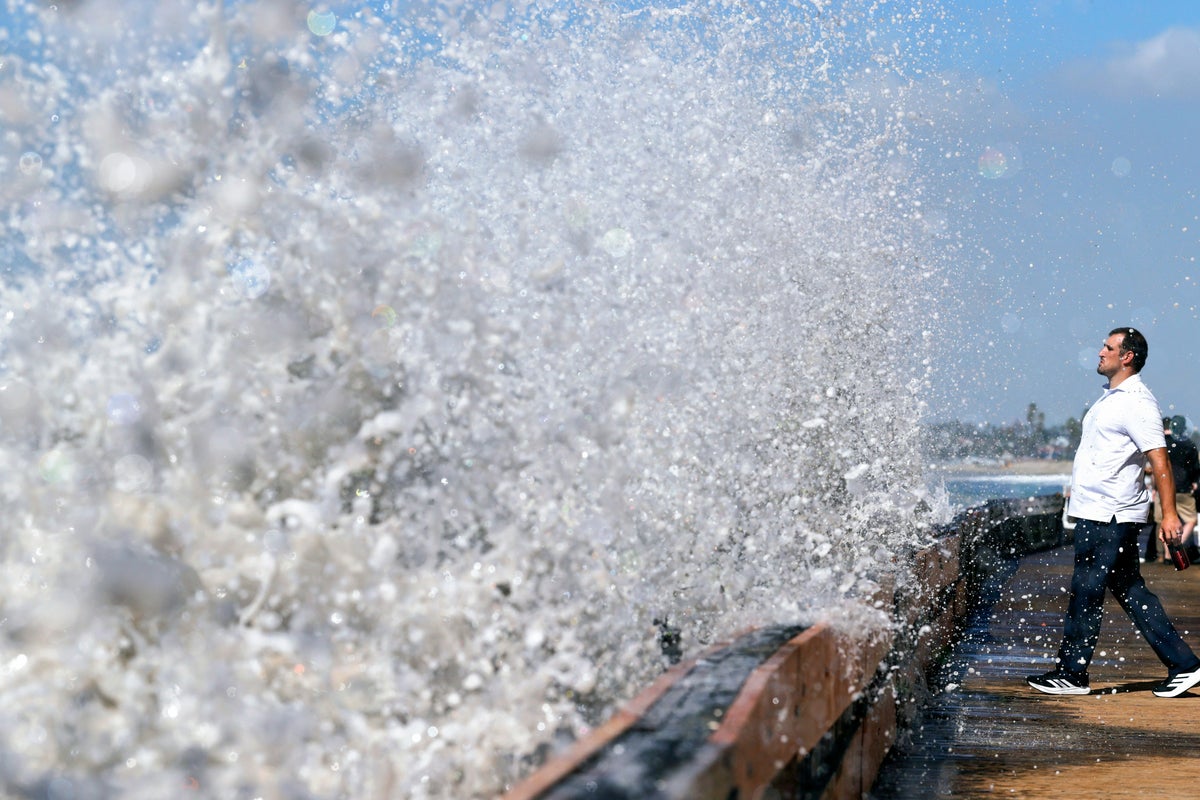
🔮 A massive wave of energy is expected to slam into the California coast in October, sending sea levels rising by up to a foot and threatening coastal homes and ecosystems.

Claims (17 extracted, 4 hedged)

A massive wave of energy is expected to slam into the California coast in October, sending sea levels rising by up to a foot and threatening coastal homes and ecosystems. asserted
levels → expect → homes
The so-called Kelvin wave forms because of sudden changes in wind speed and force, and has the ability to push warm water vast distances for months, according to forecaster AccuWeather. uncertain
wave → call → AccuWeather
In this case, the Kelvin wave is driven by strengthening super El Niño conditions, experts say. asserted
experts → drive → conditions
The natural climate pattern is forecast to bring more life-threatening flooding rainstorms and extreme temperatures across the U.S. into next year, worsened by human-caused climate change. asserted
pattern → forecast → change
The Kelvin wave is “one of the first, if not the first indication that El Niño is here,” Dillon Amaya, an assistant professor in the department of marine, earth and atmospheric sciences at North Carolina State University, told The New York Times on Wednesday. asserted
Amaya → tell → Wednesday
Past El Niño events have raised West Coast water levels by more than 7.9 inches, according to NASA. uncertain
events → raise → NASA
Unfortunately for Californians, that’s not the only reason water levels are expected to swell, too. asserted
levels → ’ → Californians
The Golden State’s king tides - especially high tides that occur due to the position of the Earth, moon and sun - are expected to be worse than typical this year due to the moon’s location in relation to Earth’s equator. asserted
that → occur → equator
Those happen around Thanksgiving and Christmas, Anthony Edwards, a meteorologist at The San Francisco Chronicle, wrote on Monday. asserted
Edwards → happen → Monday
And climate change has brought sea levels inching upward for decades, rising 8-9 inches worldwide since 1880, according to federal data. uncertain
levels → bring → data
In the now-hurricane-riddled Pacific, sea levels have risen 4-6 inches since 1993, according to the United Nations. uncertain
levels → riddle → Nations
These effects have made for some records already in California. asserted
effects → make → California
The Bay Area got its second-ever coastal flood advisory this month and a previous Kelvin wave caused San Francisco’s highest June and July tides on record. asserted
wave → get → record
That’s also part of what led Gov. Gavin Newsom to declare a state of emergency, mobilizing state agencies to distribute sandbags and pumps. asserted
what → ’ → sandbags
And the triple-threat is what has experts so concerned, saying bigger impacts are coming. asserted
impacts → have → ?
“This coming Kelvin wave is just the beginning,” Dr Jonathan Warrick, a research geologist at the U.S. Geological Survey, told The Guardian on Wednesday. asserted
Warrick → come → Wednesday
“The thing to look out for is what will happen in January, February and March – that’s when we get the biggest storms, we get our largest waves and we have some very large tides.” asserted
we → look → tides
💬Give feedback
🕘History 🎫Support