Photo via New York Post

Freak ocean phenomenon takes hold of California coast with seas surging

Read the original at New York Post ↗
Cite

Monahan, A. (2026, October 3). Freak ocean phenomenon takes hold of California coast with seas surging. New York Post. https://nypost.com/2026/10/02/us-news/el-nino-causes-ocean-phenomenon-waves-to-raise-california-sea-levels/

Dated when The Aporia collected the article, usually within hours of publication. Check the original for its exact date and byline.

New York Post · collected 2026-10-03 · by Amanda Monahan

Quick Summary

California's coast is experiencing an unusual surge caused by a "Kelvin wave," which can raise sea levels up to one foot and increase flood risks significantly. This phenomenon, combined with elevated sea temperatures and recent hurricane impacts, could lead to record-high sea levels along the state’s coastline. Oceanographers warn that every two to four inches of additional sea level rise doubles the flood risk for coastal areas already battered by unusual ocean events like waves crashing over Pacific Coast Highway in Malibu last month.
Written by AI on 2026-10-03, from this article's own text only (the story summary below draws on all the coverage).

AI analysis

Story summary

A massive underwater warm water band known as a Kelvin wave, driven by El Niño conditions, is moving up the western coast of North and South America. Expected to reach California's southern coast by early October and extend northward, it could raise sea levels along the California coast by up to one foot. This surge, akin to water sloshing in a bathtub during an earthquake rather than typical waves, combines with ongoing climate change-induced sea level rise to significantly increase flood risks. Coastal areas from California through Oregon and Washington are particularly concerned, as higher seas, larger-than-average waves, and large spring tides could cause severe erosion and flooding. Notably, scientists like Daniel Swain warn of the certainty of coastal flooding during wet weather months when the wave arrives.

Written for “Kelvin Wave Hits West Coast” on 2026-10-31, grounded in this article and the 5 other(s) covering the same event.

Story

📰 Kelvin Wave Hits West Coast
Environment · 6 article(s) covering the same event. Compare every outlet's account →

Compared with similar articles

This article reads unscored and hedges 18% of its claims. Each row says how that neighbour differs.
The Guardian
Hedges 9 of 38 claims Outlet record 66/100
The Independent
⚖️ Leans left Hedges 4 of 17 claims Outlet record 59/100
The Independent
Hedges 8 of 42 claims Outlet record 59/100
Toronto Star
Hedges 8 of 45 claims Outlet record 64/100
ABC News (US)
Hedges 0 of 13 claims Outlet record 70/100
“The articles describe different weather phenomena occurring in California: one describes a coastal trapped wave or Kelvin wave causing sea level surges, while the other reports on an October heat wave breaking temperature records.”
The Guardian
Hedges 12 of 67 claims Outlet record 66/100
“The articles describe different phases of the El Niño effect impacting California's coast over a week apart.”
NBC News
Hedges 5 of 22 claims Outlet record 60/100
“Article A describes a coastal trapped wave or Kelvin wave affecting California's coast, while Article B discusses overall record-setting sea surface temperatures due to El Niño in the tropical Pacific. They cover related phenomena but different specific events.”
How this article was measured signals, leaning charts, publisher record, byline, topics and claims

Signals How these are calculated →

Claims extracted
11
sentences that state something as happening or true
Uncertain
18%
2 of 11 hedged ("reportedly", "may", "according to")
Leaning
not political
takes no side on a contested political question
Publisher signals
66/100
New York Post's corrections and hedging, across everything collected from it. Not a measure of accuracy.
Outlets on this story
6
Environment
Same framing elsewhere
1
articles that frame the event the way this one does
Analyzed 2026-10-03 · how these are computed

How this is being covered How these are calculated →

Article leaning vs. publisher reliability
Source leaning vs. consistency

Publisher

New York Post · 15592 article(s) · 35 correction(s) detected
Running correction rate · 35 correction(s)

Who wrote this

Amanda Monahan
14 article(s) here · 1 carrying a prediction
🔮 Myers Power Products, Inc., based in Ontario, filed a WARN notice earlier this month that will affect 206 employees.
🔮 No residents or pets were exposed to the animal, but two people at a nearby worksite may have been exposed and are receiving “recommended follow-up for rabies post-exposure prophylaxis,” a series
🔮 You might want to stay out of the water.
🔮 California’s coast is bracing for a massive surge that could push sea levels up by as much as a foot in the coming days, piling onto already battered beaches and raising the risk of flooding and erosion.
🔮 Culver City announced Friday that all Culver CityBus service would be suspended through the weekend as the community mourns the driver, who was gunned down around 5:15 p.m. Thursday.
🔮 An estimated $1 billion in new revenue generated from Los Angeles County’s latest sales tax increase will have to sit untouched as a lawsuit challenges the validity of the measure.
🔮 Food delivery service users may soon have food flying, literally, to their doorstep.
🔮 I would have panicked.
🔮 A rubbish fire believed to be homeless-related in May left a Larchmont homeowner homeless himself. “I spoke to LAPD to kick them out, and they did nothing, and my house burned and my dogs are dead,” Jonathan Galicia said to Eyewitness News right after the fire destroyed his home.
🔮 A passenger staying in a cabin near the Giglers told the Daily Mail that the family’s accommodations were on the ship’s second deck — meaning Gigler would have ascended roughly nine floors before reaching the 11th deck, where he is believed to have jumped.
Also by Amanda Monahan
Nothing else under this byline is closely related to this article, so these are simply their most recent.
All 14 articles by Amanda Monahan →

Topics

AFP California El Niño Malibu North Carolina State University

Subjects

California GPE · 6× AFP ORG · 1× Dillon Amaya PERSON · 1× La Jolla GPE · 1× Malibu GPE · 1× Mark Merrifield PERSON · 1× North Carolina State University ORG · 1× The California Post App ORG · 1× the Center for Climate Change Impacts and Adaptation ORG · 1× the Scripps Institute of Oceanography ORG · 1×

Narrative

“The general rule of thumb is that every two to four inches of sea level rise that we see in that background state essentially doubles your flood risk,” Dillon Amaya, an oceanographer at North Carolina State University, told AFP.
framing: assertive · carried by 1 article(s) · first seen 2026-10-03
🔮 California’s coast is bracing for a massive surge that could push sea levels up by as much as a foot in the coming days, piling onto already battered beaches and raising the risk of flooding and erosion.
2026-10-03 · New York Post
Freak ocean phenomenon takes hold of California coast with seas surging · assertive framing

Claims (11 extracted, 2 hedged)

California’s coast is bracing for a massive surge that could push sea levels up by as much as a foot in the coming days, piling onto already battered beaches and raising the risk of flooding and erosion. uncertain
that → brace → flooding
The surge, known as a “coastal trapped wave” or “Kelvin wave,” is one of the effects of El Niño that has been building along the California coast in recent weeks. And this is no ordinary wave. asserted
this → know → weeks
Sign up for the California Morning Report newsletter The biggest news, opinion and culture shaping California right now. Thanks for signing up! asserted
Sign → sign → California
The Kelvin wave is a massive, sustained bulge of water that will raise ocean levels across an area stretching 12 to 18 miles offshore — with potentially serious consequences for California’s coastline. asserted
that → raise → coastline
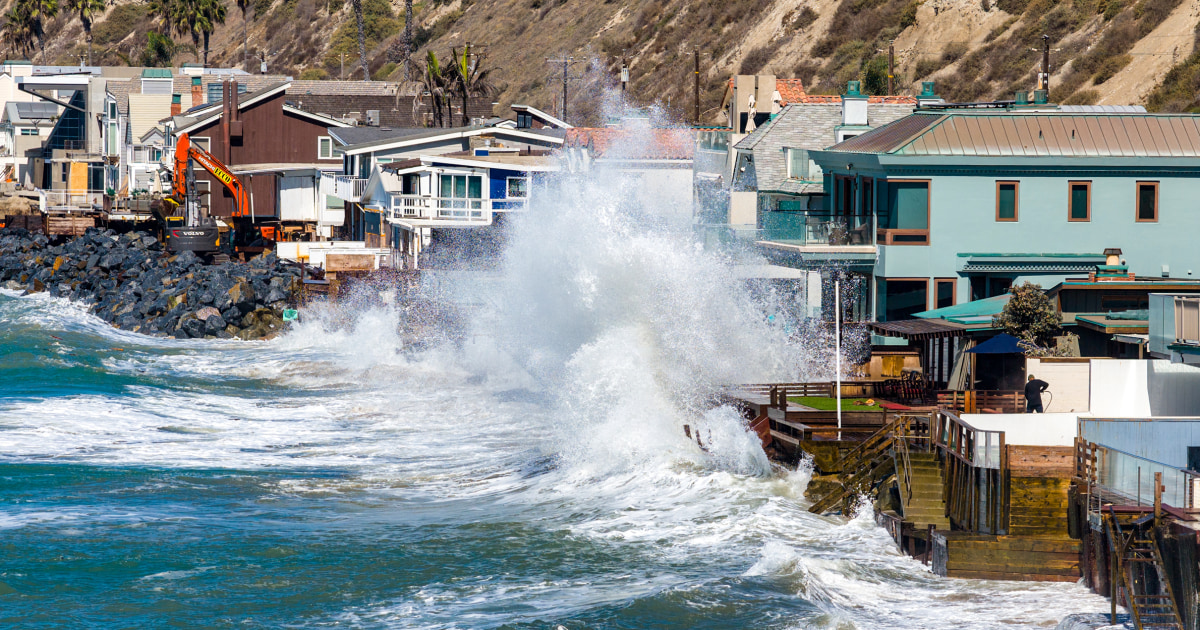
It comes after a string of unusual ocean events battered coastal communities, including waves that crashed over Pacific Coast Highway in Malibu last month. asserted
that → come → Malibu
“The general rule of thumb is that every two to four inches of sea level rise that we see in that background state essentially doubles your flood risk,” Dillon Amaya, an oceanographer at North Carolina State University, told AFP. asserted
Amaya → see → AFP
What makes the current situation particularly concerning is the combination of the wave with other factors already hammering the California coast. asserted
situation → make → coast
Download The California Post App, follow us on social, and subscribe to our newsletters With those conditions stacking up, California could soon see its highest sea levels ever recorded, Mark Merrifield, director of the Center for Climate Change Impacts and Adaptation at the Scripps Institute of Oceanography in La Jolla, told the New York Times. uncertain
Merrifield → download → Times
Sea temperatures are already elevated, while several Southern California beaches are dealing with erosion and recovering from the effects of recent hurricanes. asserted
beaches → deal → hurricanes
The Kelvin wave is both a cause and a symptom of El Niño, Amaya said. asserted
Amaya → say → Niño
As the enormous bulge of water moves across the Pacific, it suppresses the cold water that normally rises from the ocean depths, helping drive warmer surface temperatures — a hallmark of El Niño. asserted
that → move → Niño
💬Give feedback
🕘History 🎫Support