Thirty years ago, U.N. Secretary-General Boutros Boutros-Ghali offered an ambitious vision of the institution he led.
asserted
he → offer → institution
Globalization was drawing countries together even as fragmentation threatened to pull them apart.
asserted
fragmentation → draw → them
The United Nations, he argued, could help build a more cooperative international order.
uncertain
he → argue → order
Nations would be bound closer together, and the credibility of the U.N. would deepen “year by year.”
asserted
credibility → bind → year
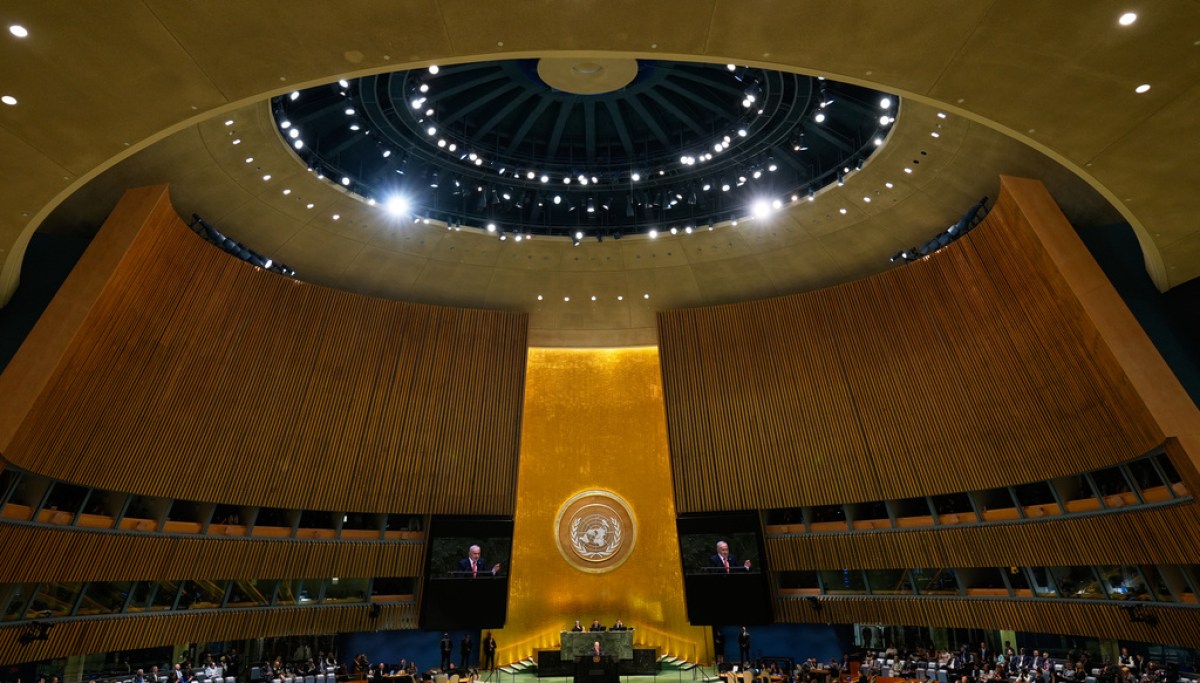
Thirty years later, another parade of world leaders gathered in New York.
asserted
parade → gather → York
This year’s General Assembly theme is “Restoring Trust”, part of its promise of “A United Nations That Delivers for All.”
asserted
That → restore → All
Secretary-General Antonio Guterres offered a darker assessment: Geopolitical divisions have deepened, and trust has eroded.
asserted
trust → offer → assessment
That may be the most realistic thing said at the U.N. all week.
uncertain
That → say → U.N.
The question after eight decades is whether gathering most of the world’s leaders in the same city every September is making the world appreciably better at solving its problems.
asserted
world → gather → problems
Russia and the West remain divided over Ukraine.
asserted
Russia → remain → Ukraine
Wars consume the Middle East, where ancient religious, ethnic, and territorial disputes continue to fuel modern conflicts with global implications.
asserted
disputes → consume → implications
Large parts of Africa remain trapped in civil war, religious violence, and persistent poverty.
asserted
parts → trap → war
Great powers repeatedly collide in the Security Council.
asserted
powers → collide → Council
The record has exposed a basic weakness in an institution built around sovereign equality: Giving every country a voice does not mean every government is equally qualified to exercise every institutional responsibility.
asserted
government → expose → responsibility
Small countries deserve a voice alongside powerful ones.
asserted
countries → deserve → ones
That should not change.
asserted
That → change → ?
Yet the U.N. repeatedly places governments with troubling records in positions where they help judge the conduct of others.
asserted
they → place → others
Its 2026 membership includes China and Cuba, along with Burundi, Ethiopia, Iraq, Pakistan, Qatar, and Vietnam.
asserted
membership → include → Burundi
They deserve representation at the U.N.
asserted
They → deserve → U.N.
Whether that qualifies governments to sit in judgment of the human-rights conduct of others is another question.
asserted
qualifies → qualify → others
Israel provides the clearest example of distorted priorities.
asserted
Israel → provide → priorities
The U.N. has legitimate grounds to scrutinize Israeli conduct.
asserted
U.N. → have → conduct
But Israel occupies a permanent agenda position in the Human Rights Council under Item 7, a distinction no other country receives.
asserted
country → occupy → Item
Why has an institution created to address human rights everywhere institutionalized special scrutiny of one country, while governments with severe human rights records sit on the council?
asserted
governments → create → council
The same problem reaches into the bureaucracy.
asserted
problem → reach → bureaucracy
The “paramount consideration” in hiring should be efficiency, competence, and integrity, according to the U.N. Charter.
uncertain
consideration → hire → Charter
Yet geography, national claims on positions, and diplomatic convention have become woven into how the institution operates.
uncertain
institution → weave → positions
An American traditionally heads political and peacebuilding affairs.
asserted
American → head → affairs
A Chinese official oversees economic and social affairs.
asserted
official → oversee → affairs
A Briton traditionally gets humanitarian affairs, a French official peacekeeping, and a Russian counterterrorism.
asserted
Briton → get → affairs
Russia effectively retains an informal claim on the U.N.’s counterterrorism leadership.
uncertain
Russia → retain → leadership
Nothing in the charter requires this arrangement.
asserted
Nothing → require → arrangement
What convention created, convention can end.
asserted
convention → create → What
The system has also produced a vast international bureaucracy.
asserted
system → produce → bureaucracy
More than 40,000 resolutions, decisions, and presidential statements have accumulated since 1946.
asserted
resolutions → accumulate → 1946
The institution has become exceptionally good at perpetuating process.
asserted
institution → become → process
Conferences produce declarations.
asserted
Conferences → produce → declarations
Declarations create mandates.
asserted
Declarations → create → mandates
Mandates require offices, reports, committees, and staff.
asserted
Mandates → require → offices
Activity becomes easier to measure than results.
asserted
Activity → become → results
…and 39 more, not listed.
 The Aporia