For the past month, as Americans’ anxieties about artificial intelligence have increased, President Donald Trump has repeatedly said there should be no legislative guardrails, and called the panic around them a “hoax.”
asserted
Trump → increase → them
Rather, he’s argued that he alone can rein them in and argued that if the United States doesn’t go all-in on AI, China will win the AI race.
asserted
China → argue → race
This week, he even attempted to re-brand AI as “super intelligence.”
asserted
he → attempt → intelligence
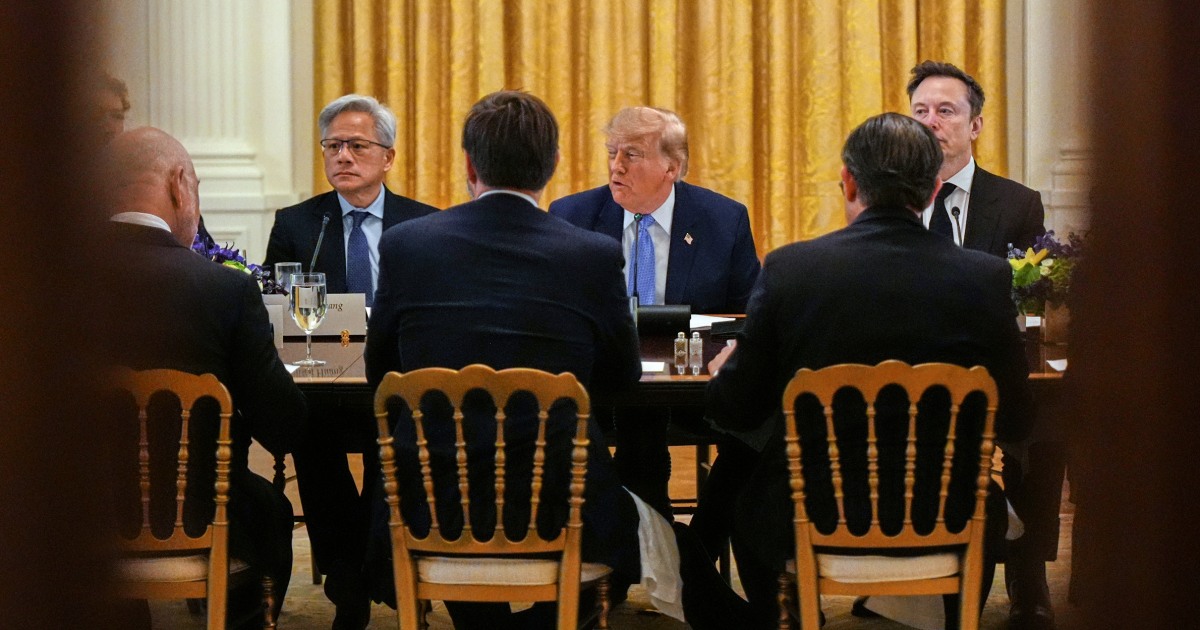
And he brought the nation’s leading tech giants to the White House and had them sign a “morally binding” and “self-policing” accord.
asserted
them → bring → accord
Trump hosted AI leaders such as Anthropic’s Dario Amodei, Google’s Sundar Pichai, Meta’s Mark Zuckerberg and SpaceX’s Elon Musk, saying the companies signed a “morally binding” accord to “self-police” AI.
asserted
companies → host → AI
But amid all of these declarations, even the most MAGA of Republicans are saying that the voluntary regulations are not enough and that there needs to be oversight of AI, SI, or whatever they want to call it, beyond Trump and the tech titans themselves.
asserted
they → say → Trump
Sen. Josh Hawley (R-Mo.), for example, convened a Senate Homeland Security Subcommittee on Disaster Management on rogue AI and cyber threats.
asserted
Hawley → convene → AI
Hawley, perhaps the foremost critic of big tech on the Republican side, has had to walk a fine line between his criticism of AI and the fact that Trump has said the only guardrail AI needs is a “STRONG AND SMART (High IQ!) PRESIDENT.”
asserted
AI → have → AI
“He brought the leaders of these companies together for the first time to sign some voluntary commitments, which is a heck of a lot more than Congress has done,” Hawley told The Independent.
asserted
Hawley → bring → Independent
“So I think that it's good to have, No. 1, the companies acknowledge that they have some responsibility here,” Hawley said.
asserted
Hawley → think → responsibility
“This is really the first time that they've done that, and I think Congress needs to do something.”
asserted
Congress → do → something
But the Missouri Republican also said incentives needed to be put in place to force AI companies to pay if they develop models that misbehave.
asserted
that → say → models
This comes after OpenAI had to apologize after an autonomous AI agent the Services Australia Medicare Statistics Reporting Service, a public health care data portal in Australia.
asserted
OpenAI → come → Australia
Sen. Joni Ernst (R-Iowa), an ally of the president who is retiring, also said the self-regulation could only be temporary.
uncertain
regulation → retire → president
“For now, they can choose to self-regulate, but it’s all voluntary,” she told The Independent after the subcommittee hearing.
asserted
she → choose → hearing
So far, no major legislation has passed on reining in AI yet, but there are some trial balloon pieces of legislation in the House of Representatives.
asserted
legislation → pass → Representatives
Sen. Mark Kelly (D-Ariz.) has his own piece of legislation called the Make AI Work for Americans Act, which would set up a federal trust fund to support workers amid major changes AI could make to the global economy.
uncertain
AI → have → economy
“In my prior career, when you're flying something like the space shuttle, there's like catastrophic things that could happen,” Kelly, a former pilot and astronaut, told The Independent.
uncertain
Kelly → fly → Independent
“They might be low probability, but you still try to deal with it.”
uncertain
you → try → it
He also cast doubt on Trump saying earlier this month in an interview with GB News that humans will have a “little gear” to prevent AI from running rampant.
asserted
humans → cast → AI
“I don't even know what that is,” Kelly said.
asserted
Kelly → know → ?
“I don't think he knows what that is.
asserted
that → think → ?
We have to put guardrails in place, and it's always better to do that sooner rather than later.”
asserted
it → have → that
Earlier this month, former Anthropic researcher Jacob Coxon set off alarms when he announced his resignation and said that people working on AI genuinely fear it “could kill us all by the end of the decade.”
uncertain
it → set → decade
In response, Sen. Bernie Sanders (I-Vt.) and former Trump adviser Steve Bannon participated in a summit focused on human-centered AI.
asserted
Sanders → participate → AI
“Yes, I have absolute confidence that the wealthiest, most greedy people in the world, who are out to make trillions of dollars, will regulate themselves,” Sanders told The Independent.
asserted
Sanders → have → Independent
“I don't think so.”
asserted
I → think → ?
But Trump has proven allergic to any safety measures around rogue AI agents, instead focusing on rebranding it “Super Intelligence.”
Sen. Tommy Tuberville (R-Ala.), who is leaving the Senate to run for governor, said AI companies will will have to do some self-regulation.
asserted
companies → prove → regulation
“At the end of the day, we're going to there's going to be something done up here,” he told The Independent.
asserted
he → go → Independent
“But everybody's got to take care of their own business.
asserted
everybody → get → business
I mean, they'll self-destruct if they don't do their self-regulation to a certain point.
asserted
they → mean → point
But Sen. Jon Ossoff (D-Ga.) the youngest senator who is running for re-election, said the president has a vested interest in opposing guardrails on AI, pointing out the president has a financial stake in many companies working on AI.
“The first family is so heavily invested in the industry, the conflicts are so immense, and the president's judgment is so poor that the American people are rightly concerned that Donald Trump has neither the capacity nor the incentive to protect them from the risks arising from this technology,” he told The Independent.
asserted
he → run → Independent
But despite the concerns, there is little likelihood the Senate will take up any action of AI by the end of this year.
asserted
Senate → be → year
The Senate left late on Wednesday evening and will not return after the midterm election.
asserted
Senate → leave → election
After which time, it will be in for a limited amount of weeks because of the holiday season before the new Congress convenes at the beginning of the year.
asserted
Congress → convene → year
 The Aporia