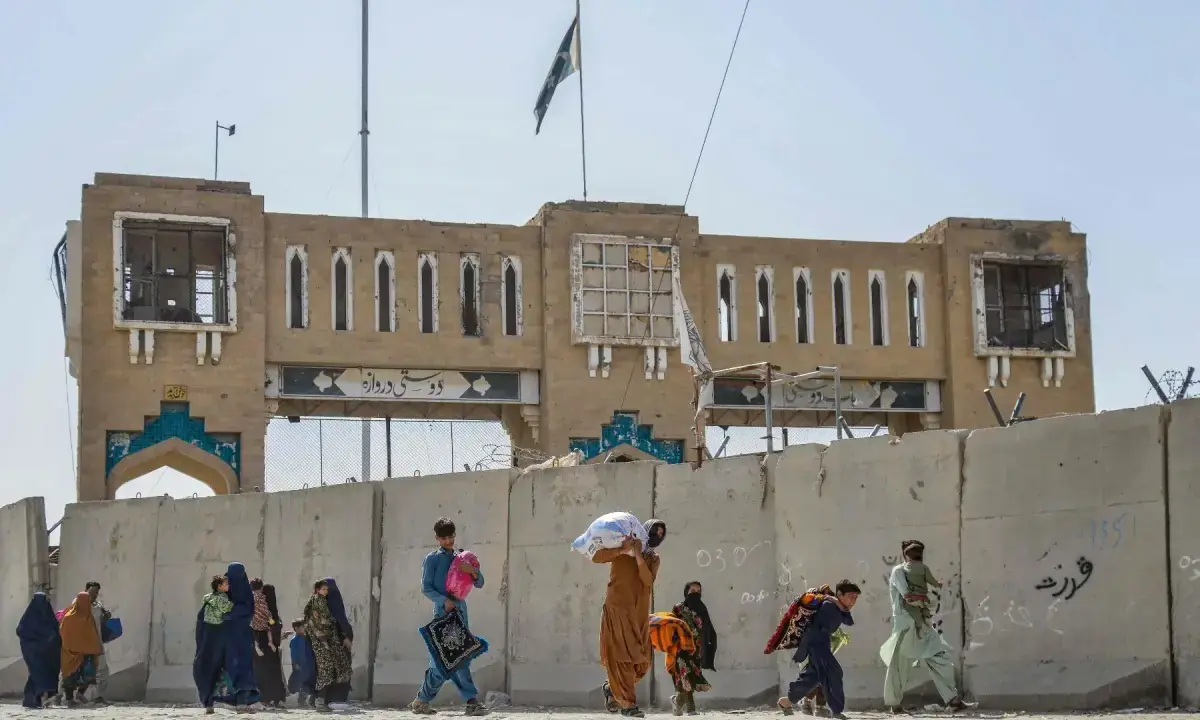
THE evolution of the Pakistan-Afghanistan relationship has always been inconsistent, and rooted in deep mistrust, blame games, propaganda, conspiracy theories, perpetual external interference and repeated cycles of violence.
asserted
evolution → root → violence
The bilateral equation has experienced many irritants, each having abundant potential for a complete breakdown.
asserted
each → experience → breakdown
Despite these complexities and substantial investments by external players, the relationship has somehow survived every dilemma, only to experience new and more challenging negative developments.
asserted
relationship → survive → developments
The current state of bilateral tensions – though one of the most damaging – is nothing new and should be seen in context.
asserted
state → see → context
Since August 1947, there has never been a decade in which Afghanistan did not make a deliberate effort to export insurgencies and unrest to Pakistan, mostly by exploiting internal socio-political grievances within segments of Pakistani society, or by capitalising on ethnic and linguistic affiliations.
asserted
Afghanistan → make → affiliations
These offensive trends were initiated by Afghanistan in the pursuit of enduring objectives such as Lar-O-Bar Yaw Afghan, Pakhtunistan, historical claims and, at times, on the behest of third parties pursuing inimical motives towards the integrity and sovereignty of Pakistan.
uncertain
trends → initiate → Pakistan
Given its hostile conduct since Aug 15, 1947, no sane person could have imagined such ‘depth’ for Pakistan on Afghan territory
uncertain
person → give → territory
On the other hand, Pakistan persistently claimed to be working for a stable, peaceful, and friendly Afghanistan, objectives that to this day are interpreted as a quest for ‘strategic depth’.
asserted
that → claim → depth
Irrespective of the past statements by a couple of leaders, it is naïve to consider that Pakistan was pursuing ‘strategic depth’ in Afghanistan.
asserted
Pakistan → consider → Afghanistan
In the security domain, the concept of ‘strategic depth’ was relevant till the conclusion of World War II, and was generally understood as a mutually-agreed arrangement under which one nation-state could place its most precious military hardware and forces in a neighbouring state, while facing military aggression from an enemy.
uncertain
state → understand → enemy
Given Afghanistan’s very hostile conduct since August 15, 1947, no sane person could have imagined such ‘strategic depth’ for Pakistan on Afghan territory while facing a military threat from its arch-rival, India.
uncertain
person → give → rival
Successive military leaders, the intelligence community and political forces envisioned a stable and friendly relationship with Afghanistan that would afford them an environment to concentrate their entire military potential on the eastern border with India, without being distracted by the defence of western frontiers.
asserted
that → envision → frontiers
During previous crises in Afghanistan, successive Pakistani governments have opted for alignments with important factions primarily for post-crisis normalcy.
asserted
governments → opt → normalcy
This was primarily done to help dominant factions or external players create a stable government in Kabul.
asserted
factions → do → Kabul
The much-maligned support for the Taliban’s rise in 1996 also had the same objective.
asserted
support → malign → objective
Most of these efforts by Pakistan, however, were not viewed favourably by the people of Afghanistan, particularly by ethnic communities in the north of Hindu Kush range.
asserted
Most → view → range
One can conclude that while supporting dominant players in the Pakhtun belt of Afghanistan, Pakistan lost positive relevance with the people of the north.
asserted
Pakistan → conclude → north
Capitalising on the resultant opportunity to hurt Pakistan’s interests, India strongly aligned itself with communities of the north throughout the period of Afghan Jihad and for years afterwards.
asserted
India → capitalise → years
As of today, however, the whole paradigm appears to have undergone a tectonic shift.
asserted
paradigm → appear → shift
While people of the north appear willing to engage with Pakistan, the Pakhtun belt under the Afghan Taliban regime is accepting transformative influence and a strong relationship with India.
asserted
belt → appear → India
Those interested in history can trace out the reasons behind this shift, some of which are even shaping the current conflict.
asserted
some → trace → conflict
Back in 2011, a Pakistani delegation visited one of the important Central Asian Republics.
asserted
delegation → visit → Republics
The delegation had an engagement to discuss Afghanistan’s situation with the defence minister of that country, who had also served in Afghanistan as a regimental commander for years during Soviet invasion.
asserted
who → have → invasion
After a lengthy presentation by our delegation, when it was the hosts’ turn to present their views, the defence minister summed up Afghanistan in one sentence.
asserted
minister → present → sentence
He said, “Gentlemen, Afghanistan will remain Afghanistan”.
asserted
Afghanistan → say → ?
This was a profound statement, as he attempted to predict Afghanistan’s future, which he thought would remain hostage to violence, tribal feuds, external influence, proxy wars, and perpetual instability.
asserted
he → attempt → violence
His opinion has, thus far, withstood the test of time.
asserted
opinion → withstand → time
We should all, however, pray and hope that he is proven wrong, sooner rather than later.
asserted
he → pray → ?
Starting with the First Afghan War of 1839, repeated British invasions of Afghanistan kept the country at war until the close of the 19th century.
asserted
invasions → start → century
Afghanistan’s geography, history, and culture had always shaped and sustained ethnic, linguistic, and tribal divisions for centuries.
asserted
geography → shape → centuries
Throughout the many Afghan wars, the British capitalised on these divisions, only to further exacerbate social and political fault lines.
asserted
British → capitalise → lines
From the beginning of the 20th century until the Soviet invasion of Afghanistan, there were intervals of stability, progress, and the evolution of peculiar governance structures that relied on accommodating tribal and ethnic interests to keep various regions aligned with the government in Kabul.
asserted
regions → be → Kabul
These limited cycles of stability, however, could never lead to enduring internal cohesion, participatory democracy, and overarching inclusivity.
uncertain
cycles → lead → cohesion
It will take a collective effort by the people of Afghanistan to enforce a moderate interpretation of Islam and an inclusive government on the Afghan Taliban
The Soviet invasion of Afghanistan in 1979 provided an opportunity for the US to orchestrate yet another clash of political ideologies in a third country, which by that time had become a trend in the international order.
asserted
which → take → order
The consequent so-called containment of communism through proxy warfare was a globally-shared geopolitical objective, fully backed by the US-led West and many influential nation-states in the Muslim world.
asserted
containment → call → world
Pakistan, being geographically contiguous, became the most important enabler for both logistics and training infrastructure for the Mujahideen, whose rank and file were drawn mostly from Afghanistan’s southern Pakhtun belt.
asserted
rank → become → belt
Pakistan joined the effort primarily to safeguard its own security interests in the face of the Soviet military presence in Afghanistan and the wider regional consequences of the conflict.
asserted
Pakistan → join → conflict
But this participation further alienated the ethnicities of the north, as well as the Pakhtun factions who later suffered at the hands of the Taliban during the 1990s.
asserted
who → alienate → 1990s
When the Soviets withdrew in 1989, Pakistan had two choices: one, leave Afghanistan to the Afghans, as was done by every country involved during the Afghan Jihad.
asserted
Pakistan → withdraw → Jihad
When reconciliation efforts did not work and Taliban rose as most dominant and powerful interest group, Pakistan opted to exercise second option, which later proved very costly.
asserted
which → work → option
…and 54 more, not listed.
 The Aporia