Jack Pearadin had spent more than a decade searching for diamonds at Arkansas' Crater of Diamonds State Park, finding more than 300 gems along the way.
asserted
Pearadin → spend → way
But earlier this year, his long-running hobby produced his most remarkable discovery yet.
asserted
hobby → run → discovery
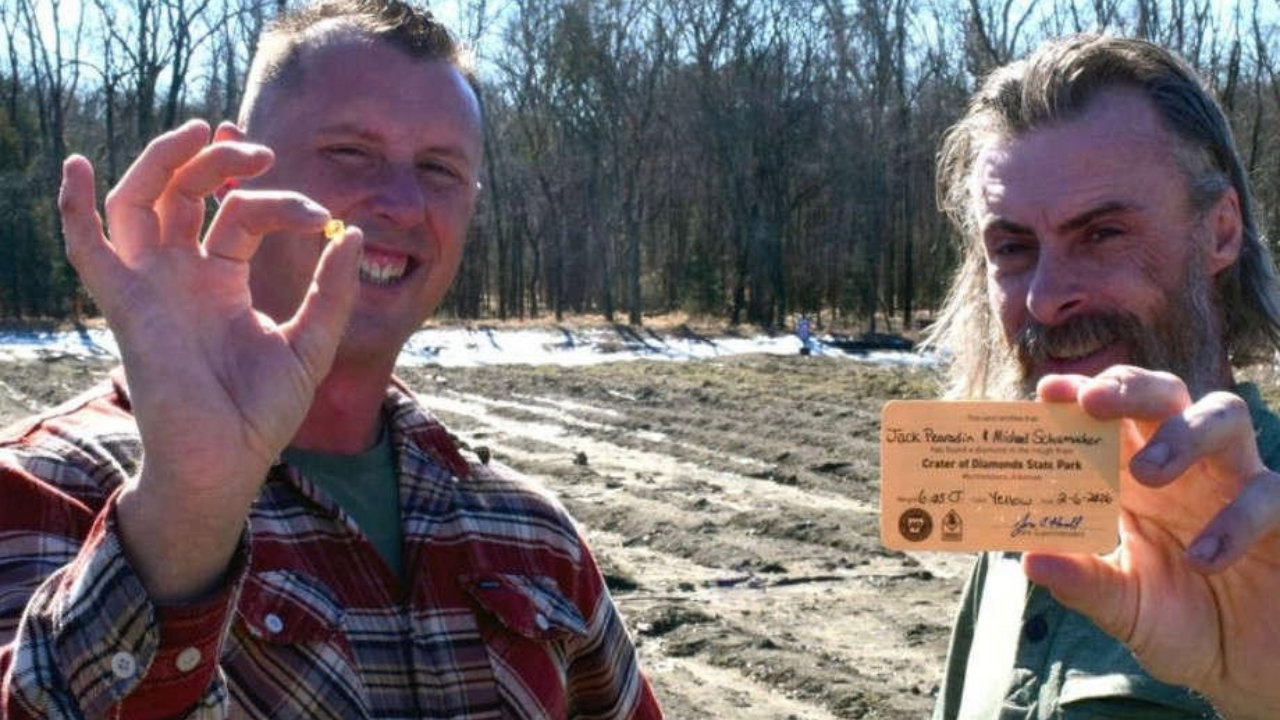
While livestreaming his search on TikTok, Pearadin uncovered a 6.03-carat yellow diamond, roughly the size of a fingernail.
asserted
Pearadin → livestreame → fingernail
Collectors told him the stone could be worth as much as $1 million, although a certified gem appraiser who spoke to The Associated Press said a high-quality six-carat yellow diamond from the park can sell for about $250,000.
uncertain
diamond → tell → 250,000
Pearadin and his friend Michael Schumacher of Wisconsin have named the stone the "American Dream".
asserted
Pearadin → name → stone
Arkansas man’s 13-year hunt leads to major diamond discovery
asserted
hunt → lead → discovery
Pearadin, a Navy reservist originally from Missouri, began searching for diamonds at the Crater of Diamonds in 2013.
asserted
Pearadin → begin → 2013
He told The Associated Press his passion for the hobby led him to move to nearby Murfreesboro.
asserted
passion → tell → Murfreesboro
The discovery came on Sunday, 25 January, after Pearadin and Schumacher dug diamond-bearing dirt from the south end of the park's search area in late December and concentrated it into gravel for later processing.
asserted
Pearadin → come → processing
A winter storm two days earlier had left more than an inch of ice across the area, making the work harder.
asserted
work → leave → area
Pearadin was processing the gravel on TikTok Live when the stone appeared.
asserted
stone → process → Live
After flipping four piles, he was walking away when a golden glint caught his eye.
asserted
glint → flip → eye
The moment was captured on camera.
asserted
moment → capture → camera
Pearadin exclaimed, "Oh my God! Oh my God!" before shouting that they had found a big one.
asserted
they → exclaim → one
Park staff confirmed the stone on 6 February.
6.03-carat yellow diamond gets the name American Dream
The diamond is the largest found at Crater of Diamonds State Park in 2026.
asserted
diamond → confirm → 2026
According to the park, it is the fourth-largest yellow diamond and the 22nd-largest diamond of any colour registered since the site became a state park in 1972.
uncertain
site → accord → 1972
Its glowing canary-yellow colour and unusual form make it distinctive.
asserted
it → glow → ?
It appears to be a hexoctahedron, a 48-sided crystal, whereas most diamonds found at the park have 12 or 24 faces.
asserted
diamonds → appear → faces
Pearadin and Schumacher named it the Pearadin Schumacher American Dream Diamond, inspired by the song "Sh-Boom (Life Could Be a Dream)" and by the fact that they found it during America's 250th anniversary year.
uncertain
they → name → year
Pearadin described it as a massive, gorgeous yellow diamond.
asserted
Pearadin → describe → diamond
The discovery also matters because the stone was found by members of the public rather than through a conventional commercial mining operation.
asserted
stone → matter → operation
The Crater of Diamonds is one of the few places in the world where ordinary visitors can search for diamonds and legally keep what they find.
asserted
they → search → what
Collectors believe it could be worth $1 million
uncertain
it → believe → ?
The $1 million figure comes from collectors who discussed the stone's potential value with Pearadin.
asserted
who → come → Pearadin
It is not a confirmed sale price or a formal appraisal, and the diamond has no certified grade yet.
asserted
diamond → confirm → grade
Certified gem appraiser Laura Stanley of Little Rock told The Associated Press that a high-quality six-carat yellow diamond from the park can sell for about $250,000, partly because of where it was found.
asserted
it → tell → 250,000
For comparison, she said a typical 0.17-carat diamond from the park sells for around $700.
asserted
diamond → say → 700
The stone's eventual value will depend on its quality, colour, clarity, shape, cutting potential and what buyers are willing to pay for a rare natural diamond with such an unusual history.
asserted
buyers → depend → history
A park where visitors can keep their diamonds
Crater of Diamonds State Park is in Murfreesboro, in southwest Arkansas.
asserted
Park → keep → Arkansas
The site was once operated commercially before becoming a state park in 1972.
asserted
site → operate → 1972
Unlike most diamond mines, it lets members of the public search its diamond-bearing field and keep what they find.
asserted
they → let → what
Adult admission is $15, and visitors can bring permitted tools or use equipment available at the park to dig, sift and wash material.
asserted
visitors → bring → material
The search area covers about 37 acres and is the eroded surface of an ancient volcanic crater.
asserted
area → cover → crater
Volcanic activity carried diamond-bearing material towards the surface, leaving diamonds and other minerals in the soil and gravel.
asserted
activity → carry → soil
More than 37,000 diamonds have been found there
According to The Associated Press, more than 37,000 diamonds have been discovered at the site since it became a state park.
uncertain
it → find → site
Most weigh about a quarter of a carat, and most are worth far less than Pearadin's stone.
asserted
most → weigh → stone
Some stones from the site's longer history have become famous.
asserted
stones → become → history
The best known is the 40.23-carat Uncle Sam, found in 1924 during an early mining operation on the land that later became the park.
asserted
that → know → land
It remains the largest diamond ever found in the US.
asserted
It → remain → US
Other notable stones include the 15.33-carat Star of Arkansas, found in 1956, the 16.37-carat Amarillo Starlight, found in 1975, and the 8.52-carat Esperanza, found in 2015.
asserted
stones → include → 2015
…and 8 more, not listed.
 The Aporia