Photo via The Hindu

Popular Mobilisation Forces | Iraq’s militias within the military

Read the original at The Hindu ↗
Cite

Johny, S. (2026, October 3). Popular Mobilisation Forces | Iraq’s militias within the military. The Hindu. https://www.thehindu.com/news/international/popular-mobilisation-forces-iraqs-militias-within-the-military/article71541613.ece

Dated when The Aporia collected the article, usually within hours of publication. Check the original for its exact date and byline.

The Hindu · collected 2026-10-03 · by Stanly Johny

Quick Summary

In June 2014, Grand Ayatollah Ali Sistani issued a fatwa calling on Iraqi citizens to defend their country against the Islamic State (IS) following IS's capture of Mosul and advance towards Baghdad. This call led to the formation of the Popular Mobilisation Forces (PMF), with support from both the Iraqi government and Iran, which provided financial aid and training. The PMF played a significant role in battling IS but remained active post-conflict, refusing to disarm and continuing tensions with U.S. forces following the January 2020 killing of key PMF leaders by a U.S. airstrike.
Written by AI on 2026-10-03, from this article's own text only (the story summary below draws on all the coverage).

AI analysis

Story summary

On June 13, 2014, Iraq's top Shia cleric, Grand Ayatollah Ali Sistani, issued a fatwa calling on Iraqis to join the fight against terrorism in response to rapid territorial advances by the Islamic State (IS). The IS had captured Mosul, Iraq’s second-largest city, on June 10 and was threatening Baghdad as well as Shia holy sites like Najaf and Karbala. Sistani's fatwa stated that defending the country and its people is a collective obligation for those capable of bearing arms against terrorists. This edict helped mobilize volunteers to form what would become the Popular Mobilisation Forces (PMF), playing a crucial role in countering IS's threat to Iraq.

Written for “Iraq Militias Integration” on 2026-11-04, grounded in this article and the 0 other(s) covering the same event.

Story

📰 Iraq Militias Integration
Politics · 1 article(s) covering the same event.

Compared with similar articles

This article reads leans left and hedges 7% of its claims. Each row says how that neighbour differs.
Washington Examiner
⚖️ Leans strongly right further right than this Hedges 3 of 65 claims Outlet record 69/100
“The articles describe different events related to militias and Iran's influence but occur at distinct times and refer to separate declarations or statements.”
Daily Mail
⚖️ Leans left Hedges 1 of 31 claims Outlet record 69/100
“Article A discusses the withdrawal of US forces from Iraq and its implications for Iran's influence, while Article B talks about the formation of Popular Mobilisation Forces in response to a fatwa by Grand Ayatollah Ali Sistani against ISIS.”
Al Jazeera
Hedges 3 of 34 claims Outlet record 60/100
“The articles discuss different aspects of events related to security and military presence in Iraq but do not describe the same specific incident.”
Dawn
Hedges 0 of 23 claims Outlet record 72/100
“Article A discusses the exit of the US-led coalition from Iraq, while Article B describes the initial response by Iraqi militias to combat ISIS in 2014.”
Euronews
⚖️ Leans right further right than this Hedges 1 of 22 claims Outlet record 60/100
“Article A describes the end of the US-led coalition mission against ISIS in Iraq, while Article B discusses the initial call to arms by Grand Ayatollah Ali Sistani against ISIS in June 2014.”
Al Jazeera
Hedges 3 of 53 claims Outlet record 60/100
“Article A discusses the withdrawal of US forces from Iraq and the subsequent Sovereignty Days celebration, while Article B focuses on a fatwa issued by Grand Ayatollah Ali Sistani in 2014 calling for Iraqi citizens to join the fight against terrorism.”
Los Angeles Times
⚖️ Leans left Hedges 2 of 57 claims Outlet record 95/100
“Article A discusses the departure of U.S. troops from Iraq on a specific date while Article B focuses on the origins and context of Iraqi militias, including their formation in response to the Islamic State threat.”
How this article was measured signals, leaning charts, publisher record, byline, topics and claims

Signals How these are calculated →

Claims extracted
46
sentences that state something as happening or true
Uncertain
7%
3 of 46 hedged ("reportedly", "may", "according to")
Leaning
Leans left
of the writing, not the subject · beta estimate
Publisher signals
60/100
The Hindu's corrections and hedging, across everything collected from it. Not a measure of accuracy.
Outlets on this story
1
Politics
Same framing elsewhere
1
articles that frame the event the way this one does
Analyzed 2026-10-03 · how these are computed

How this is being covered How these are calculated →

Article leaning vs. publisher reliability
Source leaning vs. consistency

Publisher

The Hindu · 907 article(s) · 2 correction(s) detected
Running correction rate · 2 correction(s)

Who wrote this

Stanly Johny
15 article(s) here · 1 carrying a prediction
🔮 The findings contradicted claims by the Board of Peace in its May report to the Security Council that the ceasefire had largely held and brought enormous relief to civilians.
🔮 His Yesh Atid party, which was expected to beat Likud, finished second with 21 seats.
🔮 Israelis will go to the polls on October 27 in the first general election since the October 7, 2023 Hamas attack.
2026-10-27 · assertive framing · A guide to Israel’s elections
🔮 Iran said on Saturday (October 24, 2026) that U.S. warships would not be allowed to enter the Persian Gulf and warned that any attack by the U.S. and Israel would have repercussions beyond the country, amid reports that Washington was considering resuming air strikes.
2026-10-24 · assertive framing · Iran warns of ‘apocalyptic war’ if attacked again
🔮 If Saudi Arabia continues to attack Yemen, “we will resort to major options we did not want to take, and we hold it responsible for the consequences,” the militants said, according to the Houthi-aligned Almasirah television.
🔮 “If I was in the cabinet of the Israeli government, I might not be attacking the only powerful ally that I have anywhere left in the entire world,” he said, adding: “The other thing that I would say is that over the last three months, two-thirds of the defensive weapons that have protected your homeland have been built by American hands and paid for by American tax dollars.”
2026-10-19 · assertive framing · A rift in the U.S.-Israel special relationship
🔮 What he hasn’t tried is an all-out war against Iran, which he might consider once the midterm elections are over, says Trita Parsi, executive vice-president of the Washington-based Quincy Institute.
🔮 The government’s main concern was that the flight could also be used to transport personnel of Iran’s Islamic Revolutionary Guard Corps (IRGC) and military equipment to Yemen.
2026-10-13 · assertive framing · Did Saudi Arabia walk into the Houthi trap?
🔮 The Mahdi Army had received support from Iran, but Mr. Sadr later distanced himself from Iranian influence and projected Saraya al-Salam as an Iraqi nationalist militia.
🔮 On May 1, 2003, nearly two months after launching the invasion of Iraq, the then U.S. President George W. Bush landed on the deck of the aircraft carrier USS Abraham Lincoln, which was off the San Diego coast after returning from combat operations in the Persian Gulf.
Also by Stanly Johny
A guide to Israel’s elections
2026-10-27 · The Hindu
Nothing else under this byline is closely related to this article, so these are simply their most recent.
All 15 articles by Stanly Johny →

Topics

Iraq Iraqi PMF Shia the Islamic State

Subjects

PMF ORG · 10× Iraq GPE · 8× Iran GPE · 5× Iraqi NORP · 5× U.S. GPE · 5× Sistani PERSON · 4× Baghdad GPE · 3× Mosul GPE · 3× Shia NORP · 3× the Islamic State ORG · 3×

Narrative

“The nature of the situation and the dangers facing Iraq and its people at the present time require defending the country, its people and the honour of its citizens,” said the cleric in his edict, which was read out by his representative Sheikh Abdul-Mahdi al-Karbalai, during Friday prayers in Karbala.
framing: assertive · carried by 1 article(s) · first seen 2026-10-03
🔮 The Mahdi Army had received support from Iran, but Mr. Sadr later distanced himself from Iranian influence and projected Saraya al-Salam as an Iraqi nationalist militia.
2026-10-03 · The Hindu
Popular Mobilisation Forces | Iraq’s militias within the military · assertive framing

Claims (46 extracted, 3 hedged)

On June 13, 2014, Grand Ayatollah Ali Sistani, Iraq’s top Shia cleric, issued a fatwa asking Iraqis to join the fight against terrorism. asserted
Sistani → issue → terrorism
“The nature of the situation and the dangers facing Iraq and its people at the present time require defending the country, its people and the honour of its citizens,” said the cleric in his edict, which was read out by his representative Sheikh Abdul-Mahdi al-Karbalai, during Friday prayers in Karbala. asserted
which → face → Karbala
Mr. Sistani’s call came amid the rapid territorial advances made by the Islamic State (IS), a Sunni-jihadist group, in Iraq. asserted
call → come → Iraq
On June 10, IS militants captured Mosul, Iraq’s second-largest city. asserted
militants → capture → Mosul
After consolidating in the north, they started moving south towards Baghdad, while also threatening Shia holy places such as Najaf and Karbala. asserted
they → consolidate → Najaf
In the north, the Iraqi military collapsed in the face of IS advance. asserted
military → collapse → advance
There was panic in Baghdad, where Prime Minister Nouri al-Maliki was scrambling to arrest the jihadist surge. asserted
Maliki → be → surge
“This defence is considered a wajib kifai [collective obligation] upon a sufficient number of citizens as is needed to fulfil the task,” Mr. Sistani said in his fatwa. asserted
Sistani → consider → fatwa
“Hence, the citizens who are able to bear arms and fight the terrorists in defence of their country, their people and their sanctities must volunteer to join the army and the security forces to achieve this sacred objective. asserted
who → bear → objective
The edict triggered the mobilisation of hundreds of thousands of Iraqi youth to fight the Islamic State. asserted
edict → trigger → State
But the mobilisation did not remain confined to the army and police. asserted
mobilisation → remain → army
Shia militias expanded and new armed groups emerged, eventually forming the core of the Popular Mobilisation Forces (PMFs, or Hashd al-Shaabi). asserted
groups → expand → Forces
The Iraqi state, shaken by the loss of Mosul, encouraged the militias to expand their footprint, while Iran, equally invested in defeating the IS, provided money, weapons and training to the militias. asserted
Iran → shake → militias
Seven groups were already operating in Iraq – Badr Organisation; Asaib Ahl al-Haq; Kataib Hezbollah; Kataib Sayyid al-Shuhada; Harakat Hezbollah al-Nujaba; Kataib Jund al-Imam; and Kataib al-Imam Ali. asserted
groups → operate → Iraq
Several new groups also sprang up. asserted
groups → spring → ?
All these forces were brought under the PMF umbrella for better coordination in the fight against the Islamic State. asserted
forces → bring → State
The PMF factions, which fought alongside the Iraqi military under U.S. air cover, played a key role in defeating the IS. asserted
which → fight → IS
But the battle against the jihadist group also led to the institutionalisation of the militias, which refused to disarm even after the IS was defeated and its militants were driven out of most Iraqi cities, including Mosul. asserted
militants → lead → Mosul
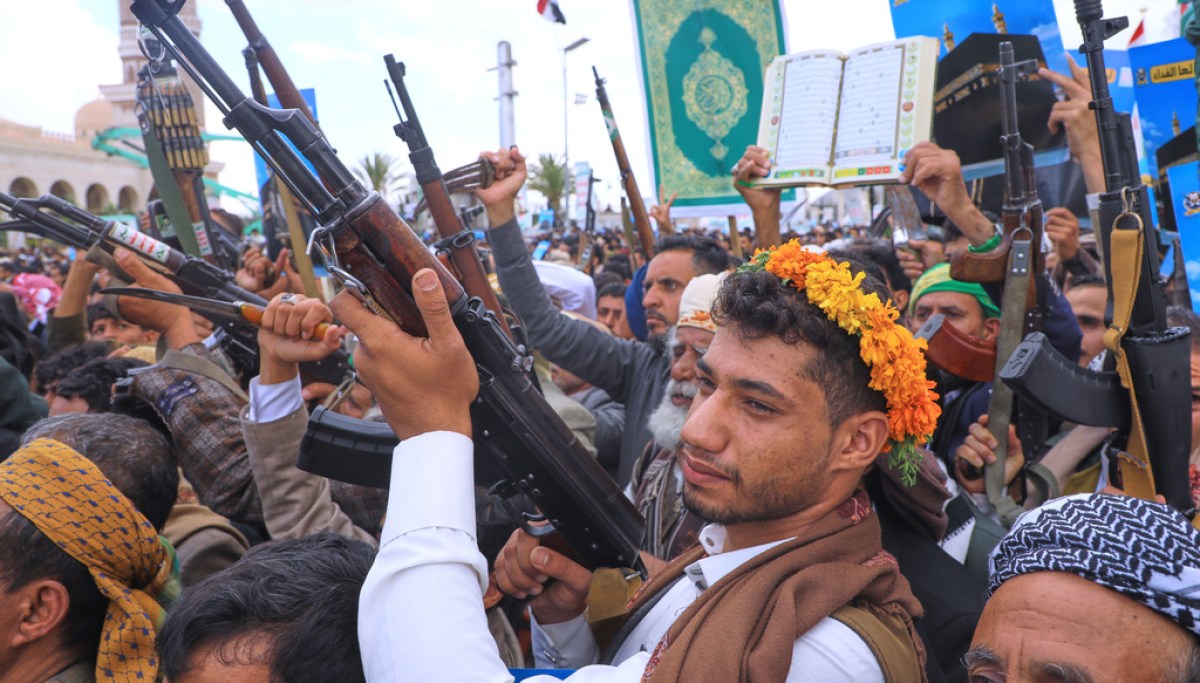
Calling themselves resistance forces, the prominent factions in the PMF demanded complete American withdrawal from Iraq. asserted
factions → call → Iraq
The killing of Abu Mahdi al-Muhandis, the deputy chairman of the PMF and leader of Kataib Hezbollah, in January 2020, along with Iran’s Qassem Soleimani, in Baghdad by a U.S. air strike opened a new phase of attritional conflict between the PMF and U.S. forces in Iraq. asserted
killing → open → Iraq
This conflict escalated further after the U.S. launched its war on Iran this year. asserted
U.S. → escalate → Iran
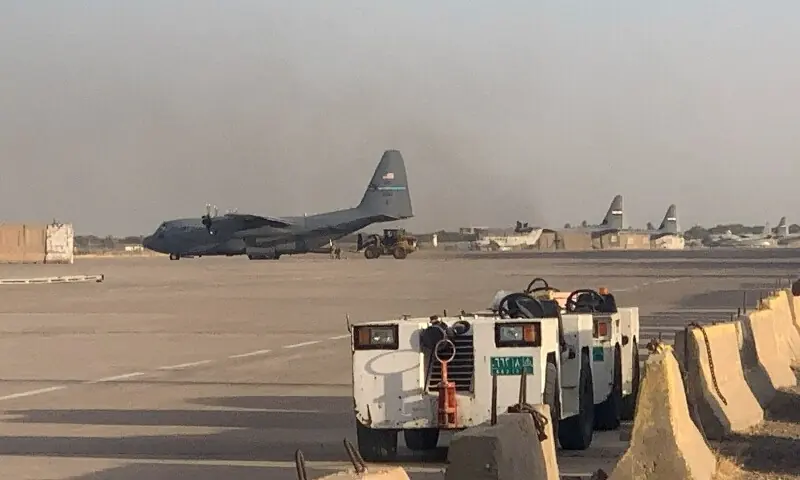
On September 30, when U.S. troops completed their withdrawal from Iraq, 23 years after the invasion started, the PMF, unsurprisingly, called it a “historic victory”. asserted
it → complete → Iraq
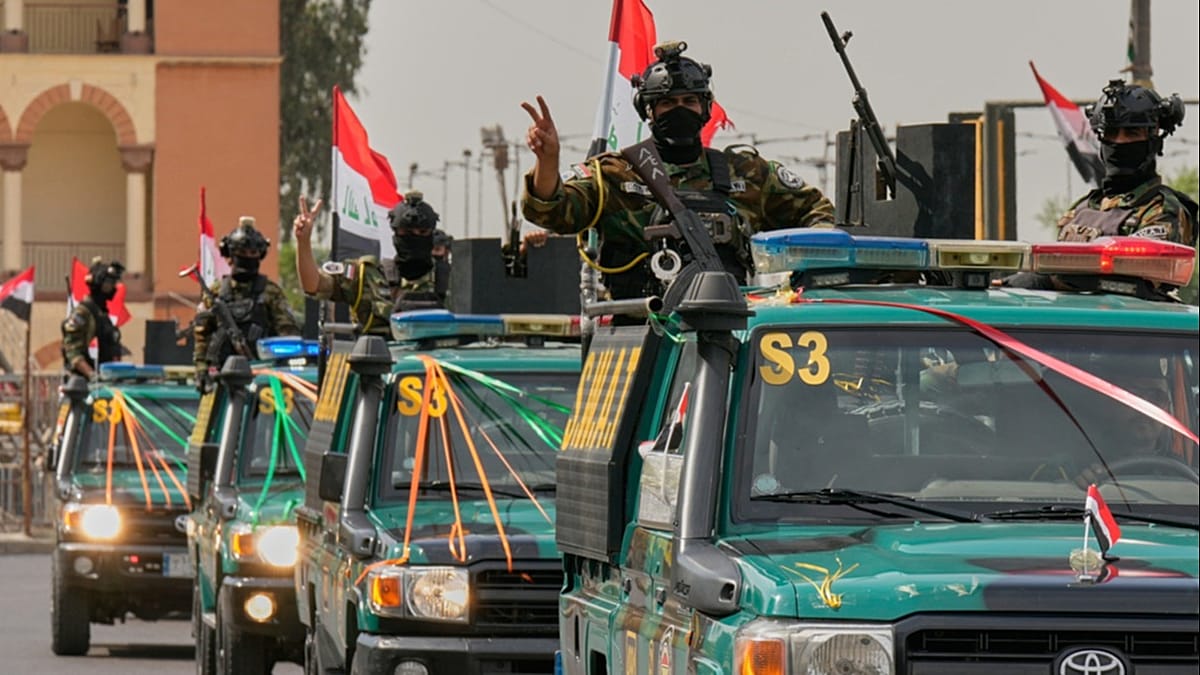
The PMF now comprises more than three dozen militias, with an estimated total strength of 240,000 fighters and an annual budget of $3.4 billion. asserted
PMF → comprise → billion
Historically, the PMF contained three broad currents: Iran-aligned factions, Sistani-aligned shrine units and the Sadrist Saraya al-Salam. asserted
PMF → contain → currents
The Sistani-aligned shrine units (Abbas Combat Division, Liwa Ali al-Akbar and Imam Ali Combat Division) subsequently broke away from the PMF structure in 2020 and came under the direct authority of the commander-in-chief. asserted
units → align → chief
Badr Organisation, originally the armed wing of the Supreme Council for the Islamic Revolution in Iraq; Kataib Hezbollah and Harakat Hezbollah al-Nujaba are the prominent Iran-backed factions within the PMF fold. asserted
Hezbollah → back → fold
The most prominent Sadrist militia is Saraya al-Salam (Peace Brigades), which is aligned with the PMF but maintains a tense relationships with its command. asserted
which → align → command
He had commanded the now-dissolved Mahdi Army that resisted U.S. troops in the early days of the invasion. asserted
that → command → invasion
The Mahdi Army had received support from Iran, but Mr. Sadr later distanced himself from Iranian influence and projected Saraya al-Salam as an Iraqi nationalist militia. asserted
Sadr → receive → militia
The U.S. had repeatedly demanded that the Iraqi state demobilise the militias, some of which, such as Kataib Hezbollah, have been designated as terrorist groups. asserted
some → demand → groups
But both mainstream Iraqi politicians and militia commanders have resisted such calls. asserted
politicians → resist → calls
In 2016, the Iraqi Parliament passed the PMF commission law, which institutionalised the PMF as an independent organisation within the Iraqi armed forces. asserted
which → pass → forces
But they continued to maintain their independent command structures. asserted
they → continue → structures
The prominent members of the PMF also formed political parties and started contesting elections. asserted
members → form → elections
In 2018, Badr Organization, Asaib Ahl al-Haq, Kataib Hezbollah and Kataib al-Imam Ali all came together to form the Fatah Alliance, a political coalition to represent the militias in the general elections (the alliance was later disbanded). asserted
alliance → come → elections
Besides, the Sadrist movement has a separate political organisation, the National Shia Movement. asserted
movement → have → organisation
In the current Iraqi parliament, Badr Organisation has 18 seats, while Sadiqoun Movement, another PMF-linked political bloc, has 27 seats. asserted
Movement → have → seats
After the U.S. and Israel started bombing Iran on February 28, 2026, the Iran-aligned militias in the PMF started attacking American military and diplomatic facilities in Iraq. asserted
militias → start → Iraq
According to U.S. officials, they carried out some 600 attacks since the war broke out and the U.S. launched air strikes targeting these groups. uncertain
U.S. → accord → groups
But the U.S. found it increasingly difficult to deter PMF factions whose decentralised operational tactics and geographical spread worked in their favour. asserted
tactics → find → favour
…and 6 more, not listed.

💬Give feedback · no sign-in needed

No sign-in needed for now. Your note is sent without a name, so it cannot be answered.

🕘History 🎫Support