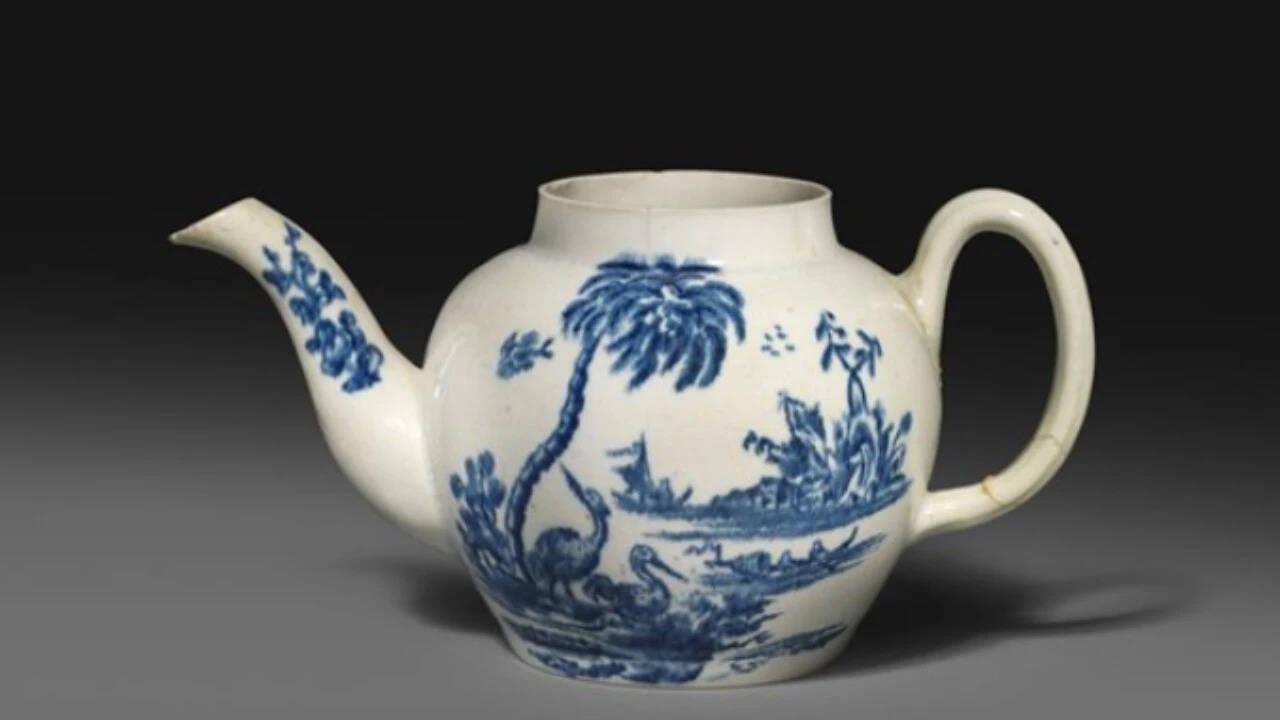
A UK collector who paid just £15 for a broken, lidless teapot at an auction in 2016 later discovered that the piece was one of the rarest known examples of early American porcelain.
asserted
piece → pay → porcelain
The teapot was eventually sold for £575,000, after experts identified it as a piece made by Staffordshire potter John Bartlam in South Carolina in the 1760s.
asserted
experts → sell → 1760s
The collector, a private buyer from south-west England, had bought the teapot at a general auction in the Midlands, The Independent reported.
asserted
Independent → buy → Midlands
It had a broken handle and was missing its lid.
asserted
It → have → lid
At the time, the piece was thought to be Isleworth pottery, made at a factory in Middlesex between 1766 and 1800.
asserted
piece → think → 1766
However, the buyer was not convinced by that identification.
asserted
buyer → convince → identification
He then took the teapot to Clare Dunham, an expert at Woolley and Wallis auctioneers in Salisbury.
asserted
He → take → Salisbury
Its blue and white decoration, including a distinctive palm tree design, led Dunham to identify it as the work of John Bartlam.
asserted
decoration → include → Bartlam
Bartlam had left England around 1763 and established a pottery business in South Carolina.
asserted
Bartlam → leave → Carolina
The identification changed the significance of the damaged teapot.
asserted
identification → change → teapot
Experts said it was only the seventh recorded piece of Bartlam porcelain to have reached the market and the only known Bartlam teapot.
asserted
it → say → market
This made it the earliest American-manufactured teapot to have been discovered.
asserted
it → make → ?
The teapot was then put up for auction by Woolley and Wallis.
asserted
teapot → put → Woolley
It was given an estimate of £10,000 to £20,000, while The Independent reported that it was expected to reach as much as £50,000.
asserted
it → give → 50,000
Instead, bidding pushed the price much higher, with the hammer falling at £460,000.
asserted
hammer → push → 460,000
After the buyer’s premium and fees were added, the teapot sold for £575,000.
asserted
teapot → add → 575,000
It was bought by London dealer Rod Jellicoe, who was bidding on behalf of The Metropolitan Museum of Art in New York.
asserted
who → buy → York
How the teapot was identified
The teapot had several features that helped connect it to Bartlam’s pottery.
asserted
that → identify → pottery
Woolley and Wallis described it as a previously unrecorded American porcelain teapot attributed to John Bartlam and dated it to around 1765–69.
asserted
Woolley → describe → 1765–69
The auction house said it was made of porcelain with underglaze blue decoration.
asserted
it → say → decoration
One side showed two cranes beneath a tall palm tree, with figures in a sampan and another figure in a separate boat.
asserted
side → show → boat
The other side featured a version of the Man on the Bridge pattern, showing a bridge connecting small islands in a Chinese pagoda landscape.
asserted
side → feature → landscape
Its cover was missing, while the handle had broken off and been restuck.
asserted
handle → miss → ?
Woolley and Wallis said the teapot had only recently been identified as an example of early American porcelain.
asserted
teapot → say → porcelain
It was believed to have been part of a matched tea service that reached England in the late 1760s or 1770s.
asserted
that → believe → 1760s
The auction house also linked the teapot to other pieces associated with Bartlam’s pottery.
asserted
house → link → pottery
Four teabowls from the same group had been found to match pieces of pottery excavated at Bartlam’s factory site in Cain Hoy, South Carolina.
asserted
teabowls → find → Hoy
The teapot was one of only seven recorded pieces of Bartlam porcelain at the time.
asserted
teapot → record → time
The other known pieces included four teabowls and two saucers from the same set.
asserted
pieces → know → set
Another example of John Bartlam's pottery
John Bartlam and his South Carolina pottery
Bartlam was trained in Staffordshire, England, and moved to South Carolina around 1763.
asserted
Bartlam → train → 1763
He established his pottery at Cain Hoy, outside Charleston, with the aim of producing porcelain in America rather than relying on luxury porcelain imported from England.
asserted
He → establish → England
The Met says the teapot was made at Bartlam’s pottery in Cain Hoy around 1765–69.
asserted
teapot → say → 1765–69
It describes the object as soft-paste porcelain with underglaze blue decoration.
asserted
It → describe → decoration
The pottery was established at a time when deposits of the special clay needed to make porcelain had recently been discovered in the Carolinas.
asserted
deposits → establish → Carolinas
The clay was being mined and shipped from Charleston to England.
asserted
clay → mine → England
Bartlam wanted his business to compete with the luxury porcelain being produced in England and sent to the American colonies.
asserted
business → want → colonies
His work therefore represented an attempt to produce similar goods in the colonies.
asserted
work → represent → colonies
The Met’s records also note that Josiah Wedgwood was concerned about the competition.
asserted
Wedgwood → note → competition
In a 1767 letter to Thomas Bentley, Wedgwood referred to a “Pottwork in Charles Town” that was using Cherokee clay from the Carolinas to make porcelain.
asserted
that → refer → porcelain
Research and archaeological excavations in the early 1990s later provided evidence of a porcelain factory at Cain Hoy dating to the late 1760s.
asserted
Research → provide → 1760s
…and 14 more, not listed.
 The Aporia