The Aporia

Roberts, M. (2026, October 5). Nobel Prize awarded for showing how nerve cells shape feelings. BBC News. https://www.bbc.co.uk/news/articles/c5ev3ypmzly8o?at_medium=RSS&at_campaign=rss
Roberts, Michelle. “Nobel Prize awarded for showing how nerve cells shape feelings.” BBC News, 5 Oct. 2026, https://www.bbc.co.uk/news/articles/c5ev3ypmzly8o?at_medium=RSS&at_campaign=rss.
Roberts, Michelle. “Nobel Prize awarded for showing how nerve cells shape feelings.” BBC News, October 5, 2026. https://www.bbc.co.uk/news/articles/c5ev3ypmzly8o?at_medium=RSS&at_campaign=rss.
Dated when The Aporia collected the article, usually within hours of publication. Check the original for its exact date and byline.
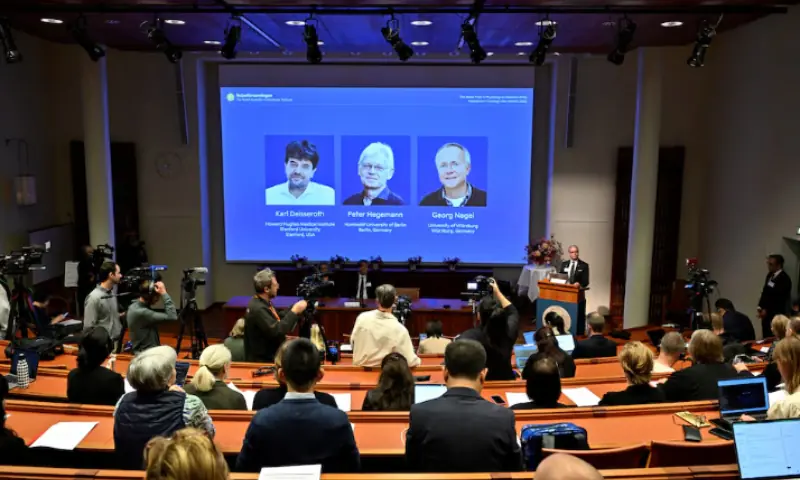
On October 5, 2026, the Nobel Prize in Physiology or Medicine was awarded to Karl Deisseroth of Stanford University, Peter Hegemann of Humboldt University in Berlin, and Georg Nagel of the University of Würzburg. The trio received the prize "for their discoveries concerning light-gated ion channels and optogenetics," which allows scientists to control individual nerve cells using light. This method is now widely used globally to study brain activity and understand neurological disorders. Each winner will share a prize of 12 million Swedish kronor (about $1.2 million). The award kicked off Nobel Week, with subsequent prizes for physics, chemistry, literature, peace, and economics to be announced from October 6-12.