Photo via Deutsche Welle

Israel's mental health crisis in the wake of Oct. 7 attacks

Read the original at Deutsche Welle ↗
Cite

Tamsut, F. (2026, October 5). Israel's mental health crisis in the wake of Oct. 7 attacks. Deutsche Welle. https://www.dw.com/en/israel-s-mental-health-crisis-in-the-wake-of-oct-7-attacks/a-79507122?maca=en-rss-en-world-4025-rdf

Dated when The Aporia collected the article, usually within hours of publication. Check the original for its exact date and byline.

Deutsche Welle · collected 2026-10-05 · by Felix Tamsut
Content note This article describes suicide or self-harm.

Quick Summary

This article reports on Israel’s severe mental health crisis following the October 7, 2023 attack by Hamas, which left nearly 1,200 people dead and many more traumatized. According to a State Comptroller report from February 2025, about 39% of Israelis—around 3 million people—are experiencing symptoms of post-traumatic stress, depression, or anxiety. Despite this crisis, the number of individuals receiving mental health treatment has only increased by 1%, highlighting the inadequacy of current support systems. The piece focuses on personal stories like those of Ronen Shalev and his family to illustrate the widespread impact of trauma and the struggle with accessing adequate care.
Written by AI on 2026-10-05, from this article's own text only (the story summary below draws on all the coverage).

AI analysis

Story summary

Israel is facing a severe mental health crisis as the third anniversary of the October 7 attacks approaches. The University of Haifa reported that 84% of therapists treating those affected by the attack showed signs of trauma themselves, and around 45% feel mentally exhausted. The attacks in Gaza, carried out by Palestinian militant group Hamas and its affiliates, left approximately 1,200 people dead and 250 hostages taken, with nearly 400 killed at a single event at the Nova Party. This triggered a war that displaced much of Gaza's population and led to tens of thousands of Palestinians being killed by Israel. The Israeli Health Ministry has increased funding but staffing shortages persist, particularly in peripheral regions, causing wait times for treatment through public healthcare systems to exceed six months.

Written for “Israel Mental Health Crisis” on 2026-10-30, grounded in this article and the 1 other(s) covering the same event.

Story

📰 Israel Mental Health Crisis
Health · 2 article(s) covering the same event. See how they differ ↓

Compared with similar articles

This article reads leans left and hedges 6% of its claims. Each row says how that neighbour differs.
Deutsche Welle
⚖️ Leans strongly left further left than this Hedges 3 of 54 claims Outlet record 95/100
The Free Press
⚖️ Leans strongly right further right than this Hedges 2 of 15 claims Outlet record 96/100
“The articles discuss different aspects of Israel's security situation but describe distinct events - one about a thwarted hijacking and another about mental health issues related to past terrorist attacks.”
BBC News
Outlet record 69/100
“The articles discuss different aspects of events related to Israel's security and mental health crisis but do not describe the same specific incident.”
New York Post
Hedges 0 of 12 claims Outlet record 66/100
“Article A discusses a heroic act during a flydubai flight incident where an Israeli plumber subdued an alleged hijacker, while Article B covers Israel's mental health crisis in the wake of attacks on October 7.”
National Post
⚖️ Leans strongly right further right than this Hedges 2 of 44 claims Outlet record 60/100
“The articles describe different events: one about an antisemite attack in Belleville and another about Israel's mental health crisis following a terrorist attack on October 7.”
Daily Mail
Hedges 2 of 33 claims Outlet record 68/100
“Article A describes an incident where a survivor of the October 7 attacks is booed off stage during a protest at an anti-IDF film premiere, while Article B discusses Israel's mental health crisis in the wake of the October 7 attacks.”
New York Post
⚖️ Leans strongly right further right than this Hedges 0 of 45 claims Outlet record 66/100
“The articles discuss different events; Article A refers to a historical massacre in 1929, while Article B discusses mental health issues following the Oct. 7, 2023 attacks.”
New York Post
Hedges 0 of 35 claims Outlet record 66/100
“Article A focuses on a specific incident involving the Labban family and their baby during the Oct. 7 terror attack, while Article B discusses the broader mental health crisis related to the attacks three years later.”
Al Jazeera
⚖️ Leans right further right than this Hedges 1 of 9 claims Outlet record 60/100
“The articles discuss different aspects of events related to Israel's political climate and mental health impact following an attack, but do not describe the same specific incident.”
New York Post
Hedges 0 of 32 claims Outlet record 66/100
“Article A reports on the birth of a baby to parents whose son was abducted and killed by Hamas, while Article B discusses the mental health impact of the Oct. 7 attack that killed nearly 400 people at the Nova Party.”
How this article was measured signals, leaning charts, publisher record, byline, topics and claims

Signals How these are calculated →

Claims extracted
52
sentences that state something as happening or true
Uncertain
6%
3 of 52 hedged ("reportedly", "may", "according to")
Leaning
Leans left
of the writing, not the subject · beta estimate
Publisher signals
95/100
Deutsche Welle's corrections and hedging, across everything collected from it. Not a measure of accuracy.
Outlets on this story
2
Health
Same framing elsewhere
2
articles that frame the event the way this one does
Analyzed 2026-10-05 · how these are computed

How this is being covered How these are calculated →

Article leaning vs. publisher reliability
Source leaning vs. consistency

Publisher

Deutsche Welle · 545 article(s) · 0 correction(s) detected
No corrections detected for this publisher. That may mean careful reporting, or simply that nothing has been checked.

Who wrote this

Felix Tamsut
2 article(s) here · 1 carrying a prediction
🔮 Warning: This article contains references to death by suicide that some readers may find disturbing.
Also by Felix Tamsut
Nothing else under this byline is closely related to this article, so these are simply their most recent.

Topics

Gaza Israel Israeli Palestinian the Nova Party

Subjects

Israel GPE · 9× Roee PERSON · 5× Shalev PERSON · 5× Gavriela PERSON · 2× Gaza GPE · 2× Israeli NORP · 2× Hamas ORG · 1× Palestinian NORP · 1× Ronen Shalev's PERSON · 1× the Nova Party ORG · 1×

Narrative

Research by the University of Haifa found that 84% of the therapists who treated people affected by the October 7 attack showed traumatic symptoms themselves, and some 45% of them said they feel mentally exhausted. Israel's Health Ministry has repeatedly said it has increased funding and job openings for the country's public mental health system, but staffing shortages remain, especially in peripheral regions in the far north and south. Because of these issues, the report said waiting times for treatment through Israel's public healthcare system were longer than six months.
framing: assertive · carried by 2 article(s) · first seen 2026-10-05
🔮 Warning: This article contains references to death by suicide that some readers may find disturbing.
2026-10-05 · Deutsche Welle
Israel's mental health crisis in the wake of Oct. 7 attacks · assertive framing
2026-10-06 · Deutsche Welle
Israel's mental health crisis in the wake of October 7 attacks · assertive framing

Claims (52 extracted, 3 hedged)

Warning: This article contains references to death by suicide that some readers may find disturbing. uncertain
readers → contain → suicide
As October 7's third anniversary approaches, Ronen Shalev's body tells him something's coming. asserted
something → approach → him
"You start shivering," he tells DW. asserted
he → start → DW
"It's not just one day and you move on. asserted
you → move → ?
We have many graves to visit, many families to meet. asserted
We → have → graves
It's a difficult time and you feel it in your body." asserted
you → feel → body
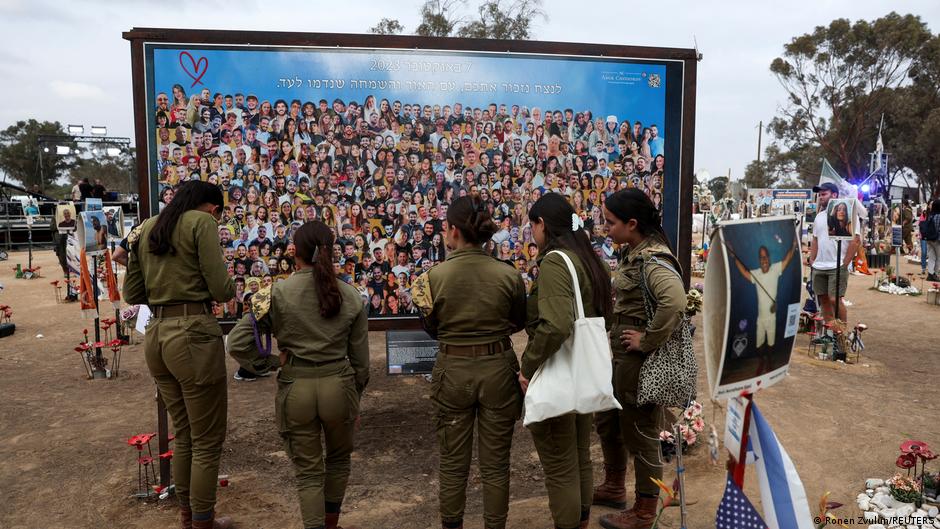
Both of his children attended the Nova Party in Israel's south, where almost 400 people were killed in a terrorist attack carried out by Palestinian militant group Hamas and its affiliates in Gaza. asserted
people → attend → Gaza
In total, roughly 1,200 people were killed in the attack and around 250 were taken hostage. asserted
250 → kill → attack
The attack triggered the war in Gaza, during which Israel has killed tens of thousands of Palestinians and displaced much of the territory's population. asserted
Israel → trigger → population
Shalev's son, Roee, was shot and hospitalized, but he survived. asserted
he → shoot → ?
Roee's partner, Mapal Adam, was killed in front of his eyes. asserted
partner → kill → eyes
Shalev's daughter, Lior, also made it out. asserted
daughter → make → it
Shortly after that day, Shalev's wife Gavriela went missing, before her body was found in a burned car with a goodbye letter. asserted
body → go → letter
"She couldn't handle the sorrow from that day," Shalev says. asserted
Shalev → handle → day
At the same time, his son Roee's post-traumatic symptoms started emerging, mostly in the form of extreme mood swings. asserted
son → emerge → swings
"He went to treatment to please me, but he didn't really believe in it. asserted
he → go → it
He thought he was OK, that he was strong," Shalev remembers. asserted
Shalev → think → ?
Two years after Gavriela's death, Roee couldn't take it anymore, either. asserted
Roee → take → it
"I'm alive, but I'm dead within," Roee wrote in his goodbye message, which he posted on his Instagram account. asserted
he → write → account
A country in post-traumatic state Since October 2023, Israel has been grappling with a mental health crisis of unprecedented scale. asserted
Israel → grapple → scale
According to a report by Israel's State Comptroller from February 2025, some 39% of the Israeli public reported suffering from post-traumatic symptoms, depression, anxiety or a combination of the three, on a medium or severe level. uncertain
% → accord → level
This amounts to some 3 million people, 600,000 of whom could suffer severely. uncertain
600,000 → amount → whom
However, the report also found that the number of people receiving mental health treatment had only risen by 1% since October 7, 2023, a difference of around 60,000 people. asserted
number → find → people
Among the affected groups are survivors of the attack, as well as people evacuated from their homes in Israel's south and north due to the war. asserted
survivors → affect → war
Noga Dagan-Buzaglo is a researcher with the Adva Center, a think tank focusing on inequality in Israeli society. asserted
Buzaglo → focus → society
She wrote an extensive paper about Israel's mental health system and its challenges post-October 7. asserted
She → write → system
She tells DW that while the country's mental health budget did increase due to the war, it was too little, too late, as the health system faced an ongoing crisis that was not handled properly. asserted
that → tell → crisis
"The biggest challenge is convincing people to work in Israel's public mental health system, both due to lower wages in comparison to the private sector and due to an overload of work," she says. asserted
she → convince → work
Sedatives often the go-to solution The current situation affects mental health professionals, too. asserted
situation → go → professionals
Research by the University of Haifa found that 84% of the therapists who treated people affected by the October 7 attack showed traumatic symptoms themselves, and some 45% of them said they feel mentally exhausted. Israel's Health Ministry has repeatedly said it has increased funding and job openings for the country's public mental health system, but staffing shortages remain, especially in peripheral regions in the far north and south. Because of these issues, the report said waiting times for treatment through Israel's public healthcare system were longer than six months. asserted
times → find → months
In some cases, Dagan-Buzaglo says, patients had to wait more than a year before receiving help. asserted
patients → say → help
Mental health NGOs and volunteers try to fill the gaps, often struggling themselves under the workload. asserted
NGOs → try → workload
This also leads to an increased use of prescription medications. asserted
This → lead → medications
Some people turn to substances like alcohol and drugs. asserted
people → turn → alcohol
The Israeli Ministry of Health said earlier this year that it had registered a rise of between 13% and 17% in the prescription of sedatives, sleep aids and antidepressants. asserted
it → say → sedatives
Those who suffer from the situation the most are the ones who cannot afford to pay a private therapist. asserted
who → suffer → therapist
Dagan-Buzaglo labels the Israeli public health system's response to the situation as "simply bad." asserted
Buzaglo → label → situation
Combat soldiers have received a special focus when it comes to Israel's mental health crisis. asserted
it → receive → crisis
Statistics published by the Israeli parliament and the IDF suggest a sharp rise of suicide cases among reservists: from a maximum of one annual case in the six years preceding the war to 11 cases in 2024, as well as nine cases investigated as suspected suicides in 2025. asserted
Statistics → publish → 2025
This does not include ex-soldiers who committed suicide due to trauma after the end of their service. asserted
who → include → service
…and 12 more, not listed.

💬Give feedback
🕘History 🎫Support