Photo via The Straits Times

AI borrowing binge rattles US markets

Read the original at The Straits Times ↗
Cite

The Straits Times. (2026, October 6). AI borrowing binge rattles US markets. The Straits Times. https://www.straitstimes.com/world/united-states/ai-borrowing-binge-rattles-us-markets

Dated when The Aporia collected the article, usually within hours of publication. Check the original for its exact date and byline.

The Straits Times · collected 2026-10-06 · by The Straits Times

Quick Summary

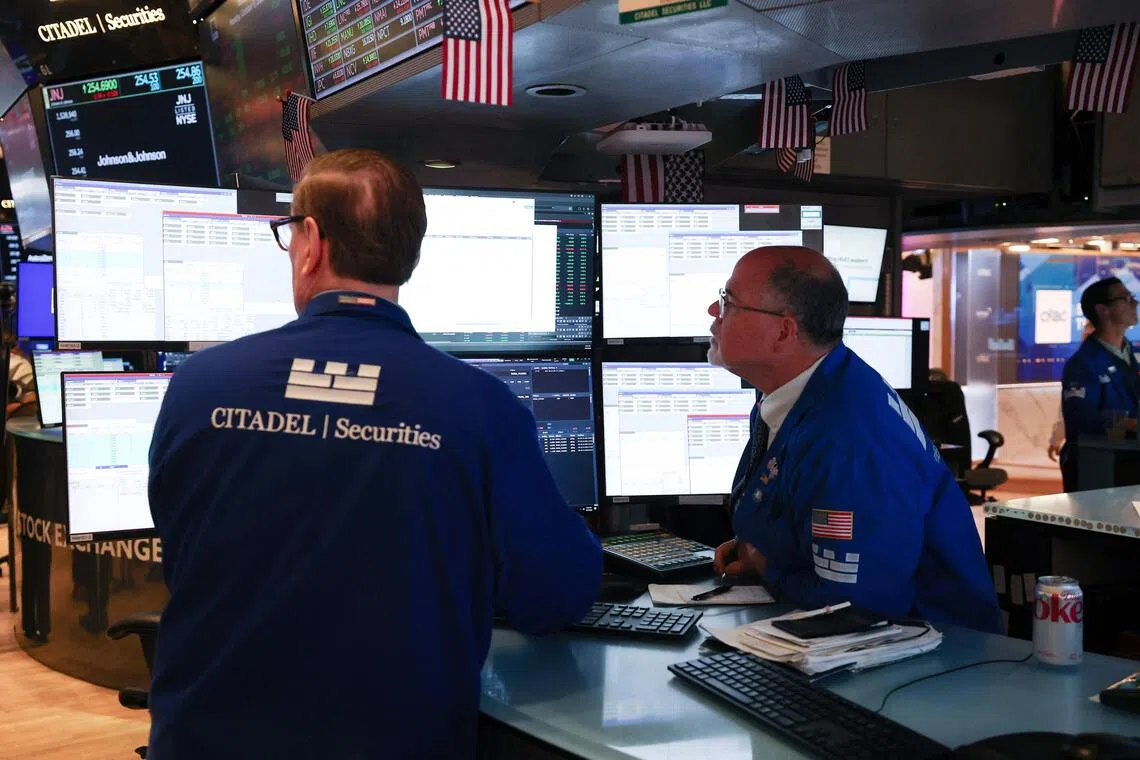
Rising US interest rates and a surge in artificial intelligence (AI) spending by major tech companies have caused significant disruptions in financial markets. In just nine months since January 2024, tech sector borrowing has reached approximately $500 billion, with Goldman Sachs predicting this figure will rise to $1.2 trillion by 2027. This borrowing binge is straining the market for US Treasury bonds and driving up interest rates, affecting everything from mortgages to car loans.
Written by AI on 2026-10-06, from this article's own text only (the story summary below draws on all the coverage).

AI analysis

Story summary

The tech sector has seen a significant increase in borrowing since January 2024, with companies like Google, Meta, Amazon, and Microsoft raising debt to fund AI infrastructure. In just nine months, the total amount borrowed reached around US$500 billion (S$639.7 billion), compared to almost nothing in the previous year. This borrowing spree is causing ripples in the financial market, including an impact on US Treasury bonds. Goldman Sachs predicts that by 2027, this figure could rise to US$1.2 trillion, making AI sector borrowing exceed historical benchmarks for infrastructure development. Chris Della Fave from Post Oak Group estimates that currently, AI accounts for about 25% of all corporate bond issuance, up from just 4% two years ago. This trend is unprecedented and could have significant implications on global financial stability and market dynamics.

Written for “AI Impact On Markets” on 2026-11-02, grounded in this article and the 0 other(s) covering the same event.

Story

📰 AI Impact On Markets
Economy/Business · 1 article(s) covering the same event.

Compared with similar articles

This article reads unscored and hedges 16% of its claims. Each row says how that neighbour differs.
ABC News (AU)
Hedges 5 of 43 claims Outlet record 68/100
“The articles discuss related economic issues but describe different specific events: one focuses on Bank of America's warning about the superannuation sector in Australia, while the other covers AI companies borrowing heavily in the US.”
Semafor
Hedges 1 of 4 claims Outlet record 59/100
“Article A discusses a broader trend of tech companies borrowing heavily due to rising interest rates and the need for funds in AI development, while Article B focuses on specific fundraising talks by Alphabet's Isomorphic Labs.”
The Sydney Morning Herald
Hedges 5 of 32 claims Outlet record 61/100
“The articles discuss different topics: one covers AI companies borrowing heavily due to rising interest rates, while the other focuses on Elon Musk's impact on Wall Street through his financial deals.”
Washington Examiner
⚖️ Leans left Hedges 1 of 55 claims Outlet record 70/100
“The articles discuss different aspects of AI development and funding in the US; Article A focuses on borrowing by tech companies due to rising interest rates, while Article B discusses infrastructure investments under government pressure.”
The Straits Times
⚖️ Leans right Hedges 2 of 21 claims Outlet record 66/100
“The articles describe different events: one about companies borrowing money due to AI competition and rising interest rates, the other about a Trump administration summit securing donations for AI research.”
Semafor
⚖️ Leans left Hedges 1 of 4 claims Outlet record 59/100
“The articles discuss different aspects of financial market conditions and impacts in the US but do not describe the same specific incident or occurrence.”
How this article was measured signals, leaning charts, publisher record, byline, topics and claims

Signals How these are calculated →

Claims extracted
25
sentences that state something as happening or true
Uncertain
16%
4 of 25 hedged ("reportedly", "may", "according to")
Leaning
not political
takes no side on a contested political question
Publisher signals
66/100
The Straits Times's corrections and hedging, across everything collected from it. Not a measure of accuracy.
Outlets on this story
1
Economy/Business
Same framing elsewhere
1
articles that frame the event the way this one does
Analyzed 2026-10-06 · how these are computed

How this is being covered How these are calculated →

Article leaning vs. publisher reliability
Source leaning vs. consistency

Publisher

The Straits Times · 4193 article(s) · 5 correction(s) detected
Running correction rate · 5 correction(s)

Who wrote this

The Straits Times
2728 article(s) here · 1 carrying a prediction
🔮 How it plays out over the coming days or weeks could have a significant impact on next year's parliamentary election and potentially push Poland closer to US President Donald Trump and away from the European mainstream.
2026-11-02 · assertive framing · Explainer-What's behind Poland's constitutional crisis?
🔮 Houthi official Hamid Rizq posted a video, which Reuters could not immediately verify, of what he said were the group's fighters entering Souq al-Rabouh in Maqatirah district.
🔮 "The worst forecasts are coming true.
2026-11-02 · assertive framing · Seven migrants die in seas off Spain's Canary Islands
🔮 • Critics notably say CNews'agenda increasingly follows the lines taken by Marine Le Pen's far-right National Rally (RN), from which the channel could benefit if, as polls suggest, Le Pen wins the 2027 Presidential election and fulfils her promise to privatise public broadcasting, which CNews has long criticised.
🔮 Though no one would call him naive — he has served both as leader of the opposition against Prime Minister Benjamin Netanyahu and as a member of a unity cabinet under him — Herzog's soft-spoken manner can appear out of step with the times.
🔮 We could not bear it.
🔮 They saw an example of what reparatory justice could look like in practice.
🔮 On the eve of elections that will decide whether President Donald Trump’s Republican Party keeps control of Congress, voters’ minds are on the economy, with high and rising prices a key issue and many blaming Trump’s policies, specifically tariffs and the Iran war, for the nagging inflation.
🔮 US President Donald Trump’s threat to strike Iran again confronts America’s Gulf allies with a stark prospect: another war decided in Washington in which the US bases built to protect them could instead make them targets for harsh Iranian reprisal.
🔮 Hungary's governing Tisza party will approve the president's nominee for chief prosecutor, Prime Minister Peter Magyar said on Monday, a significant step in Magyar's efforts to reshape public institutions after his April election victory.
Also by The Straits Times
Nothing else under this byline is closely related to this article, so these are simply their most recent.
All 2728 articles by The Straits Times →

Topics

Google Meta Microsoft NEW YORK Treasury

Subjects

Malek PERSON · 2× Meta ORG · 2× Microsoft ORG · 2× Oracle ORG · 2× Amazon ORG · 1× Chris Della Fave PERSON · 1× Goldman Sachs ORG · 1× Google ORG · 1× NEW YORK GPE · 1× Treasury ORG · 1×

Narrative

From next to nothing in 2024, tech sector borrowing has reached around US$500 billion (S$639.7 billion) in the nine months since January, as Google, Meta, Amazon, Microsoft and others raise debt hand over fist to finance the chips, servers and data centres that power AI.
framing: assertive · carried by 1 article(s) · first seen 2026-10-06
🔮 In inflation-adjusted terms, the AI sector is expected to borrow more in 2026 than US cable operators did to build out the entire internet, or than railroad companies did during the 19th-century US rail boom.
2026-10-06 · The Straits Times
AI borrowing binge rattles US markets · assertive framing

Claims (25 extracted, 4 hedged)

AI borrowing binge rattles US markets asserted
binge → rattle → markets
The world’s richest companies can no longer rely on their massive cash piles alone to stay in the artificial intelligence race and have suddenly started borrowing massively in a shift that is sending repercussions across the world. asserted
that → rely → world
Rising US interest rates, including on the Treasury bonds that anchor the global economy, are sending tremors through the financial world, and some analysts point to the AI borrowing bonanza as one of the culprits. asserted
analysts → rise → culprits
From next to nothing in 2024, tech sector borrowing has reached around US$500 billion (S$639.7 billion) in the nine months since January, as Google, Meta, Amazon, Microsoft and others raise debt hand over fist to finance the chips, servers and data centres that power AI. asserted
that → reach → AI
Goldman Sachs expects a further ramp-up in 2027, to US$1.2 trillion. asserted
Sachs → expect → trillion
“This is not something that we’ve seen before,” said Chris Della Fave, senior vice-president at fund-raising advisory firm Post Oak Group, who estimates that AI now accounts for 25% of all corporate bond issuance, up from 4% two years ago. asserted
AI → see → %
In inflation-adjusted terms, the AI sector is expected to borrow more in 2026 than US cable operators did to build out the entire internet, or than railroad companies did during the 19th-century US rail boom. asserted
companies → adjust → boom
So far, investors have eagerly snapped up the chance to lend to the tech giants, but they have demanded returns that would have been unthinkable for such blue-chip companies not long ago. asserted
that → snap → companies
Even Meta has had to offer more than 7% a year, while riskier cloud data centre specialists have gone above 9%. asserted
specialists → have → %
The impact reaches well beyond the companies building AI – their debt is even starting to crowd out demand for the US government bonds that anchor the financial system. An investor who might otherwise buy a US Treasury bond “might decide to buy Microsoft” instead, said Mark Malek, chief investment officer at Siebert Financial, referring to the tech giant’s bonds. uncertain
Malek → reach → bonds
That shift pushes up the rates Washington pays to borrow, he explained. asserted
he → push → rates
This adds to the other force driving up US borrowing costs: inflation, fuelled by the war against Iran and high energy prices. asserted
This → add → Iran
The interest rate on 10-year US government bonds – Wall Street’s benchmark and widely seen as the most important number in global finance, setting the tone for everything from mortgages to car loans – is now above 5.3%, its highest level since 2002. asserted
rate → see → 2002
Adding to the volatility, hedge funds had piled into US government bonds like never before, holding 7% of all those in circulation at the end of 2025, though that share has since fallen. asserted
share → add → 2025
Hedge funds, which place big bets on markets, move their money far faster than more cautious investors such as insurers and pension funds. asserted
which → place → insurers
Even if the war and the oil situation stabilised, Della Fave said, “I wouldn’t expect the yields to dramatically reduce, to be honest, because of this influence of the AI debt situation”. asserted
yields → stabilise → situation
Beyond the rising cost of borrowing, some are questioning the risks of betting on an AI boom that could hit a wall, as the dot.com bubble did in 2000. uncertain
bubble → rise → 2000
Even a moderate slowdown in the frenzied pace of construction, delays on certain projects or weaker-than-expected revenue growth could trigger a shock in financial markets, Malek warned. uncertain
Malek → expect → markets
In late September, the Bank of England’s Financial Policy Committee warned that “the risk of a sharper correction persists”, particularly if concerns about the pace of AI development or adoption hit earnings expectations. asserted
concerns → warn → expectations
In July, amid some second-guessing about the AI boom, the tech-heavy Nasdaq index fell nearly 7%. asserted
index → fall → boom
Against this backdrop, cloud specialist Oracle is sometimes seen as a bellwether. asserted
Oracle → see → bellwether
With massive debt (US$125 billion), cash reserves that shrink every quarter and a possible delay on a huge data centre project in New Mexico, several warning lights are flashing for Larry Ellison’s group. asserted
lights → shrink → group
“Let’s say Oracle has a problem... asserted
Oracle → let → problem
They can’t pay for something,” Malek said. asserted
Malek → pay → something
Trouble with its debt “could trigger contagion” across AI finance as a whole, he added. uncertain
he → trigger → whole

💬Give feedback
🕘History 🎫Support