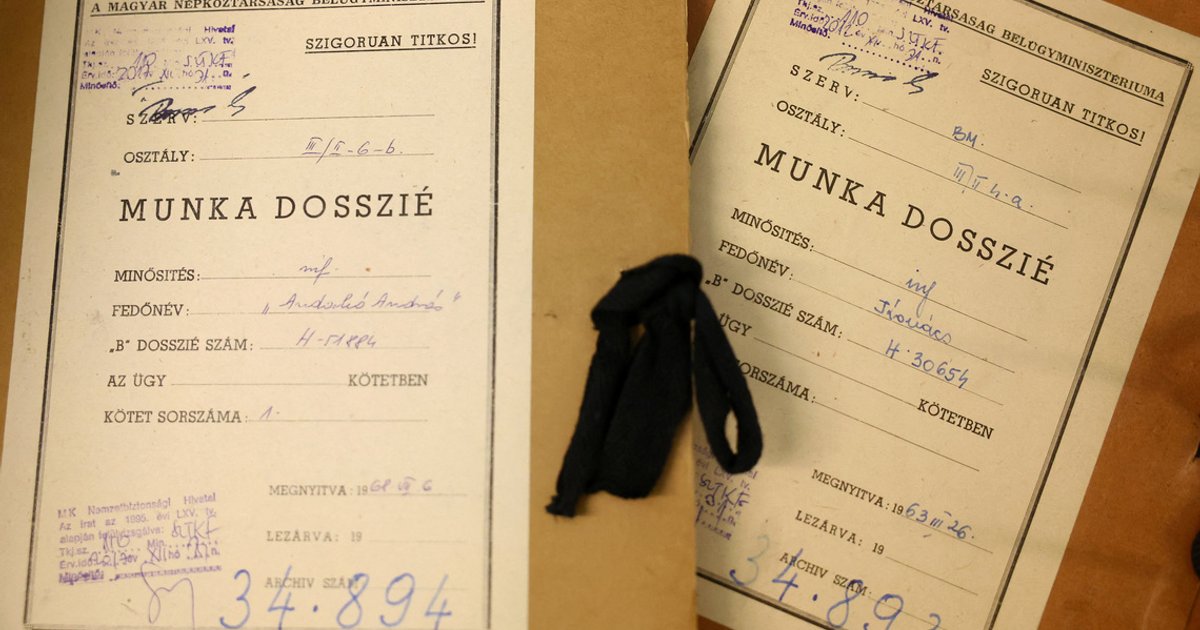
Photo via The Straits Times

Hungary to open Communist-era informer files in reckoning with Cold War past

Read the original at The Straits Times ↗
Cite

The Straits Times. (2026, October 6). Hungary to open Communist-era informer files in reckoning with Cold War past. The Straits Times. https://www.straitstimes.com/world/europe/hungary-to-open-communist-era-informer-files-in-reckoning-with-cold-war-past

Dated when The Aporia collected the article, usually within hours of publication. Check the original for its exact date and byline.

The Straits Times · collected 2026-10-06 · by The Straits Times

Quick Summary

Hungary plans to release tens of thousands of Communist-era police files in an online database for public access. The initiative, timed for the 70th anniversary of Hungary's 1956 anti-Soviet uprising, includes records of informers and collaborators totaling around 55,000 individuals who monitored others during the period from 1956 to 1989. Prime Minister Peter Magyár announced this move as part of efforts to address the country's totalitarian past by allowing anyone to search through these previously restricted archives online.
Written by AI on 2026-10-06, from this article's own text only (the story summary below draws on all the coverage).

AI analysis

Story summary

In a significant move, Hungary plans to release tens of thousands of Communist-era police files online, marking its 70th anniversary since the 1956 anti-Soviet uprising. The database will be accessible to all citizens, not just researchers or close family members as was previously allowed. This step is part of Prime Minister Peter Magyar’s commitment to open up records stored in a vast archive basement in Budapest, allowing Hungarians to confront their totalitarian past more openly. Between 1955 and 1989, an estimated 260,000 people acted as informants for the Communist state security services, helping to enforce political repression across the country. Unlike Poland, where archives were opened earlier but access is restricted, Hungary will allow open and unrestricted searches in its database.

Written for “Hungary Opens Informer Files” on 2026-11-04, grounded in this article and the 0 other(s) covering the same event.

Story

📰 Hungary Opens Informer Files
Politics · 1 article(s) covering the same event.

Compared with similar articles

Nothing to compare against. No article is close enough to this one for the pipeline to have linked or judged the pair.
How this article was measured signals, leaning charts, publisher record, byline, topics and claims

Signals How these are calculated →

Claims extracted
26
sentences that state something as happening or true
Uncertain
8%
2 of 26 hedged ("reportedly", "may", "according to")
Leaning
not political
takes no side on a contested political question
Publisher signals
66/100
The Straits Times's corrections and hedging, across everything collected from it. Not a measure of accuracy.
Outlets on this story
1
Politics
Same framing elsewhere
1
articles that frame the event the way this one does
Analyzed 2026-10-06 · how these are computed

How this is being covered How these are calculated →

Article leaning vs. publisher reliability
Source leaning vs. consistency

Publisher

The Straits Times · 4402 article(s) · 5 correction(s) detected
Running correction rate · 5 correction(s)

Who wrote this

The Straits Times
2887 article(s) here · 1 carrying a prediction
🔮 That meant the Democratic wave was deep enough to sweep away Republican lawmakers who might normally have sailed to reelection.
2026-11-04 · assertive framing · Seven numbers that explain Democrats' US midterm rout
🔮 US House Speaker Mike Johnson will not seek minority leadership post
🔮 Trump's intervention to grant the boy's mother, Doris Adu Gyamfi, a visa followed a phone call with New York Mayor Zohran Mamdani, who requested his help to allow her to attend her son's funeral with relatives •
🔮 It is not immediately clear how US President Donald Trump’s loss of control over Congress will shape the course of the United States’ eight-month-old conflict with Iran.
🔮 Prior to the attack, Ozon said in a financial results release last week that it expected to lose 30.1 billion roubles ($367 million) from drone attacks across 11 sites.
🔮 With the arrest of over 300 people last weekend outside the US embassy in London, plus two dozen or so outside the Supreme Court on Wednesday, the figure is now more than 4,000 – though any resulting charges could be dropped if the ban is overturned.
🔮 The election outcome could also have broad implications for the US fiscal outlook as well as sectors such as defence, healthcare and banking.
🔮 It is not immediately clear how US President Donald Trump's loss of control over Congress will shape the course of his country's eight-month-old conflict with Iran.
🔮 One of Musk's biggest challenges could be slower approvals for the data centers crucial to tapping the $28.5 trillion addressable market that SpaceX touted to investors ahead of its IPO.
🔮 “The voters have delivered a mandate for change and it is change they will get.”
Also by The Straits Times
Nothing else under this byline is closely related to this article, so these are simply their most recent.
All 2887 articles by The Straits Times →

Topics

BUDAPEST Cold War Communist Hungary anti-Soviet

Subjects

Hungary GPE · 7× BUDAPEST GPE · 4× Communist NORP · 4× Muller PERSON · 3× Stasi ORG · 2× East Germany's GPE · 1× Hungarians NORP · 1× Peter Magyar PERSON · 1× Western NORP · 1× anti-Soviet NORP · 1×

Narrative

Its director, Bendeguz Gergo Cseh, hailed the release of the Communist-era files, based on a law passed by parliament in September, as a "historic step" and said it went further than elsewhere in the former eastern bloc. Poland opened its archives much earlier but does not allow open, unrestricted searches, as will be the case now in Hungary.
framing: assertive · carried by 1 article(s) · first seen 2026-10-06
🔮 In a historic move, Hungary will soon start releasing tens of thousands of Communist-era police files in an online public database, giving people access to lists of informers and collaborators used by the former state security services.
2026-10-06 · The Straits Times
Hungary to open Communist-era informer files in reckoning with Cold War past · assertive framing

Claims (26 extracted, 2 hedged)

Hungary to open Communist-era informer files in reckoning with Cold War past BUDAPEST, Oct 6 - asserted
Hungary → open → past
In a historic move, Hungary will soon start releasing tens of thousands of Communist-era police files in an online public database, giving people access to lists of informers and collaborators used by the former state security services. asserted
Hungary → start → services
The release, timed for the 70th anniversary of Hungary's 1956 anti-Soviet uprising, is part of Prime Minister Peter Magyar's pledge to make the records, stored in a vast basement of archives in Budapest, public and allow Hungarians to come to terms with their totalitarian past. asserted
Hungarians → time → past
Although Communist rule ended in 1989, Hungary delayed fully opening the files due to a lack of strong political will from successive governments. asserted
Hungary → end → governments
So far, apart from researchers, ordinary people could only request access to their own records or those of close family members but now anybody will be able to conduct searches in the online database. uncertain
anybody → request → database
During the Cold War, secret police agencies in eastern Europe such as East Germany's Stasi or Hungary's security services relied on collaborators drawn from the public, often via blackmail, threats or rewards. asserted
agencies → rely → blackmail
Between 1956 and 1989 some 55,000 secret collaborators were recorded in Hungary. asserted
collaborators → record → Hungary
They monitored friends, family members, neighbours and co-workers to detect signs of dissent and Western influence -- and their reports often led to arrests and interrogation. asserted
reports → monitor → arrests
Many flats in downtown Budapest -- called K-flats or conspiracy flats -- served as locations for meetings between secret police officials and civilian collaborators. asserted
flats → call → officials
MUSIC BANDS TARGETED In the 1980s, informants attended concerts in Budapest's underground rock scene that attracted youthful crowds and were seen by the authorities as potentially subversive. asserted
that → target → authorities
Peter Muller "Sziami", still an iconic figure in today's music scene, recalls his band Kontroll Csoport (group) performing in 1983 a song he had written titled "Informers and Provocateurs". asserted
he → recall → song
"In our own way," the lyrics read, "we keep watch too: the one standing in front of you is our man -- you’ve blushed, you’ve been exposed, informers and provocateurs. asserted
you → read → you
" "And then we turned spotlights on the crowd and we saw the audience of around 1,000 people spinning around, looking to see who could be the informers," Muller, 74, said in his studio, smiling mischievously. uncertain
Muller → turn → studio
Muller was almost thrown out of college for his music, and police banned some of his concerts and interrogated him. asserted
police → throw → him
His first punk-rock band called "URH" in 1980, legendary in the underground culture, was named after the radio frequency band used by the state police and was often targeted. asserted
band → call → police
Despite those memories, however, Muller has mixed feelings about the opening of the files after such a long time. asserted
Muller → have → time
"I do not feel entirely comfortable with the idea that society needs such a cleansing or catharsis after all this time — that people must be singled out, humiliated, shamed, and punished when they have either already died or moved on to a different stage of life," he told Reuters. asserted
he → feel → Reuters
The Historical Archives of the Hungarian State Security (ABTL) manages the former state security services' records, with files comprising the names of 50,000 to 60,000 collaborators. asserted
Archives → manage → collaborators
Its director, Bendeguz Gergo Cseh, hailed the release of the Communist-era files, based on a law passed by parliament in September, as a "historic step" and said it went further than elsewhere in the former eastern bloc. Poland opened its archives much earlier but does not allow open, unrestricted searches, as will be the case now in Hungary. asserted
Poland → hail → Hungary
Germany also took a more restrictive approach in its 1991 act to open the Stasi files, while in the Czech Republic not all files have been uploaded to an online database. asserted
files → take → database
The Hungarian law says understanding the past and the transparency of public institutions are "essential prerequisites" for the functioning of a democratic state. asserted
understanding → say → state
The release of four types of files will come in two stages, starting on November 4. asserted
release → come → November
On that day in 1956 Soviet tanks entered Budapest to crush a pro-democracy uprising that had begun on October 23. asserted
that → enter → October
Some details of the files will be redacted to protect sensitive personal information, including health records, addictions and sexual orientation. asserted
details → redact → records
"As both an archivist and a historian, I believe that passing judgment based on this information is inappropriate," Cseh told Reuters. asserted
Cseh → believe → Reuters
"However, I do think it is possible to gain insight into life stories and confront our past more deeply — not only at an individual level but also at a societal one." asserted
it → think → one

💬Give feedback · no sign-in needed

No sign-in needed for now. Your note is sent without a name, so it cannot be answered.

🕘History 🎫Support