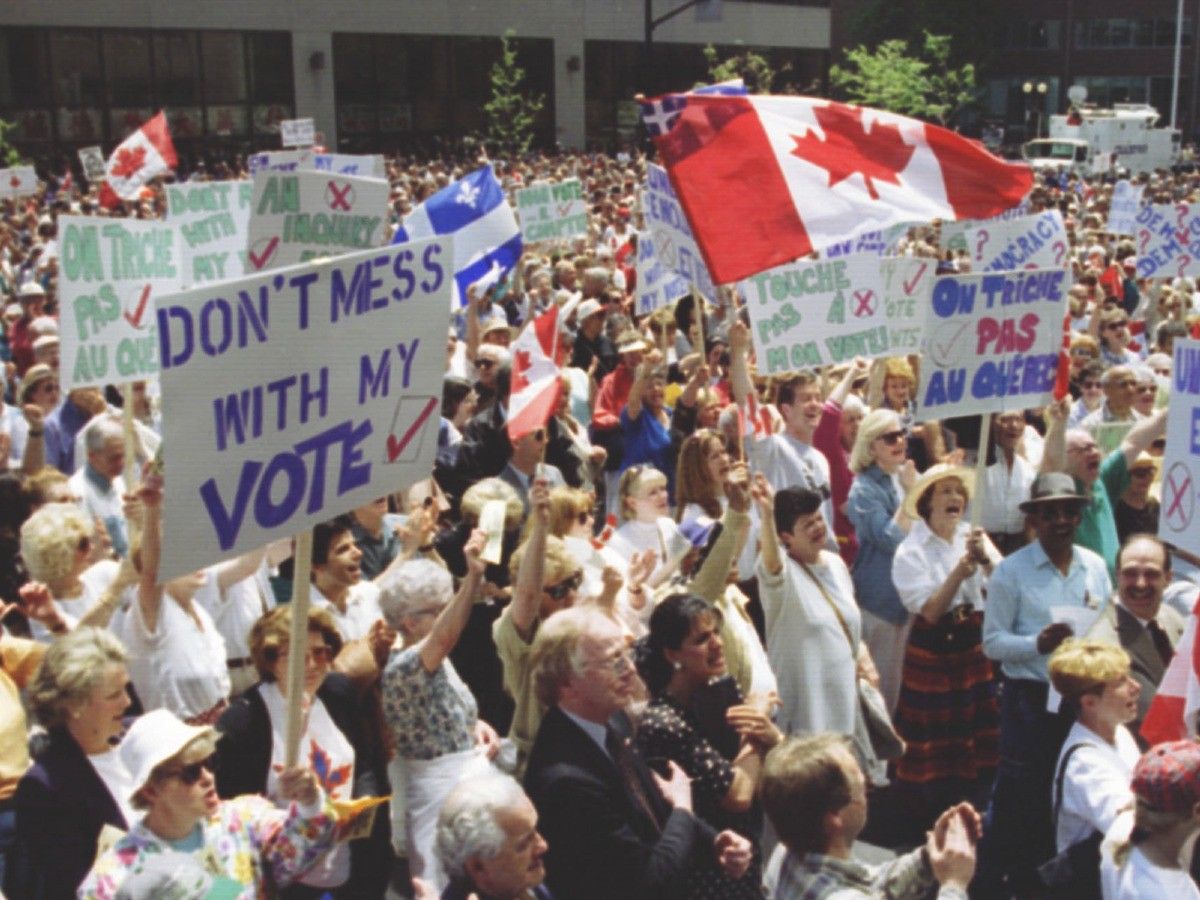
Photo via CBC News

How did Quebec separatists win if most Quebecers oppose separation? | About That

Read the original at CBC News ↗
Cite

How did Quebec separatists win if most Quebecers oppose separation? | About That. (2026, October 7). CBC News. https://www.cbc.ca/player/play/9.7371995?cmp=rss

Dated when The Aporia collected the article, usually within hours of publication. Check the original for its exact date and byline.

CBC News · collected 2026-10-07

Quick Summary

In Quebec's recent provincial elections, the Parti Québécois won despite polls showing that most Quebecers do not support separation from Canada. Andrew Chang analyzes how the fall of the incumbent Coalition Avenir Québec paved the way for this outcome, focusing on the shift in voter priorities that allowed sovereignty to become a less critical issue during these elections.
Written by AI on 2026-10-07, from this article's own text only (the story summary below draws on all the coverage).

AI analysis

Story summary

The leaders of Quebec’s five main political parties, including the separatist Parti Québécois (PQ) and Coalition Avenir Québec (CAQ), made their final pitches to undecided voters over the weekend ahead of a provincial election on October 5, 2026. PQ leader Paul St-Pierre Plamondon has been leading in polls throughout the campaign and promised a sovereignty referendum by 2029. Despite skepticism from opponents who argue that referendums cause political instability and harm the economy, St-Pierre Plamondon urges voters to support his party for a majority government to implement change after eight years of CAQ rule. About one quarter of eligible voters had already cast ballots in advance polls.

Written for “Quebec Election Vote” on 2026-11-01, grounded in this article and the 41 other(s) covering the same event.

Story

📰 Quebec Election Vote
Politics · 42 article(s) covering the same event. Compare every outlet's account →

Compared with similar articles

This article reads unscored and hedges 0% of its claims. Each row says how that neighbour differs.
National Post
⚖️ Leans left Hedges 7 of 92 claims Outlet record 60/100
The Hindu
⚖️ Leans right Hedges 2 of 23 claims Outlet record 60/100
The Globe and Mail
⚖️ Leans left Hedges 7 of 42 claims Outlet record 52/100
The Globe and Mail
⚖️ Leans left Hedges 3 of 41 claims Outlet record 52/100
CBC News
⚖️ Leans left Hedges 1 of 31 claims Outlet record 74/100
Al Jazeera
⚖️ Leans left Hedges 2 of 15 claims Outlet record 60/100
BBC News
⚖️ Leans left Hedges 4 of 29 claims Outlet record 68/100
The Guardian
Hedges 4 of 24 claims Outlet record 66/100
National Post
⚖️ Leans left Hedges 0 of 37 claims Outlet record 60/100
“Article A describes an individual meeting between a young sovereigntist and the PQ leader to sign a book, while Article B discusses the broader political context of Quebec's provincial election results.”
The Straits Times
⚖️ Leans right Hedges 2 of 26 claims Outlet record 66/100
“While both articles discuss the election of Quebec separatists, Article A describes the expectation before the election on October 5th, while Article B discusses the outcome and aftermath after the election on October 7th.”
How this article was measured signals, leaning charts, publisher record, byline, topics and claims

Signals How these are calculated →

Claims extracted
3
sentences that state something as happening or true
Uncertain
0%
0 of 3 hedged ("reportedly", "may", "according to")
Leaning
withheld
no quote in the article backed the model's score
Publisher signals
74/100
CBC News's corrections and hedging, across everything collected from it. Not a measure of accuracy.
Outlets on this story
42
Politics
Same framing elsewhere
1
articles that frame the event the way this one does
Analyzed 2026-10-07 · how these are computed

How this is being covered How these are calculated →

Article leaning vs. publisher reliability
Source leaning vs. consistency

Publisher

CBC News · 1792 article(s) · 5 correction(s) detected
Running correction rate · 5 correction(s)

Who wrote this

No reporter is named on this article.

Topics

Canada Coalition Avenir Québec Quebec Quebecers the Parti Québécois

Subjects

Quebec GPE · 2× Quebecers NORP · 2× Adobe Stock ORG · 1× Andrew Chang PERSON · 1× Canada GPE · 1× Coalition Avenir Québec ORG · 1× Paul St-Pierre Plamondon PERSON · 1× Reuters ORG · 1× The Canadian Press ORG · 1× the Parti Québécois ORG · 1×

Narrative

Andrew Chang explains how the fall of the incumbent Coalition Avenir Québec led to the rise of the Parti Québécois and its leader, Paul St-Pierre Plamondon, and why sovereignty became a separate issue for voters.
framing: assertive · carried by 1 article(s) · first seen 2026-10-07

Claims (3 extracted, 0 hedged)

How did Quebec separatists win if most Quebecers oppose separation? | asserted
Quebecers → win → separation
For the first time in over a decade, Quebec has elected a separatist party in its provincial elections, even though most Quebecers don’t want to secede from Canada. asserted
Quebecers → elect → Canada
Andrew Chang explains how the fall of the incumbent Coalition Avenir Québec led to the rise of the Parti Québécois and its leader, Paul St-Pierre Plamondon, and why sovereignty became a separate issue for voters. asserted
sovereignty → explain → voters
💬Give feedback
🕘History 🎫Support