Photo via The Sydney Morning Herald

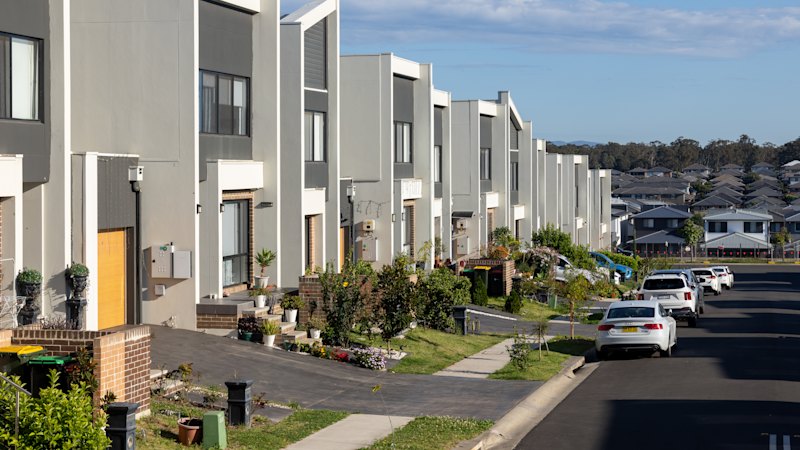
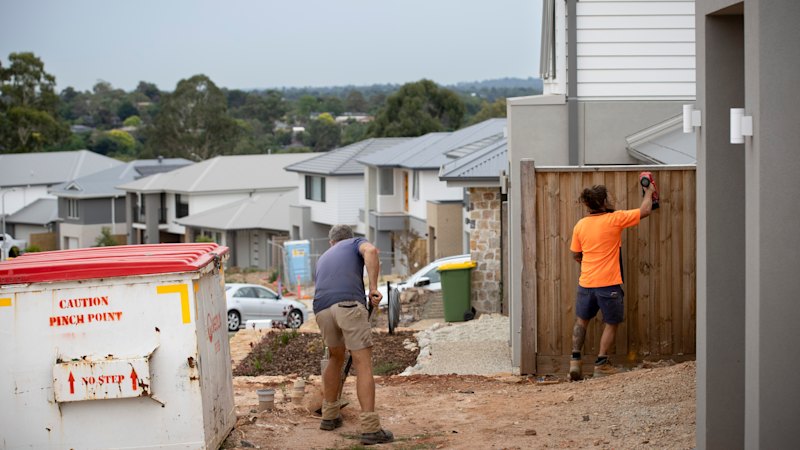
Home construction is up but still well short of government targets

Read the original at The Sydney Morning Herald ↗
Cite

Wade, M., & Busch, B. (2026, October 7). Home construction is up but still well short of government targets. The Sydney Morning Herald. https://www.smh.com.au/politics/federal/home-construction-is-up-but-still-well-short-of-government-targets-20261007-p613h2.html?ref=rss&utm_medium=rss&utm_source=rss_feed

Dated when The Aporia collected the article, usually within hours of publication. Check the original for its exact date and byline.

The Sydney Morning Herald · collected 2026-10-07 · by Matt Wade, Brittany Busch

Quick Summary

The Australian Bureau of Statistics reported a 7% rise in homes starting construction and a 5.8% increase in completed homes for the June quarter, reaching 52,201 and 47,168 respectively. However, this surge still falls short of the government's target to build 1.2 million homes over five years by nearly 100,000 units. Economic challenges like rising interest rates, higher construction costs due to increased oil prices from the Middle East conflict, and housing tax changes are expected to slow future progress, according to experts.
Written by AI on 2026-10-07, from this article's own text only (the story summary below draws on all the coverage).

AI analysis

Story summary

The Australian Bureau of Statistics reported an increase in home construction for the June quarter, with 52,201 homes beginning construction and 47,168 being completed. Despite this growth, Labor remains nearly 100,000 homes short of its goal to build a record number of dwellings over five years. The housing sector faces challenges from rising interest rates, increased construction costs due to the Middle East war, and uncertainty caused by recent budget changes. The Housing Industry Association estimates that missing these targets has created an $11 billion financial gap for state governments due to lower stamp duty and GST collections, potentially stunting economic activity worth $45 billion and leaving up to 242,160 Australians without housing.

Written for “Home Construction Shortfall” on 2026-11-03, grounded in this article and the 0 other(s) covering the same event.

Story

📰 Home Construction Shortfall
Economy/Business · 1 article(s) covering the same event.

Compared with similar articles

This article reads leans left and hedges 9% of its claims. Each row says how that neighbour differs.
CBC News
⚖️ Leans left Hedges 2 of 37 claims Outlet record 74/100
“The articles describe different national contexts and timelines for housing initiatives in Canada versus Australia.”
Evening Standard
Hedges 3 of 14 claims Outlet record 64/100
“The articles discuss different aspects of the housing market and do not refer to the same specific incident or data point.”
Daily Mail
Hedges 1 of 25 claims Outlet record 69/100
“Both articles discuss housing construction data, but they focus on different aspects: Article A focuses on the surge in home construction and its relation to government targets, while Article B emphasizes the failure to meet those targets despite a high number of completed dwellings.”
The Sydney Morning Herald
Hedges 0 of 5 claims Outlet record 61/100
“The articles refer to national and state-level data on home construction but describe different statistics for Australia as a whole versus Western Australia specifically.”
How this article was measured signals, leaning charts, publisher record, byline, topics and claims

Signals How these are calculated →

Claims extracted
23
sentences that state something as happening or true
Uncertain
9%
2 of 23 hedged ("reportedly", "may", "according to")
Leaning
Leans left
of the writing, not the subject · beta estimate
Publisher signals
61/100
The Sydney Morning Herald's corrections and hedging, across everything collected from it. Not a measure of accuracy.
Outlets on this story
1
Economy/Business
Same framing elsewhere
1
articles that frame the event the way this one does
Analyzed 2026-10-07 · how these are computed

How this is being covered How these are calculated →

Article leaning vs. publisher reliability
Source leaning vs. consistency

Publisher

The Sydney Morning Herald · 5927 article(s) · 15 correction(s) detected
Running correction rate · 15 correction(s)

Who wrote this

Matt Wade
21 article(s) here · 1 carrying a prediction
🔮 But researchers say that figure would rise to about 45 per cent with closer analysis of Brisbane’s CBD and inner suburbs, including South Brisbane, Fortitude Valley, Newstead, Milton and Spring Hill, where knowledge-intensive services such as finance, professional services, and information technology are concentrated.
🔮 The Reserve Bank has already lifted interest rates four times this year to combat elevated inflation and is expected to deliver a fifth rate hike after its monetary policy board meets on Tuesday.
2026-11-02 · assertive framing · The reason why a rate rise will hurt Sydneysiders most
🔮 Sydney’s professional heartland is set to be reshaped by automation with hundreds of thousands of workers in the city’s inner suburbs more exposed to artificial intelligence-driven disruption than anywhere else in Australia.
2026-11-01 · assertive framing · The Sydney suburbs most exposed to AI disruption
🔮 Many aspiring home buyers will welcome the recent pullback in prices, although four interest rate hikes by the Reserve Bank this year, which has driven the downturn, have made it harder for new home borrowers to service a mortgage.
🔮 If not for a fall in the labour force participation rate – the share of people in work or looking for work – last month’s jobless rate in NSW would have been higher.
🔮 If you looked at the figures for your area across several age brackets, you may have noticed how earnings track.
🔮 “For the first time … ordinary Australians will be able to build a decent nest egg for their retirement,” said the then-Prime Minister.
2026-10-09 · assertive framing · Is Australia saving too much for retirement?
🔮 But the home building sector has this year been hit by a series of interest rate hikes, higher construction prices due to the Middle East war and uncertainty prompted by the May budget’s housing tax changes which are yet to properly flow through to the figures.
🔮 Households will face “recession-like” conditions next year, a leading forecaster has warned, as fresh evidence shows consumers are losing confidence in the economy amid growing cost-of-living pressures.
🔮 That followed hikes in February, March and May.
Also by Matt Wade
AI is coming for office workers. How vulnerable is Brisbane?
2026-11-02 · The Sydney Morning Herald
The reason why a rate rise will hurt Sydneysiders most
2026-11-02 · The Sydney Morning Herald
The Sydney suburbs most exposed to AI disruption
2026-11-01 · The Sydney Morning Herald
Nothing else under this byline is closely related to this article, so these are simply their most recent.
All 21 articles by Matt Wade →
Brittany Busch
17 article(s) here · 1 carrying a prediction
🔮 Communications Minister Anika Wells said outside court that the government was seeking to protect Australians from harm and would defend that goal from “sustained ideological attacks”. “The question of what we accept from tech platforms who offer us an online world is the most compelling policy question of our time,” she said.
🔮 Bethany Luna-Riley did everything she could to prepare for the birth of her first child.
🔮 Business groups are warning years of expensive turmoil will be unleashed by the federal government’s plans for a minimum tax on discretionary trusts as Treasurer Jim Chalmers warns that without reform, the nation’s tax revenue will be eaten away, leaving working Australians exposed to even higher taxes.
🔮 Treasurer Jim Chalmers has already been forced to walk back a number of measures in the May budget after unforseen consequences copped backlash.
🔮 Treasurer Jim Chalmers has since negotiated a delay in the ban, and Prime Minister Anthony Albanese on Tuesday said the government will consult the business community over the issue.
🔮 Corruption-busting barrister Geoffrey Watson, SC, has accused the Albanese government of “bully boy” tactics as it fights a Freedom of Information ruling that would reveal where nuclear waste from AUKUS submarines would be stored.
🔮 The former treasurer, who was considered a future Liberal leader before losing his seat in 2022, has stoked speculation he will run again with the release of a new memoir, which includes criticism the party has lost touch with its roots, as well as his proposals for policy remedies.
🔮 Albanese later said he would not have done the podcast if he had his time again.
🔮 The defeat scuppered Frydenberg’s political future, which his colleagues thought as treasurer could have included the Liberal leadership.
🔮 The ATO said it would stop taking credit card payments for tax bills from November 30, arguing it could not absorb the fees.
Also by Brittany Busch
Nothing else under this byline is closely related to this article, so these are simply their most recent.
All 17 articles by Brittany Busch →

Topics

Australia KPMG Labor The Australian Bureau of Statistics the Middle East war

Subjects

Australia GPE · 1× Australians NORP · 1× Housing Industry Association ORG · 1× Iran GPE · 1× KPMG ORG · 1× Labor ORG · 1× Reardon PERSON · 1× Terry Rawnsley PERSON · 1× The Australian Bureau of Statistics ORG · 1× Tim Reardon PERSON · 1×

Narrative

“That growth isn’t going to be sustained, and that we won’t see an increase in home building activity in 2027.” The association estimates the failure to hit the government’s housing targets has left an $11 billion “black hole” in the finances of state and territory governments because not enough stamp duty and GST was collected over the two years since the target was set. Had the target been on track, the construction would have generated $45 billion in economic activity and potentially housed 242,160 Australians based on average household sizes, the housing association said.
framing: assertive · carried by 1 article(s) · first seen 2026-10-07
🔮 But the home building sector has this year been hit by a series of interest rate hikes, higher construction prices due to the Middle East war and uncertainty prompted by the May budget’s housing tax changes which are yet to properly flow through to the figures.
2026-10-07 · The Sydney Morning Herald
Home construction is up but still well short of government targets · assertive framing

Claims (23 extracted, 2 hedged)

A surge in homes built last quarter has failed to get the government back on track for its 1.2 million homes target as experts warn the deteriorating economic conditions threaten to slow down future housing projects. asserted
conditions → build → projects
The Australian Bureau of Statistics released its quarterly building activity data on Wednesday, showing a boost to the number of homes that began construction and the number of projects finished in the June quarter. asserted
that → release → quarter
But it also showed Labor remained almost 100,000 short of the homes needed to reach its target of building a record number of dwellings over five years – a key plank in its plan to tackle the housing crisis and get more first home buyers into the market. asserted
Labor → show → market
The number of homes, including houses and apartments, that began construction in the June quarter rose 7 per cent to 52,201. asserted
that → include → 52,201
Homes that were completed rose 5.8 per cent to 47,168. asserted
that → complete → 47,168
But the home building sector has this year been hit by a series of interest rate hikes, higher construction prices due to the Middle East war and uncertainty prompted by the May budget’s housing tax changes which are yet to properly flow through to the figures. uncertain
which → hit → figures
KPMG urban economist Terry Rawnsley said the uptick in commencements and completions showed Australia was trending in the right direction, and a record number of more than 240,000 houses under construction would enter the market over the next year or so. asserted
number → say → year
“Developers are seeing that prices are softening, their holding costs are increasing... so they’re probably on the bike pedalling as fast as they can to complete projects and get them into the market,” he said. asserted
he → see → market
But projects starting today would be more expensive because they break ground after the start of the US’s war on Iran, which has increased oil costs, he said. asserted
he → start → costs
“This is probably as good as it’s going to get for the foreseeable future,” he said. asserted
he → go → future
Housing Industry Association chief economist Tim Reardon said the 52,000 commencements in the quarter would not be enough to keep up with demand. asserted
commencements → say → demand
“There hasn’t been a material increase in the volume of new home building over the past decade, we’re still building a similar volume … despite the pick-up that we can see in today’s data, it’s about average for recent decades,” he said. asserted
he → build → decades
“We have not built enough homes in the past year to meet growth and demand, and we don’t anticipate that in the next 12 months we’ll build enough homes to meet the growth in demand. asserted
we → build → demand
Reardon said the number of houses would probably continue to rise in the September quarter because of the strength of the market coming into 2026, but they could start to fall by early 2027. uncertain
they → say → 2027
“What today’s data shows us is just how much momentum there was in the housing market coming into this year,” he said. asserted
he → show → year
“That growth isn’t going to be sustained, and that we won’t see an increase in home building activity in 2027.” The association estimates the failure to hit the government’s housing targets has left an $11 billion “black hole” in the finances of state and territory governments because not enough stamp duty and GST was collected over the two years since the target was set. Had the target been on track, the construction would have generated $45 billion in economic activity and potentially housed 242,160 Australians based on average household sizes, the housing association said. asserted
association → go → sizes
Treasurer Jim Chalmers and Housing Minister Clare O’Neil released a statement on Wednesday welcoming the June quarter increase in dwelling starts and completions. asserted
Chalmers → release → starts
“These are encouraging numbers, but we know they can bounce around from quarter to quarter and that there’s more work to do,” it said. asserted
it → know → quarter
“We are tackling housing supply from all angles, including funding enabling infrastructure, building 55,000 social and affordable homes and working with states and territories to streamline approvals.” asserted
We → tackle → approvals
Master Builders Australia chief executive Denita Wawn said the outlook for new projects was increasingly challenging. asserted
outlook → say → projects
“The cumulative impact of the federal budget, continued interest rate increases and an ongoing global uncertainty have deteriorated the environment.” asserted
impact → continue → environment
She said the “flat result” for higher density housing revealed by the latest figures was concerning because strong growth in that type of residential construction was needed it Australia is meet its housing targets. asserted
Australia → say → targets
Subscribers can sign up to our weekly Inside Politics newsletter. asserted
Subscribers → sign → newsletter

💬Give feedback
🕘History 🎫Support