A Florida State University doctoral candidate is trying to tackle one of the most persistent classes of environmental contaminants with a technology designed not just to capture PFAS, but potentially destroy them.
asserted
candidate → try → them
Kimberley Christopher, a doctoral candidate in Florida State University’s Department of Chemistry and Biochemistry, has developed a patent-pending plasma process that uses electrons to trigger the breakdown of per- and polyfluoroalkyl substances, better known as PFAS or “forever chemicals.”
asserted
that → develop → PFAS
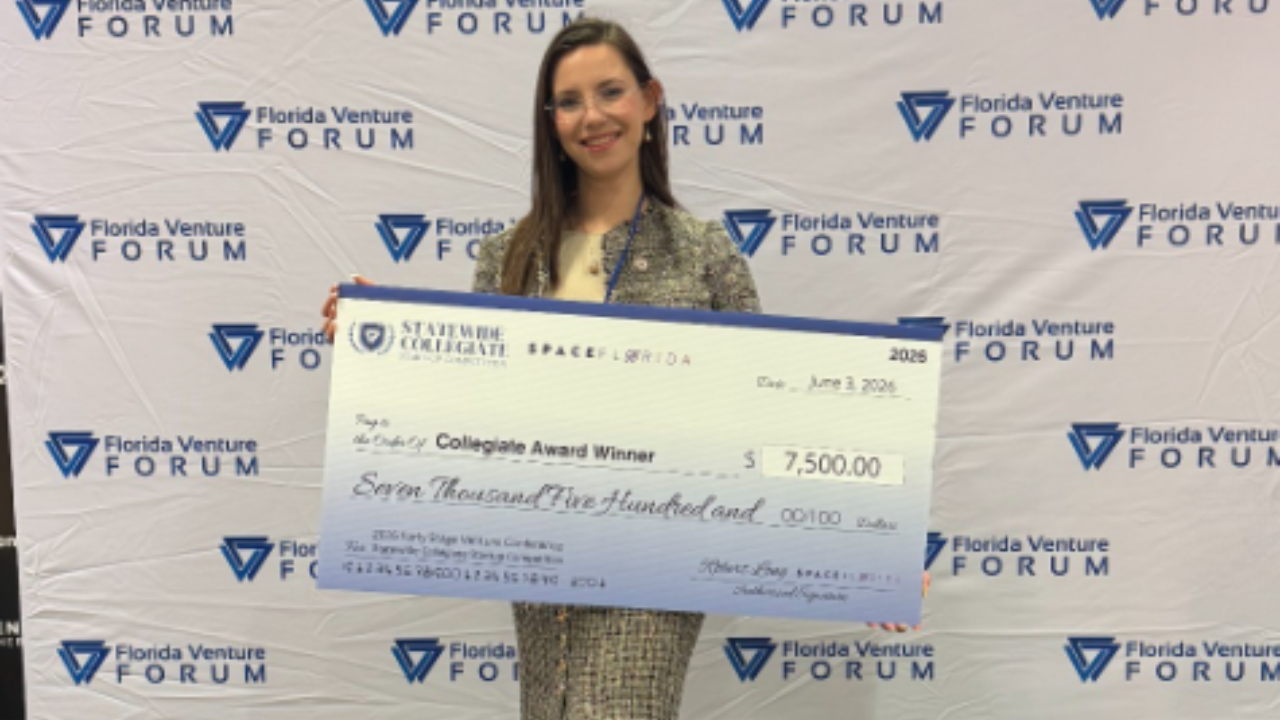
After winning a collegiate startup pitch competition, Christopher is now testing the technology’s commercial potential through the National Science Foundation’s I-Corps program.
asserted
Christopher → win → program
The NSF-backed project, led by FSU chemical engineering professor Bruce R. Locke, is examining whether the technology can become a cost-competitive, energy-efficient way of destroying PFAS in water.
asserted
technology → back → water
The active I-Corps award runs from September 2026 through August 2027 and provides $50,000 in funding for the team to assess its translation and commercial potential.
asserted
team → run → translation
Why PFAS are difficult to destroy
PFAS refers to a large class of human-made chemicals that have been used for decades because of their resistance to heat, water, oil and grease.
asserted
that → destroy → heat
They have been used in products ranging from nonstick cookware and stain-resistant materials to firefighting foams and some industrial applications.
asserted
They → use → foams
Their chemical stability, however, also makes many PFAS extremely difficult to break down once they enter the environment.
asserted
they → make → environment
US health authorities say 97% of people in US have measurable PFAS in their blood, while exposure can occur through contaminated drinking water, food, consumer products and contaminated sites.
asserted
exposure → say → water
The US Environmental Protection Agency has also established drinking-water limits for several PFAS, including PFOA and PFOS, reflecting concerns over their potential health effects.
asserted
Agency → establish → effects
The challenge is not simply removing the chemicals from water.
asserted
challenge → remove → water
Some existing treatment approaches concentrate PFAS and transfer them into another material, leaving the contaminated substance to be managed or disposed of later.
asserted
approaches → exist → substance
That is where Christopher's research takes a different approach.
asserted
research → take → approach
From capturing PFAS to breaking them down
Christopher is working with Locke, FSU engineering innovation director Robert Wandell and chemistry professor Igor Alabugin on an electron-based framework for PFAS destruction.
asserted
Christopher → capture → destruction
The approach uses nonthermal plasma and electrons to initiate chemical reactions that weaken the carbon-fluorine bonds characteristic of PFAS.
asserted
that → use → PFAS
According to the NSF project description, an electron injected into a PFAS molecule can trigger carbon-fluorine bond fragmentation, with the electron subsequently regenerated.
uncertain
electron → accord → fragmentation
The proposed mechanism therefore allows the electron to act catalytically rather than simply being consumed in the reaction.
asserted
electron → propose → reaction
Research presented by Christopher and her FSU collaborators has focused on electron upconversion, a process intended to generate stronger reducing agents from relatively mild electron donors.
asserted
Research → present → donors
Their computational work suggests that the approach can weaken carbon-fluorine bonds and promote degradation of certain PFAS compounds in nonthermal plasma systems.
uncertain
approach → suggest → systems
FSU called the resulting technology the Radi-Reactor plasma process.
asserted
FSU → call → technology
The university said it is designed to permanently destroy PFAS rather than merely transfer the contaminants from water into another waste stream.
asserted
it → say → stream
The technology is being evaluated through I-Corps to determine where it could work best and which customers would actually need it.
uncertain
customers → evaluate → it
30 interviews helped shape the idea
Christopher did not initially enter her doctoral program intending to become an entrepreneur.
asserted
Christopher → shape → program
Her research is in computational physical organic chemistry, but a regional I-Corps program introduced her to the commercial side of scientific research.
asserted
program → introduce → research
As part of the regional program, Christopher conducted 30 discovery interviews with potential users and stakeholders.
asserted
Christopher → conduct → users
The goal was to understand how organisations currently deal with PFAS contamination, what problems remain unresolved and which potential customer groups could benefit most from a destruction technology.
uncertain
groups → understand → technology
PFAS contamination affects a wide range of industries and waste streams, making the customer-discovery process particularly important.
asserted
process → affect → industries
The NSF project identifies possible applications including PFAS-rich landfill leachate, firefighting-foam waste, industrial wastewater and drinking water.
asserted
project → identify → leachate
Christopher's experience eventually took the technology from laboratory discussions to a competitive pitch.
asserted
experience → take → pitch
After completing the regional I-Corps program, Christopher was nominated by FSU's Jim Moran College of Entrepreneurship to participate in the Florida Venture Forum Collegiate Pitch Competition.
asserted
Christopher → complete → Competition
There, she presented the PFAS technology to investors, venture capitalists and other potential supporters.
asserted
she → present → investors
With support from FSU's IGNITE program, Christopher won first place, according to the university.
uncertain
Christopher → win → university
The win helped move the project into the next phase.
asserted
win → move → phase
Christopher's team began the NSF's national I-Corps program in early September 2026.
asserted
team → begin → September
Unlike a conventional scientific research grant, I-Corps focuses heavily on customer discovery and determining whether a laboratory invention can become a viable product or business.
asserted
invention → focus → discovery
The NSF describes I-Corps as a seven-week entrepreneurial training program designed to help scientists and engineers move promising inventions beyond the laboratory and toward commercialisation.
asserted
scientists → describe → commercialisation
Since its launch in 2012, more than 2,500 teams have participated, with nearly 1,400 subsequently launching startups, according to the NSF.
100 interviews in seven weeks
The next stage is considerably larger than Christopher's first round of customer research.
uncertain
stage → participate → research
Her team plans to complete 100 discovery interviews over seven weeks, from September through October, as it investigates potential markets and identifies the customer segment most likely to benefit from the technology.
asserted
it → plan → technology
The goal is not simply to prove that the chemistry works.
asserted
chemistry → prove → ?
Christopher also wants to determine where the process could have the greatest real-world impact and whether it can eventually compete on cost and efficiency with existing approaches.
uncertain
it → want → approaches
…and 5 more, not listed.
 The Aporia