Photo via The Guardian

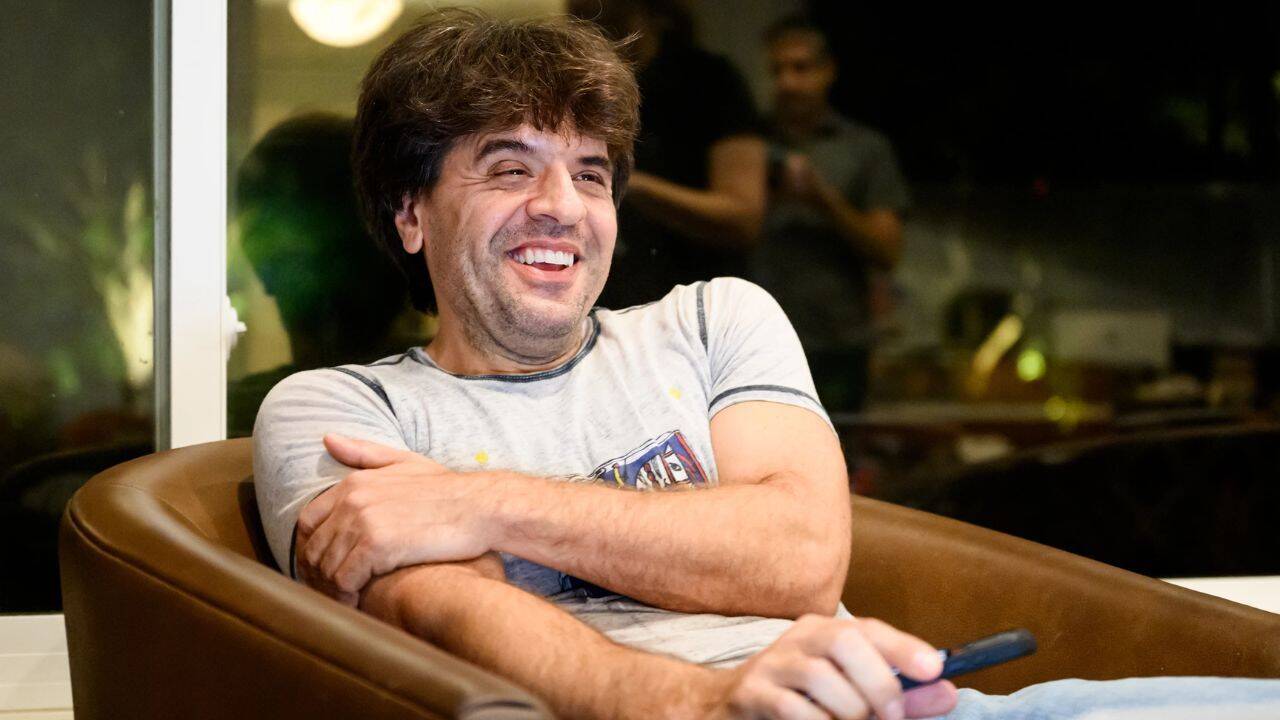
Moment Karl Deisseroth tells his family he won the Nobel prize in medicine – video

Read the original at The Guardian ↗
Cite

Guardian staff reporter. (2026, October 7). Moment Karl Deisseroth tells his family he won the Nobel prize in medicine – video. The Guardian. https://www.theguardian.com/science/video/2026/oct/07/moment-karl-deisseroth-tells-his-family-he-won-the-nobel-prize-in-medicine-video

Dated when The Aporia collected the article, usually within hours of publication. Check the original for its exact date and byline.

The Guardian · collected 2026-10-07 · by Guardian staff reporter

Quick Summary

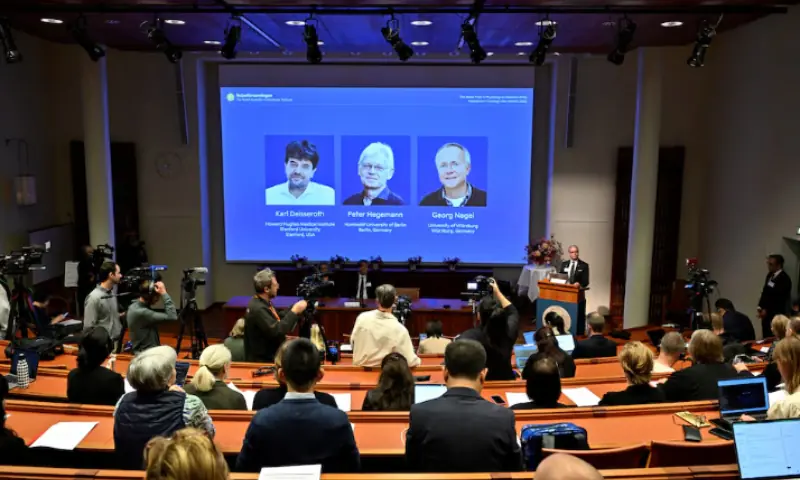
Stanford University released a video showing Karl Deisseroth informing his family about winning the Nobel Prize in Medicine. After receiving congratulatory calls early Monday morning, Deisseroth paused to make lunches for his sleeping children at home in Stanford. The prize was awarded to Deisseroth and two German researchers for their contributions to optogenetics, which uses light and genes to control neurons in living brains.
Written by AI on 2026-10-07, from this article's own text only (the story summary below draws on all the coverage).

AI analysis

Story summary

Dr. Karl Deisseroth, a scientist at Stanford University in California, won the 2026 Nobel Prize in Physiology or Medicine for his groundbreaking work in optogenetics. After receiving congratulatory calls from journalists and well-wishers during the early hours of Monday morning, October 5th, Dr. Deisseroth needed to take a break to make school lunches for his children who were asleep at home in Stanford. His research, which combines light with genes to control neurons in living brains, was recognized alongside German researchers Peter Hegemann and Georg Nagel, marking a significant advancement in brain science. Despite the accolades, Dr. Deisseroth prioritized his family responsibilities by preparing meals for his children before they headed off to school that morning.

Written for “Nobel Prize Winner Makes Lunch” on 2026-11-01, grounded in this article and the 3 other(s) covering the same event.

Story

📰 Nobel Prize Winner Makes Lunch
Science · 4 article(s) covering the same event. Compare every outlet's account →

Compared with similar articles

This article reads unscored and hedges 0% of its claims. Each row says how that neighbour differs.
CBC News
Hedges 0 of 1 claims Outlet record 74/100
Times of India
Hedges 6 of 42 claims Outlet record 59/100
The Globe and Mail
Hedges 2 of 16 claims Outlet record 52/100
“Article A reports on the Nobel Prize announcement, while Article B covers Karl Deisseroth telling his family about winning the prize later.”
Dawn
Hedges 2 of 26 claims Outlet record 72/100
“Article A reports on the announcement of the Nobel Prize winners, while Article B covers a video of Karl Deisseroth telling his family about winning the prize, which is a different but related event.”
Al Jazeera
Hedges 3 of 14 claims Outlet record 60/100
“Article A reports on the announcement of the Nobel prize winners, while Article B covers a separate event of Karl Deisseroth informing his family about winning the prize.”
ABC News (US)
Hedges 0 of 8 claims Outlet record 70/100
“The articles describe different Nobel Prize awards on consecutive days, not the same specific event.”
ABC News (US)
Hedges 0 of 8 claims Outlet record 70/100
“The articles describe different parts of the Nobel Prize process; one covers the announcement at Karolinska Institute, while the other reports on a laureate informing his family about winning the prize.”
New York Post
Hedges 0 of 17 claims Outlet record 66/100
“Article A reports on the awarding of the Nobel Prize to three scientists, while Article B focuses on Karl Deisseroth informing his family about winning the prize, which is a related but different event.”
10/5: CBS Evening News Different event
CBS News
Hedges 0 of 1 claims Outlet record 66/100
“Article A reports on the announcement of Nobel Prize winners, while Article B describes a personal moment when Karl Deisseroth informs his family about winning the prize.”
Toronto Star
Hedges 0 of 2 claims Outlet record 64/100
“The articles describe related events, but Article A focuses on Dr. Deisseroth making school lunches after receiving congratulatory calls, while Article B is about a video of him telling his family he won the Nobel Prize.”
How this article was measured signals, leaning charts, publisher record, byline, topics and claims

Signals How these are calculated →

Claims extracted
5
sentences that state something as happening or true
Uncertain
0%
0 of 5 hedged ("reportedly", "may", "according to")
Leaning
not political
takes no side on a contested political question
Publisher signals
66/100
The Guardian's corrections and hedging, across everything collected from it. Not a measure of accuracy.
Outlets on this story
4
Science
Same framing elsewhere
1
articles that frame the event the way this one does
Analyzed 2026-10-07 · how these are computed

How this is being covered How these are calculated →

Article leaning vs. publisher reliability
Source leaning vs. consistency

Publisher

The Guardian · 1868 article(s) · 6 correction(s) detected
Running correction rate · 6 correction(s)

Who wrote this

Guardian staff reporter
14 article(s) here · 0 carrying a prediction
🔮 Isaias is forecast to make landfall on Friday night, somewhere along the Alabama-Florida line, with surging seas up to 7ft (2.1 meters) and waves as high as 30ft (9.1 meters)
🔮 Donald Trump says he could 'annihilate Iran' if no deal is reached – video
🔮 Bernie Sanders says Congress has been ‘asleep at the wheel’ over AI – video Bernie Sanders criticised the advancement of artificial intelligence at the Pro-Human Assembly in Washington on Tuesday, warning that the current type of AI was 'the least capable version of AI that we will ever have'.
🔮 Zohran Mamdani, the New York mayor, announced on 14 September that New York City, alongside several other major cities, will sue the Trump administration over a new rule that would make it more easy to deny green cards and visas to immigrants based on their need of public benefits
Wire or desk byline, not an individual reporter.
Also by Guardian staff reporter
Nothing else under this byline is closely related to this article, so these are simply their most recent.
All 14 articles by Guardian staff reporter →

Topics

California Germany Stanford Stanford University

Subjects

Deisseroth PERSON · 2× Karl Deisseroth PERSON · 2× California GPE · 1× Germany GPE · 1× Stanford ORG · 1× Stanford University ORG · 1×

Narrative

But it wasn't long before the California scientist asked for a break for a more ordinary task: he needed to make school lunches for his children who were asleep in the family home in Stanford where he had been speaking to journalists and wellwishers in the middle of the night.
framing: assertive · carried by 1 article(s) · first seen 2026-10-07

Claims (5 extracted, 0 hedged)

Moment Karl Deisseroth tells his family he won the Nobel prize in medicine – video asserted
he → tell → video
Stanford University has shared a video of Karl Deisseroth telling his two daughters and one of his sons he has won a Nobel prize in medicine. asserted
he → share → medicine
Deisseroth spent hours fielding congratulatory calls on Monday after learning he had won the prize for helping to open a field of brain science called optogenetics. asserted
he → spend → science
But it wasn't long before the California scientist asked for a break for a more ordinary task: he needed to make school lunches for his children who were asleep in the family home in Stanford where he had been speaking to journalists and wellwishers in the middle of the night. asserted
he → ask → night
Deisseroth, 54, shares the prize with two researchers in Germany for their work in optogenetics, a field that combines light with genes to switch neurons on and off in living brains asserted
that → share → brains
💬Give feedback
🕘History 🎫Support