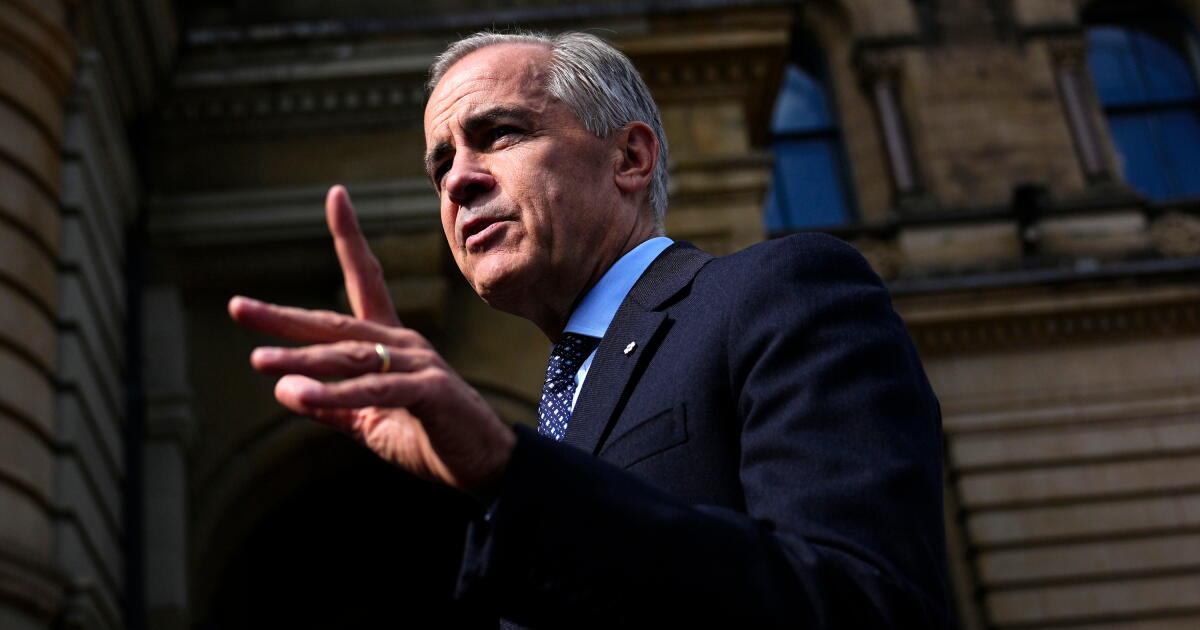
Photo via Global News

Canada’s counter-tariffs kick in on hundreds of U.S. goods

Read the original at Global News ↗
Cite

Rabinovitch, A. (2026, September 8). Canada’s counter-tariffs kick in on hundreds of U.S. goods. Global News. https://globalnews.ca/news/12050675/donald-trump-tariffs-canada-retaliation/

Dated when The Aporia collected the article, usually within hours of publication. Check the original for its exact date and byline.

Global News · collected 2026-09-08 · by Ariel Rabinovitch

Quick Summary

Canadian Prime Minister Mark Carney's counter-tariffs on US goods have taken effect, targeting $28 billion worth of American imports, including hundreds of items such as hockey sticks and essential oils. The tariffs are in response to US President Donald Trump's 50% tariffs on Canadian goods, which targeted sectors like dairy exports and auto exports. According to a recent Angus Reid Institute survey, 60% of Canadians are willing to pay up to 20% more for household expenses if it means sticking with Canada's current negotiating strategy. Carney has warned that the alternative to his counter-tariffs would be worse, but critics like Conservative Leader Pierre Poilievre have urged him to be transparent about the impact on Canadian consumers.
Written by AI on 2026-09-08, from this article's own text only (the story summary below draws on all the coverage).

AI analysis

Story summary

As of September 4, 2026, a tentative trade deal between Canada and the U.S., aimed at avoiding damaging tit-for-tat tariffs, collapsed just hours before its deadline. This breakdown triggered President Donald Trump to impose new 50% tariffs on $28 billion worth of Canadian exports. Prime Minister Mark Carney responded by announcing Canada's intention to match these tariffs dollar for dollar to protect domestic workers and businesses. The escalating trade tensions have led to the U.S. Justice Department ordering a freeze on all antitrust work with Canada, exacerbating the economic conflict between the neighboring countries.

The dispute has also spurred a "Buy Canadian" movement among consumers who are actively seeking out locally made products over American alternatives as part of their show of solidarity amid the ongoing trade war. Additionally, retaliatory tariffs have been imposed on various goods including dairy, motorcycles, and alcoholic beverages, further complicating economic relations between the two nations. This conflict comes amidst broader political tensions highlighted by President Trump's repeated rhetoric about annexing Canada. Despite historic close ties, both countries face significant challenges in resolving their trade disputes amicably.

Written for “U.S.-Canada Trade War Escalates” on 2026-10-31, grounded in this article and the 53 other(s) covering the same event.

Story

📰 U.S.-Canada Trade War Escalates
Economy/Business · 54 article(s) covering the same event. See how they differ ↓

Compared with similar articles

This article reads unscored and hedges 11% of its claims. Each row says how that neighbour differs.
The Globe and Mail
⚖️ Leans left Hedges 0 of 4 claims Outlet record 52/100
The Guardian
Hedges 1 of 19 claims Outlet record 66/100
BBC News
Hedges 2 of 31 claims Outlet record 68/100
The Guardian
Hedges 1 of 52 claims Outlet record 66/100
Los Angeles Times
Hedges 3 of 45 claims Outlet record 95/100
TIME
⚖️ Leans left Hedges 5 of 45 claims Outlet record 59/100
The Globe and Mail
⚖️ Leans strongly right Hedges 3 of 28 claims Outlet record 52/100
Toronto Star
⚖️ Leans left Hedges 1 of 49 claims Outlet record 64/100
Toronto Star
Hedges 0 of 11 claims Outlet record 64/100
CBC News
⚖️ Centre Hedges 1 of 1 claims Outlet record 74/100
How this article was measured signals, leaning charts, publisher record, byline, topics and claims

Signals How these are calculated →

Claims extracted
19
sentences that state something as happening or true
Uncertain
11%
2 of 19 hedged ("reportedly", "may", "according to")
Leaning
withheld
no quote in the article backed the model's score
Publisher signals
63/100
Global News's corrections and hedging, across everything collected from it. Not a measure of accuracy.
Outlets on this story
54
Economy/Business
Same framing elsewhere
1
articles that frame the event the way this one does
Analyzed 2026-09-08 · how these are computed

How this is being covered How these are calculated →

Article leaning vs. publisher reliability
Source leaning vs. consistency

Publisher

Global News · 2602 article(s) · 11 correction(s) detected
Running correction rate · 11 correction(s)

Who wrote this

Ariel Rabinovitch
27 article(s) here · 1 carrying a prediction
🔮 Prime Minister Mark Carney said Thursday that Cleveland-Cliffs would be making a “mistake” by not respecting its obligations and commitments, as the U.S.-based owner of Stelco faces potential legal action from the federal government over their laying off of up to 500 Canadian steelworkers.
🔮 A human user might give an AI agent parameters and prompts from organizing a calendar to drafting emails and making a shopping list.
🔮 The Bank of Canada is expected to make an interest rate announcement Wednesday, with many economists predicting a hike for the first time in three years.
🔮 Rogers says it will begin charging most customers across Canada a 1.6 per cent processing fee next year for bill payments made using a credit card.
🔮 The Bank of Canada has held its key interest rate unchanged for about a year, but some economists expect rates to begin increasing again as early as next week — which would be the first hike in more than three years.
🔮 Several legal experts say that, based on publicly available information, the federal government could have a strong case.
🔮 Industry Minister Mélanie Joly is expected to speak Wednesday afternoon — her first public appearance since Stelco answered Ottawa’s legal threat over layoffs of up to 500 workers.
🔮 Dyed diesel has now been cleared for general use in the U.S. as gas prices soar, but Canadians could still face fines if caught using it on roads and highways.
🔮 Get daily National news “The strength in exports in August was tied largely to the front-running of U.S. tariffs that came into effect late in the month,” said senior economist Katherine Judge at CIBC in a statement, adding: “That means that the spike in exports is temporary and will ease in September.”
🔮 Dyed diesel is essentially regular diesel fuel that is dyed a reddish colour to identify it for exclusive off-road applications, like with tractors and farming equipment, and it’s comparably cheaper than regular diesel because it is exempt from most road and highway taxes. Trump’s executive order allows for Americans to use dyed diesel to fill up trucks and other road vehicles that would normally have to fill up for a higher cost at truck stops.
Also by Ariel Rabinovitch
Nothing else under this byline is closely related to this article, so these are simply their most recent.
All 27 articles by Ariel Rabinovitch →

Topics

Canada Canadian Canadians U.S. the United States

Subjects

Canada GPE · 8× Carney PERSON · 8× Trump PERSON · 5× U.S. GPE · 5× Canadian NORP · 4× Canadians NORP · 3× American NORP · 1× Donald Trump PERSON · 1× Mark Carney PERSON · 1× the United States GPE · 1×

Narrative

Three-in-five (60 per cent) of survey respondents said they are willing to stay the course on Canada’s current negotiating strategy even if it means paying 10 or 20 per cent more for household expenses, including groceries and clothing.
framing: assertive · carried by 1 article(s) · first seen 2026-09-08
🔮 He added that the alternative would be far worse.
2026-09-08 · Global News
Canada’s counter-tariffs kick in on hundreds of U.S. goods · assertive framing

Claims (19 extracted, 2 hedged)

Prime Minister Mark Carney vowed to match Trump’s recently imposed 50 per cent tariffs “dollar-for-dollar,” and trade negotiations fell apart last month. asserted
negotiations → vow → dollar
As the country pivots away from the United States, Carney is warning Canadians that “this won’t be easy, and I won’t pretend otherwise.” asserted
I → pivot → Canadians
He added that the alternative would be far worse. asserted
alternative → add → ?
In a national video address released Tuesday, Carney reiterated Canada’s plan to respond to the U.S. trade war, including retaliatory tariffs which kicked in just after midnight and that are valued at roughly $28 billion. asserted
that → release → billion
Carney says the aim is to come out stronger and more resilient so no country can hold Canada hostage. asserted
country → say → Canada
Get daily National news Carney says he doesn’t believe in escalating the trade war, but that Canada’s retaliatory tariffs are necessary to protect workers. asserted
tariffs → get → workers
Trump’s tariffs of 50 per cent targeted a massive new list Canadian goods with the focus on specific sectors the administration claimed were engaged in “discriminatory” trade actions that negatively impacted the U.S. asserted
that → target → U.S.
This included provincial bans on alcohol imports, tariffs on some American made auto exports and quotas on tariff-free U.S. dairy exports. asserted
This → include → exports
Within each of the three main categories are hundreds of other Canadian items exposed to 50 per cent tariffs ranging from hockey sticks to floating docks, honey to essential oils and cement to plastics. asserted
hundreds → expose → plastics
Carney has said the tariffs from Trump were designed to harm some Canadians more than others. asserted
tariffs → say → others
For those whose jobs are impacted by these new tariffs, Carney says, “we will do whatever it takes for as long as it takes to bridge those people to a better future.” asserted
it → impact → future
Conservative Leader Pierre Poilievre has been critical of Trump’s actions on tariffs and his “trolling” of Canada, but he still urged Carney in a news conference Monday to be transparent about the counter-tariffs. asserted
he → urge → tariffs
“Every single mother, small business owner and seniors should know what they will pay in these new counter-tariffs to make sure that the people who are not to blame for this … they should not be the ones to pay for it,” Poilievre said. asserted
Poilievre → know → it
He also once again called for Carney to put forward the details of the deal that Canada walked away from last month. asserted
Canada → call → that
The majority of Canadians may be willing to endure some higher prices amid the latest trade war escalations, as suggested by a new Angus Reid Institute survey released Tuesday, which featured about 1,500 Canadian adults participating from Sept. 3 to Sept 4. uncertain
which → endure → Sept
Three-in-five (60 per cent) of survey respondents said they are willing to stay the course on Canada’s current negotiating strategy even if it means paying 10 or 20 per cent more for household expenses, including groceries and clothing. asserted
it → say → groceries
As Canada’s counter-tariffs kick in, are you more or less determined to Buy Canadian? asserted
you → kick → Canadian
Are you willing to pay higher prices or change brands in order to support the country’s response to Trump’s trade war? asserted
you → pay → war
Share your stance using the contact form below and we may use some or all of your response in upcoming stories. uncertain
we → share → stories

💬Give feedback
🕘History 🎫Support