Photo via The Sydney Morning Herald

‘Cash is king’: Sydney businesses lash government over surcharge ban

Read the original at The Sydney Morning Herald ↗
Cite

Harris, C. (2026, October 10). ‘Cash is king’: Sydney businesses lash government over surcharge ban. The Sydney Morning Herald. https://www.smh.com.au/national/nsw/cash-is-king-sydney-businesses-lash-government-over-surcharge-ban-20261010-p614b8.html?ref=rss&utm_medium=rss&utm_source=rss_feed

Dated when The Aporia collected the article, usually within hours of publication. Check the original for its exact date and byline.

The Sydney Morning Herald · collected 2026-10-10 · by Christopher Harris

Quick Summary

Sydney small business owners are facing financial losses due to Australia's ban on card surcharges implemented by the Reserve Bank and Prime Minister Anthony Albanese starting October 1. The ban aims to save consumers $1.6 billion annually but has led some businesses to introduce minimum cash payment amounts, with estimates of individual losses ranging from $3000 to $16,000 per business. Business owners argue that the policy is financially unsustainable and may lead to increased prices or closure of small enterprises.
Written by AI on 2026-10-10, from this article's own text only (the story summary below draws on all the coverage).

AI analysis

Story summary

Small businesses across Sydney, including cafes and restaurants like Cranes Newsagency and La Botte Doro, are facing significant financial challenges due to a new ban on credit card surcharges that took effect on October 1. This ban, implemented by the Reserve Bank of Australia in what it deemed was "public interest," aims to reduce payment confusion for consumers and potentially lower prices slightly. However, many business owners argue this will force them to raise prices or absorb costs, leading to estimated annual losses ranging from $12,000 to $16,000 per business. The Australian Competition & Consumer Commission (ACCC) has advised businesses they can adjust their pricing but must be transparent about it and avoid misleading consumers. Despite the government's intention for a fairer payment system, economists warn this could lead to inflation as prices increase to compensate for the costs of electronic payments.

Written for “Card Surcharge Ban” on 2026-11-05, grounded in this article and the 1 other(s) covering the same event.

Story

📰 Card Surcharge Ban
Economy/Business · 2 article(s) covering the same event. See how they differ ↓

Compared with similar articles

This article reads unscored and hedges 10% of its claims. Each row says how that neighbour differs.
ABC News (AU)
⚖️ Leans left Hedges 2 of 31 claims Outlet record 67/100
“The articles describe different government decisions affecting small businesses and credit card payments, not the same specific incident.”
The Sydney Morning Herald
Outlet record 61/100
“While both articles discuss the ban on credit card surcharges, they describe different aspects of the situation: Article A focuses on the ATO's stance, while Article B reports reactions from Sydney businesses.”
ABC News (AU)
Hedges 2 of 31 claims Outlet record 67/100
The Sydney Morning Herald
Hedges 9 of 95 claims Outlet record 61/100
“The articles discuss different aspects of the card surcharge ban; Article A focuses on organizations adapting to the ban, while Article B covers small businesses' reactions and economic concerns.”
ABC News (AU)
Hedges 6 of 27 claims Outlet record 67/100
“While both articles discuss the impact of the RBA's card surcharge ban, Article A focuses on cafes raising prices for coffee in response to the ban, while Article B discusses Sydney businesses urging cash payments and concerns over inflationary impacts. These are related but distinct aspects of the broader issue.”
The Sydney Morning Herald
Hedges 1 of 25 claims Outlet record 61/100
“While both articles discuss the impact of the Reserve Bank of Australia's ban on credit card surcharges, they describe different aspects and outcomes related to the policy implementation.”
Daily Mail
Hedges 4 of 18 claims Outlet record 69/100
“The articles describe different aspects of the same policy change but do not report on a single specific incident or meeting.”
The Guardian
Hedges 7 of 21 claims Outlet record 66/100
“The articles describe related issues around card surcharges but cover different aspects and timelines, with Article A focusing on business reactions immediately following the ban implementation and Article B discussing expert analyses days later about price increases.”
Daily Mail
Hedges 2 of 34 claims Outlet record 69/100
“The articles discuss different aspects of the card surcharge ban, with Article A focusing on Labor's announcements and subsequent issues, while Article B highlights Sydney businesses' reactions to the ban.”
The Sydney Morning Herald
Hedges 0 of 3 claims Outlet record 61/100
“While both articles discuss the impact of credit card surcharge bans on small businesses, they describe different aspects and impacts over time in different cities.”
How this article was measured signals, leaning charts, publisher record, byline, topics and claims

Signals How these are calculated →

Claims extracted
31
sentences that state something as happening or true
Uncertain
10%
3 of 31 hedged ("reportedly", "may", "according to")
Leaning
withheld
no quote in the article backed the model's score
Publisher signals
61/100
The Sydney Morning Herald's corrections and hedging, across everything collected from it. Not a measure of accuracy.
Outlets on this story
2
Economy/Business
Same framing elsewhere
1
articles that frame the event the way this one does
Analyzed 2026-10-10 · how these are computed

How this is being covered How these are calculated →

Article leaning vs. publisher reliability
Source leaning vs. consistency

Publisher

The Sydney Morning Herald · 6202 article(s) · 15 correction(s) detected
Running correction rate · 15 correction(s)

Who wrote this

Christopher Harris
16 article(s) here · 1 carrying a prediction
🔮 It is a long, steep decline which some might describe as terminal, so it might seem strange that Caringbah High would revive the language.
🔮 When North Sydney Girls High School student Angela Lin, 18, woke up on her birthday on Monday, she was feeling comfortable about the exam she would sit alongside 3769 NSW students.
🔮 But there is also another shadow economy that a first-time parent might not be aware: giving days, fundraising events and a busy social calendar all geared towards extracting more cash.
🔮 Rose Bay Secondary College modern history teacher Emily Lawson appears popular with students, but she harbours views which might prompt a double-take in the staff room.
🔮 The final question on Wednesday’s Higher School Certificate English Advanced exam might have seemed oddly specific or even divorced from the poetry and novels students studied in class.
🔮 In the next four weeks, 79,675 students are expected to complete at least one of the 123 written HSC exams that will span about 350 hours, starting with 75,348 putting their heads down for the first English paper from 9.50am on Tuesday.
🔮 Snowballing tuition hikes mean the cost of 13 years of an independent education is set to reach $800,000 by the end of the next decade if school fees continue to grow at 5 per cent each year.
2026-10-10 · assertive framing · The cost of 13 years of private school to hit $800k
🔮 The Reserve Bank of Australia decided it was in the “public interest” to ban surcharges on card payments from October 1 and Prime Minister Anthony Albanese said it could make the cost of a cup of coffee cheaper.
🔮 Universities Australia chief executive Luke Sheehy said curbing international students would be “extraordinarily challenging” for universities.
🔮 Education Minister Jason Clare said recent funding agreements would result in $20 billion flowing into public schools in coming decade under the needs-based Gonski funding model.
Also by Christopher Harris
Nothing else under this byline is closely related to this article, so these are simply their most recent.
All 16 articles by Christopher Harris →

Topics

ATO Italian Leichhardt Sydney The Reserve Bank of Australia

Subjects

ATO ORG · 2× Australian NORP · 2× Australians NORP · 2× Anthony Albanese PERSON · 1× Gabrielle Franco PERSON · 1× Italian NORP · 1× La Botte Doro ORG · 1× Leichhardt GPE · 1× Sydney GPE · 1× The Reserve Bank of Australia ORG · 1×

Narrative

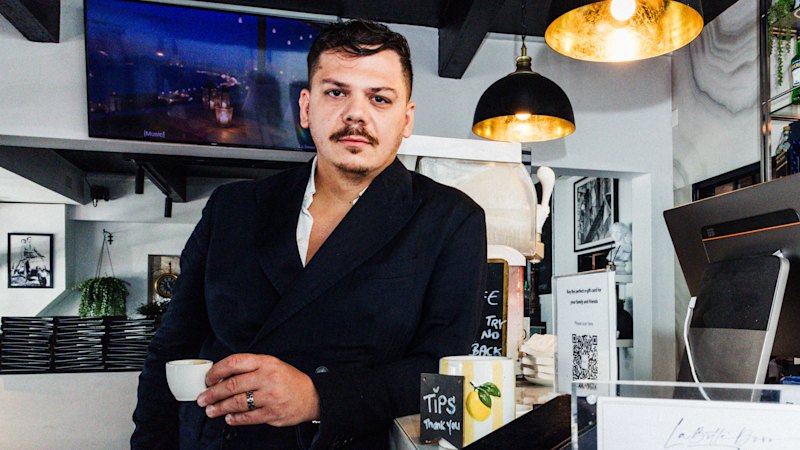
At Cranes Newsagency in Marrickville, owner Geoffrey Ji put up a sign saying there was now a $10 minimum spend for EFTPOS payments, Opal card top-offs had a $35 minimum spend, and he would not be accepting any credit card payments whatsoever from October 1.
framing: assertive · carried by 1 article(s) · first seen 2026-10-10
🔮 The Reserve Bank of Australia decided it was in the “public interest” to ban surcharges on card payments from October 1 and Prime Minister Anthony Albanese said it could make the cost of a cup of coffee cheaper.
2026-10-10 · The Sydney Morning Herald
‘Cash is king’: Sydney businesses lash government over surcharge ban · assertive framing

Claims (31 extracted, 3 hedged)

Small business owners across Sydney are reintroducing minimum amounts for card payments and putting up signs urging customers to pay cash as they face losing thousands of dollars each year due to the ban on card surcharges. asserted
they → reintroduce → surcharges
The Reserve Bank of Australia decided it was in the “public interest” to ban surcharges on card payments from October 1 and Prime Minister Anthony Albanese said it could make the cost of a cup of coffee cheaper. uncertain
cost → decide → coffee
But economists have since issued a warning that the new rules could be inflationary as businesses raise prices to recoup electronic payment costs under the changes, which were expected to save consumers $1.6 billion every year. uncertain
which → issue → billion
In Leichhardt, the owner of popular Italian trattoria La Botte Doro, Gabrielle Franco, has put up a sign saying “cash is king”, encouraging people to pay cash. asserted
cash → put → cash
That’s because he estimates he stands to lose between $12,000 and $16,000 should he absorb the costs of electronic payments, noting he declared all income to the Australian Tax Office. asserted
he → ’ → Office
“I can’t increase prices,” he said. asserted
he → increase → prices
I work seven days like a dog. asserted
I → work → dog
The government is taking $16,000 out of my pocket.” asserted
government → take → pocket
He said the business was already squeezed by high inflation, while the surcharge ban would likely flow on to how much suppliers charged as they increased their prices to cover the cost of paying with a card. asserted
they → say → card
“A lot of small businesses are going to shut – the suppliers are going to bring in extra charges for delivery,” he said. asserted
he → go → delivery
“I worked so hard to start my business, get my visa, I work to pay my bills and make my customers happy. asserted
customers → work → bills
I am not angry, you just got to navigate things. asserted
you → got → things
“I need to perform for the government, they do nothing for me.” asserted
they → need → me
At Cranes Newsagency in Marrickville, owner Geoffrey Ji put up a sign saying there was now a $10 minimum spend for EFTPOS payments, Opal card top-offs had a $35 minimum spend, and he would not be accepting any credit card payments whatsoever from October 1. asserted
he → put → October
He estimates he stands to lose around $3000 a month should he carry on business as usual. asserted
he → estimate → business
“For the newspaper we make around 20¢,” he said. asserted
he → make → 20¢
“If everyone uses the card, there is no profit.” asserted
everyone → use → card
In response to the surcharge ban, the ATO said it would no longer accept credit card payments from small businesses that use them to pay tax bills in instalments to maintain cash flow. asserted
that → say → flow
Following a backlash against that decision, the government said it would delay the ban for a year. asserted
it → follow → year
Owner of Alkalizer Café in Campbelltown, Shefali Pall, welcomed that announcement on Friday because she uses credit card payments to the ATO it as a cashflow management tool. asserted
she → welcome → tool
But she said simply delaying the introduction of a credit card ban was not a solution. asserted
delaying → say → ban
“Businesses need flexibility. asserted
Businesses → need → flexibility
It is very simple: if you have a $30,000 to $50,000 ATO bill to pay, the credit card gives you that flexibility. asserted
card → have → flexibility
They will have to find a middle ground. asserted
They → have → ground
As part of the reforms, the maximum fee a customer’s bank can charge to small businesses on a consumer credit card payment dropped from 0.8 per cent to 0.3 per cent of the transaction. asserted
bank → charge → transaction
But the Australian Banking Association noted if costs did not decrease for small businesses, it was because other companies including Visa, Mastercard, Square or Tyro may have raised their fees while banks have reduced theirs. uncertain
banks → note → theirs
On Saturday, Energy Minister Chris Bowen acknowledged different views but said ultimately, Australians, including small businesses, were better off with a reduction in fees and no surcharges. asserted
Australians → acknowledge → fees
I think almost every Australian uses credit cards every day now, and we shouldn’t be charged for doing so,” he said. asserted
he → think → cards
Business NSW executive director Paul Nicolaou said rising costs and additional red tape was making it harder and more expensive to operate, noting 14,000 companies across the country entered external administration last financial year. asserted
companies → say → administration
“We cannot continue adding costs and complexity to businesses and then be surprised when more operators close their doors,” he said. asserted
he → continue → doors
Subscribers can sign up to our weekly Inside Politics newsletter. asserted
Subscribers → sign → newsletter

💬Give feedback · no sign-in needed

No sign-in needed for now. Your note is sent without a name, so it cannot be answered.

🕘History 🎫Support