Photo via Times of India

16-foot Burmese python tagged in Florida; scientists test drones to track snakes

Read the original at Times of India ↗
Cite

TOI World Desk. (2026, October 10). 16-foot Burmese python tagged in Florida; scientists test drones to track snakes. Times of India. https://timesofindia.indiatimes.com/world/us/a-16-foot-burmese-python-weighing-147-9-pounds-was-released-after-radio-tagging-in-florida-us-scientists-are-now-testing-drones-to-track-invasive-snakes-across-the-everglades/articleshow/134788939.cms

Dated when The Aporia collected the article, usually within hours of publication. Check the original for its exact date and byline.

Times of India · collected 2026-10-10 · by TOI World Desk

Quick Summary

Scientists from the U.S. Geological Survey are testing drones equipped with radio trackers and cameras in the Florida Everglades to locate invasive Burmese pythons more efficiently. One female snake, measuring 16 feet and weighing 147.9 pounds, was recently tagged as part of this initiative. The drone technology aims to reduce search costs and improve data collection by covering difficult terrain faster than ground-based methods.
Written by AI on 2026-10-10, from this article's own text only (the story summary below draws on all the coverage).

AI analysis

Story summary

Scientists from the US Geological Survey (USGS) are testing drones equipped with radio tracking devices to monitor invasive Burmese pythons in the Florida Everglades. One tagged female python measured an impressive 16 feet and weighed 147.9 pounds. The drones help researchers track snake movements more efficiently, reducing costs and improving data accuracy compared to ground-based searches. This technology is particularly useful in tracking elusive snakes across challenging terrain like the Everglades. Additionally, USGS collaborates with local partners such as the South Florida Water Management District and the UF Croc Docs Team on similar studies focusing on python movement in aquatic environments like the Francis S. Taylor Wildlife Management Area.

Written for “Python Tracking Drones Florida” on 2026-11-03, grounded in this article and the 1 other(s) covering the same event.

Story

📰 Python Tracking Drones Florida
Science · 2 article(s) covering the same event. See how they differ ↓

Compared with similar articles

This article reads unscored and hedges 0% of its claims. Each row says how that neighbour differs.
Times of India
Hedges 5 of 28 claims Outlet record 59/100
How this article was measured signals, leaning charts, publisher record, byline, topics and claims

Signals How these are calculated →

Claims extracted
29
sentences that state something as happening or true
Uncertain
0%
0 of 29 hedged ("reportedly", "may", "according to")
Leaning
not political
takes no side on a contested political question
Publisher signals
59/100
Times of India's corrections and hedging, across everything collected from it. Not a measure of accuracy.
Outlets on this story
2
Science
Same framing elsewhere
1
articles that frame the event the way this one does
Analyzed 2026-10-10 · how these are computed

How this is being covered How these are calculated →

Article leaning vs. publisher reliability
Source leaning vs. consistency

Publisher

Times of India · 3982 article(s) · 3 correction(s) detected
Running correction rate · 3 correction(s)

Who wrote this

TOI World Desk
1379 article(s) here · 1 carrying a prediction
🔮 Origins of the emergency relief campaign The project started in early 2020 when Dozier realised that federal emergency support money could take months to reach low-income workers who were at immediate risk of losing their homes.
🔮 Before that, visitors could participate in organised activities such as guided hikes, birdwatching, educational programmes and public hunts.
🔮 While their decision to buy an abandoned French hamlet might appear like an unexpected adventure, Yip and Paul's official website reveals that their story together began decades earlier.
🔮 Hundreds of polar bears are expected to gather near the Canadian town of Churchill in Manitoba as temperatures fall and the animals wait for Hudson Bay to freeze.
🔮 Together they would support the reforestation of Mutuba trees in Uganda for three years.
🔮 In the letter, he apologised for forgetting to send his greetings earlier and expressed hope that they would meet the following year again.
🔮 Meeker told Signal Akron that the sculpture contained details that people could continue discovering over time.
🔮 The possibility that the farm could eventually reach another generation now seems less remote.
🔮 According to his plea agreement, he repeatedly gave investors false information about how their money would be used.
🔮 The couple challenged the move in court, and a judge subsequently ordered that the fence could not be removed or relocated while the legal dispute continued.
Wire or desk byline, not an individual reporter.
Also by TOI World Desk
Nothing else under this byline is closely related to this article, so these are simply their most recent.
All 1379 articles by TOI World Desk →

Topics

Burmese The United States Geological Survey USGS United States University of Florida

Subjects

Burmese NORP · 9× The United States Geological Survey ORG · 2× United States GPE · 2× Canva ORG · 1× Chris Holmquist-Johnson PERSON · 1× Department of the Interior ORG · 1× Holmquist-Johnson's ORG · 1× USGS ORG · 1× University of Florida ORG · 1× the Department of the Interior ORG · 1×

Narrative

Holmquist-Johnson's main work involves rivers and forests in the western United States, including mapping changes in river channels and surveying thinned forest areas, so the Everglades project shows how skills built in one setting can be carried into another.
framing: assertive · carried by 1 article(s) · first seen 2026-10-10
🔮 In this article, you will learn how the technology works, why pythons are so hard to track, what the scientists hope to gain, and what important questions remain unanswered.

Claims (29 extracted, 0 hedged)

Deep in the Florida Everglades, a vast and difficult landscape, scientists are trying a new way to find invasive Burmese pythons; they are looking from above. asserted
they → try → pythons
Researchers are testing small drones fitted with radio tracking equipment or cameras to locate snakes more efficiently, follow their movements across difficult terrain, and cut the cost of searching from the ground. asserted
Researchers → test → ground
One female python released after tagging measured 16 feet and weighed 147.9 pounds. asserted
python → release → pounds
In this article, you will learn how the technology works, why pythons are so hard to track, what the scientists hope to gain, and what important questions remain unanswered. asserted
questions → learn → what
How United States scientists use drones to monitor invasive Burmese pythons across the Everglades The United States Geological Survey, a federal science agency, is testing a different approach to a long-running wildlife problem. asserted
Survey → use → problem
Scientists at its Fort Collins Science Centre are using uncrewed aircraft systems, commonly called drones, to track invasive Burmese pythons and to learn more about how the snakes move across a vast and difficult landscape. asserted
snakes → use → landscape
The work is described in the center's September 2026 series, which highlights how its projects support sound decision-making. asserted
projects → describe → making
The python project stands out because the agency's own account calls it a novel use of technology that is more commonly applied to monitoring rivers and forests. asserted
that → stand → rivers
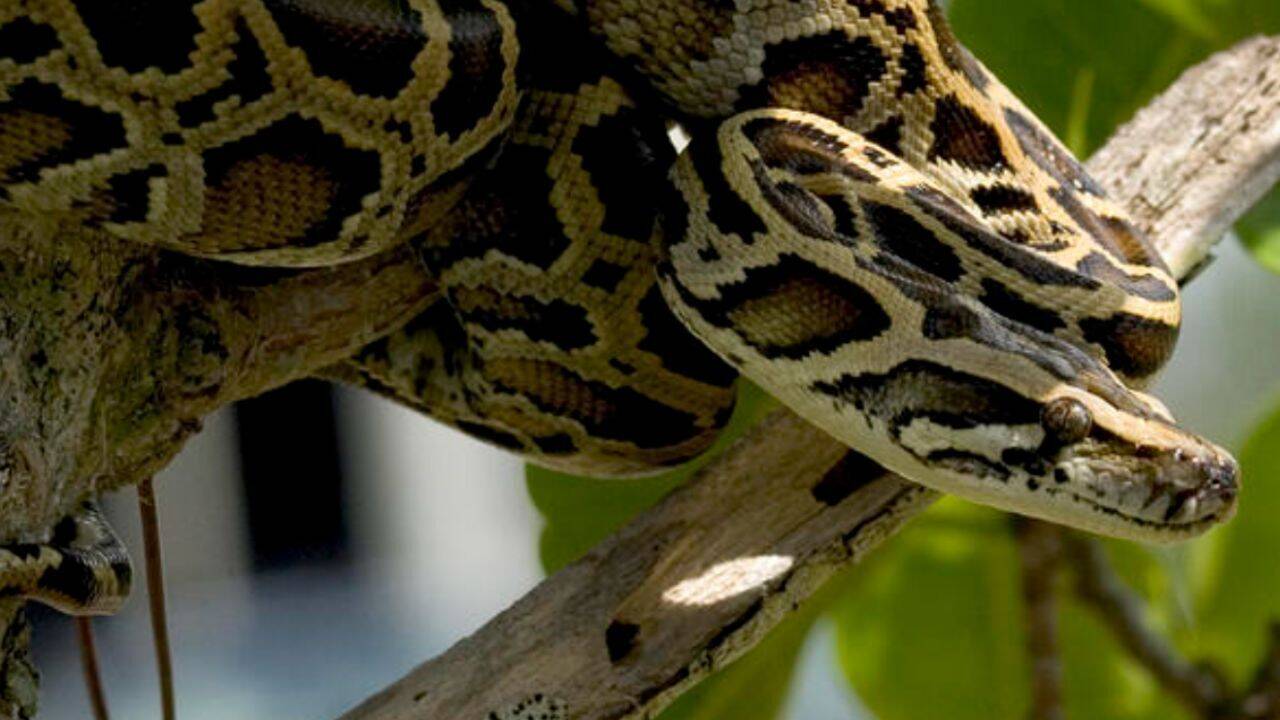
The 16-foot, 147.9-pound female Burmese python that was radio-tagged A photograph published by the USGS captures the technology at work. asserted
photograph → tag → work
In the image, agency biologists operate a small uncrewed aircraft system while University of Florida interns release a newly radio-tagged female Burmese python, 16 feet long and weighing 147.9 pounds, back into the Greater Everglades Ecosystem. asserted
interns → operate → Ecosystem
The scene shows how the pieces fit together: a snake carrying a radio tag, people on the ground handling it safely, and an aircraft overhead testing how well the tag can be followed from the sky. asserted
tag → show → sky
Why Burmese pythons threaten Everglades mammals and why tracking them across difficult terrain is hard (Image: Canva) How radio tracking equipment and cameras improve python detection efficiency asserted
equipment → threaten → efficiency
The agency explains that the aircraft can carry either radio tracking equipment or a camera. asserted
aircraft → explain → equipment
The platform is being evaluated as a way to improve detection and tracking efficiency, collect better data, and reduce the labour and operating costs of traditional ground-based monitoring for pythons. asserted
platform → evaluate → pythons
In plain terms, a drone can cover wet, thick, hard-to-walk areas far faster than a person on foot, and it can pick up a tagged snake's signal or spot the animal from overhead. asserted
it → cover → animal
If it works well, fewer people would need to spend long hours searching difficult ground. asserted
people → work → ground
Why Burmese pythons threaten Everglades mammals and why tracking them across difficult terrain is hard asserted
tracking → threaten → terrain
The United States Geological Survey leads federal research to control the Burmese python, which has become firmly established across the Greater Everglades Ecosystem and poses a serious threat to native wildlife. asserted
which → lead → wildlife
The snake can grow to more than 17 feet long and is believed to be a key factor in the sharp decline of mammal populations in the region. asserted
snake → grow → region
Finding such a well-camouflaged animal in a huge, wet landscape is slow and costly, which explains why scientists are eager to test aerial tools. asserted
scientists → find → tools
How drone training for Department of the Interior scientists brought python tracking to the Everglades The idea grew out of a training program. asserted
idea → bring → program
Chris Holmquist-Johnson, a certified instructor in uncrewed aircraft systems for the Department of the Interior, trained a group of Fort Collins Science Centre scientists working in the Florida Everglades about a year before the article was published. asserted
article → train → Everglades
Those researchers are now using the technology to track Burmese pythons and are gaining new insight into their movement behaviour. asserted
researchers → use → behaviour
Holmquist-Johnson's main work involves rivers and forests in the western United States, including mapping changes in river channels and surveying thinned forest areas, so the Everglades project shows how skills built in one setting can be carried into another. asserted
skills → involve → another
Why further testing matters for python control asserted
testing → matter → control
It is important to read the project for what it is. asserted
it → read → project
The agency describes the aircraft as a tool still under evaluation, and the sources do not report measured results, such as how many more snakes are found or how much money is saved. asserted
money → describe → results
The 16-foot, 147.9-pound snake is a single example from a photograph, not an average, and the agency notes that pythons can grow even longer. asserted
pythons → note → photograph
As testing continues, the key questions will be how reliably the aircraft locate tagged and untagged snakes, and whether the savings in time and cost hold up across the seasons and the many kinds of habitat in the Everglades. asserted
savings → continue → Everglades

💬Give feedback
🕘History 🎫Support