Photo via Noahpinion

A Nobel for New Keynesian macro, at last!

Read the original at Noahpinion ↗
Cite

Smith, N. (2026, October 13). A Nobel for New Keynesian macro, at last! Noahpinion. https://www.noahpinion.blog/p/a-nobel-for-new-keynesian-macro-at

Dated when The Aporia collected the article, usually within hours of publication. Check the original for its exact date and byline.

Noahpinion · collected 2026-10-13 · by Noah Smith commentary

Quick Summary

The article discusses the awarding of the Nobel Prize in Economics to Bob Hall and Michael Woodford for their contributions to New Keynesian macroeconomics, a field that explains how economic policies affect inflation and employment through microeconomic foundations. The author notes this recognition was long overdue and provides context on the historical development of modern macroeconomics, highlighting the shift from aggregate relationships between economic indicators to models based on individual behavior and expectations.
Written by AI on 2026-10-13, from this article's own text only (the story summary below draws on all the coverage).

AI analysis

Story summary

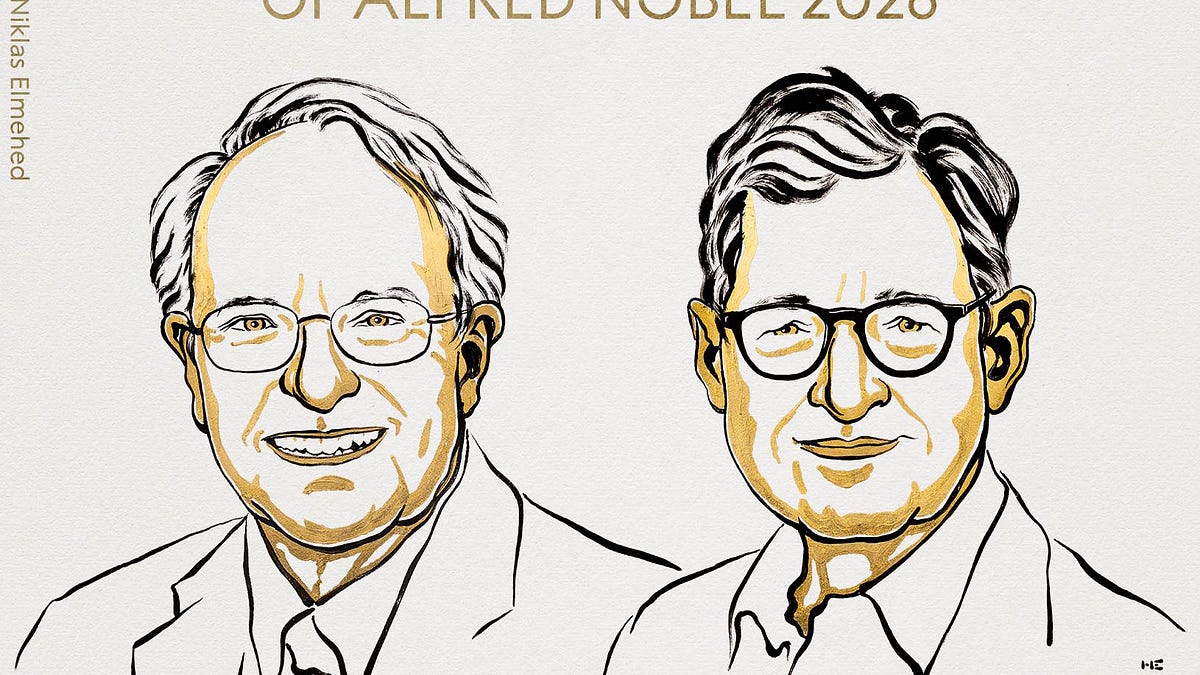
Robert Hall from Stanford University and Michael Woodford from Columbia University have been awarded the 2026 Nobel Prize in Economics "for microeconomic foundations of macroeconomic stabilisation," announced by the Royal Swedish Academy of Sciences on October 12, 2026. The prize recognizes their work on developing new models that improve policymakers' ability to manage economic shocks and reduce peaks and troughs in economies. Each laureate received $1.2 million (12 million Swedish crowns), making it the final Nobel Prize for this year. Hall’s affiliation with Stanford University, California, and Woodford's connection to Columbia University, New York, underscores their contributions to economic theory and practice globally. The award highlights the advancement of stabilisation policies over traditional models that struggled during historical crises like the 1970s oil shock.

Written for “Nobel Economics Prize 2026” on 2026-11-02, grounded in this article and the 10 other(s) covering the same event.

Story

📰 Nobel Economics Prize 2026
Economy/Business · 11 article(s) covering the same event. Compare every outlet's account →

Compared with similar articles

This article reads unscored and hedges 9% of its claims. Each row says how that neighbour differs.
The Hindu
Hedges 0 of 15 claims Outlet record 77/100
The Guardian
Hedges 1 of 22 claims Outlet record 66/100
NPR
Hedges 0 of 2 claims Outlet record 60/100
The Hindu
⚖️ Leans left Hedges 5 of 58 claims Outlet record 77/100
“While both articles discuss Bob Hall and Mike Woodford receiving the Nobel Prize in Economics, Article A focuses on the award announcement as a milestone for New Keynesian macroeconomics, while Article B provides a broader context of the significance within economic theory over time.”
How this article was measured signals, leaning charts, publisher record, byline, topics and claims

Signals How these are calculated →

Claims extracted
133
sentences that state something as happening or true
Uncertain
9%
12 of 133 hedged ("reportedly", "may", "according to")
Leaning
not political
takes no side on a contested political question
Publisher signals
not measured
these signals count newsroom corrections; Commentary has none to count
Outlets on this story
11
Economy/Business
Same framing elsewhere
1
articles that frame the event the way this one does
Analyzed 2026-10-13 · how these are computed

How this is being covered How these are calculated →

Article leaning vs. publisher reliability
Source leaning vs. consistency

Publisher

Noahpinion · 48 article(s) · 0 correction(s) detected
No corrections detected for this publisher. That may mean careful reporting, or simply that nothing has been checked.

Who wrote this

Noah Smith
38 article(s) here · 1 carrying a prediction
🔮 The original “Kirk and Spock” series, which aired in the 1960s, was more of a technological vision — the idea that one day we would zip around the cosmos getting into adventures, as easily as we’d zip around the world in a boat today.
2026-10-31 · assertive framing · Farewell, my Captain
🔮 It’s far too early to tell how much AI will eventually speed up the growth of total factor productivity.
2026-10-29 · assertive framing · A golden age of science is coming
🔮 “No man could bind him, no, not with chains…neither could any man tame him” — Mark 5:3—4 When I was 14 or 15 — I don’t quite remember — I first got access to the World Wide Web.
2026-10-25 · assertive framing · The internet breaks
🔮 But unlike some countries whose rates have also risen, investors have serious doubts that France’s government will take the necessary steps to pay back what it owes.
2026-10-22 · assertive framing · France and the limits of liberalism
🔮 No scripted scene in Game of Thrones could have approached the raw, atavistic horror of that real-life execution.
2026-10-18 · assertive framing · Why are we ruled by barbarians?
🔮 Somehow I never got around to writing that post, and now I never will.
2026-10-13 · assertive framing · A Nobel for New Keynesian macro, at last!
🔮 The trick will probably fail, just as Trump’s promise to give every American $5000 for voting Republican backfired.
2026-10-11 · assertive framing · Why Donald Trump won in 2024
🔮 Right now I can’t even think of what an appropriate comparison would be.
2026-10-09 · assertive framing · Maybe the Rapture is already here
🔮 In 1998 he famously wrote: The growth of the Internet will slow drastically, as the flaw in ‘Metcalfe’s law’—which states that the number of potential connections in a network is proportional to the square of the number of participants—becomes apparent: most people have nothing to say to each other!
2026-10-05 · assertive framing · What the AI boom is doing for Americans
🔮 I wrote one of them back in May:
2026-10-03 · assertive framing · The second Trump presidency is a world-historic failure
Also by Noah Smith
Farewell, my Captain
2026-10-31 · Noahpinion
A golden age of science is coming
2026-10-29 · Noahpinion
The internet breaks
2026-10-25 · Noahpinion
France and the limits of liberalism
2026-10-22 · Noahpinion
Nothing else under this byline is closely related to this article, so these are simply their most recent.
All 38 articles by Noah Smith →

Topics

New Keynesian

Subjects

Bob Hall PERSON · 3× Hall PERSON · 3× New Keynesian NORP · 2× Alex Tabarrok PERSON · 1× Michael Woodford PERSON · 1× Mike Woodford PERSON · 1× Miles Kimball PERSON · 1× Tyler Cowen PERSON · 1× Woodford GPE · 1×

Narrative

As for Michael Woodford, everyone I know assumed that if New Keynesian macro ever did get the prize, Woodford would be included, as he literally wrote the book on it.1 But anyway, let’s talk about New Keynesian economics — what it is, how it came about, why it’s important, and why it didn’t get a Nobel until now.
framing: assertive · carried by 1 article(s) · first seen 2026-10-13
🔮 Somehow I never got around to writing that post, and now I never will.
2026-10-13 · Noahpinion
A Nobel for New Keynesian macro, at last! · assertive framing

Claims (133 extracted, 12 hedged)

I have a Google Doc with a long list of posts I’ve been meaning to write. asserted
I → have → posts
Far down the list was a line that read “New Keynesian macroeconomics deserves a Nobel”. asserted
macroeconomics → read → Nobel
Somehow I never got around to writing that post, and now I never will. asserted
I → get → post
Because today, it happened! asserted
it → happen → ?
This year’s Econ Nobel went to Bob Hall and Mike Woodford, two of the theory’s most important creators. asserted
Nobel → go → creators
First, let me say that this prize is long overdue. asserted
prize → let → ?
In 2009, I asked my PhD advisor, Miles Kimball, who was the greatest living macroeconomist. asserted
who → ask → advisor
Without hesitation, he answered “Bob Hall”, and said he would be very surprised if Hall didn’t win the Nobel at some point. asserted
Hall → answer → point
Hall’s work is breathtakingly broad; if you want good summaries, I recommend Alex Tabarrok and Tyler Cowen (as usual). asserted
I → want → Tabarrok
As for Michael Woodford, everyone I know assumed that if New Keynesian macro ever did get the prize, Woodford would be included, as he literally wrote the book on it.1 But anyway, let’s talk about New Keynesian economics — what it is, how it came about, why it’s important, and why it didn’t get a Nobel until now. asserted
it → know → Nobel
Let’s start with a brief history of modern macroeconomics. asserted
’s → let → macroeconomics
Back in the 1960s and early 1970s, most economists tried to understand the macroeconomy by looking at relationships between macroeconomic aggregates. asserted
economists → try → aggregates
For example, “If income goes up by 10%, how much will spending go up?”. asserted
spending → go → %
Or “If inflation goes up by 3 percentage points, how much will unemployment go down?”. asserted
unemployment → go → points
Suppose you see that when inflation rises, unemployment goes down. asserted
unemployment → suppose → ?
That correlation is called a Phillips Curve. asserted
correlation → call → ?
So you think “OK, if we raise inflation, more people will get jobs”. asserted
people → think → jobs
But you try that, and it doesn’t work — you push inflation up (by printing more money), but unemployment stays high. asserted
unemployment → try → money
The correlation you saw before has now broken down. asserted
you → see → ?
Now you’ve got two problems instead of one! asserted
you → get → problems
This is a very simplified version of what a lot of economists think happened in the 1970s. asserted
lot → think → 1970s
Whether that’s what really happened is a story for another day. asserted
what → ’ → day
But the stagflation of the 1970s prompted the econ profession as a whole to rethink how it modeled the macroeconomy. asserted
it → prompt → macroeconomy
A lot of researchers asked: What parts of the macroeconomy are invariant to policy? asserted
parts → ask → policy
What are the solid foundations we can stand on, so that when we try to make some sort of change, we don’t cause our own theories to crumble? asserted
theories → stand → change
The answer most economists settled on was called “microfoundations”. asserted
economists → settle → ?
They reasoned that the basic drivers of individual and corporate economic behavior shouldn’t change when macro policies like interest rates and government spending change. asserted
policies → reason → rates
Most importantly, those drivers include: Technology Consumer preferences The process by which people and businesses form expectations of the future Do all three of these really stay the same when economic policy changes? asserted
policy → include → these
But it gave macroeconomists a place to start. asserted
it → give → place
So in the late 1970s and early 1980s, economists started to build macro models based on theories of individual and corporate behavior. asserted
economists → start → behavior
These were called “microfounded” macro models. asserted
These → call → ?
The last of those three “microfoundations” — expectations — was particularly thorny to think about. asserted
last → think → microfoundations
Almost any sort of expectation-formation process that you write down allows policymakers to trick people over and over, by surprising them systematically. asserted
policymakers → write → them
Economists thought that eventually, people should wise up to the government’s tricks. asserted
people → think → tricks
So they came up with the idea that consumers and businesses should, on average, be as smart as the economists making the models. asserted
consumers → come → models
If economists write down a model of how the world works, that model should be the average person’s mental model in the model. asserted
model → write → model
Basically, people generally know how the economy works, and they plan accordingly. asserted
they → know → ?
This idea is called “rational expectations”. asserted
idea → call → ?
In 1978, Bob Hall wrote a very influential paper that convinced a lot of economists that this was the right track. asserted
this → write → economists
Hall wanted to test a simple idea, originally developed by Milton Friedman: If people plan out their consumption in advance, then changes in the level of consumption should be completely random.3 asserted
changes → want → consumption
…and 93 more, not listed.

💬Give feedback
🕘History 🎫Support