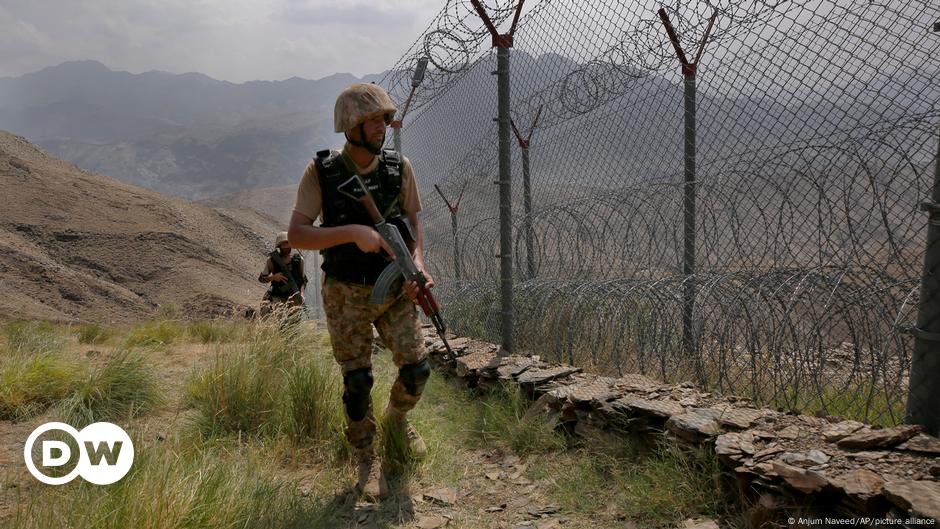
Photo via Dawn

SMOKERS’ CORNER: IN CASE OF EMERGENCY

Read the original at Dawn ↗
Cite

Paracha, N. F. (2026, October 18). SMOKERS’ CORNER: IN CASE OF EMERGENCY. Dawn. https://www.dawn.com/news/2037716/smokers-corner-in-case-of-emergency

Dated from the outlet's own feed. Check the original for its byline.

Dawn · collected 2026-10-18 · by Nadeem F. Paracha

Quick Summary

The Pakistani government has declared emergency rule in the Khyber Pakhtunkhwa (KP) province, a region historically influenced by conflicts with Afghanistan. This decision follows decades of complex and often contradictory policies toward various Taliban groups, including periods when Pakistan supported both Afghan and Pakistani Taliban factions while fighting others. Now, amid renewed violence and instability linked to these policies, the government aims to use emergency powers to facilitate military action against the Tehreek-i-Taliban Pakistan (TTP) and address the broader security crisis in KP. The article suggests that such measures might unexpectedly serve as catalysts for institutional reform by overcoming bureaucratic obstacles and legislative delays.
Written by AI on 2026-10-18, from this article's own text only (the story summary below draws on all the coverage).

AI analysis

Story summary

On October 11, 2026, emergency rule was imposed in Khyber Pakhtunkhwa (KP), a province led by former Prime Minister Imran Khan's party, Pakistan Tehreek-e-Insaf (PTI). Under the emergency declaration, KP's chief minister Sohail Afridi and several other PTI members were placed under preventive custody. The federal government accused the suspended provincial administration of colluding with militant groups like the Pakistani Taliban.

The Peshawar High Court sought replies from the KP government and senior police officials regarding the detention of Afridi and other PTI leaders, including lawmaker Junaid Akbar and others who went missing after the emergency declaration. Despite these efforts, many lawmakers remain untraceable, raising concerns over their welfare and legal rights.

Additionally, a new Area Development Secretariat (ADS) was established to manage emergency-stricken areas in KP, headed by bureaucrat Yahya Akhundzada with extensive powers similar to those of a provincial government. This move aims to better coordinate efforts against terrorism but has also sparked confusion regarding the distribution of responsibilities between the federal and provincial setups.

Despite ongoing legal challenges from PTI leaders seeking production orders for detained members, no clear timeline has been provided by the government on when emergency rule might be lifted or under what conditions those in custody will be released. This situation continues to fuel political tensions and debates over civil liberties and governance in Pakistan.

Written for “Emergency Imposed In KP” on 2026-10-31, grounded in this article and the 49 other(s) covering the same event.

Story

📰 Emergency Imposed In KP
Politics · 50 article(s) covering the same event. Compare every outlet's account →

Compared with similar articles

This article reads leans left and hedges 8% of its claims. Each row says how that neighbour differs.
Deutsche Welle
⚖️ Leans right further right than this Hedges 5 of 37 claims Outlet record 95/100
Dawn
⚖️ Leans right further right than this Hedges 0 of 8 claims Outlet record 72/100
Dawn
⚖️ Leans strongly right further right than this Hedges 0 of 20 claims Outlet record 72/100
Dawn
⚖️ Leans right further right than this Hedges 0 of 22 claims Outlet record 72/100
Dawn
Hedges 5 of 45 claims Outlet record 72/100
“Article A discusses the imposition of emergency rule in KP, while Article B focuses on PPP Chairperson Bilawal Bhutto-Zardari's statement regarding potential conditions to end governor's rule and emergency.”
Dawn
Hedges 0 of 19 claims Outlet record 72/100
“Article A discusses the imposition of emergency rule in Khyber Pakhtunkhwa province by the Pakistani government, while Article B covers a counterterrorism dialogue between Pakistan and the EU about security threats from Afghanistan.”
After the emergency Same event
Dawn
⚖️ Leans right further right than this Hedges 5 of 33 claims Outlet record 72/100
Emergency matters Same event
Dawn
⚖️ Leans right further right than this Hedges 10 of 40 claims Outlet record 72/100
Dawn
Hedges 2 of 17 claims Outlet record 72/100
“Article A describes the imposition of emergency rule in Khyber Pakhtunkhwa, while Article B reports on a court hearing regarding petitions against this decision.”
Dawn
⚖️ Leans right further right than this Hedges 1 of 12 claims Outlet record 72/100
“Article A discusses the imposition of emergency rule and governor's rule in Khyber Pakhtunkhwa, while Article B describes Prime Minister Shehbaz Sharif's visit to Peshawar after these measures were taken.”
How this article was measured signals, leaning charts, publisher record, byline, topics and claims

Signals How these are calculated →

Claims extracted
50
sentences that state something as happening or true
Uncertain
8%
4 of 50 hedged ("reportedly", "may", "according to")
Leaning
Leans left
of the writing, not the subject · beta estimate
Publisher signals
72/100
Dawn's corrections and hedging, across everything collected from it. Not a measure of accuracy.
Outlets on this story
50
Politics
Same framing elsewhere
1
articles that frame the event the way this one does
Analyzed 2026-10-18 · how these are computed

How this is being covered How these are calculated →

Article leaning vs. publisher reliability
Source leaning vs. consistency

Publisher

Dawn · 2483 article(s) · 3 correction(s) detected
Running correction rate · 3 correction(s)

Who wrote this

Nadeem F. Paracha
7 article(s) here · 1 carrying a prediction
🔮 This radical route culminated in the violent events of May 2023, and November 2024, where party supporters targeted state and military installations.
2026-10-25 · assertive framing · SMOKERS’ CORNER: WHY POLITICAL RADICALISM EATS ITSELF
🔮 Despite a major Pakistani military offensive (2015–2017) that displaced the TTP, Pakistan maintained the belief that the TTA were ‘good Taliban’ who would remain allies once in power.
2026-10-18 · assertive framing · SMOKERS’ CORNER: IN CASE OF EMERGENCY
🔮 I will not delve into the numerous anomalies highlighted by sceptics, including those raised by active pilots and aviation experts.
2026-10-11 · assertive framing · SMOKERS’ CORNER: False Flags and Credibility
🔮 However, the assumption that Yassin’s movement would remain a benign social organisation focused solely on rivalling the PLO proved to be a miscalculation.
2026-10-04 · assertive framing · SMOKERS’ CORNER: THE MAKING OF HAMAS
🔮 Last week, when Polish foreign minister Radosaw Sikorski claimed that Poland could swiftly defeat Russia in a direct conflict, political commentators across the United States and Europe met his remarks with mild mockery.
2026-09-27 · mixed framing · SMOKERS’ CORNER: THE AGE OF POLITICAL ABSURDITY
🔮 As long as the opposition fails to address the deep-seated ethnic, economic and existential anxieties of Sindhis, the electoral dominance of the PPP in Sindh will endure.
2026-09-20 · assertive framing · SMOKERS’ CORNER: WHY THE PPP DOMINATES SINDH
🔮 Their fears and historical experiences explain why plans to create a separate Karachi province will face stiff resistance.
2026-09-06 · assertive framing · SMOKERS’ CORNER: A SEPARATE PROVINCE?
Also by Nadeem F. Paracha
Nothing else under this byline is closely related to this article, so these are simply their most recent.
All 7 articles by Nadeem F. Paracha →

Topics

Afghanistan Pakistan TTA TTP Taliban

Subjects

TTP ORG · 11× TTA ORG · 9× Pakistan GPE · 7× India GPE · 4× Taliban ORG · 4× Afghanistan GPE · 3× American NORP · 3× Kabul GPE · 3× PTI ORG · 3× Pakistani NORP · 3×

Narrative

Similarly, France’s 2015 emergency created integrated counter-terrorism intelligence databases and administrative search powers that permanently improved the state’s capacity to disrupt terror plots, while the UK’s security provisions during the conflict between Irish militants and the state in the 1970s and 1980s were eventually codified into permanent frameworks, such as the Terrorism Act 2000.
framing: assertive · carried by 1 article(s) · first seen 2026-10-18
🔮 Despite a major Pakistani military offensive (2015–2017) that displaced the TTP, Pakistan maintained the belief that the TTA were ‘good Taliban’ who would remain allies once in power.
2026-10-18 · Dawn
SMOKERS’ CORNER: IN CASE OF EMERGENCY · assertive framing

Claims (50 extracted, 4 hedged)

Last week, the government of Pakistan imposed emergency rule and governor’s rule in Khyber Pakhtunkhwa (KP). asserted
government → impose → Pakhtunkhwa
The Pashtun-majority province, which shares a long border with Afghanistan, has been deeply shaped by events across the frontier. asserted
which → share → frontier
KP’s instability escalated during the 1980s, when Gen Ziaul Haq’s dictatorship, backed by American and Saudi funding, transformed Pakistan into a launching pad for anti-Soviet Afghan Islamist insurgents. asserted
dictatorship → escalate → insurgents
After the Soviet withdrawal in 1988, Pakistan aligned with the Afghan Taliban (TTA), who took power in Kabul in 1996. asserted
who → align → 1996
Even after the US forces ousted the TTA in 2001, Pakistan provided TTA fighters sanctuary to counter the new regime in Kabul installed by the US. asserted
Pakistan → oust → US
In 2007, the Tehreek-i-Taliban Pakistan (TTP) emerged. asserted
Pakistan → emerge → 2007
While the TTA maintained ties with Pakistan’s security establishment, they also cultivated ideological links with the TTP. asserted
they → maintain → TTP
However, the TTA remained passive as the TTP carried out brutal attacks inside Pakistan. asserted
TTP → remain → Pakistan
Despite a major Pakistani military offensive (2015–2017) that displaced the TTP, Pakistan maintained the belief that the TTA were ‘good Taliban’ who would remain allies once in power. asserted
who → displace → power
TTP became the ‘bad Taliban.’ asserted
TTP → become → ?
The strategy was as juvenile as it sounds. asserted
it → sound → ?
Under the Pakistan Tehreek-i-Insaf (PTI), the government began resettling TTP fighters who had escaped to Afghanistan. asserted
who → begin → Afghanistan
There was no serious bar on them retaining their weapons and regrouping. asserted
them → be → weapons
Decades of contradictory policies towards the Afghan and Pakistani Taliban have left Khyber Pakhtunkhwa mired in insecurity. asserted
Decades → leave → insecurity
As the state imposes emergency rule in KP, the question is whether extraordinary powers can help correct the state’s longstanding strategic failures asserted
powers → impose → failures
Understandably, during the TTA’s return to power in 2021 in Afghanistan and Imran Khan’s ouster in 2022, the TTP launched a fresh wave of violent attacks, primarily in KP. asserted
TTP → launch → KP
The TTP had sensed that, after Khan’s fall, the policy of the new military establishment might shift. uncertain
policy → sense → establishment
And it did. asserted
it → do → ?
Today, the federal government and military establishment accuse KP’s PTI-led provincial administration of shielding TTP elements. asserted
government → accuse → elements
Meanwhile, the ‘good versus bad Taliban’ strategy has crumbled as the TTA regime in Kabul refuses to stop TTP attacks and has begun cultivating ties with India. asserted
regime → crumble → India
According to the Pakistani government and the military establishment, the emergency in KP will sideline the PTI-led provincial administration, paving the way for a decisive military operation against the TTP that will be able to counter proxies backed by the TTA and India more effectively. uncertain
that → accord → TTA
Emergencies are often viewed as dents in a democratic system. asserted
Emergencies → view → system
Indeed, but here I would explore it from another angle. asserted
I → explore → angle
There are political scientists, legal scholars and economists who have long observed that structural emergencies frequently act as catalysts for institutional growth. asserted
emergencies → be → growth
By fracturing rigid bureaucracies, overriding legislative inertia, regulating politicised security institutions and mobilising state capacity, there is a history of emergency conditions that have spurred economic advancement and curbed security threats. asserted
that → fracture → threats
In The Political Economy of States of Emergency, legal scholar Balakrishnan Rajagopal demonstrates that economic and national security emergencies historically drive states to centralise financial governance, rationalise labour markets and establish resilient public safety nets. asserted
emergencies → demonstrate → nets
Complementing this, the American sociologist Mancur Olson argued that emergencies dismantle entrenched interest groups. asserted
emergencies → complement → groups
These groups slow down economic growth and facilitate agitation. asserted
groups → slow → agitation
A clear historical example of this occurred during India’s 21-month emergency (1975–1977), declared by prime minister Indira Gandhi. asserted
example → occur → Gandhi
Prior to the declaration, India was experiencing severe economic stagflation, spiralling inflation driven by global oil shocks, constant industrial strikes and political violence. asserted
India → experience → shocks
As documented by the American legal historian Granville Austin, the centralisation of executive power through the emergency enabled the enforcement of a 20-point programme, clamping down on hoarding and strikes, which rapidly reduced inflation, increased industrial production and elevated tax compliance through stringent enforcement. asserted
which → document → enforcement
Violence against the state and government too decreased significantly. asserted
Violence → decrease → state
In South Korea, the state of emergency following the Korean War in the 1950s allowed state planners to initiate rapid, export-led industrialisation that transformed a devastated nation into a global economic power. asserted
that → follow → power
In his book Constitutional Dictatorship, American political scientist Clinton Rossiter argued that temporary emergency powers are necessary mechanisms designed precisely to preserve constitutional order during existential threats. asserted
powers → argue → threats
According to Rossiter, far from destroying the legal framework, well-regulated emergency powers allow democracies to deploy decisive force to restore order without permanent constitutional erosion. uncertain
democracies → accord → erosion
In Singapore, early post-independence security emergencies led to the establishment of streamlined administrative and judicial frameworks that laid the foundation for one of the world’s most stable, low-crime and commercially reliable legal environments. asserted
that → lead → environments
According to Austin, in India, periods of national emergency eventually led the judiciary to refine constitutional protections, such as establishing the “basic structure doctrine” to balance executive emergency authority with civil liberties. uncertain
periods → accord → liberties
This structural tightening creates a durable framework that lowers everyday crime rates and clarifies rule-of-law standards after the crisis subsides. asserted
crisis → create → standards
Emergencies also provide governments with the operational flexibility required to dismantle sophisticated clandestine networks, disrupt their financial channels and re-establish state sovereignty over ungoverned spaces. asserted
Emergencies → provide → spaces
In Inside Terrorism, American political scientist Bruce Hoffman highlights that anti-terror operations require agility that standard peacetime administrative frameworks rarely afford. asserted
frameworks → highlight → that
…and 10 more, not listed.

💬Give feedback
🕘History 🎫Support