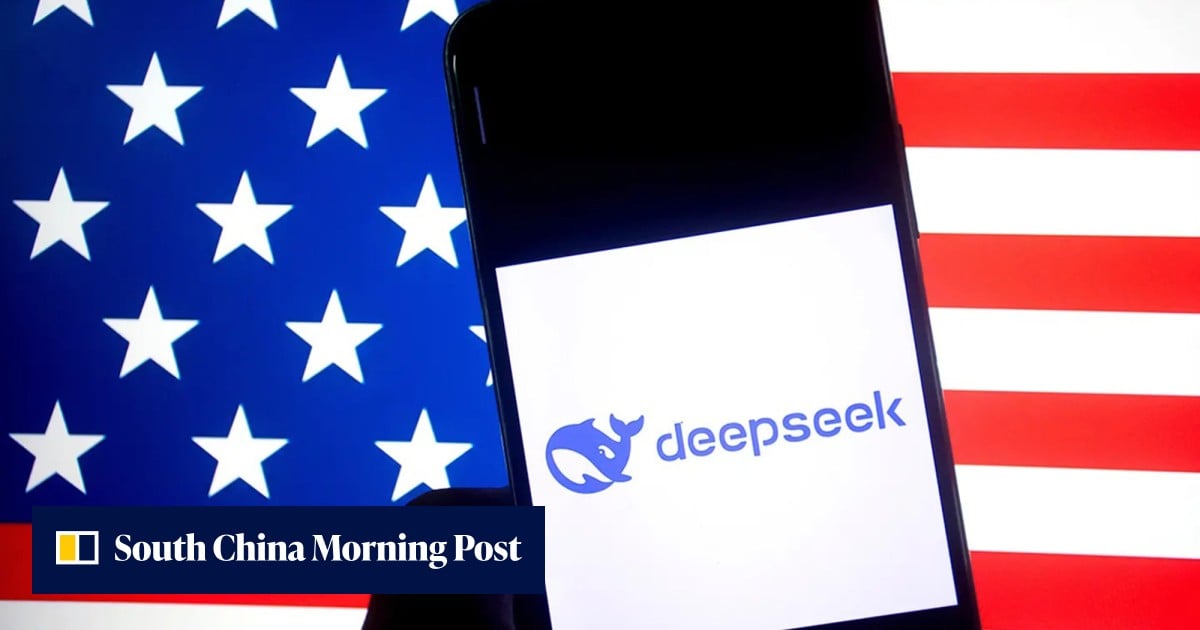
Photo via The Straits Times

US banning Chinese AI DeepSeek from government agency IT systems

Read the original at The Straits Times ↗
Cite

The Straits Times. (2026, October 19). US banning Chinese AI DeepSeek from government agency IT systems. The Straits Times. https://www.straitstimes.com/world/united-states/us-banning-chinese-ai-deepseek-from-government-agency-it-systems

Dated from the outlet's own feed. Check the original for its byline.

The Straits Times · collected 2026-10-19 · by The Straits Times

Quick Summary

The US Department of Homeland Security (DHS) has ordered the removal of DeepSeek products and third-party services that use the Chinese AI model from all US civilian agency IT systems. This ban also prohibits future acquisition of DeepSeek products by these agencies due to concerns over potential data transfer to China and security vulnerabilities. DHS cited multiple threat vectors, including the risk of transferring sensitive information and producing actionable intelligence on US persons or government agencies. Several other US federal agencies and states have already banned the use of DeepSeek.
Written by AI on 2026-10-19, from this article's own text only (the story summary below draws on all the coverage).

AI analysis

Story summary

As of October 19, 2026, the U.S. Department of Homeland Security (DHS) has ordered federal civilian agencies to remove AI software developed by DeepSeek, a Chinese company, from government IT systems due to national security concerns. The directive also bans future acquisitions of DeepSeek products and services. DHS cited "multiple threat vectors" posed by DeepSeek models, including the potential for transferring sensitive data to the People’s Republic of China (PRC) if used by U.S. government employees or vendors. Additionally, DHS warned that DeepSeek models may contain malware or other security vulnerabilities, which could produce actionable intelligence on US persons and agencies. This decision follows previous bans implemented by various U.S. agencies, including the Department of Commerce and the Navy.
Written for “US Banning China's DeepSeek AI” on 2026-11-04, grounded in this article and the 2 other(s) covering the same event.

Story

📰 US Banning China's DeepSeek AI
Politics · 3 article(s) covering the same event. Compare every outlet's account →

Compared with similar articles

This article reads leans right and hedges 27% of its claims. Each row says how that neighbour differs.
South China Morning Post
⚖️ Leans right Hedges 1 of 3 claims Outlet record 62/100
New York Post
⚖️ Leans right Hedges 2 of 14 claims Outlet record 66/100
Semafor
Hedges 3 of 4 claims Outlet record 59/100
“Article A discusses potential export controls by China, while Article B reports on a specific US ban on Chinese AI DeepSeek within government IT systems.”
South China Morning Post
⚖️ Leans right Hedges 3 of 9 claims Outlet record 62/100
“Article A describes a specific ban on Chinese AI DeepSeek by US agencies, while Article B discusses broader US-China talks and cooperation in AI.”
How this article was measured signals, leaning charts, publisher record, byline, topics and claims

Signals How these are calculated →

Claims extracted
15
sentences that state something as happening or true
Uncertain
27%
4 of 15 hedged ("reportedly", "may", "according to")
Leaning
Leans right
of the writing, not the subject · beta estimate
Publisher signals
66/100
The Straits Times's corrections and hedging, across everything collected from it. Not a measure of accuracy.
Outlets on this story
3
Politics
Same framing elsewhere
1
articles that frame the event the way this one does
Analyzed 2026-10-19 · how these are computed

How this is being covered How these are calculated →

Article leaning vs. publisher reliability
Source leaning vs. consistency

Publisher

The Straits Times · 4353 article(s) · 5 correction(s) detected
Running correction rate · 5 correction(s)

Who wrote this

The Straits Times
2849 article(s) here · 1 carrying a prediction
🔮 The strikes, which also targeted a cargo vessel at sea near Odesa, follow Tuesday's bombardments with missiles and drones that knocked out power to swathes of Ukraine, a week before US-brokered peace talks were set to resume.
🔮 While Ramaswamy, 41, faced sharp backlash over his ad campaign, Trump continued to back the Republican candidate and accused the media of a coordinated attack to undermine his chances. US Vice-President J.D. Vance similarly defended his “good friend” Ramaswamy while on the campaign trail in Ohio. But Democrats swiftly criticised the ad, as did some Republicans including outgoing Ohio governor Mike DeWine, who could not run again due to term limits. In the ad by Ramaswamy’s campaign, Acton’s estranged mother – Donna Arthur – said her daughter has “lied her entire life” and should not be allowed to become governor. Acton issued a statement in October saying that she and her brother had “endured abuse, hunger, and neglect” as children. “Between the ages of 10 and 12, I was sexually abused by her husband, while my birth mother did nothing to protect me,” she said.
🔮 It was a striking Democratic gain in a state President Donald Trump carried by more than 16 percentage points in 2024 and where the race had initially been expected to be safely Republican.
🔮 The top Democrat in the US House of Representatives vowed on Nov 3 he would use his expected majority to go after corruption, in an election when alleged grift by President Donald Trump has been top of voters’ minds.
🔮 In an interview with Fox News, Trump said Democrats would send legislation he considered “insane” to his desk and that he would veto it.
🔮 Three-term Republican Texas Governor Greg Abbott lost to Democratic state Representative Gina Hinojosa in a stunning upset that ends the Republican Party’s three-decade hold on the governor’s office, US media projected on Nov 3.
🔮 Talarico defeated the state’s Attorney-General Ken Paxton, a close ally of President Donald Trump who survived impeachment and years of scandal, NBC News and CBS News projected.
🔮 Democrat Kathy Hochul was projected to win a second full term as New York’s governor, defeating Republican Bruce Blakeman in a race polls showed her leading throughout the campaign.
🔮 Trump says he will accept results of US midterm elections Erica L. Green and Tyler Pager AI generated
🔮 But after initially saying Trump was “cautiously optimistic,” the mood music changed as Democrats looked increasingly likely to deal the president a bruising setback that could upend his last two years in power.
Also by The Straits Times
Nothing else under this byline is closely related to this article, so these are simply their most recent.
All 2849 articles by The Straits Times →

Topics

Chinese DHS DeepSeek FCC WASHINGTON

Subjects

Chinese NORP · 8× DHS ORG · 4× FCC ORG · 3× WASHINGTON GPE · 2× Homeland Security Department ORG · 1× Navy ORG · 1× New York GPE · 1× PRC GPE · 1× The US ORG · 1× the Department of Commerce ORG · 1×

Narrative

In July, the FCC voted to bar sales of devices in the US that contain key hardware from Chinese companies deemed to be national security risks and has proposed to prohibit US telecommunications carriers from interconnecting with Chinese telecom firms deemed national security risks.
framing: mixed · carried by 1 article(s) · first seen 2026-10-19
🔮 DHS said DeepSeek models pose “multiple threat vectors” and raised concerns that use of the product “may result in the transfer of sensitive data to the PRC if used by US government employees or vendors”.
2026-10-19 · The Straits Times
US banning Chinese AI DeepSeek from government agency IT systems · mixed framing

Claims (15 extracted, 4 hedged)

US banning Chinese AI DeepSeek from government agency IT systems AI generated asserted
AI → ban → systems
The US Homeland Security Department (DHS) is ordering the removal of DeepSeek products and third-party services using the Chinese AI model from US civilian agency IT systems, according to a notice published on Oct 19. uncertain
Department → order → Oct
The department is also banning acquisition of DeepSeek products and third-party services developed using DeepSeek by US civilian government agencies. asserted
department → ban → agencies
DHS said DeepSeek models pose “multiple threat vectors” and raised concerns that use of the product “may result in the transfer of sensitive data to the PRC if used by US government employees or vendors”. uncertain
use → say → employees
DHS also said use of DeepSeek by government agencies “could produce actionable intelligence on US persons and/or government agencies. uncertain
use → say → persons
The models themselves may contain malware or other security vulnerabilities”. uncertain
models → contain → malware
In a July memo made public on Oct 19, DHS told federal agencies to monitor flows of traffic in and out of government websites to address potential risks from DeepSeek. asserted
DHS → make → DeepSeek
Previously, several US agencies, including the Department of Commerce and the Navy, have banned the use of DeepSeek on government devices. asserted
agencies → include → devices
Multiple states including New York, Tennessee, and Virginia have taken similar steps. asserted
states → include → steps
The Chinese Embassy in Washington did not immediately comment. asserted
Embassy → comment → Washington
The Trump administration has taken a series of steps to crack down on Chinese tech companies. asserted
administration → take → companies
The Federal Communications Commission (FCC) will vote on Oct 29 to bar all Chinese labs from testing electronic devices such as smartphones, cameras and computers for use in the US. asserted
Commission → vote → US
In 2025, 82% of US electronics were tested in China. asserted
% → test → China
In December, the FCC banned import of all new models of Chinese drones and also banned imports of new models of Chinese-made consumer routers, the boxes connecting computers, phones and smart devices to the internet. asserted
FCC → ban → internet
In July, the FCC voted to bar sales of devices in the US that contain key hardware from Chinese companies deemed to be national security risks and has proposed to prohibit US telecommunications carriers from interconnecting with Chinese telecom firms deemed national security risks. asserted
that → vote → firms
💬Give feedback
🕘History 🎫Support