Photo via The Straits Times

Israel’s elections: Four possible scenarios

Read the original at The Straits Times ↗
Cite

The Straits Times. (2026, October 21). Israel’s elections: Four possible scenarios. The Straits Times. https://www.straitstimes.com/world/middle-east/israels-elections-four-possible-scenarios

Dated from the outlet's own feed. Check the original for its byline.

The Straits Times · collected 2026-10-21 · by The Straits Times

Quick Summary

Israel will hold elections on October 27, with results expected to be closely contested in a fragmented political landscape where no single party is likely to secure the necessary 61 seats for a majority in the 120-seat Knesset. The article outlines four potential outcomes: immediate coalition formation after negotiations between parties, a minority government relying on ad hoc support from other lawmakers including Arab Israeli parties, and a national unity government aimed at bridging political divides. Polls indicate that Benjamin Netanyahu’s right-wing bloc is neck and neck with the opposition led by former military chief Gadi Eisenkot, each holding around 50 to 52 seats.
Written by AI on 2026-10-21, from this article's own text only (the story summary below draws on all the coverage).

AI analysis

Story summary

Israel holds parliamentary elections on October 27, 2026, with no single party expected to win a majority in the 120-seat Knesset. President Isaac Herzog will consult with party representatives after the results are announced and name a candidate to form a government coalition. This process can be complex and time-consuming, as it did in November 2022 when Benjamin Netanyahu took 58 days to form his government due to fragmented political negotiations and parties' insistence on their interests.

Written for “Israel Elections Scenarios” on 2026-10-30, grounded in this article and the 0 other(s) covering the same event.

Story

📰 Israel Elections Scenarios
Politics · 1 article(s) covering the same event.

Compared with similar articles

This article reads unscored and hedges 22% of its claims. Each row says how that neighbour differs.
Toronto Star
⚖️ Leans left Hedges 5 of 55 claims Outlet record 64/100
“Article A discusses Mansour Abbas and his party's potential role in deciding Israel's election, while Article B outlines four possible scenarios for post-election coalition formation without specifying any particular person or party.”
Al Jazeera
⚖️ Leans right Hedges 4 of 53 claims Outlet record 60/100
“Article A describes a specific meeting and pact signed by opposition leaders on September 26 to oust Netanyahu, while Article B outlines possible election scenarios based on proportional representation voting rules for the October 27 election.”
The Sydney Morning Herald
⚖️ Leans left Hedges 3 of 82 claims Outlet record 61/100
“The articles discuss Israel's upcoming elections but describe different aspects and do not focus on a single specific incident or occurrence.”
Al Jazeera
⚖️ Leans strongly left Hedges 6 of 56 claims Outlet record 60/100
“Article A discusses Israel's relationship with Europe and Ursula von der Leyen's comments, while Article B focuses on potential scenarios for upcoming Israeli elections.”
The Sydney Morning Herald
⚖️ Leans left Hedges 3 of 51 claims Outlet record 61/100
“Article A reports on voter sentiment and activities in the lead-up to Israel's elections, while Article B provides an analysis of potential election outcomes and coalition scenarios.”
The Straits Times
Hedges 1 of 7 claims Outlet record 66/100
“Article A reports on Trump endorsing Netanyahu for the Israeli election, while Article B discusses possible scenarios and outcomes of the upcoming election itself.”
CBS News
Hedges 1 of 15 claims Outlet record 66/100
“Article A reports on Trump endorsing Netanyahu for reelection, while Article B discusses possible coalition scenarios following Israel's upcoming elections.”
National Post
Hedges 6 of 53 claims Outlet record 60/100
“The articles discuss different aspects of Israel's upcoming election on Oct 27, 2026; one focuses on the stakes and issues, while the other outlines potential post-election scenarios.”
Al Jazeera
Hedges 5 of 44 claims Outlet record 60/100
“The articles discuss Israel's upcoming elections but do not describe the same specific incident or occurrence.”
The Straits Times
⚖️ Leans left Hedges 5 of 35 claims Outlet record 66/100
“Article A discusses the potential impact of Arab voter turnout in a specific upcoming Israeli election that could affect Netanyahu's position, while Article B provides an overview of possible scenarios following the actual election results.”
How this article was measured signals, leaning charts, publisher record, byline, topics and claims

Signals How these are calculated →

Claims extracted
27
sentences that state something as happening or true
Uncertain
22%
6 of 27 hedged ("reportedly", "may", "according to")
Leaning
not political
takes no side on a contested political question
Publisher signals
66/100
The Straits Times's corrections and hedging, across everything collected from it. Not a measure of accuracy.
Outlets on this story
1
Politics
Same framing elsewhere
1
articles that frame the event the way this one does
Analyzed 2026-10-21 · how these are computed

How this is being covered How these are calculated →

Article leaning vs. publisher reliability
Source leaning vs. consistency

Publisher

The Straits Times · 4019 article(s) · 5 correction(s) detected
Running correction rate · 5 correction(s)

Who wrote this

The Straits Times
2506 article(s) here · 1 carrying a prediction
🔮 "In no case will there be a family photo with European partners and Mr. Lavrov together because ... there is no normalcy with Russia," German Foreign Minister Johann Wadephul told reporters earlier on Friday.
🔮 The two parties are set to unveil a series of deals – from critical minerals to artificial intelligence – and lay the groundwork for a broader alliance open to other democracies seeking to better navigate global trade tensions.
🔮 The restaurant flap is the latest offbeat detour in a campaign in which Trump has warned darkly about communism, commented on the physique of men's bodies and joked that the $5,000 payments he is promising Americans if Republicans keep Congress would barely cover a meal at his Mar-a-Lago club in Florida.
🔮 Neither side wants to be blamed by Trump for something going wrong in Oleshky, an event that could burnish his self-professed credentials as a peacemaker before US midterm legislative elections. But the two sides remain far apart on potential terms for ending the conflict in Ukraine, and there appears to be no immediate prospect of it ending.
🔮 In a statement announcing the demolitions, Israel's military said it would "continue to operate proactively and offensively" to thwart attacks in the West Bank and "protect residents in the area".
🔮 He registered to vote in Illinois under his birth name Robert Francis Prevost and requested a ballot on October 3, the Chicago Sun-Times reported on Thursday, citing the Will County Clerk's office.
🔮 Meta, TikTok and X argued the notices create unprecedented regulatory burdens, with X claiming that what it described as “the most burdensome information request X has received from any regulator” would cost it millions of pounds.
🔮 President Trump loves his supporters, and in addition to nearly 20 tele-rallies, he will hold back-to-back rallies in Kansas and Iowa on Sunday," the official said, speaking on condition of anonymity.
🔮 Over the past decade or so, G-7 countries would at least “have agreed a coordinated platform before they came to the G-20, but now we don’t even really have that,” she added.
🔮 Given the web of interconnected conflicts in the Horn of Africa, with neighbouring countries and powers further afield backing their respective proxies, experts have warned that war in Ethiopia could trigger a broader conflict in the region.
Also by The Straits Times
Nothing else under this byline is closely related to this article, so these are simply their most recent.
All 2506 articles by The Straits Times →

Topics

Arab Israel Parliament Raam the Joint List

Subjects

Israel GPE · 6× Netanyahu PERSON · 6× Eisenkot PERSON · 4× Arab NORP · 3× Parliament ORG · 3× Israeli NORP · 2× Raam ORG · 2× the Joint List ORG · 2× Jerusalem GPE · 1× Knesset ORG · 1×

Narrative

After the official announcement of the results, President Isaac Herzog will consult with party representatives and name a candidate who has the chance to form a government – not necessarily the party with the most seats, but the one deemed best positioned to secure enough seats in Parliament.
framing: mixed · carried by 1 article(s) · first seen 2026-10-21
🔮 Israel’s elections: Four possible scenarios AI generated Jerusalem – Israel goes to the polls on Oct 27 with results forecast to be close, meaning that the next government will be determined by whoever can cobble together a coalition in a fragmented political landscape.
2026-10-21 · The Straits Times
Israel’s elections: Four possible scenarios · mixed framing

Claims (27 extracted, 6 hedged)

Israel’s elections: Four possible scenarios AI generated Jerusalem – Israel goes to the polls on Oct 27 with results forecast to be close, meaning that the next government will be determined by whoever can cobble together a coalition in a fragmented political landscape. asserted
whoever → generate → landscape
Israel votes through proportional representation based on the nationwide vote and it is highly unlikely that any single party would come even close to the 61 seats needed for a majority in the 120-seat Parliament, or Knesset. asserted
party → vote → Parliament
Immediately after the election, the parties will begin negotiations to try to reach the 61-seat threshold. asserted
parties → begin → threshold
After the official announcement of the results, President Isaac Herzog will consult with party representatives and name a candidate who has the chance to form a government – not necessarily the party with the most seats, but the one deemed best positioned to secure enough seats in Parliament. asserted
who → consult → Parliament
The negotiations can be arduous and lengthy, with parties insisting on parochial interests, and can produce unstable governments. asserted
parties → insist → governments
Following the previous election in November 2022, it took Benjamin Netanyahu 58 days to form his government. asserted
it → follow → government
Polls show that Netanyahu’s right-wing and far-right coalition and the opposition bloc, whose most prominent figure is former military chief Gadi Eisenkot, are neck and neck, with approximately 50 to 52 seats each. asserted
figure → show → seats
The two sides have been nearly even in polls for weeks, foreshadowing a mathematical puzzle that both sides will have to solve to find the 10 or so seats needed for a coalition. Israeli political history is full of twists and turns, with defections and other unexpected shifts in alliances. asserted
history → foreshadow → alliances
Israel also has two new right-wing parties that are seen as scratching the threshold of entering Parliament, where they could throw their decisive support to one of the two blocs. uncertain
they → have → blocs
If no bloc manages to secure 61 seats, a candidate could attempt to govern without a majority but rather through support on an ad hoc basis by other lawmakers. uncertain
candidate → manage → lawmakers
In this scenario, lawmakers from Israel’s Arab minority – who make up 20% of the population and generally identify as Palestinians – could play a critical role. uncertain
who → make → role
Polls show that two Arab-Israeli lists, the Joint List and Raam, could win 12 to 14 seats in total. uncertain
lists → show → total
Raam, led by Mansour Abbas, a kingmaker in the past, has stated its willingness to work with Eisenkot’s bloc, and the Joint List has offered to provide a “safety net” for any coalition that ousts Netanyahu from power. asserted
that → lead → power
But the leading figures in the opposition bloc are reluctant to publicly acknowledge such a possibility, due to the hostility of a large segment of the Jewish electorate towards any form of alliance with Israeli Arabs. asserted
figures → lead → Arabs
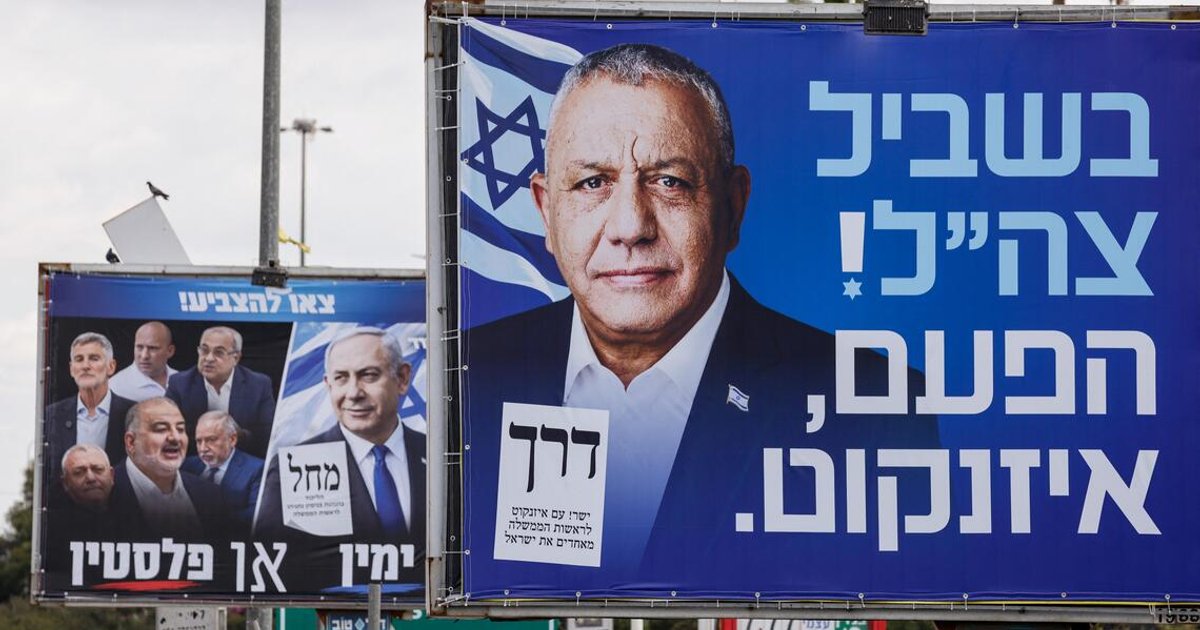
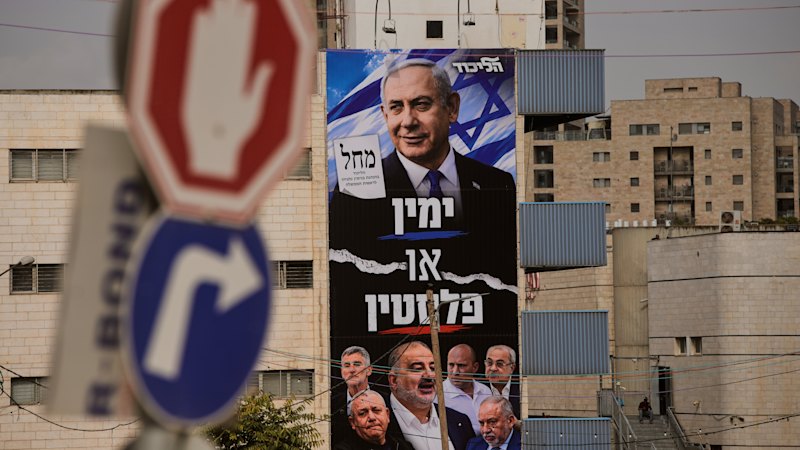
This has not prevented Netanyahu from focusing his campaign on the possibility of Eisenkot working with Arab parties, campaigning on the slogan, “Either the right wing or Palestine.” asserted
Eisenkot → prevent → slogan
3. National unity government Considering Israel’s extreme polarisation, a national unity government would appear fanciful, but it could theoretically create a less extreme government. uncertain
it → consider → government
Israeli commentators have often mused on the possibility of a national unity government in which Netanyahu would jettison his provocative far-right allies as well as ultra-Orthodox parties and team up with Eisenkot, who shares Netanyahu’s views on many security issues. asserted
who → muse → issues
The grand coalition would also exclude Arab parties. asserted
coalition → exclude → parties
A poll published on Oct 16 found that 55% of Israelis would prefer a national unity government over new elections, if the vote did not produce a clear majority. asserted
vote → publish → majority
This scenario has a recent precedent. asserted
scenario → have → precedent
In 2020, Netanyahu and Benny Gantz, like Eisenkot a retired general appealing to the centre, reached a power-sharing agreement after three elections in less than a year, which stipulated a rotation of the prime ministership. asserted
which → retire → ministership
But the partnership fell apart after a year, triggering a new election. asserted
partnership → fall → election
According to media reports, Herzog is working behind the scenes to bring Netanyahu and Eisenkot together to repeat the experiment should a deadlock occur after Oct 27. uncertain
deadlock → accord → Oct
However, the scenario would face strong opposition from both sides, particularly from the opposition bloc, which is treating the election as a referendum against Netanyahu and has questioned his character. asserted
which → face → character
4. Deadlock and new elections If no candidate manages to form a government, Israel will have to return to the polls. asserted
Israel → manage → polls
The country held four elections between April 2019 and March 2021 due to the inability of politicians to forge a lasting coalition. asserted
country → hold → coalition
The candidate designated by the president will, in principle, have 28 days to form a coalition, with a possible 14-day extension, although there are other procedural ways to prevent an immediate calling of new elections. asserted
candidate → designate → elections

💬Give feedback
🕘History 🎫Support