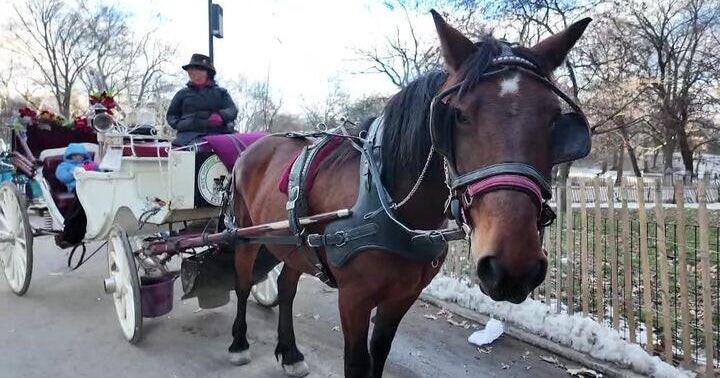
Photo via BBC News

Some New Yorkers hail ban on horse-drawn carriages, but drivers fear for incomes

Read the original at BBC News ↗
Cite

Halpert, M. (2026, October 22). Some New Yorkers hail ban on horse-drawn carriages, but drivers fear for incomes. BBC News. https://www.bbc.co.uk/news/articles/c6qjnwd1pgjxo?at_medium=RSS&at_campaign=rss

Dated from the outlet's own feed. Check the original for its byline.

BBC News · collected 2026-10-22 · by Madeline Halpert

Quick Summary

New York City Council is expected to vote on a ban of horse-drawn carriages in Central Park starting June 2028, following concerns about animal and public safety after recent incidents including the death of a tourist named Romanch Mahajan and a carriage horse that ate a toxic plant. The ban, supported by Mayor Zohran Mamdani, aims to end a controversial tradition that has lasted over 160 years but faces opposition from some drivers who argue their horses are well cared for. Since 1982, 40 horses have died in Central Park due to issues like overheating and collisions.
Written by AI on 2026-10-22, from this article's own text only (the story summary below draws on all the coverage).

AI analysis

Story summary

The New York City Council voted on October 22, 2026, to ban horse-drawn carriages from city streets and Central Park starting June 1, 2028. The bill, named Romanch’s Law after the death of an 18-year-old tourist, Romanch Mahajan, who died in a carriage accident earlier this year, was supported by Mayor Zohran Mamdani and passed with 40 out of 51 votes. It aims to end a 160-year-old tradition while providing transition support for the approximately 150 drivers currently employed in the industry. The legislation includes provisions to ensure humane treatment for retired horses, preventing their sale or transfer to other carriage companies. Critics argue that carriages harm animal welfare and pose safety risks, while supporters highlight the cultural significance and job creation aspects of the longstanding tourist attraction.

Written for “NYC Horse Carriage Ban Deal” on 2026-11-02, grounded in this article and the 27 other(s) covering the same event.

Story

📰 NYC Horse Carriage Ban Deal
Politics · 28 article(s) covering the same event. Compare every outlet's account →

Compared with similar articles

This article reads unscored and hedges 7% of its claims. Each row says how that neighbour differs.
New York Post
⚖️ Leans left Hedges 0 of 14 claims Outlet record 66/100
New York Post
Hedges 1 of 18 claims Outlet record 66/100
“The articles discuss different aspects of the horse-drawn carriage ban in New York City and do not describe the same specific incident.”
BBC News
⚖️ Leans left Hedges 1 of 20 claims Outlet record 68/100
“While both articles discuss the impending ban on horse-drawn carriages in New York City, Article A focuses on the legislative process and a recent accident, while Article B discusses reactions to the vote that has already occurred.”
Daily Mail
⚖️ Leans right Hedges 1 of 33 claims Outlet record 68/100
“While both articles discuss the decision to ban horse-drawn carriages in New York City, they describe different aspects of the event - one focuses on the personal impact on drivers and their horses, while the other covers Trump's criticism of the decision.”
CBS News
Hedges 1 of 27 claims Outlet record 66/100
“Article A discusses the impact on a carriage driver due to the recent vote, while Article B reports on the actual vote and passage of the bill by the NYC Council.”
The Hindu
⚖️ Leans left Hedges 1 of 21 claims Outlet record 77/100
“While both articles discuss the New York City Council's vote to ban horse-drawn carriages on October 22, 2026, they describe different aspects of the event. Article A focuses on a specific driver's reaction and concerns about the ban, while Article B covers the broader context including the voting details and the law's namesake.”
ABC News (AU)
⚖️ Leans left Hedges 2 of 23 claims Outlet record 68/100
“Article A discusses a driver's reaction to the proposed ban and its impact on her livelihood, while Article B reports on the city council voting to enact the ban from June 2028.”
CBC News
⚖️ Leans left Hedges 1 of 18 claims Outlet record 60/100
“Article A discusses the reaction to a ban on horse-drawn carriages, while Article B describes the city council's vote to advance the bill for such a ban.”
National Post
⚖️ Leans left Hedges 0 of 13 claims Outlet record 60/100
“Article A discusses the impact on horse-drawn carriage drivers after a decision has been made, while Article B describes the actual city council vote and outcome that led to this decision.”
New York Post
Hedges 0 of 13 claims Outlet record 66/100
“Article A discusses the impact on horse carriage drivers due to the city's vote, while Article B reports on a lawsuit filed by the union immediately after the vote.”
How this article was measured signals, leaning charts, publisher record, byline, topics and claims

Signals How these are calculated →

Claims extracted
56
sentences that state something as happening or true
Uncertain
7%
4 of 56 hedged ("reportedly", "may", "according to")
Leaning
withheld
no quote in the article backed the model's score
Publisher signals
68/100
BBC News's corrections and hedging, across everything collected from it. Not a measure of accuracy.
Outlets on this story
28
Politics
Same framing elsewhere
1
articles that frame the event the way this one does
Analyzed 2026-10-22 · how these are computed

How this is being covered How these are calculated →

Article leaning vs. publisher reliability
Source leaning vs. consistency

Publisher

BBC News · 4864 article(s) · 6 correction(s) detected
Running correction rate · 6 correction(s)

Who wrote this

Madeline Halpert
19 article(s) here · 1 carrying a prediction
🔮 He plead guilty in May to 101 state charges, including first-degree murder - resulting in a sentence of life in prison - but initially pleaded not guilty in the federal case.
🔮 The winning ticket will expire on Wednesday "unless the rightful ticket holder comes forward", OLG said.
🔮 On Thursday, New York City Council is expected to vote to pass a ban on the carriages that would start in June 2028.
🔮 - Published New York City Council is expected to outlaw horse-drawn carriages starting in June 2028, a ban that also has the support of the mayor.
🔮 Inside, the shop was packed with cameramen and customers, while passersby looked inside, asking: "Where's the bird?" Art of Play has found itself at the centre of a social media storm since the weekend when Grammy-winning musician Kelly Clarkson complained online that the boutique store would not let her buy a singing and dancing mechanical bird that was perched on the wall.
🔮 Cornell's president said anyone who violated the new fraternity party policy at the New York university would be suspended.
🔮 , Trump said Russia would then supply 500,000 tonnes in November and one million more after that.
🔮 She said she was intoxicated during the alleged incident and could not provide consent.
🔮 This week, Van Houten's office announced it would be reopening the case - less than two weeks after Doe filed her civil lawsuit.
🔮 Typically, after a student reports an assault on campus, the university's Title IX office determines whether the alleged behaviour could constitute a violation of policy.
Also by Madeline Halpert
Nothing else under this byline is closely related to this article, so these are simply their most recent.
All 19 articles by Madeline Halpert →

Topics

BBC Manhattan New York New York City Council New York's

Subjects

Lawson PERSON · 5× New York GPE · 3× BBC ORG · 2× Alexus Lawson PERSON · 1× Manhattan GPE · 1× New York City Council GPE · 1× New York's GPE · 1× New Yorkers NORP · 1× Ron Tsur PERSON · 1× Zohran Mamdani PERSON · 1×

Narrative

Lawson, who owns six horses, pointed out that New York City carriages were the most regulated in the country and said horses enjoyed the stimulation. "They look at an animal in harness and they see a trap," Lawson said of officials pushing for the ban.
framing: assertive · carried by 1 article(s) · first seen 2026-10-22
🔮 On Thursday, New York City Council is expected to vote to pass a ban on the carriages that would start in June 2028.

Claims (56 extracted, 4 hedged)

- Published After petting a carriage horse in New York's Central Park at the age of five, Alexus Lawson was hooked. She has driven a carriage in Manhattan's most famous park, pulled by her horse, for six years. asserted
She → publish → years
But since Lawson heard about the city's vote this week to outlaw the carriages over animal and public-safety concerns, she has been worried. asserted
she → hear → concerns
"What am I supposed to do with my horse?" asked the 28-year-old, who has been driving in the park for six years. asserted
who → suppose → years
"You're going to tell me I can't work with her anymore? asserted
I → go → her
How am I supposed to ensure her health?" asserted
I → suppose → health
Lawson is one of roughly 200 horse-drawn carriage drivers in Central Park. asserted
Lawson → draw → Park
Use of the carriages has been an at-times controversial tradition for over 160 years that has become a popular tourist activity. asserted
that → become → years
On Thursday, New York City Council is expected to vote to pass a ban on the carriages that would start in June 2028. asserted
that → expect → June
The proposal is backed by Mayor Zohran Mamdani, who says he will help develop a transition plan for workers in the industry. asserted
he → back → industry
But several drivers who spoke to the BBC said they did not want new jobs, and disputed claims their horses are mistreated - even as many New Yorkers and tourists welcomed the ban. "There were a few cases of horses dying in the middle of the park. uncertain
horses → speak → park
You can clearly see that they're not taken care of," said New York resident Ron Tsur. asserted
Tsur → see → care
"That's not what they're supposed to be doing." Since 1982, 40 horses working in Central Park have died, according to the Manhattan Borough President's office, which blames issues including overheating and collisions. uncertain
which → suppose → overheating
New York leaders previously sought a ban, under pressure from animal-rights activists, but faced pushback from city council members and unions representing the workers. asserted
leaders → seek → workers
But the ban movement found new momentum this summer after the death of a teenager. asserted
movement → find → teenager
In June, Romanch Mahajan, a tourist visiting New York with his family from India, was in a carriage when the horse bolted, causing the 18-year-old to fall out and die. asserted
old → visit → carriage
The planned ban - named Romanch's Law after the teen - also follows the death this year of a carriage horse, Deniz, who ate a toxic plant in Central Park. asserted
who → plan → Park
'Horses are working animals' Several Central Park horse carriage drivers who spoke to the BBC said they were devoted to their horses and that the rides did not pose a safety risk. asserted
rides → work → risk
Lawson, who was nearby on the day Mahajan fell to his death, called the deadly incident "extremely tragic". asserted
Mahajan → fall → incident
But she said if the city was really worried about the safety of the horse-drawn carriages, it would outlaw them immediately - not in two years' time. asserted
it → say → time
The Central Park Conservancy, the non-profit organisation that manages Central Park and supports the carriage ban, said that over the past 13 months alone, there had been seven "horse-related incidents". asserted
that → manage → months
In May, a driver was taken to the hospital after a spooked horse hit another carriage, causing it to tip over. uncertain
it → take → carriage
In January, another horse, named Destiny, ran into traffic near the park, causing a multi-car collision. asserted
horse → name → collision
Lawson, who owns six horses, pointed out that New York City carriages were the most regulated in the country and said horses enjoyed the stimulation. "They look at an animal in harness and they see a trap," Lawson said of officials pushing for the ban. asserted
Lawson → own → ban
"They see a job as something that's terrible. asserted
that → see → something
Horses are working animals." asserted
Horses → work → ?
Medet Fidan, a carriage driver for 12 years, feels similarly attached to his horse, calling allegations of mistreatment a joke. asserted
Fidan → feel → mistreatment
"I spend more time with my horses than my wife and my kids," he said. asserted
he → spend → wife
"They're telling me I'm abusing my horse? asserted
I → tell → horse
Fidan said he was angry, and that officials were passing a ban without talking in-person to drivers and others in the industry. asserted
officials → say → industry
"If you don't listen to me, how can you come and kill my business, destroy my family's, my livelihood?" he asked. asserted
he → listen → business
The city council held a hearing in July, inviting community members, including horse-carriage drivers, to comment. asserted
council → hold → drivers
The legislation to end horse-drawn carriages proposes an "industry transition framework" including potential job placement, training, career counselling, and financial compensation for those in the business. asserted
legislation → end → business
A spokesperson for Mamdani said his office was involved in planning to find new jobs for these workers - who make around $60,000 (£ 44,000) to $70,000 a year, according to drivers who spoke at the city council hearing. uncertain
who → say → hearing
But the Transport Workers Union, which represents the drivers, said the plan did not include guarantees - including compensation - and that the workers would be "economically wiped out". asserted
workers → represent → compensation
The union also raised concerns about a lack of funding for individuals and organisations who eventually take in the horses. asserted
who → raise → horses
It argued that thousands end up at slaughter auctions each year. asserted
thousands → argue → auctions
The bill forbids selling horses for slaughter or for similar work. asserted
bill → forbid → work
'Confining for the horses' Though carriage drivers say they are committed to the health of their horses, concerns over the animals' well-being have been raised in the city for decades. asserted
concerns → confine → decades
The carriages have been opposed by animal-rights groups, including one that was founded in response to New York's industry. asserted
that → oppose → industry
In 1866, after Henry Bergh witnessed the brutal beating of a carriage horse, he established the American Society for the Prevention of Cruelty to Animals (ASPCA) to protest horses' treatment and other instances of animal abuse. asserted
he → witness → abuse
…and 16 more, not listed.

💬Give feedback
🕘History 🎫Support