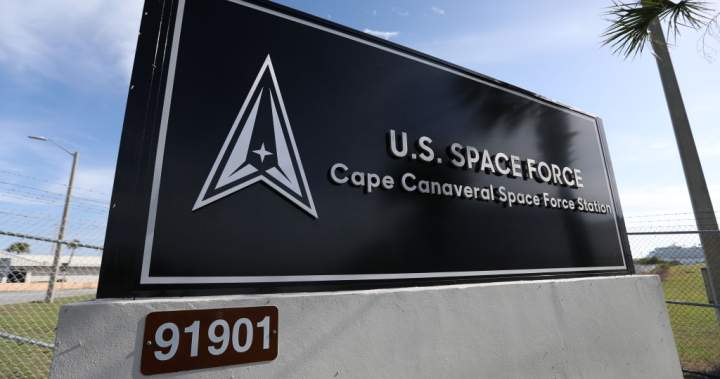
Photo via Global News

U.S. confirms space weapons launch for the 1st time. Should you be concerned?

Read the original at Global News ↗
Cite

Goodman, R. (2026, September 15). U.S. confirms space weapons launch for the 1st time. Should you be concerned? Global News. https://globalnews.ca/news/12059774/us-space-weapons/

Dated when The Aporia collected the article, usually within hours of publication. Check the original for its exact date and byline.

Global News · collected 2026-09-15 · by Rachel Goodman

Quick Summary

The U.S. Air Force Secretary confirmed at a conference that the U.S. has launched space weapons for the first time, aimed at defending against hostile actions. No specific details were provided about these weapons or their operational nature. An air and space law expert noted that while this confirmation is rhetorically significant, it does not imply any major legal or practical changes since similar technologies have existed for decades. China responded by urging the U.S. to halt its militarization of outer space.
Written by AI on 2026-09-15, from this article's own text only (the story summary below draws on all the coverage).
See how they differ ↓

AI analysis

Story summary

On September 14, 2026, the United States Space Force confirmed it had deployed weapons into Earth's orbit for the first time. A spokesperson stated that these "on-orbit space control weapons" are designed to defend against hostile actions from adversaries but did not specify the nature of these capabilities. Both China and Russia have been developing their own space and counterspace technologies, posing threats to US interests in space.

In response, China's Foreign Ministry urged the US to halt its military buildup in orbit, warning against an arms race and weaponizing outer space. The Kremlin similarly called for space to remain free of weapons. These developments signal a growing militarization trend in Earth’s orbit, potentially leading to increased tensions between major powers.

The US move comes amid efforts by China and Russia to modernize their militaries with advanced space technologies, viewing space supremacy as crucial for future conflicts. Analysts fear this confirmation will accelerate the arms race in space among these nations.

Written for “US Deploys Space Weapons” on 2026-11-21, grounded in this article and the 23 other(s) covering the same event.

How they differ

14 outlets covered “US Deploys Space Weapons”.

What each outlet says

One AI summary per outlet of its latest article on this story, written from that article alone and checked against it. Open the article for the outlet's own words.

Global NewsThis outlet15 Sep

The U.S. Air Force Secretary confirmed at a conference that the U.S. has launched space weapons for the first time, aimed at defending against hostile actions. No specific details were provided about these weapons or their operational nature. An air and space law expert noted that while this confirmation is rhetorically significant, it does not imply any major legal or practical changes since similar technologies…

U.S. confirms space weapons launch for the 1st time. Should you be concerned? (this article)
The Hindu21 Sep

On September 14, 2026, U.S. Air Force Secretary Troy Meink announced the deployment of "on-orbit space control weapons" aimed at defending against hostile actions, a move confirmed by Space Force chief Gen. Douglas Schiess. This admission raises concerns as it aligns with military doctrines that consider both offensive and defensive operations for space control, complicating international rules governing orbital…

Unsafe space: On the U.S. and ‘on-orbit space control weapons‘ →6 articles from The Hindu on this story
South China Morning Post19 Sep

At Beijing’s Xiangshan Forum, defense experts warned that the United States breaking the taboo by deploying weapons in space could ignite an arms race and destabilize global security. Speakers urged dialogue between the US and China ahead of President Xi Jinping's visit to Washington. The US Air Force Secretary confirmed the Pentagon has deployed space control weapons but did not specify the systems involved.

US space weapons move has ‘broken taboo’, could spark new arms race, Beijing forum told →2 articles from South China Morning Post on this story
BBC15 Sep

The United States recently announced that it has deployed an undisclosed space weapon into Earth’s orbit, though specifics about its capabilities and deployment date remain unclear. The article discusses potential types of weapons, such as electronic warfare platforms or kinetic kill vehicles, which could disrupt or destroy satellites. Experts suggest that while other countries like Russia and China may have similar…

What weapon could the US have put into space? →2 articles from BBC on this story
The Straits Times15 Sep

U.S. Space Force Chief Douglas Schiess and Air Force Secretary Troy Meink recently confirmed at a conference near Washington that the Pentagon operates weapons in Earth's orbit, aiming to deter aggressive activities by China and Russia. This admission marks a significant shift towards openly discussing space weaponization despite concerns raised by Chinese and Russian officials about potential arms races and…

US admission of orbital weapons seen as landmark moment in race with China, Russia →2 articles from The Straits Times on this story
The Guardian19 Sep

Air force secretary Troy Meink disclosed that the US has deployed weapons in space but provided no details about them. This vague announcement came amid growing concerns over Russian and Chinese activities in outer space and follows President Trump’s initiative to establish Space Force as a new military branch. Experts like Clayton Swope from CSIS speculate that this disclosure is part of a broader strategy to deter…

The US air force admitted to deploying weapons in space. Don’t expect the White House to explain why →2 articles from The Guardian on this story
Show 8 more outlets
Washington Examiner18 Sep

The United States has recently confirmed its possession of space weapons, with Air Force Secretary Troy Meink acknowledging that the Space Force has "on-orbit space control weapons." This disclosure follows statements from Gen. Dan Caine emphasizing military preparedness in space. China and Russia have responded critically, urging a halt to military buildup in space due to fears it could escalate into an arms race…

America just admitted it has space weapons. Now, one miscalculated orbit could start World War III →2 articles from Washington Examiner on this story
Euronews14 Sep

The United States Space Force announced on Monday that the U.S. has deployed weapons into orbit, marking a significant escalation in militarization of space. The statement indicated these capabilities can be used for both offensive and defensive purposes to protect against adversary actions. Countries like China and Russia criticized this move, with Chinese officials urging the U.S. to halt its military buildup in…

United States Space Force says US has weapons in orbit →
Daily Mail15 Sep

The U.S. Air Force has confirmed that the United States deployed its first space weapon in orbit, though details about its offensive capabilities remain undisclosed. Speaking at the Air, Space and Cyber Conference, Secretary Troy Meink stated this deployment is necessary to address evolving threats posed by Russia and China's advancements in space technology aimed at disrupting or attacking U.S. satellites. The…

US confirms for first time it has deployed a space weapon in orbit →
Toronto Star15 Sep

Troy Meinking, the Air Force Secretary, announced at the Air and Space Cyber Conference in Maryland on Monday that the United States now possesses weapons deployed in space for defensive purposes. This marks the first time the U.S. government has officially acknowledged the presence of such capabilities in orbit.

US acknowledges for the first time that it has deployed weapons in space →
Dawn15 Sep

The United States Space Force confirmed on Tuesday that it has deployed weapons in orbit, a move criticized by both Russia and China. Russian spokesperson Dmitry Peskov called for the demilitarization of space, while Chinese foreign ministry spokesman Guo Jiakun warned against turning outer space into a battlefield. The U.S. statement provided no specific details about the type or number of weapons deployed but…

US confirms deployment of orbital weapons, draws ire of Russia and China →
New York Post15 Sep

Air Force Secretary Troy Meink confirmed at an Air & Space Forces Association conference that the US has launched secret weapons into orbit, aimed at countering threats from Russia and China, particularly concerning intelligence provided by satellites to Iran. While details such as the number of weapons or duration in space were not disclosed, Meink emphasized their role in defense against hostile actions. China…

US launches mysterious weapons into space in move against China and Russia, Air Force secretary confirms →
Time15 Sep

On September 14, Air Force Secretary Troy Meink admitted at an aerospace conference in Maryland that the U.S. military has space-based weapons and intends to defend against threats from orbit. This acknowledgment breaks long-standing policy avoidance of weaponizing space, despite international treaties prohibiting such actions since 1967. The article highlights historical instances of space militarization by the…

The U.S. Just Admitted it Has Weapons in Space. Why That's a Big Deal →
Fox News15 Sep

Air Force Secretary Troy Meink disclosed at the Air & Space Forces Association’s conference in Maryland that the U.S. has weapons currently orbiting Earth to defend against attacks in space. However, Meink did not provide details such as what these weapons are or how they function. This revelation marks a shift towards more openness about U.S. military capabilities in space amid growing concerns over China and…

Pentagon reveals secret space weapons are already in orbit — but won't say what they do →

Where they agree and split

Agreed

AI · cited, from two or more outlets

  • The US Space Force stated that these capabilities can be employed for both offensive and defensive purposes.24
Quoted from the coverage (2)

China, responding to the U.S., said Tuesday, “We urge the U.S. side to stop expanding its military capabilities and preparing for war in outer space,” according to a BBC report citing the AFP.

6 outlets

"These capabilities can be employed for offensive and defensive purposes at the direction of combatant commands."

5 outlets

Disputed

Picked by our model, which is sometimes wrong

  • While the US confirmed deploying space weapons, there is disagreement over whether this action constitutes a significant legal or strategic shift.56
  • Outlets differ on the potential risks and implications of the weapon deployment for international relations and stability in space.57

Framing

How the first headlines put it

  • The BBC headline focuses on the confirmation aspect, while Dawn highlights the reaction from Russia and China.13
  • Global News asks if the public should be concerned about space weapons, whereas The Guardian questions why the White House is not providing more details.56
Attributed to a source4
Stated as fact7
The headlines (11)

United States Space Force says US has weapons in orbit Euronews · attributed to a source

US has weapons deployed in orbit, Space Force says, for ‘offensive and defensive’ use South China Morning Post · attributed to a source

U.S. has weapons deployed in orbit, Space Force says The Hindu · attributed to a source

US has weapons deployed in orbit, Space Force says The Straits Times · attributed to a source

US confirms for first time it has deployed space weapons BBC · stated as fact

US confirms for first time it has deployed a space weapon in orbit Daily Mail · stated as fact

US confirms for first time it has deployed weapons into space The Guardian · stated as fact

Air Force secretary admits US weapons are stationed in outer space Washington Examiner · stated as fact

US acknowledges for the first time that it has deployed weapons in space Toronto Star · stated as fact

US confirms deployment of orbital weapons, draws ire of Russia and China Dawn · stated as fact

US launches mysterious weapons into space in move against China and Russia, Air Force secretary confirms New York Post · stated as fact

Words to watch (3)

The US air force admitted to deploying weapons in space. Don’t expect the White House to explain why The Guardian

Air Force secretary admits US weapons are stationed in outer space Washington Examiner

The U.S. Just Admitted it Has Weapons in Space. Why That's a Big Deal Time

The full story: what happened, how it changed, and all 24 articles →

Compared with similar articles

This article reads unscored and hedges 21% of its claims. Each row says how that neighbour differs.
Euronews
Hedges 0 of 13 claims Outlet record 60/100
South China Morning Post
Centre Hedges 0 of 5 claims Outlet record 62/100
BBC News
Hedges 4 of 22 claims Outlet record 65/100
The Straits Times
Leans right Hedges 1 of 8 claims Outlet record 64/100
Daily Mail
Hedges 2 of 17 claims Outlet record 69/100
The Hindu
Hedges 0 of 10 claims Outlet record 60/100
The Guardian
Leans left Hedges 2 of 29 claims Outlet record 64/100
Toronto Star
Hedges 0 of 2 claims Outlet record 64/100
New York Post
Leans right Hedges 0 of 8 claims Outlet record 66/100
BBC News
Leans right Hedges 12 of 45 claims Outlet record 65/100

Story

US Deploys Space Weapons
Politics · 24 article(s) covering the same event. Compare every outlet's account →
How this article was measured signals, leaning charts, publisher record, byline, topics and claims

Signals How these are calculated →

Claims extracted
33
sentences that state something as happening or true
Uncertain
21%
7 of 33 hedged ("reportedly", "may", "according to")
Leaning
withheld
no quote in the article backed the model's score
Publisher signals
63/100
Global News's corrections and hedging, across everything collected from it. Not a measure of accuracy.
Outlets on this story
24
Politics
Same framing elsewhere
1
articles that frame the event the way this one does
Analyzed 2026-09-15 · how these are computed

How this is being covered How these are calculated →

Article leaning vs. publisher reliability
Source leaning vs. consistency

Publisher

Global News · 3539 article(s) · 13 correction(s) detected
Running correction rate · 13 correction(s)

Who wrote this

Rachel Goodman
74 article(s) here · 1 carrying a prediction
Once a vein was located, Reinaldo Dennes, 70, repeatedly moaned in pain, according to the Associated Press, which reported that a prison spokesperson said all procedures were followed appropriately and suggested that Dennes may have exaggerated or faked the pain.
Rikers Island, the infamous New York City jail, will close in 2032 under a plan announced by Mayor Zohran Mamdani on Friday, whose strategy for shuttering the notorious lockup hinges on reducing the number of inmates and implementing a wave of reformed social safety nets.
The Twilight actor will be the seventh actor to play the beloved British spy and the first since Amazon MGM took over the film franchise from the Broccoli family, which was the driving force behind the series for over six decades.
“The nice thing about Peruvians, including the person who with a lot of faith simply wanted to offer me a rosary, are things you carry in your heart – or maybe in your eye – but that mark the life of someone,” he said. “It tells you that here truly there is enthusiasm.
The review will focus on the Greek system’s integration with housing and residential life on campus and evaluate its future, the university president, Michael Kotlikoff, wrote in an open letter to the Cornell community on Monday, adding that details of the overhaul will be announced in due course. “I know many in our community have lost confidence in the Cornell administration’s ability to prevent and respond to sexual violence,” Kotlikoff wrote, noting that the administration had “fallen short” when it came to protecting students.
Zelenskyy said it was struck with a combination of drones and missiles, and that it served to remind Russia that “war will always return to where it began.” Earlier this year, Ukrainian forces downed the Chonhar and Henichesk bridges, two strategic crossings linking Crimea to southern Ukraine. “The occupiers are left with fewer and fewer land routes to Crimea,” the General Staff’s statement said.
Britain’s Prince William and Catherine, Princess of Wales, have arrived in India for a short three-day visit; the first overseas trip the couple has made together since the princess’s cancer diagnosis in 2024.
In a YouTube video posted to the channel where the couple would host a “Sunday Service” together and read to viewers from a bible, Brand’s wife, Laura Brand, read a statement from him, prefacing it by saying, “We trust God, and we trust his plan…even though it’s painful and will take some getting used to.”
The naming of Pattinson ends years of speculation about who would inherit the role from Daniel Craig, who stepped down after the 2021 release of No Time to Die.
The 27-year-old, who is on the Washington Commanders’ practice squad, will turn his attention to the reality television show, which is set to premiere on March 21.
Also by Rachel Goodman
Nothing else under this byline is closely related to this article, so these are simply their most recent.
All 74 articles by Rachel Goodman →

Topics

China Russia U.S. U.S. Air Force the Air and Space Cyber Conference

Subjects

U.S. GPE · 12× Russia GPE · 7× China GPE · 5× the U.S. Space Force ORG · 4× BBC ORG · 1× Maryland GPE · 1× Meink PERSON · 1× Troy Meink PERSON · 1× U.S. Air Force ORG · 1× the Joint Force ORG · 1×

Narrative

U.S. Air Force Secretary Troy Meink told the Air and Space Cyber Conference in Maryland on Monday that it has deployed “on-orbit space control weapons capable of defending the Joint Force against hostile adversary action.” An on-orbit weapon is a system launched into orbit and designed to target threats from that position for the purpose of space control.
framing: mixed · carried by 1 article(s) · first seen 2026-09-15
In 2024, the U.S. said Russia was developing anti-satellite devices that could launch from space, but argued at the time that those capabilities posed no imminent threat to American infrastructure.

Claims (33 extracted, 7 hedged)

The U.S. has confirmed for the first time that it has sent weapons into space, but an air and space law expert says the action has no “legal significance” and that there is no indication the U.S. has taken any “groundbreaking” steps in its pursuit of dominance in the domain. asserted
U.S. → confirm → domain
U.S. Air Force Secretary Troy Meink told the Air and Space Cyber Conference in Maryland on Monday that it has deployed “on-orbit space control weapons capable of defending the Joint Force against hostile adversary action.” An on-orbit weapon is a system launched into orbit and designed to target threats from that position for the purpose of space control. asserted
weapon → tell → control
“We are increasing readiness against existing threats,” Meink said. asserted
Meink → increase → threats
He did not provide details on what the weapons are, how they operate, the nature of the threats the U.S. has identified, or if they are related to an orbital arms race with China and Russia. asserted
they → provide → China
China, responding to the U.S., said Tuesday, “We urge the U.S. side to stop expanding its military capabilities and preparing for war in outer space,” according to a BBC report citing the AFP. “So, there’s no legal prohibition there,” she explained. uncertain
she → respond → AFP
“The rhetorical significance is that the U.S. is openly acknowledging it,” she said, before likening it to when the U.S. started referring to space as a “war-fighting domain,” close to a decade ago. asserted
U.S. → acknowledge → domain
“That was a big rhetorical change but didn’t have a significant practical change in terms of what capabilities were out there.” asserted
capabilities → have → terms
A contested domain for decades Orbital machinery with militaristic capabilities are not a new concept. asserted
machinery → contest → capabilities
In 1986, The U.S. conducted testing of such technologies; according to the Secure World Foundation, Russia first tested an on-orbit system in the 1960s, the organization says. uncertain
organization → conduct → 1960s
In 2019, U.S. President Donald Trump created the U.S. Space Force, a distinct military branch of the U.S. Army dedicated to warfare in space, akin to China’s Aerospace Force, and last year signed an executive order outlining the department’s role as both a defensive and offensive entity designed to establish “superiority in space.” asserted
Trump → create → space
Get daily National news Russia has a similar space warfare branch under its Aerospace Forces, a combined department overseeing aerospace warning systems, missile defences, and military satellites, though it is not an independent division of the army. asserted
it → get → army
In 2024, the U.S. said Russia was developing anti-satellite devices that could launch from space, but argued at the time that those capabilities posed no imminent threat to American infrastructure. uncertain
capabilities → say → infrastructure
While Russia, China, and the U.S. have emerged as dominant forces, Harrington acknowledged that the degree of contestation has increased as more states invest in defensive space capabilities. asserted
states → emerge → capabilities
“It’s a security dilemma,” she said. asserted
she → ’ → ?
“Once weapons and capabilities start being developed, start being deployed, then other states feel they have to do the same thing to protect against those capabilities.” asserted
they → start → capabilities
In August, Trump signed an executive order to establish the nation’s first Space Academy to educate and train a new generation of technical and operational staff for NASA, the U.S. Space Force and the commercial space industry. asserted
Trump → sign → NASA
“Given the rapid growth of the U.S. Space Force and commercial space industry, and the expansion of our ambitions to the Moon and far beyond the Moon, it’s clear we will need to educate and train an entire generation of skilled service members, engineers, and civil operators,” he said last month. asserted
he → give → members
According to a space threat fact sheet published by the U.S. Space Force, China “develops and operates space and counterspace capabilities as part of a military modernization strategy” intended to exercise control over the U.S. military in the Indo-Pacific region, while Russia views space as a “warfighting domain” and believes “space supremacy will be a decisive factor in future conflicts.” uncertain
supremacy → accord → conflicts
No recent information has publicly surfaced about how close Russia might be to deploying anti-satellite weapons in space, according to a 2025 Space Threat Assessment report by the Center for Strategic and International Studies, though it notes several potential threats. uncertain
it → surface → threats
“The jamming and spoofing of GPS signals in and around war zones, including near and in Russia and throughout the Middle East,” has become a “worrisome trend,” it says, citing Russian and Chinese technology in various states of orbit as showing increasingly complex operational capabilities and tactical proficiencies that can be used in space warfare. asserted
that → include → warfare
Jamming is common, Harrington noted, and not novel. asserted
Harrington → note → ?
The report goes on to say that the U.S. and its international partners “remain concerned that Russia could decide to deploy such a weapon,” and that U.S. Space Force senior leaders are prepared to conduct offensive and defensive space operations with the intention to field more “counterspace capabilities.” uncertain
leaders → go → capabilities
The report described space as “fair game” during conflict and says the normalization of space as a “military operational domain” means warfare may bring the same level of destruction to space that it would to places “closer to Earth.” uncertain
it → describe → Earth
It also says that counterspace threats should be viewed as an effort by adversaries to degrade the ability of the U.S. and its allies to fight and win a war, to disrupt the economy and day-to-day life on Earth. asserted
threats → say → Earth
Why space matters on Earth Harrington noted the significant role space capabilities play in modern life; without them, we would not have precise location services on our phones, car navigation systems that rely on infrastructure in space, or Starlink, which uses orbiters for its high-speed internet connections. asserted
which → matter → connections
Satellite systems are essential to everything from banking services to pumping fuel at the gas station, which both rely on the timing signals from satellites for payment processing, Harrington said. asserted
Harrington → pump → processing
“If those timing signals are not available, then you have a freeze in the financial system for calculating financial transactions. asserted
you → have → transactions
A lot of different problems can occur.” asserted
lot → occur → problems
Satellites also help with weather forecasting and data collection for the study of climate change. asserted
Satellites → help → change
“There are fundamental aspects of day-to-day life that are dependent on space capabilities, whether those are navigation and timing, communication, or observation. asserted
those → be → capabilities
But those are all essential capabilities that we rely on day-to-day,” she explained. asserted
she → rely → day
Currently, the Outer Space Treaty serves as the principal legislation laying out fundamental rules about activities in space, and all of the major spacefaring states are party to it. asserted
all → serve → it
The Outer Space Treaty covers all activities in outer space, whether they are carried out by governments or private organizations. asserted
they → cover → governments
Give feedback · no sign-in needed

No sign-in needed for now. Your note is sent without a name, so it cannot be answered.

History Support