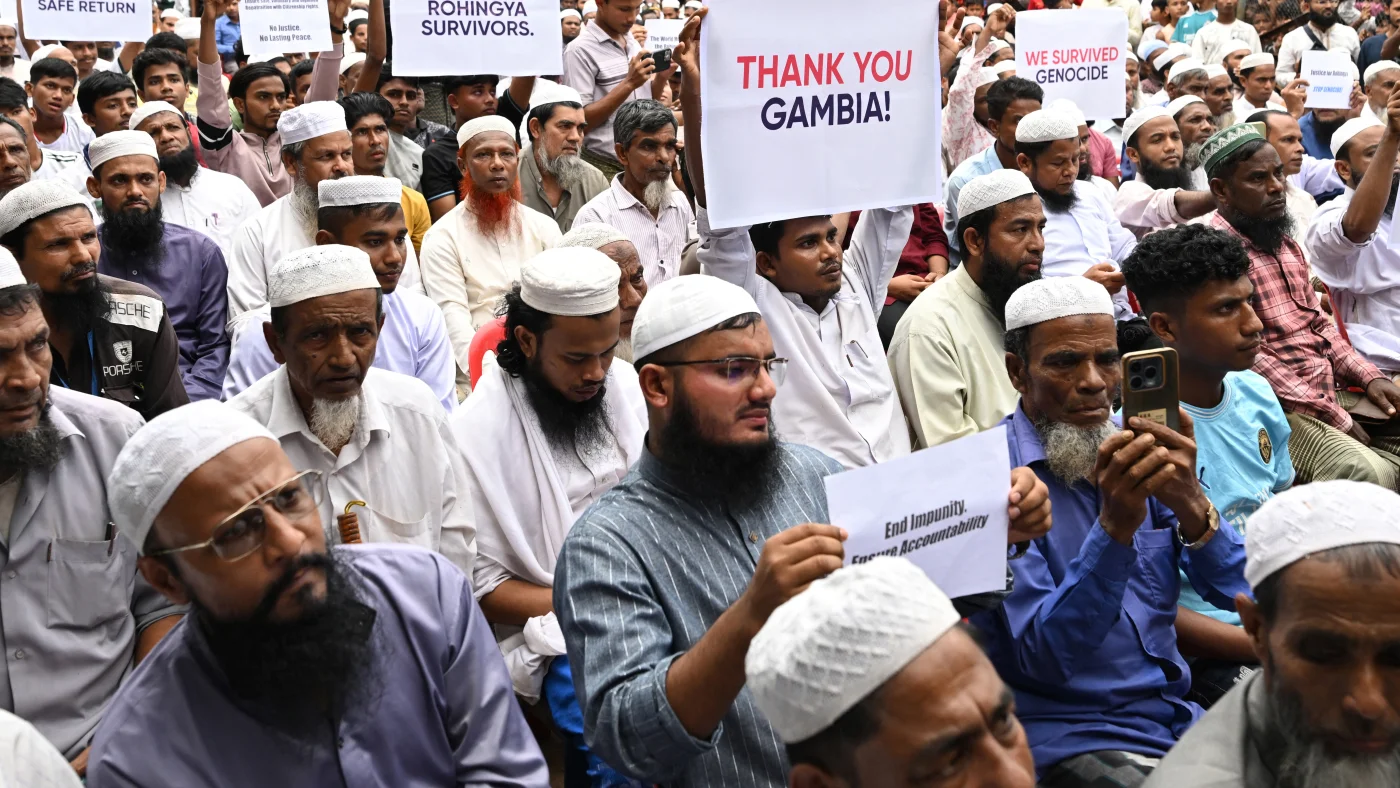
Photo via Al Jazeera

Can the Rohingya genocide verdict deliver justice?

Read the original at Al Jazeera ↗
Cite

Sakib, N. (2026, November 20). Can the Rohingya genocide verdict deliver justice? Al Jazeera. https://www.aljazeera.com/opinions/2026/11/20/can-the-rohingya-genocide-verdict-deliver-justice?traffic_source=rss

Dated from the outlet's own feed. Check the original for its byline.

Al Jazeera · collected 2026-11-20 · by Nazmus Sakib

Quick Summary

The International Court of Justice ruled that Myanmar is responsible for committing genocide against the Rohingya, a first in the court’s 80-year history. The verdict, voted nine to six, found Myanmar’s military actions in 2017, including killings and sexual violence, to be genocide rather than just counterterrorism measures. The court also ordered Myanmar to provide reparations including safe return for refugees and compensation. However, the ruling’s impact is limited by the lack of enforcement mechanisms and potential vetoes at the UN Security Council.
Written by AI on 2026-11-20, from this article's own text only (the story summary below draws on all the coverage).
See how they differ ↓

AI analysis

Story summary

The International Court of Justice (ICJ) in The Hague ruled on November 20, 2026, that Myanmar committed genocide against its Rohingya minority. This landmark judgment comes seven years after The Gambia filed the case with the ICJ in 2019. The ruling could add significant international pressure on Myanmar's military leader, Min Aung Hlaing, who led the 2016-2017 military crackdown on the Rohingya and later overthrew the elected government of Aung San Suu Kyi in a 2021 coup, sparking a civil war that has claimed tens of thousands of lives. Legal experts suggest the ICJ's decision may bolster South Africa's genocide case against Israel over the conflict in Gaza, establishing a precedent for similar claims.

Written for “Myanmar Genocide Ruling Implications” on 2026-11-21, grounded in this article and the 42 other(s) covering the same event.

How they differ

18 outlets covered “Myanmar Genocide Ruling Implications”.

What each outlet says

One AI summary per outlet of its latest article on this story, written from that article alone and checked against it. Open the article for the outlet's own words.

Al JazeeraThis outlet20 Nov

The International Court of Justice ruled that Myanmar is responsible for committing genocide against the Rohingya, a first in the court’s 80-year history. The verdict, voted nine to six, found Myanmar’s military actions in 2017, including killings and sexual violence, to be genocide rather than just counterterrorism measures. The court also ordered Myanmar to provide reparations including safe return for refugees…

Can the Rohingya genocide verdict deliver justice? (this article)11 articles from Al Jazeera on this story
The Guardian20 Nov

The International Court of Justice (ICJ) ruled that Myanmar committed genocide against the Rohingya minority, a decision that has sparked mixed reactions from global powers. The EU praised the ruling as "landmark," while the US took a cautious stance, emphasizing the need to avoid politicizing the court. China, a supporter of Myanmar’s military regime, expressed concerns over judicial overreach and urged caution in…

US reacts cautiously to Myanmar genocide ruling as EU praises ‘critical’ role of UN’s top court →6 articles from The Guardian on this story
The Hindu20 Nov

On November 20, 2026, Myanmar's government spokesperson, Khaing Khaing Soe, dismissed a ruling by the International Court of Justice (ICJ) that Myanmar's security forces conducted State-sponsored genocide against the Rohingya Muslim minority as unfair. The ICJ ruling, which was the first of its kind, was based on a case filed by Gambia seven years earlier. Mr. Khaing Soe claimed that the decision was not unanimous…

Myanmar calls ICJ ruling on genocide 'unfair' →5 articles from The Hindu on this story
Deutsche Welle20 Nov

The International Court of Justice ruled that Myanmar committed genocide against the Rohingya community in 2016 and 2017, ordering Myanmar to prevent future crimes, provide legal protections, and offer reparations to victims. The ruling came after The Gambia filed a case with the ICJ in 2016, accusing Myanmar of a deliberate campaign of violence against the Rohingya. Rohingya activists like Lucky Karim and Wai Wai…

Myanmar genocide ruling: Rohingya say struggle for justice not over →3 articles from Deutsche Welle on this story
Zeteo19 Nov

This article is an opinion piece by Prem, discussing the perceived instability in the United States following recent system outages and breaches affecting major organizations and government bodies. The author argues that despite these crises, the U.S. society is barely held together not by competent leadership but in spite of it, due to the incompetence of the current cabinet. The piece critiques the responses given…

First Draft – Now We Know What Stands Between Trump’s U.S. and Total Collapse: A Cabinet of Idiots →2 articles from Zeteo on this story
CBC20 Nov

The International Court of Justice ruled that Myanmar committed genocide against the Rohingya Muslim minority, a decision celebrated as recognition of their suffering but criticized for its lack of practical impact due to Myanmar's disregard of international rulings. The ICJ ordered Myanmar to provide reparations and allow Rohingya refugees to return to their villages, but most Rohingya villages have been destroyed…

International court's ruling on Myanmar genocide means little for victims, but much for future cases →2 articles from CBC on this story
Show 12 more outlets
The Straits Times20 Nov

The International Court of Justice ruled that Myanmar committed genocide against the Rohingya, a decision that legal experts believe could strengthen South Africa’s genocide case against Israel over the Gaza conflict. The court’s judgment, which found Myanmar guilty of multiple violations of the 1948 Genocide Convention, establishes a legal precedent that genocidal intent can be established alongside military…

Myanmar genocide judgment may bolster Gaza case against Israel →2 articles from The Straits Times on this story
ABC News (AU)20 Nov

Myanmar has rejected the International Court of Justice's ruling that its security forces committed genocide against the Rohingya Muslim minority as "unfair." The court's decision, made yesterday, holds Myanmar responsible for the atrocities against the Rohingya. Meanwhile, Rohingya refugees in Bangladesh have welcomed the verdict, although it is uncertain when they will be able to return to their homes in Myanmar.

Myanmar calls international court ruling on Rohingya genocide 'unfair' →2 articles from ABC News (AU) on this story
Daily Mail16 Nov

Legal and military experts warn that Britain could face genocide accusations under a looser definition of the term, which the International Court of Justice may endorse in its upcoming judgment on Myanmar. The Policy Exchange think tank report highlights potential risks for Britain regarding historical events like the Irish potato famine and the Mau Mau rebellion, and current concerns about Russia and Iran…

Britain at risk of Ireland or Kenya 'genocide' claims under looser definition, say experts - as they warn about Russia and Iran weaponising allegations →
NPR19 Nov

The International Court of Justice ruled that Myanmar committed genocide against the Rohingya minority, marking the first time a state has been held responsible for genocide by the U.N.'s top court. The decision, brought by Gambia under the 1948 Genocide Convention, found that Myanmar’s military campaign in 2017 was systematic and included the killing of around 10,000 Rohingya and the burning of 392 villages. The…

The U.N.'s top court rules Myanmar committed genocide against the Rohingya →
Dawn19 Nov

The International Court of Justice ruled that Myanmar’s security forces committed genocide against the Rohingya Muslim minority in 2017, marking only the fourth genocide ruling since World War II. The court found that Myanmar’s military killed thousands of Rohingya civilians, engaged in widespread sexual violence, and burned villages, meeting the legal threshold for genocide. The decision, brought by Gambia, is…

Top UN court finds Myanmar committed state-sponsored genocide against Muslim Rohingya →
Sydney Morning Herald19 Nov

The International Court of Justice (ICJ) has ruled that Myanmar is guilty of genocide against Rohingya Muslims, marking the first time the court has convicted a state under the 1948 Genocide Convention. The ICJ ordered Myanmar to cease all ongoing violations, prosecute those responsible, and provide reparations. The court’s decision, handed down in a 9-6 vote, is significant given Myanmar’s likely non-compliance due…

‘Intention to purge’: Myanmar found guilty of genocide against Rohingya in landmark ruling →
Semafor19 Nov

The International Court of Justice has ruled that Myanmar is guilty of genocidal intent against the Rohingya, following atrocities that led to the killing of about 10,000 Rohingya nearly a decade ago and the displacement of up to 700,000 more to Bangladesh. The court’s decision notes that Myanmar’s military committed widespread violence including sexual assaults and attacks on children. This ruling could set a…

ICJ finds Myanmar guilty of 'genocidal intent' against Rohingya →
Euronews20 Nov

The International Court of Justice (ICJ) ruled that Myanmar is guilty of genocide against the Rohingya minority, marking the first such ruling in the ICJ’s 80-year history. The court found Myanmar’s security forces responsible for widespread violence, including killings and sexual assaults, and the systematic destruction of Rohingya villages. The ICJ ordered Myanmar to provide compensation for damages and facilitate…

Myanmar guilty of genocide against Rohingya UN court rules →
Toronto Star20 Nov

Myanmar’s government has rejected a ruling by the International Court of Justice (ICJ) that found the country guilty of genocide against the Rohingya Muslim minority. The ICJ’s decision, announced on Thursday, was based on a nine-to-six vote among the judges. Myanmar’s President Min Aung Hlaing’s spokeswoman, Khine Khine Soe, described the ruling as unfair. The case centers on the brutal military operations against…

Myanmar dismisses UN court ruling finding country responsible of Rohingya genocide as 'unfair' →
Time20 Nov

The International Court of Justice ruled that Myanmar committed genocide against the Rohingya Muslim minority, marking the first time a state has been found responsible for genocide in the court's history. The court’s decision, issued Thursday, cites the murder of at least 10,000 people, including up to 2,109 children under five, and the displacement of over 700,000 Rohingya in 2017. Myanmar’s government has denied…

What Comes Next After Historic Myanmar Genocide Ruling →
Global News20 Nov

The International Court of Justice ruled that Myanmar committed genocide against the Rohingya Muslim minority during the military’s 2017 “clearance operations” in Rakhine state, with nine out of fifteen judges agreeing on the verdict. Myanmar’s government, now led by former military leader Min Aung Hlaing, dismissed the ruling as unfair, while Rohingya activists and the militant group ARSA hailed it as a critical…

UN court finds Myanmar guilty of Rohingya genocide in landmark judgement →
The Free Press20 Nov

The International Court of Justice recently ruled that Myanmar is guilty of genocide in a case initiated by The Gambia. However, the article argues that this ruling, focusing on Myanmar’s treatment of the Rohingya Muslims, may undermine the court’s legitimacy and set a precedent that could be used arbitrarily against other nations, including Israel. The author suggests that the ruling was less about the Rohingya…

How the Campaign Against Israel Rewrote the Law of Genocide →

Where they agree and split

Agreed

Reported by outlets on both sides of the middle

The Myanmar military, in response to the attack by ARSA, launched “clearance operations” that led to widespread arson, civilian deaths, and reports of Rohingya youths being picked up for interrogation.

5 outlets
Show 3 more

The court’s rulings are final and legally binding, but it has no way to enforce them beyond reporting noncompliance to the U.N. Security Council.

4 outlets

The Gambia brought the case in 2019 under the 1948 Genocide Convention, which allows any signatory state to take another to court over suspected breaches.

4 outlets

There was no immediate response from the government in Myanmar or the military, which is regarded as the real underlying power.

4 outlets
The full story: what happened, how it changed, and all 43 articles →

Compared with similar articles

This article reads leans left and hedges 5% of its claims. Each row says how that neighbour differs.
CBC News
Leans left Hedges 5 of 36 claims Outlet record 72/100
The Guardian
Leans left Hedges 0 of 29 claims Outlet record 64/100
Al Jazeera
Leans left Hedges 0 of 6 claims Outlet record 60/100
The Sydney Morning Herald
Leans right further right than this Hedges 8 of 43 claims Outlet record 61/100
The Hindu
Leans left Hedges 0 of 20 claims Outlet record 78/100
Semafor
Leans left Hedges 0 of 4 claims Outlet record 64/100
TIME
Leans left Hedges 9 of 71 claims Outlet record 60/100
The Hindu
Leans strongly left further left than this Hedges 2 of 16 claims Outlet record 78/100
NPR
Hedges 2 of 50 claims Outlet record 60/100

Story

Myanmar Genocide Ruling Implications
World · 43 article(s) covering the same event. Compare every outlet's account →
How this article was measured signals, leaning charts, publisher record, byline, topics and claims

Signals How these are calculated →

Claims extracted
44
sentences that state something as happening or true
Uncertain
5%
2 of 44 hedged ("reportedly", "may", "according to")
Leaning
Leans left
of the writing, not the subject · beta estimate
Publisher signals
60/100
Al Jazeera's corrections and hedging, across everything collected from it. Not a measure of accuracy.
Outlets on this story
43
World
Same framing elsewhere
1
articles that frame the event the way this one does
Analyzed 2026-11-20 · how these are computed

How this is being covered How these are calculated →

Article leaning vs. publisher reliability
Source leaning vs. consistency

Publisher

Al Jazeera · 6194 article(s) · 4 correction(s) detected
Running correction rate · 4 correction(s)

Who wrote this

Nazmus Sakib
1 article(s) here · 1 carrying a prediction
The 9-6 split will inevitably be used by Myanmar to cast doubt on the ruling.
2026-11-20 · assertive framing · Can the Rohingya genocide verdict deliver justice?
The only article under this byline in the corpus.

Topics

ARSA Bangladesh Myanmar Rakhine Rohingya

Subjects

Rohingya NORP · 11× Myanmar GPE · 8× ARSA ORG · 2× ASEAN ORG · 2× Bangladesh GPE · 2× China GPE · 2× Rakhine GPE · 2× UNSC ORG · 2× the Arakan Army ORG · 2× the International Court of Justice ORG · 1×

Narrative

Bangladesh should tie cross-border trade, humanitarian access and political engagement with the Arakan Army to measurable Rohingya benchmarks: Freedom of movement, restoration of land, an end to forced recruitment, international monitoring and a pathway to citizenship.
framing: assertive · carried by 1 article(s) · first seen 2026-11-20
The 9-6 split will inevitably be used by Myanmar to cast doubt on the ruling.
2026-11-20 · Al Jazeera
Can the Rohingya genocide verdict deliver justice? · assertive framing

Claims (44 extracted, 2 hedged)

On Thursday, the International Court of Justice did something it had never done in its 80-year history: It held a state responsible for committing genocide. asserted
state → do → genocide
By nine votes to six, the court found that Myanmar’s 2017 campaign against the Rohingya crossed the gravest threshold in international law. asserted
campaign → find → law
That matters because Myanmar’s defence was never simply that nothing terrible happened. asserted
nothing → matter → ?
It argued that its “clearance operations” followed attacks by the Arakan Rohingya Salvation Army (ARSA) and were, however brutal, fundamentally counterterrorism. asserted
operations → argue → Army
Genocide requires more than proof of killing, rape or village destruction; it requires specific intent to destroy a protected group. asserted
it → require → group
The court found that Myanmar’s government forces killed thousands of Rohingya civilians, committed widespread sexual violence, inflicted extreme violence on children and attacked people fleeing towards Bangladesh. asserted
forces → find → Bangladesh
Taking the evidence together, it concluded that the “only reasonable inference” was an intention to destroy a substantial part of the Rohingya population in northern Rakhine state. asserted
inference → take → state
That strips away the central evasion of the past decade. asserted
That → strip → decade
Nor can the atrocities now be dismissed as excesses by rogue soldiers. asserted
atrocities → dismiss → soldiers
The 9-6 split will inevitably be used by Myanmar to cast doubt on the ruling. asserted
split → use → ruling
And by 10 votes to five, the court went further, ordering reparations, including safe, voluntary and dignified return, family reunification, restitution of property and compensation where restitution is impossible. asserted
restitution → go → property
Yasmin Ullah, a Rohingya rights activist who sat in the courtroom, called it “a great day for the Rohingya”. asserted
who → sit → Rohingya
In Cox’s Bazar, refugees had been making an equally practical demand: They want to go home, but with rights, citizenship and dignity. asserted
They → make → rights
But here is the problem: You cannot eat a judgement. asserted
You → eat → judgement
You cannot live inside one. asserted
You → live → one
You cannot rebuild a burned village with one or raise a child safely inside one. asserted
You → rebuild → one
The ICJ has no enforcement arm. asserted
ICJ → have → arm
Under Article 94(2) of the United Nations Charter, noncompliance can be taken to the UN Security Council (UNSC), where China or Russia could block action. uncertain
China → take → action
That makes pressure outside the UNSC essential: Targeted sanctions, ASEAN diplomacy, the ICC investigation and Argentina’s universal-jurisdiction case, where arrest warrants have already been issued for 25 suspects. asserted
warrants → make → suspects
Who governs the map has also changed. asserted
governs → govern → map
In 2017, Myanmar’s military dominated Rakhine. asserted
military → dominate → Rakhine
Today, the Arakan Army controls most of it, and UN investigators have documented forced recruitment, movement restrictions, arbitrary killings and other abuses against Rohingya under its rule. asserted
investigators → control → rule
Any serious return framework must therefore deal with whoever controls the ground. asserted
whoever → deal → ground
Bangladesh should tie cross-border trade, humanitarian access and political engagement with the Arakan Army to measurable Rohingya benchmarks: Freedom of movement, restoration of land, an end to forced recruitment, international monitoring and a pathway to citizenship. asserted
Bangladesh → tie → citizenship
Dhaka should also press Myanmar’s authorities, ASEAN, China, India, Gulf states and Western governments to support a monitored return-and-reparations mechanism. asserted
Dhaka → press → mechanism
For too long, ports, pipelines and trade corridors have been treated as “strategic” while the Rohingya remain in the humanitarian file. asserted
Rohingya → treat → file
Everyone wants something from Myanmar. asserted
Everyone → want → Myanmar
None of this matters if the camps fall apart before return becomes possible. asserted
return → matter → this
About 95 percent of Rohingya refugees are moderately to highly vulnerable and rely almost entirely on humanitarian assistance. asserted
percent → rely → assistance
The UN’s scaled-down 2026 response plan seeks $710.5m, 26 percent less than the previous year’s appeal. asserted
plan → scale → appeal
In April, the World Food Programme reduced support for about two-thirds of refugees under a new tiered system; about 17 percent now receive only $7 per person per month. asserted
percent → reduce → month
Donors applauding the verdict should fund the wait as seriously as they praise the destination. asserted
they → applaud → destination
The Organisation of Islamic Cooperation, which backed The Gambia’s case, and Gulf donors have a particular responsibility. asserted
which → back → responsibility
Western governments should restore cuts, while lenders and donors should support Bangladeshi host communities. asserted
lenders → restore → communities
Underfunded camps feed trafficking, exploitation and dangerous sea journeys towards Malaysia and Indonesia. asserted
camps → feed → Malaysia
A judgement that opens a path home is worth little if the people it was meant for cannot survive the wait. asserted
it → open → wait
Reparations now have legal force, not merely moral appeal. asserted
Reparations → have → force
Property claims should be documented; land restored where possible; compensation paid where it cannot. uncertain
it → document → ?
Aid says: You are suffering, so we will help you survive. asserted
you → say → ?
Reparations say: A wrong was done to you, and someone is obliged to repair it. asserted
someone → say → it
…and 4 more, not listed.
Give feedback · no sign-in needed

No sign-in needed for now. Your note is sent without a name, so it cannot be answered.

History Support