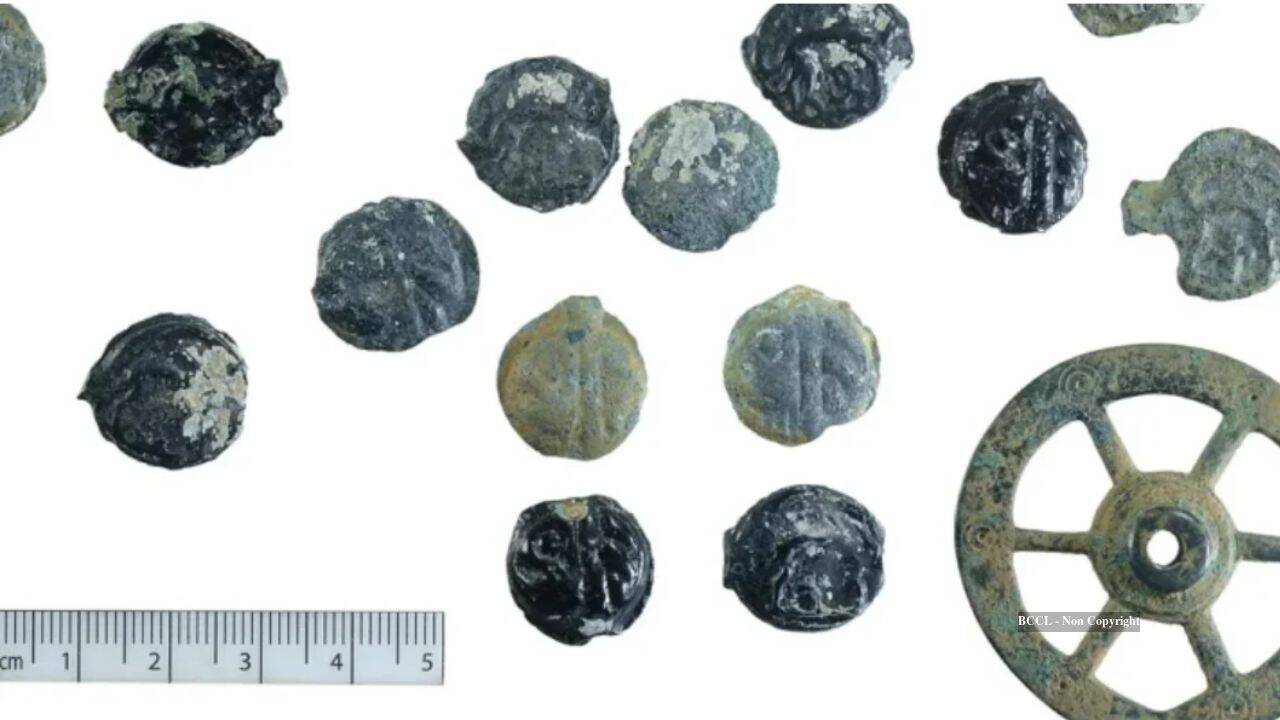
Archaeologists working in northeastern France have uncovered 28 ancient Gallic coins in a small pit beside fragments of a human skull and a miniature bronze wagon wheel, a combination that suggests the site may have been a Late Iron Age sanctuary.
uncertain
site → work → combination
The finds were made during preventive excavations near Bure in the Meuse department, an area being investigated in connection with France’s Cigéo deep geological repository project, as per reports by Inkorr and The History Blog.
asserted
finds → make → Inkorr
The discovery is significant because the objects appear to have been deliberately deposited rather than casually lost.
asserted
objects → appear → ?
The coins, known as potins, were found alongside human bone fragments and a five-centimetre metal wheel, a type of miniature object often associated with votive offerings in Iron Age Gaul.
asserted
coins → know → Gaul
Researchers believe the site may have served a ritual purpose for the Leuci, a Gallic people who lived in the region during the Late La Tène period.
uncertain
who → believe → period
What was found
The excavation revealed a building measuring about 7.5 by 5.5 metres.
asserted
excavation → find → metres
Archaeologists identified four large postholes, each roughly one metre in diameter and more than 80 centimetres deep.
asserted
Archaeologists → identify → diameter
The arrangement suggests that the posts may have leaned inward, possibly forming a conical structure rather than a conventional rectangular building.
uncertain
posts → suggest → building
Inside one of the postholes, researchers recovered fragments of a human skull and lower jaw.
asserted
researchers → recover → skull
In ancient Gaul, skulls and other human remains could be treated as sacred deposits, particularly in ritual or ceremonial settings.
uncertain
skulls → treat → settings
The 28 cast Gallic coins were found in a small pit near the remains.
asserted
coins → cast → remains
These potins circulated in northeastern Gaul during the Late Iron Age and typically carried stylized imagery rather than realistic portraits.
asserted
potins → circulate → portraits
Their presence with skull fragments and a miniature wheel makes the assemblage especially unusual for the territory of the Leuci.
asserted
assemblage → make → Leuci
The coins depict a stylized human head influenced by portraits of Philip II of Macedon, along with a military standard shaped like a boar and a symbol resembling either a fleur-de-lis or an inverted letter T.
asserted
coins → depict → lis
Such imagery reflects the cultural connections and artistic influences circulating across Gaul in the centuries before Roman conquest.
asserted
imagery → reflect → conquest
Archaeologists believe objects of this kind may have served as amulets or ritual offerings.
uncertain
objects → believe → amulets
At first glance, a wagon wheel doesn’t seem like an obvious religious symbol, but wheels were important in Iron Age societies both practically and symbolically.
asserted
wheels → seem → societies
Vehicles, movement and the cycles of life could all have potent associations.
uncertain
Vehicles → have → associations
The coins, wheel and human remains together form a pattern that is consistent with known votive practices.
asserted
that → form → practices
Many Iron Age sanctuaries contain pits, postholes or other defined spaces into which people deposited valuable or meaningful objects.
asserted
people → contain → objects
The act of burial itself may have been part of the ritual, rather than simply a way of storing items.
uncertain
act → store → items
The building’s unusual shape, the deliberate placement of objects, and the presence of human remains all support the idea that the site was more than an ordinary settlement structure.
asserted
site → support → structure
The large postholes suggest a substantial construction, while the small pit containing the coins and bone fragments points to a focused ritual deposit.
asserted
pit → suggest → deposit
Archaeologists cannot yet say exactly what ceremonies took place there or which deity, if any, was honoured.
asserted
ceremonies → say → deity
The evidence does, however, fit the broader pattern of Late Iron Age religious activity in Gaul, where sanctuaries often combined architecture, offerings, and symbolic deposits.
asserted
sanctuaries → fit → architecture
The discovery is described as exceptionally rare for this part of the Leuci territory and unusual in Belgic Gaul more broadly.
asserted
discovery → describe → Gaul
The term “sanctuary” does not necessarily mean a temple in the classical Roman sense.
asserted
term → mean → sense
It can refer to a sacred space used for offerings, ceremonies, or communal rituals.
asserted
It → refer → offerings
The building may have housed such activities, while the deposits preserved in its postholes may represent offerings made at particular moments in the site’s use.
uncertain
deposits → house → use
A window into the Leuci
The Leuci were one of the Gallic peoples inhabiting parts of northeastern Gaul before Roman expansion reshaped the region.
asserted
expansion → inhabit → region
Finds like these help researchers understand not only what they made and used, but also how they organised belief, memory, and community life.
asserted
they → help → belief
Coins, for example, can reveal trade links, political imagery, and the movement of ideas across tribal boundaries.
asserted
Coins → reveal → boundaries
The skull fragments add an even creepier element.
asserted
fragments → add → element
Human remains found in ritual context could reveal ancestor veneration, commemoration, trophy practices, or other customs that are hard to interpret from archeology alone.
uncertain
that → find → archeology
The bones will need further analysis by scientists to establish their age, sex, condition and whether they show any signs of trauma or deliberate treatment.
asserted
they → need → trauma
If it was made specifically as an offering, rather than broken from a full-size vehicle, it strengthens the case that the deposit was ritual in nature.
asserted
deposit → make → nature
Its tiny size and careful positioning beside the coins and skull fragments suggests it was deliberately placed, and not accidentally lost.
uncertain
it → suggest → coins
Why the site matters
The discovery adds to a growing picture of religious and cultural life in Late Iron Age Gaul.
asserted
discovery → matter → Gaul
It also shows how modern infrastructure projects can uncover evidence that would otherwise remain hidden beneath farmland, roads, and development sites.
asserted
that → show → farmland
The excavation was carried out by France’s National Institute for Preventive Archaeological Research, known as Inrap, as part of work linked to the Cigéo project.
asserted
excavation → carry → project
…and 7 more, not listed.
 The Aporia