Photo via Dawn

Decoding defence deals

Read the original at Dawn ↗
Cite

Abbas, K. (2026, October 25). Decoding defence deals. Dawn. https://www.dawn.com/news/2039531/decoding-defence-deals

Dated from the outlet's own feed. Check the original for its byline.

Dawn · collected 2026-10-25 · by Khurram Abbas

Quick Summary

Since September 2025, Pakistan has signed multiple defense agreements with Arab and Muslim states, including a Strategic Mutual Defence Agreement (SMDA) with Saudi Arabia, a Makkah Joint Defence Agreement (MJDA) with Turkiye and Saudi Arabia, a pact with Kuwait, and the Badr agreement involving Pakistan, Turkiye, Qatar, and Indonesia. These deals aim to enhance Pakistan's strategic relevance in the Middle East by fostering joint defense production among signatories, reducing reliance on Western weapons, and mitigating India’s military superiority. Key drivers for these agreements include Pakistan’s desire to modernize its defense sector through cost-sharing with regional partners and to diversify its weapon suppliers beyond China, which currently accounts for nearly 80% of Pakistan's arms imports according to the Stockholm International Peace Research Institute.
Written by AI on 2026-10-25, from this article's own text only (the story summary below draws on all the coverage).

AI analysis

Story summary

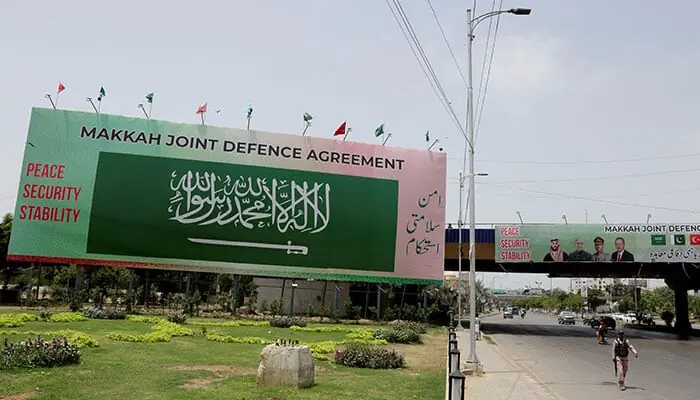
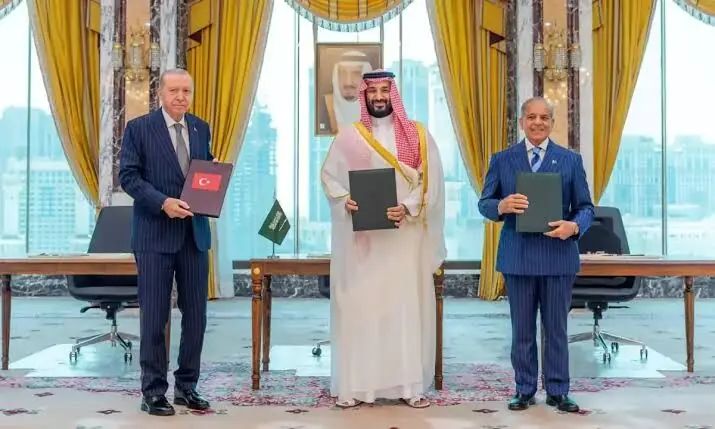
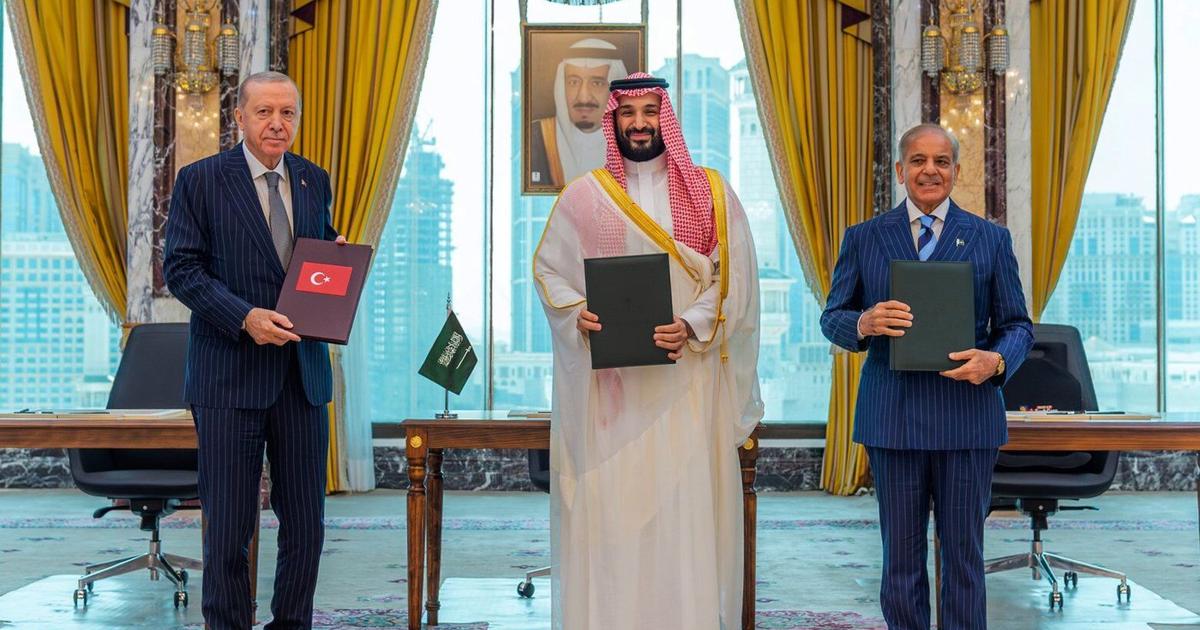
Turkish President Recep Tayyip Erdogan, Saudi Crown Prince Mohammed bin Salman, and Pakistani Prime Minister Shehbaz Sharif signed the Makkah Joint Defence Agreement in August 2025, aiming to bolster cooperation among Pakistan, Saudi Arabia, and Turkey as regional powers amid increasing uncertainty due to conflicts with Iran. The agreement includes provisions for collective defense against external attacks, mirroring NATO’s Article 5, but explicitly excludes offensive actions.

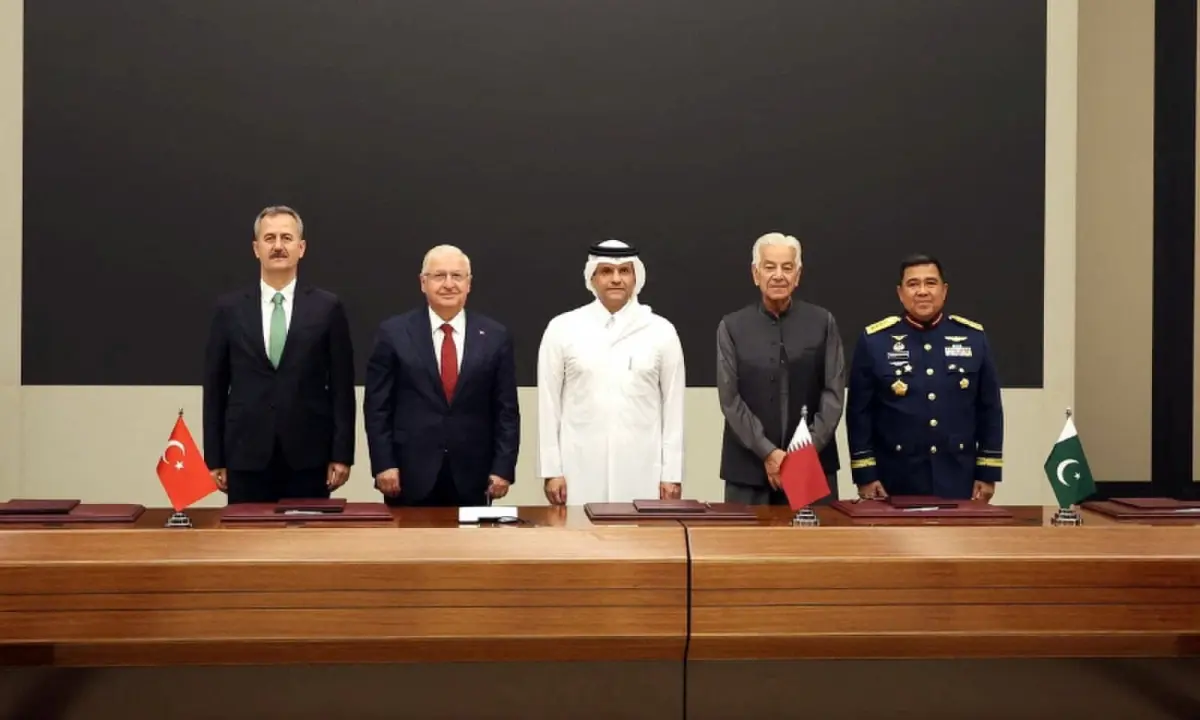
In addition to the Makkah pact, Pakistan has also signed multiple other defense agreements since September 2025, including the Strategic Mutual Defence Agreement (SMDA) with Saudi Arabia and a separate agreement with Kuwait. The Badr Memorandum of Understanding was signed by Pakistan, Turkey, Qatar, and Indonesia in Doha on October 17, focusing on joint defense production, technology transfer, research, and development to reduce reliance on Western arms sales.

These agreements aim to enhance regional security and strategic autonomy for the participating nations while fostering industrial cooperation and interoperability among their armed forces. The text of the Makkah Joint Defence Agreement emphasizes defensive measures and excludes commitments to offensive operations or sending troops abroad, addressing concerns about involvement in conflicts like the Saudi-Houthi war in Yemen.

The proliferation of these defense pacts reflects a broader trend in the Middle East toward diversifying security partnerships amid growing doubts about traditional US-led arrangements. Despite this fragmentation, there is an emphasis on building mutual defense capabilities without necessarily aligning with existing blocs or committing to aggressive military engagements beyond self-defense.

Written for “Makkah Defence Alliance Pact” on 2026-11-04, grounded in this article and the 7 other(s) covering the same event.

Story

📰 Makkah Defence Alliance Pact
Politics · 8 article(s) covering the same event. Compare every outlet's account →

Compared with similar articles

This article reads leans left and hedges 6% of its claims. Each row says how that neighbour differs.
Dawn
Hedges 5 of 37 claims Outlet record 72/100
“Article A focuses on the publication of the text of the Makkah Joint Defence agreement specifically between Turkey, Pakistan, and Saudi Arabia. Article B discusses multiple defence agreements signed by Pakistan with various countries over a period, including but not limited to the Makkah Joint Defence Agreement.”
Al Jazeera
Hedges 3 of 24 claims Outlet record 60/100
“Article A describes Pakistan signing several defense agreements, while Article B reports on a meeting between ministers and security officials from nations involved in those agreements to discuss regional tensions.”
South China Morning Post
⚖️ Leans left Hedges 0 of 2 claims Outlet record 62/100
Dawn
Hedges 6 of 31 claims Outlet record 72/100
“While both articles mention similar defense agreements involving multiple countries, they do not describe the same specific signing or ratification event at a single time and place.”
Dawn
Hedges 2 of 48 claims Outlet record 72/100
“While both articles mention the Makkah Joint Defence Agreement, Article A describes the signing of various defence agreements by Pakistan, while Article B reports on a response to remarks about a meeting in Tehran involving those countries. These describe different specific events.”
Euronews
Hedges 3 of 31 claims Outlet record 60/100
“The articles discuss different aspects of defense alliances involving similar nations but describe distinct events — one focusing on multiple new agreements and the other on talks between alliance members and Iran.”
Toronto Star
Hedges 1 of 42 claims Outlet record 64/100
“Article A describes Turkey's government asking parliament to ratify a mutual defense agreement with Saudi Arabia and Pakistan, while Article B discusses multiple defense agreements signed by Pakistan with various countries in the past year, including the Mecca Joint Defence Agreement but not focusing on it specifically.”
Dawn
⚖️ Leans left Hedges 8 of 45 claims Outlet record 72/100
“Article A discusses the signing of the Badr Memorandum of Understanding specifically on a Wednesday, while Article B refers to it as part of a series of defence agreements over the past year without specifying a particular day or time.”
Al Jazeera
⚖️ Leans left Hedges 9 of 34 claims Outlet record 60/100
“The articles describe related defense agreements but do not specify the exact same agreement signed on the same date.”
Dawn
Hedges 5 of 29 claims Outlet record 72/100
“Article A discusses various defense agreements signed by Pakistan and other countries, while Article B describes a diplomatic meeting involving Iran and officials from signatories of the Makkah Joint Defence Agreement (MJDA), indicating different specific events.”
How this article was measured signals, leaning charts, publisher record, byline, topics and claims

Signals How these are calculated →

Claims extracted
48
sentences that state something as happening or true
Uncertain
6%
3 of 48 hedged ("reportedly", "may", "according to")
Leaning
Leans left
of the writing, not the subject · beta estimate
Publisher signals
72/100
Dawn's corrections and hedging, across everything collected from it. Not a measure of accuracy.
Outlets on this story
8
Politics
Same framing elsewhere
1
articles that frame the event the way this one does
Analyzed 2026-10-25 · how these are computed

How this is being covered How these are calculated →

Article leaning vs. publisher reliability
Source leaning vs. consistency

Publisher

Dawn · 2656 article(s) · 3 correction(s) detected
Running correction rate · 3 correction(s)

Who wrote this

Khurram Abbas
6 article(s) here · 1 carrying a prediction
🔮 India’s infrastructure push began in May 2025, with the announcement of the tender for the Uri-II project (240 MW), followed quickly in June 2025 by the tender announcement for the Dulhasti-II project (260 MW).
2026-11-01 · assertive framing · India’s water blackmail
🔮 It primarily requires the ability to absorb, adapt, and indigenise technology at a pace that may prevent New Delhi from achieving decisive superiority over Islamabad.
2026-10-25 · assertive framing · Decoding defence deals
🔮 The decision to operationalise the collective defence clause in less than two months of signing the MJDA suggests that Islamabad might remain embroiled in several layers of Middle Eastern conflicts in future under these security commitments.
2026-10-10 · assertive framing · Pakistan’s Yemen moment
🔮 However, both parties postponed their marches (although the PTI has indicated it would begin its protest over the weekend), which temporarily eased the immediate concern of large-scale agitation.
2026-10-02 · assertive framing · Politics of agitation
🔮 The emphasis on political objectives and tight deadlines risks coming at the expense of military professionalism and could undermine the combat effectiveness of India’s armed forces across the three services.
🔮 Furthermore, New Delhi’s subsequent decision to hold the 1960 Indus Waters Treaty in abeyance, coupled with the intense four-day armed hostilities of May 2025, has effectively slammed the door on any lingering hopes for normalisation in the foreseeable future.
2026-09-19 · assertive framing · The forgotten NSP
Also by Khurram Abbas
India’s water blackmail
2026-11-01 · Dawn
Pakistan’s Yemen moment
2026-10-10 · Dawn
Politics of agitation
2026-10-02 · Dawn
Nothing else under this byline is closely related to this article, so these are simply their most recent.
All 6 articles by Khurram Abbas →

Topics

Arab Islamabad Pakistan Saudi Arabia Turkiye

Subjects

Islamabad GPE · 13× Pakistan GPE · 12× China GPE · 4× Saudi Arabia GPE · 3× Turkiye GPE · 3× Indonesia GPE · 2× Qatar GPE · 2× Arab NORP · 1× Kuwait GPE · 1× Muslim NORP · 1×

Narrative

This approach is rooted in Pakistan’s historically bitter experiences with sudden embargoes and sanctions, alongside Islamabad’s broader resistance to the West’s tendency to use defence exports as political leverage over the Global South during geopolitical crises.
framing: assertive · carried by 1 article(s) · first seen 2026-10-25
🔮 It primarily requires the ability to absorb, adapt, and indigenise technology at a pace that may prevent New Delhi from achieving decisive superiority over Islamabad.
2026-10-25 · Dawn
Decoding defence deals · assertive framing

Claims (48 extracted, 3 hedged)

SINCE September 2025, Pakistan has signed multilayered and multi-domain defence agreements with several Arab and Muslim states. asserted
Pakistan → sign → states
It has signed a Strategic Mutual Defence Agreement (SMDA) with Saudi Arabia, the Makkah Joint Defence Agreement (MJDA) with Turkiye and Saudi Arabia, and a defence pact with Kuwait. asserted
It → sign → Kuwait
Pakistan has recently signed another defence agreement — the Badr agreement. asserted
Pakistan → sign → agreement
These defence deals have, in the past year, increased Pakistan’s strategic relevance in the Middle East. asserted
deals → increase → East
Interestingly, each accord carries the explicit provision for joint defence production and investment in the defence industry. asserted
accord → carry → industry
This clause in every defence pact reveals Islamabad’s long-term strategic objective of moving from a buyer-seller relationship to a co-production partnership with reliable partners in the region. asserted
clause → reveal → region
There are four primary strategic factors that have driven Islamabad’s emphasis on the joint defence production clause in each defence pact. asserted
that → be → pact
The India factor remains the primary driver. asserted
factor → remain → ?
New Delhi’s defence budget now exceeds $80 billion, and its rapid induction of advanced platforms has widened the qualitative gap. asserted
induction → exceed → gap
Joint production arrangements with middle powers are likely to allow Pakistan to accelerate defence modernisation without bearing the full research and development cost. asserted
Pakistan → allow → cost
By manufacturing components and subsystems domestically, Pakistan can sustain a higher operational tempo and maintain credible conventional deterrence. asserted
Pakistan → manufacture → deterrence
Islamabad believes that strategic parity in South Asia does not require numerical equivalence. asserted
parity → believe → equivalence
It primarily requires the ability to absorb, adapt, and indigenise technology at a pace that may prevent New Delhi from achieving decisive superiority over Islamabad. uncertain
that → require → Islamabad
These defence deals, therefore, function as a force-multiplier for Pakistan’s conventional and strategic capabilities. asserted
deals → function → capabilities
Pakistan’s defence pacts over the past year have increased its strategic relevance. asserted
pacts → increase → relevance
Islamabad’s second strategic objective is the diversification of defence suppliers and reduced reliance of its defence supply chain on Western weapons. asserted
objective → reduce → weapons
Historically, Islamabad has relied on Chinese weapons but the extent of dependency has increased significantly in the last two decades. asserted
extent → rely → decades
The Stockholm International Peace Research Institute has noted that this dependency is nearly 80 per cent. asserted
dependency → note → ?
Although Pakistan and China enjoy unprecedented trust and depth in their all-weather strategic relationship, in theoretical terms, heavy reliance on any single external source worries Islamabad. asserted
reliance → enjoy → Islamabad
Similarly, Islamabad is increasingly seeking to decouple its military procurement from Western-reliant supply chains. asserted
Islamabad → seek → chains
This approach is rooted in Pakistan’s historically bitter experiences with sudden embargoes and sanctions, alongside Islamabad’s broader resistance to the West’s tendency to use defence exports as political leverage over the Global South during geopolitical crises. asserted
approach → root → crises
Primarily, Islamabad is eager to cultivate robust, non-Western defence partnerships to secure reliable and uninterrupted arms supplies free from the influence of foreign powers. asserted
Islamabad → cultivate → powers
By integrating affluent Saudi and Qatari capital with the technologically advanced Turkish weapons industry, Pakistan is building an insulated, collaborative defence network with the middle powers to achieve this strategic objective. asserted
Pakistan → integrate → objective
Islamabad believes that these defence deals, alongside its strategic alliance with China, may allow Islamabad to minimise its conventional vulnerabilities, help modernise its armed forces, and ultimately achieve a much higher degree of long-term strategic autonomy. uncertain
Islamabad → believe → autonomy
Moreover, Islamabad is acutely aware that the intensifying US-China strategic competition will make it increasingly difficult to maintain a purely China-centric defence supply chain in the long run. asserted
it → intensify → run
Therefore, by building parallel defence production partnerships with Saudi Arabia, Qatar, Turkiye, and Indonesia, Pakistan is creating a middle-power buffer to avoid unwanted political pressure from the US. asserted
Pakistan → build → US
Interestingly, these countries are not fully aligned with either Washington or Beijing, and provide Islamabad greater room for manoeuvre. asserted
countries → align → manoeuvre
Third, the economic factor equally occupies the strategic motivations of Islamabad. asserted
factor → occupy → Islamabad
Pakistan wants to enhance its ability to modernise the defence production industry and increase defence exports. asserted
Pakistan → want → exports
Pakistan’s official defence exports stood at approximately $280m in 2024. asserted
exports → stand → 2024
The recently concluded deals can significantly enhance defence exports to $650-700m by 2027, crossing the $1bn mark by 2030. asserted
deals → conclude → 2030
The Gulf states, seeking to reduce their own dependence on Western suppliers, constitute the most immediate and lucrative market for Pakistani defence exports. asserted
states → seek → exports
Joint ventures under the Badr agreement, MJDA and SMDA are designed to produce systems that meet the Gulf’s operational requirements, while carrying Pakistani certification, and, crucially, a lower price tag. asserted
that → design → certification
Successful penetration of these markets would generate much-needed foreign exchange for Pakistan, create skilled employment, and justify further capital investment in the domestic defence industry. asserted
penetration → generate → industry
Beyond the Gulf, there is also potential for niche exports to African and Central Asian countries that face similar budgetary constraints and seek cost-effective, reliable platforms. asserted
that → be → platforms
The fourth objective linked to the third is to attract foreign direct investment to Pakistan’s defence sector. asserted
objective → link → sector
The joint production clauses are structured to encourage equity participation rather than simple technology licensing. asserted
clauses → structure → licensing
Early commitments already indicate potential inflows of $1.2-1.5bn over the next five years in manufacturing facilities, testing ranges, and human capital development. asserted
commitments → indicate → facilities
These investments will upgrade the physical infrastructure of Pakistan’s public-sector defence industry. asserted
investments → upgrade → industry
These inflows can stimulate related industries, including electronics, metallurgy, and software, while creating thousands of high-skill jobs for individuals who would otherwise migrate overseas. asserted
who → stimulate → individuals
…and 8 more, not listed.

💬Give feedback
🕘History 🎫Support