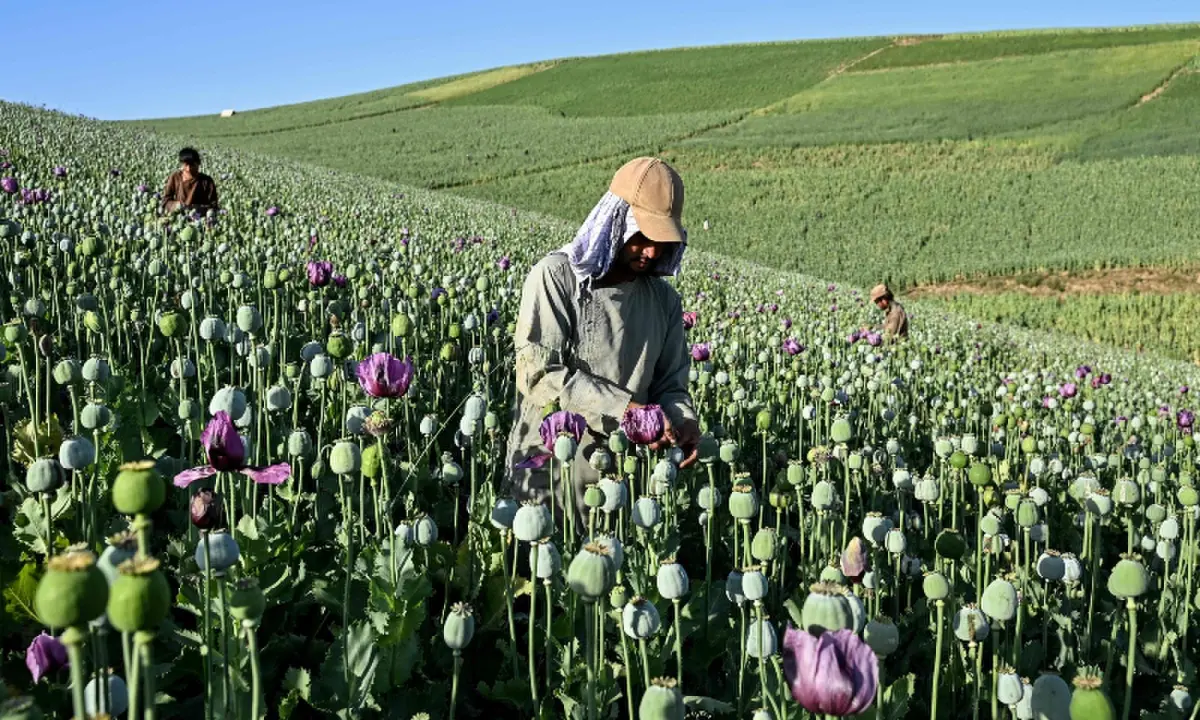
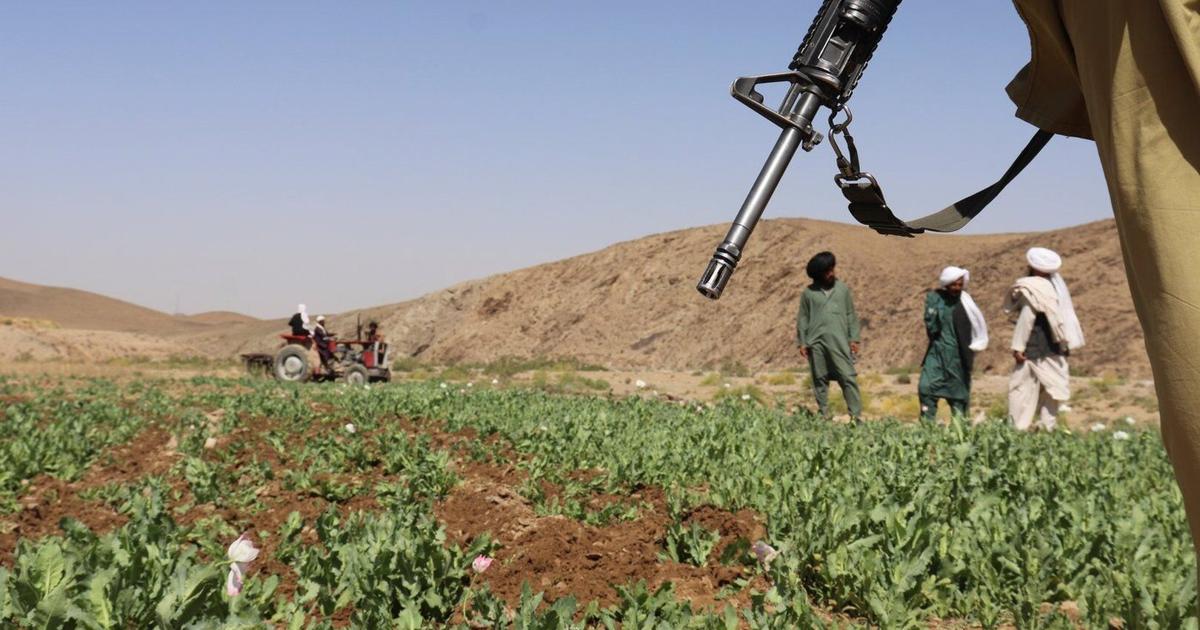
Photo via Dawn

Afghanistan opium poppy cultivation surges despite Taliban govt ban: UN

Read the original at Dawn ↗
Cite

AFP. (2026, October 29). Afghanistan opium poppy cultivation surges despite Taliban govt ban: UN. Dawn. https://www.dawn.com/news/2040685/afghanistan-opium-poppy-cultivation-surges-despite-taliban-govt-ban-un

Dated from the outlet's own feed. Check the original for its byline.

Dawn · collected 2026-10-29 · by AFP

Quick Summary

The United Nations reported a significant increase in opium poppy cultivation in Afghanistan in 2026, with cultivated areas expanding from 10,000 hectares in 2025 to 43,000 hectares. This surge followed the Taliban government's ban on opium production and saw estimated opium production rise fivefold from 300 tonnes to 1,500 tonnes. Despite efforts by the Taliban authorities to destroy poppy fields, many farmers continue to cultivate opium due to its high financial return compared to other crops, with one hectare of wheat generating $770 versus $10,000 for a hectare of poppies.
Written by AI on 2026-10-29, from this article's own text only (the story summary below draws on all the coverage).

AI analysis

Story summary

The United Nations Office on Drugs and Crime (UNODC) reported on October 29, 2026, that opium poppy cultivation in Afghanistan more than quadrupled from 10,000 hectares in 2025 to 43,000 hectares in 2026 despite a ban imposed by the Taliban government. Estimated opium production also jumped fivefold from 300 tonnes to 1,500 tonnes over the same period. This surge marks the first significant increase since the Taliban banned narcotics in 2022, which previously reduced cultivation areas from more than 200,000 hectares.

Deepening poverty has driven some farmers back into cultivating opium poppy clandestinely because it is a lucrative crop compared to other less profitable alternatives. Mohammad, a 22-year-old farmer in Afghanistan’s northeast, told AFP that without opium farming, his family cannot even afford basic food. The Taliban authorities claim to have destroyed more than 22,000 hectares of poppy fields but UNODC notes many plots are concealed among cereal crops or behind walls, making them hard to detect.

Written for “Afghanistan Opium Cultivation Surges” on 2026-11-03, grounded in this article and the 3 other(s) covering the same event.

Story

📰 Afghanistan Opium Cultivation Surges
Politics · 4 article(s) covering the same event. Compare every outlet's account →

Compared with similar articles

This article reads unscored and hedges 13% of its claims. Each row says how that neighbour differs.
The Hindu
Hedges 5 of 37 claims Outlet record 77/100
Toronto Star
Hedges 0 of 3 claims Outlet record 64/100
Al Jazeera
⚖️ Leans left Hedges 0 of 2 claims Outlet record 60/100
“While both articles discuss opium poppy cultivation in Afghanistan, Article A reports on a UN report about the surge of opium cultivation despite a government ban, while Article B focuses on the reasons Afghan farmers are turning to opium farming for economic survival.”
How this article was measured signals, leaning charts, publisher record, byline, topics and claims

Signals How these are calculated →

Claims extracted
38
sentences that state something as happening or true
Uncertain
13%
5 of 38 hedged ("reportedly", "may", "according to")
Leaning
withheld
no quote in the article backed the model's score
Publisher signals
72/100
Dawn's corrections and hedging, across everything collected from it. Not a measure of accuracy.
Outlets on this story
4
Politics
Same framing elsewhere
1
articles that frame the event the way this one does
Analyzed 2026-10-29 · how these are computed

How this is being covered How these are calculated →

Article leaning vs. publisher reliability
Source leaning vs. consistency

Publisher

Dawn · 2620 article(s) · 3 correction(s) detected
Running correction rate · 3 correction(s)

Who wrote this

AFP
903 article(s) here · 1 carrying a prediction
🔮 A deal with Tehran “could happen,” Trump wrote on his Truth Social platform.
2026-11-03 · assertive framing · US signals progress in Iran talks to avert flare-up
🔮 PARIS: Exceeding 1.5C of global warming will have “irreversible” consequences for glaciers, sea ice and the Earth’s frozen regions, two UN reports warned on Monday, calling for urgent action.
🔮 More than 150 Afghans in the United States would be deported via Pakistan to Afghanistan, including relatives of those who assisted US forces before their 2021 withdrawal, according to US media reports and an advocacy group. “The Islamic Emirate of Afghanistan expresses its serious concern over reports that the United States intends to deport some Afghan refugees to Pakistan who have not yet been able to obtain legal residency documents in that country,” foreign ministry spokesman Abdul Qahar Balkhi said in a statement.
🔮 Itamar Ben Gvir, the far-right Israeli firebrand who achieved international notoriety as part of the outgoing government, fell short of expectations that he would gain ground in the latest election.
🔮 Polls show Democrats poised to seize the House of Representatives and within reach of the Senate in Tuesday’s vote — a shift that would impose tight political constraints on the president.
🔮 Some of the defendants allegedly “hid behind a screen” and conspired with the husband over the years to administer substances to the woman so she could be “used and abused”.
🔮 Donald Trump chose Washington’s Reflecting Pool — an iconic landmark where botched repairs came to symbolise the 80-year-old’s chaotic presidency — for a final speech on Monday to rally Republicans against a predicted tide of Democratic victories in midterm elections.
🔮 The British Minister will also meet EU Defence Chief Andrius Kubilius.
🔮 "We have stated that, if Iran's demands are met, it would be possible to restore security to the Strait of Hormuz and resume the negotiating process within a short period.
Wire or desk byline, not an individual reporter.
Also by AFP
Nothing else under this byline is closely related to this article, so these are simply their most recent.
All 903 articles by AFP →

Topics

Afghanistan Badakhshan Myanmar Taliban UNODC

Subjects

Afghanistan GPE · 7× UNODC ORG · 7× Taliban ORG · 6× Mohammad PERSON · 5× AFP ORG · 4× Badakhshan GPE · 3× Myanmar GPE · 2× Afghan NORP · 1× the United Nations ORG · 1× the United Nations Office on Drugs and Crime ORG · 1×

Narrative

“Opium prices slightly decreased from $570 per kilogramme in 2025 to $500 per kilogramme in 2026, remaining well above pre-ban levels of less than $100 per kilogramme,” UNODC said in a press release. “The fourfold increase in opium poppy cultivation shows the difficulty in sustaining decreases in illicit opium cultivation when poor farmers have no alternatives to feed their families,” said UNODC Executive Director Monica Juma.
framing: assertive · carried by 1 article(s) · first seen 2026-10-29
🔮 In May, two people were killed in clashes that erupted as Afghan security forces moved to destroy opium poppy fields in Badakhshan.

Claims (38 extracted, 5 hedged)

Opium poppy cultivation in Afghanistan more than quadrupled in 2026 despite a Taliban government ban, the United Nations said on Thursday, urging that impoverished farmers needed alternatives to the lucrative crop. asserted
farmers → quadruple → crop
Cultivated areas reached 43,000 hectares (around 106,200 acres), up from 10,000 hectares in 2025, while estimated opium production jumped fivefold from 300 tonnes to 1,500 tonnes, the United Nations Office on Drugs and Crime (UNODC) said in a report. asserted
Office → reach → report
Long the world’s leading producer of poppies, Afghanistan was overtaken by Myanmar after a 2022 Taliban government ban crushed the trade in the country. asserted
ban → lead → country
But rampant poverty has driven some farmers to return to the trade. asserted
poverty → drive → trade
“Without opium, we cannot even afford basic food,” Mohammad, a 22-year-old farmer in Afghanistan’s northeast, told AFP. asserted
Mohammad → afford → AFP
Afghanistan’s 2022 crackdown drove cultivated areas down from more than 200,000 hectares to 10,000 hectares in 2025. asserted
crackdown → drive → 2025
Myanmar cultivated 53,000 hectares in 2025, with no 2026 figures available. asserted
figures → cultivate → 2025
The Taliban authorities claim to have destroyed more than 22,000 hectares. uncertain
authorities → claim → hectares
But UNODC said many poppy plots were concealed among cereal crops or behind walls, making them difficult to detect. asserted
them → say → walls
Mohammad lives with his parents in Badakhshan, which has become Afghanistan’s main opium poppy-growing province. asserted
which → live → Badakhshan
“The Taliban threaten us and do not allow us to grow opium. asserted
us → threaten → opium
We cultivate it with a great deal of fear,” he said, asking only to be identified by his first name. asserted
he → cultivate → name
“I want to buy a car, build a house and get married. asserted
I → want → house
Without opium, I cannot achieve these things,” he further explained. asserted
he → achieve → things
In May, two people were killed in clashes that erupted as Afghan security forces moved to destroy opium poppy fields in Badakhshan. uncertain
forces → kill → Badakhshan
Another 35-year-old farmer named Mohammad, who ploughs his poppy field with an ox, said: “If we grow wheat, it is not enough to sustain our lives. asserted
it → name → lives
We are forced to grow poppies to earn a good income.” asserted
We → force → income
Mohammad said that he is threatened by the authorities and sometimes his crops are destroyed, but he will continue. asserted
he → say → authorities
“It is the only way to cover living expenses,” he said. asserted
he → cover → expenses
One hectare of wheat generated just over $770 in 2023, compared with $10,000 for a hectare of poppy, according to UNODC. uncertain
hectare → generate → UNODC
“Opium prices slightly decreased from $570 per kilogramme in 2025 to $500 per kilogramme in 2026, remaining well above pre-ban levels of less than $100 per kilogramme,” UNODC said in a press release. “The fourfold increase in opium poppy cultivation shows the difficulty in sustaining decreases in illicit opium cultivation when poor farmers have no alternatives to feed their families,” said UNODC Executive Director Monica Juma. asserted
Juma → decrease → families
The Taliban government acknowledged that the ban was not a “sustainable and long-term solution” without alternative livelihoods and economic support for farmers. asserted
ban → acknowledge → farmers
The challenge comes as Afghanistan faces the return of 6.6m Afghans since 2023, climate disasters, dwindling aid and banking isolation since the Taliban movement returned to power in 2021. asserted
movement → come → 2021
With support from Japan and the European Union, UNODC has funded programmes to help farmers find alternatives. asserted
farmers → fund → alternatives
Through the NGO Afghan Aid, Zikrullah, 35, who supports an extended family of 12 in Badakhshan, received improved wheat seeds and fertiliser. asserted
who → support → seeds
“We’re satisfied, it takes less effort than opium and we’re more at ease,” he told AFP, also asking to be identified only by his first name. asserted
he → ’re → name
A third farmer named Mohammad, 30, who has converted 80 per cent of his land to wheat, told AFP that the lack of water in recent years has affected crops other than poppy. asserted
lack → name → poppy
To curb opium production sustainably, alternative crops alone are insufficient, UNODC Country Representative for Afghanistan Polleak Ok Serei told AFP in an interview in Kabul. asserted
Representative → curb → Kabul
“Sustainable alternative livelihood requires more than thinking in terms of alternative crops,” he said. asserted
he → require → crops
Farmers “need access to markets, including international markets through trades. asserted
Farmers → need → trades
They need infrastructure, roads, irrigation, storage”. asserted
They → need → infrastructure
UNODC estimated in 2025 that approach would require approximately $500m, but “only 10pc” had been funded by donors and the Taliban authorities, according to Ok Serei. The strategy also takes time, he said. uncertain
he → estimate → time
“Thailand spent 15 years investing in alternative livelihood before starting eradicating,” Ok Serei said. asserted
Serei → spend → livelihood
The problem extends far beyond Afghanistan, he said. asserted
he → extend → Afghanistan
“It truly is an international problem,” Ok Serei added, explaining that Afghan drugs were consumed across other continents. asserted
drugs → add → continents
Afghan opium is the main source of heroin in the European Union, where approximately 850,000 people used opioids in 2024, according to the European Union Drugs Agency. uncertain
people → use → Agency
Addressing the problem requires international cooperation, the UN representative said. asserted
representative → address → cooperation
Ok Serei called for a “drug demand reduction strategy, not only in Afghanistan but also outside of Afghanistan”. asserted
Serei → call → Afghanistan

💬Give feedback
🕘History 🎫Support