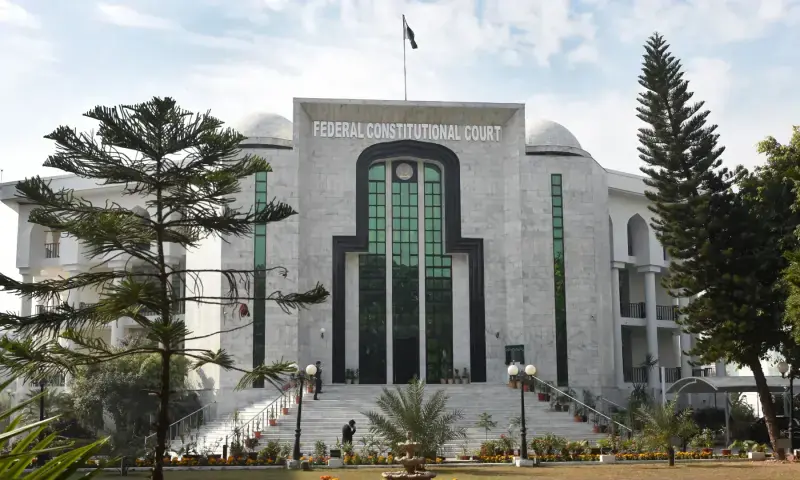
IT HAS been a year since the creation of the Federal Constitutional Court (FCC), and in the words of its top judge, the time “passed so swiftly that the passage of time had scarcely been felt”.
asserted
passage → pass → time
Justice Aminuddin Khan’s observation came during a dignified ceremony on Friday, held to mark the completion of the court’s first year.
asserted
observation → come → year
The occasion was full of pomp and circumstance, with a commemorative postage stamp being issued and souvenirs being presented to court officials and law officers.
asserted
souvenirs → issue → officials
But the court’s establishment, which in many ways upended the country’s established judicial hierarchy, has also had a major impact on the dispensation of justice over the past year.
asserted
which → upend → year
Created under the controversial 27th Constitutional Amendment, the FCC came into being on Nov 13, 2025, and Justice Aminuddin was sworn in as the inaugural chief justice the next day.
asserted
Aminuddin → create → justice
FCC observes one full year since its formation, but some lawyers see no real cause for celebration
Soon after it was formed, around 22,259 cases out of a total of 56,058 pending before the Supreme Court were transferred to it, realigning the constitutional and appellate jurisdictions of the two forums.
For senior counsel Tariq Mehmood Khokhar, however, there was little cause for celebration.
“This is a moment for scrutiny,” he noted, saying that the FCC owes its origins to a praetorian diktat, enacted by an unrepresentative legislature and filled by executive appointments.
asserted
FCC → observe → appointments
Calling for the cleansing and rebuilding of constitutional institutions tainted by raw power, he said that constitutional and democratic order must be restored and judicial independence reaffirmed.
asserted
independence → call → power
The FCC, if it is to command public confidence, ought to contribute to that process, Mr Khokhar emphasised.
asserted
Khokhar → command → process
The Democratic Alliance, a confederation of lawyers led by former Pakistan Bar Council vice chairman Abid Saqi, also put out a statement terming the day “the death anniversary of judicial independence”.
asserted
Alliance → lead → independence
“A court whose judges are effectively hand-picked by the executive cannot credibly adjudicate disputes in which that same executive is the principal party,” they noted.
asserted
they → pick → which
This point of view is endorsed by several political actors, especially the joint opposition, which has accused the government of undermining democracy and compromising judicial independence through the 27th Amendment.
asserted
which → endorse → Amendment
The criticism reached a fever pitch in the wake of a recent FCC order, restraining the Peshawar High Court from hearing pleas relating to the imposition of emergency and governor’s rule in Khyber Pakhtunkhwa.
asserted
criticism → reach → Pakhtunkhwa
The new top court formally commenced operations on Nov 17 by initially hearing cases within the premises of the Islamabad High Court on Constitution Avenue.
asserted
court → commence → Avenue
Later, in December, the federal government housed the new forum inside the Federal Shariat Court building — located right opposite the Supreme Court — while the FSC was relocated to the IHC’s premises.
asserted
FSC → house → premises
Later, the FCC CJ inducted a first batch of judges, boosting their ranks to seven against a sanctioned strength of 13.
asserted
CJ → induct → 13
However, the frosty relations between the SC and FCC were evident from the start, as no one from the Supreme Court — not even CJP Yahya Afridi — turned up for the swearing-in ceremony.
asserted
one → turn → ceremony
Today, despite the passage of a year, no further appointments or elevations have been made, though a proposal is under consideration to appoint a few more ad-hoc judges from different high courts for a specific time period, to help with the swift dispensation of pending cases.
asserted
proposal → make → cases
One of the most significant moves came soon after its inception in December 2025, when the FCC sent a loud and clear message to all other courts in the country, stating that they were required to adhere to its judgements.
asserted
they → come → judgements
While deciding a property dispute, the FCC had held that Article 189 of the Constitution stipulated that any decision rendered by the Supreme Court, which resolves a question of law or enunciates a principle of law, was binding upon all other courts within Pakistan, with the exception of FCC.
asserted
which → decide → FCC
“This exception arises from the 27th Amendment, which establishes that decisions issued by FCC are binding on all courts in Pakistan, including the Supreme Court itself.
asserted
decisions → arise → Court
Consequently, all courts in Pakistan are constitutionally mandated to adhere to the judgments of FCC,” the judgment had emphasised.
asserted
judgment → mandate → FCC
Later, through a different ruling, the FCC made it clear that precedential hierarchy also stands restructured after the 27th Amendment, dispelling the impression that it was unconditionally bound by previous Supreme Court pronouncements – a position that was not necessarily required under the constitutional framework.
asserted
that → make → framework
In May, though, CJP Yahya Afridi through a judgment elucidated the post-27th amendment judicial framework, by ruling that the constitutional scheme does not position either of the two apex courts — the Federal Constitutional Court (FCC) and the Supreme Court — as an appellate forum over the other.
uncertain
scheme → elucidate → other
Rather, it treats both as coordinate courts exercising clearly demarcated jurisdictions over distinct classes of matters, the CJP had emphasised.
asserted
CJP → treat → matters
But to further assert its precedential seniority, the court last month regretted the course adopted by Supreme Court bench on a matter “already determined” by the FCC, and described the approach of one of the senior-most judges at the SC as “something that raises serious concerns regarding judicial discipline, legal norms and institutional propriety”.
asserted
that → assert → discipline
 The Aporia