Not all findings in history lead us to an answer; some leave us grappling with even more questions.
asserted
some → lead → questions
Human remains have long opened up a range of curious questions: what happened, why, and who were these people?
asserted
people → open → questions
More often than not, they open the pathway for researchers to learn what beliefs and traditions shaped community life and even death.
asserted
beliefs → open → life
But sometimes, what appears to be a familiar archaeological finding can turn out to tell a rather different story.
asserted
appears → appear → story
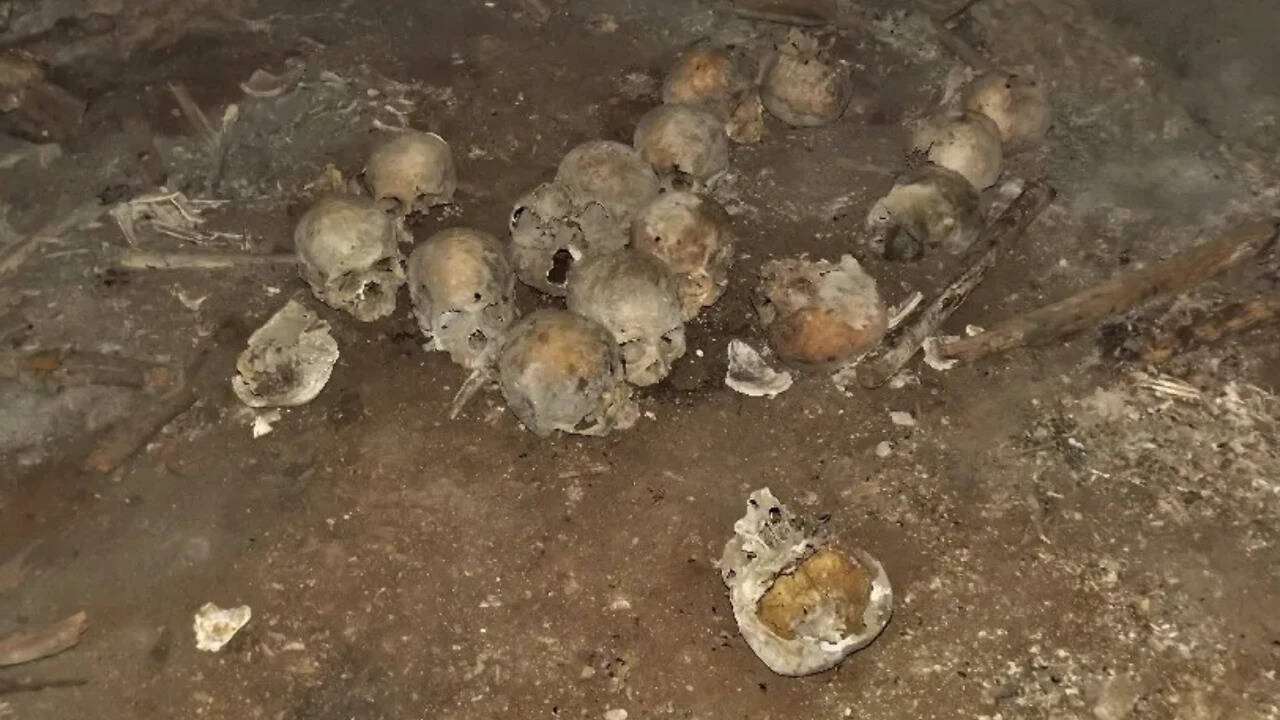
This was the case with a collection of 165 human skulls discovered inside a cave in Chiapas, Mexico, in 2012.
asserted
This → discover → 2012
At first associated with the ancient Maya practice of displaying human skulls, the remains have now offered researchers a more complicated picture of the people who were part of these ceremonies, with women and children forming a significant part of this collection.
asserted
women → associate → collection
the discovery was made in the Frontera Comalapa region of Chiapas, close to Mexico's border with Guatemala.
asserted
discovery → make → Guatemala
When the human skulls were first encountered inside the cave in 2012, their presence raised questions about the circumstances in which they had been brought together.
asserted
they → encounter → which
Ensuing investigations by INAH, established that the remains belonged to people who lived approximately 1,000 years ago, during the Early Postclassic period, between AD 900 and 1200.
asserted
who → ensue → AD
The collection was identified as a tzompantli, a structure associated with the ceremonial display or arrangement of human skulls in ancient Mesoamerican societies.
asserted
collection → identify → societies
These structures are perhaps most widely associated with the Aztec civilisation, particularly the large skull displays found in the ancient city of Tenochtitlan.
asserted
structures → associate → Tenochtitlan
However, the Frontera Comalapa discovery is considerably older than the famous skull altars of central Mexico, adding another dimension to what researchers understand about the practice.
asserted
researchers → add → practice
According to INAH's announcement dated October 28, 2026, researchers have now established that the collection contains 165 skulls.
uncertain
collection → accord → skulls
Of these, 15 belonged to children, while 83 were identified as belonging to women and 79 to men.
asserted
83 → belong → men
The sex of the remaining three individuals could not be determined because their skulls were too fragmented.
uncertain
skulls → remain → individuals
The nearly equal representation of women and men in this particular collection, however, suggests that the people represented in these ancient ceremonies may have come from a much wider group than previously assumed.
uncertain
people → suggest → group
What the skulls revealed about the people
Determining the sex of the individuals was not straightforward, as the researchers did not have pelvic bones available for examination.
asserted
bones → reveal → examination
The pelvis is generally considered the most reliable skeletal indicator for estimating biological sex.
asserted
pelvis → consider → sex
Instead, researchers examined differences in the skulls, including the shape of the lower jaw and the bony structures above the eye sockets.
asserted
researchers → examine → sockets
The initial investigations were undertaken by physical anthropologist Javier Montes de Paz, while the subsequent estimations were carried out by researchers Cristell Delesma Pérez and Abigail Reyes López.
asserted
estimations → undertake → Pérez
The ages of the individuals also offer an interesting glimpse into the population represented in the cave.
asserted
ages → offer → cave
Most of the adults were estimated to have been between 25 and 35 years old when they died.
asserted
they → estimate → adults
However, researchers have also identified two individuals who were perhaps roughly between 55 and 70 years of age.
asserted
who → identify → age
Researchers also identified cut marks on the remains of three individuals, while some of the bones showed evidence of exposure to heat.
asserted
some → identify → heat
Soot deposits were also observed on the cave's ceiling.
asserted
deposits → observe → ceiling
Together, these findings suggest that fire may have been used inside the cave, possibly by people entering with torches to carry out ceremonies.
uncertain
fire → suggest → ceremonies
Lozada Toledo suggested that the cave could have been a place of pilgrimage for nearby Maya communities, where people gathered for different religious practices, possibly also including ceremonies seeking rainfall.
uncertain
people → suggest → rainfall
However, these findings require further exploration.
asserted
findings → require → exploration
For instance, the cut marks and evidence of heat exposure do not independently establish that all the individuals were sacrificed.
asserted
individuals → establish → exposure
The significance of a skull beyond its physical form
Another fascinating aspect of the discovery lies in the way the remains appear to have been treated after death.
asserted
remains → lie → death
Researchers found that most of the skulls were missing their lower jaws, while the teeth had also been removed from the upper jaws.
asserted
teeth → find → jaws
Some showed evidence of intentional cranial deformation, a practice carried out during childhood by using boards to influence the developing shape of the head.
asserted
Some → show → head
The collection also contained 51 long bones, alongside the 165 skulls.
asserted
collection → contain → skulls
Their preservation has allowed researchers to identify even some of the smaller skeletal structures.
asserted
researchers → allow → structures
One particularly remarkable example was the survival of a malleus, also known as the hammer bone, in the middle ear of an individual.
asserted
example → know → individual
Measuring approximately 8 to 9 millimetres, this tiny bone is not commonly preserved in archaeological contexts.
asserted
bone → measure → contexts
These details have led researchers to consider whether the remains were handled, removed and repositioned more than once as part of ceremonial practices.
asserted
remains → lead → practices
The skulls may therefore represent more than a single event or a straightforward collection of victims.
uncertain
skulls → represent → victims
According to INAH, Lozada Toledo has also pointed towards the spiritual significance attached to different parts of the human body in Mesoamerican belief systems.
uncertain
Toledo → accord → systems
The head, in particular, was associated with
tonalli, suggesting a person's essence.
asserted
head → associate → essence
…and 1 more, not listed.
 The Aporia