Antoninus Pius was a Roman emperor, specifically the fourth of the Five Good Emperors, who ruled from AD 138 to 161.
asserted
who → rule → 161
His reign was marked by relative peace and stability across the Roman Empire, alongside administrative and legal reforms.
asserted
reign → mark → reforms
However, one of his more ambitious undertakings was expanding Rome's territory further north into Scotland, a campaign that resulted in the construction of the Antonine Wall.
asserted
that → expand → Wall
The emperor's legacy was not limited to the territories he conquered or the policies he introduced.
asserted
he → limit → territories
Like many Roman rulers, Antoninus Pius also had monuments and statues erected in his honour, celebrating his achievements and reinforcing his authority across the empire.
asserted
monuments → have → empire
One such monument may have been a towering, gilded bronze statue of the emperor riding a horse, which is believed to have once stood in southern Scotland.
uncertain
which → rid → Scotland
But if the Romans had gone to such lengths to immortalise their emperor, why was the statue eventually taken apart?
asserted
statue → go → emperor
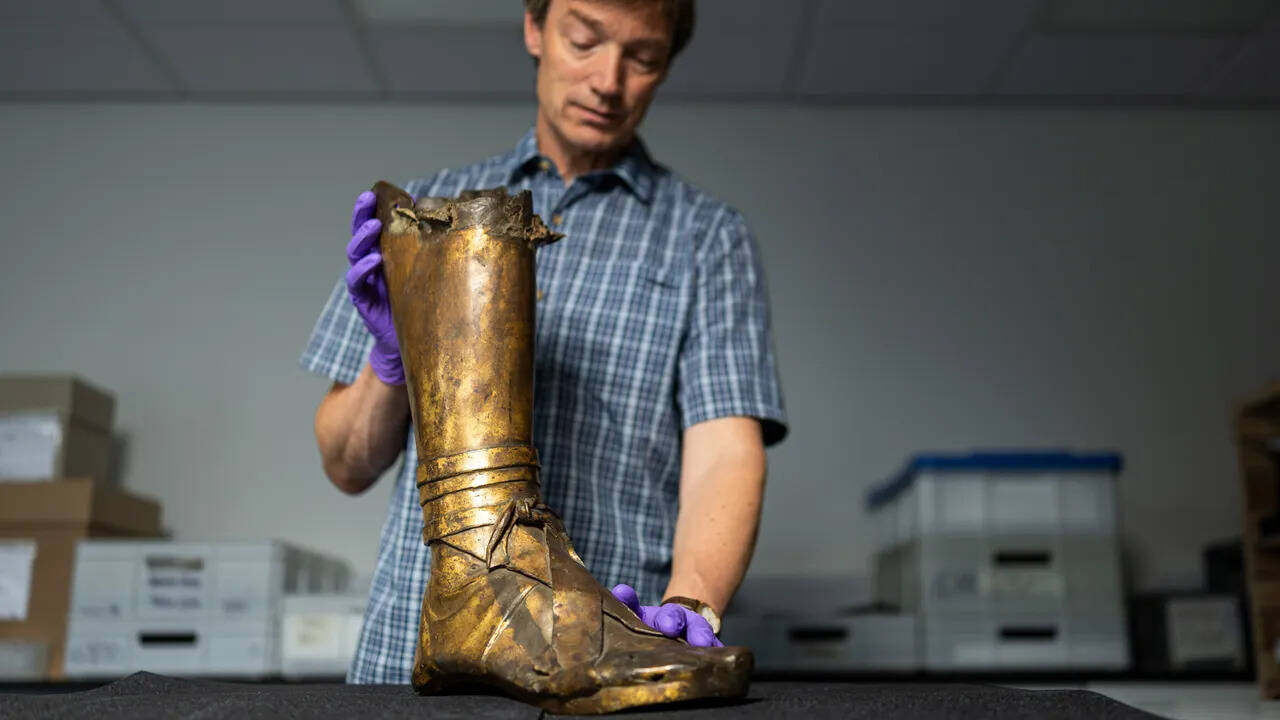
A bronze leg discovered in a Scottish bog more than 200 years ago may finally offer some answers.
uncertain
leg → discover → answers
Ahead of the Roman Scotland: Life on the Edge of Empire, an exhibition at the National Museum of Scotland,
the museum has released a statement regarding the same.
asserted
museum → release → same
Once thought to have been stolen by Scottish tribes from a Roman settlement further south, the artefact is now believed to have been deliberately removed by Roman soldiers themselves.
asserted
artefact → think → soldiers
The bronze leg, now known as the Milsington leg, was discovered in a bog near Hawick, in the Scottish Borders, in 1820.
asserted
leg → know → 1820
It is a larger-than-life lower right leg, complete with a boot, made from bronze and originally covered in gold.
asserted
It → make → gold
Dating back to around AD 140, it is believed to be the only surviving fragment of a monumental Roman imperial statue ever discovered in Scotland.
asserted
it → date → Scotland
For more than 200 years, however, its origins were understood quite differently.
asserted
origins → understand → years
The prevailing theory was that the fragment had been stolen from a Roman settlement further south, possibly York, and carried into Scotland by local tribes.
uncertain
fragment → prevail → tribes
It was difficult for historians to imagine that the Romans would have erected such an elaborate monument so far north of their established frontier.
asserted
Romans → imagine → frontier
Recent research has challenged this assumption.
asserted
research → challenge → assumption
By studying the fragment alongside other Roman statues found in frontier regions, archaeologists at National Museums Scotland believe it may have belonged to a colossal equestrian statue of Antoninus Pius.
uncertain
it → study → Pius
In other words, the emperor was probably depicted sitting on horseback, much like the famous bronze statue of Marcus Aurelius that still stands in Rome.
asserted
that → depict → Rome
The surviving leg offers a few clues about what the original sculpture looked like.
asserted
sculpture → survive → what
Its upper edge remains intact, with no visible signs of having been hacked or sawn off.
asserted
edge → remain → signs
There is also an interesting detail around the knee: the bronze is not gilded in this area, suggesting that it was originally concealed beneath the emperor's tunic or cloak.
asserted
it → be → tunic
The rest of the statue, including the emperor's torso and the horse, has yet to be found.
asserted
rest → include → torso
Researchers have even created a full-scale reconstruction of the proposed monument, using the surviving leg to give visitors an idea of its original grandeur.
asserted
Researchers → create → grandeur
According to Fraser Hunter, principal curator of prehistoric and Roman archaeology at National Museums Scotland, naturalistic human portraiture was relatively unfamiliar in the region.
uncertain
portraiture → accord → region
A towering, gold-covered emperor on horseback would have been an unmistakable display of Roman power.
asserted
emperor → tower → power
The statue was likely commissioned to commemorate Antoninus Pius's victories in Scotland during the 140s AD.
asserted
statue → commission → AD
Its placement in the newly occupied territory would have served a purpose beyond decoration.
asserted
placement → occupy → decoration
It was a way of making Rome's presence visible, reminding local communities who controlled the land and celebrating the emperor responsible for its expansion.
asserted
who → make → expansion
Why were Roman statues stolen in the first place?
asserted
statues → steal → place
The assumption that the Milsington leg had been stolen was not entirely far-fetched.
asserted
leg → steal → ?
Roman statues were valuable objects, particularly those made from bronze and covered in gold.
asserted
statues → make → gold
Their worth extended beyond their artistic craftsmanship.
asserted
worth → extend → craftsmanship
Bronze could be melted down and reused to make weapons, tools, coins and other objects, making large sculptures attractive sources of raw material.
uncertain
sculptures → melt → material
In territories where Roman control was contested, monuments could also become targets during conflicts, with defeated communities dismantling symbols of the power that had ruled over them.
uncertain
that → contest → them
There was also a political reason why statues of emperors were sometimes destroyed.
asserted
statues → be → emperors
Roman rulers were closely associated with their public image, and their likenesses appeared across cities, military settlements and conquered territories.
asserted
likenesses → associate → cities
When an emperor was disgraced or declared an enemy of the state, authorities could order his images and inscriptions to be removed.
uncertain
images → disgrace → state
This practice, commonly referred to as
damnatio memoriae, was an attempt to erase his public legacy.
asserted
practice → refer → legacy
Statues could be damaged, dismantled or repurposed, depending on the circumstances.
uncertain
Statues → damage → circumstances
…and 12 more, not listed.
 The Aporia