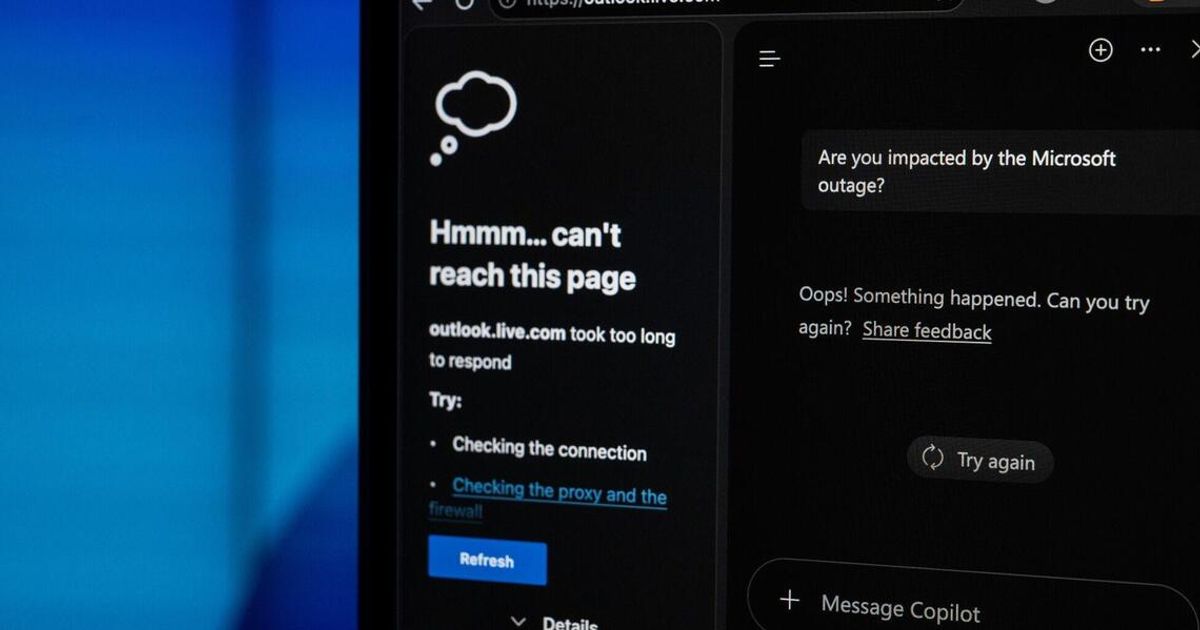
It began last Thursday when Microsoft Outlook, the email system on which millions of people and organisations depend, suddenly went down in a vast global outage.
asserted
millions → begin → outage
Within an hour, 74 countries had been affected.
asserted
countries → affect → hour
Governments and banks were hit and office workers around the world were left tearing their hair out as the disruption dragged on for almost 24 hours.
asserted
disruption → hit → hours
The following day, it was the turn of America’s aviation industry to descend into chaos when the Federal Aviation Administration (FAA) grounded all planes flying over the US for more than four hours in the longest nationwide ‘ground stop’ since the September 11 terror attacks in 2001.
asserted
Administration → descend → 2001
In all, around 14,000 flights were cancelled.
asserted
flights → cancel → all
Also on Friday, Workday, the online payroll and human resources platform used by some 11,500 companies, suffered a major outage.
asserted
Workday → use → outage
By the weekend, feverish online discussion had already started about who would be next and what might be responsible.
uncertain
what → start → weekend
But they didn’t have to wait long to find out.
asserted
they → have → ?
On Monday, three of America’s biggest banks – Chase, Bank of America and Wells Fargo – were struck by technical outages that locked customers out of their accounts.
asserted
that → strike → accounts
Users of other banks and the digital payment platform Zelle also reported problems.
asserted
Users → report → problems
The markets tumbled as investors, already skittish about the aviation fiasco, grew even more so about the banking disruption.
asserted
investors → tumble → disruption
Customers reported outages affecting Apple’s payment, retail and cloud storage operations
That afternoon brought yet more drama when United Airlines, the world’s biggest airline, suffered a systems outage lasting more than 90 minutes, forcing departing aircraft to remain on the tarmac.
asserted
Airlines → report → tarmac
Then, on Monday night, digital security experts based in Lancashire detected a large-scale cyber-attack in which hackers had compromised many of the world’s most visited websites – including HSBC, Lloyds Bank, IKEA and the BBC – in a bid to steal cryptocurrency and payment card details, as well as infect Apple iPhones.
asserted
hackers → base → iPhones
British cyber-security researcher Scott Helme discovered that malicious code, or ‘malware’, had been planted on websites belonging to 178 organisations through Optimizely, a platform used by companies to improve their websites.
asserted
code → discover → websites
And just yesterday, Google announced it had finally resolved a disruption at its UK cloud operation – part of its vast digital infrastructure that underpins so many online platforms – after an outage affecting British businesses, banks and courts.
asserted
that → announce → businesses
Meanwhile, customers reported outages affecting Apple’s payment, retail and cloud storage operations and the highly classified internal communications network used by staff of America’s National Security Agency went down, reportedly while the agency was updating its software.
So what on earth is going on?
uncertain
what → report → earth
The sense that something sinister and co-ordinated is afoot is hard to shake.
asserted
something → shake → ?
For almost as long as the internet has existed, cyber-security experts have warned of the potentially catastrophic consequences of entrusting so much of our lives to computer networks – which are vulnerable both to malign actors and spontaneous outages.
asserted
which → exist → actors
But we didn’t heed the warnings: virtually every aspect of modern civilisation now depends on technology working exactly as it should – from money in our bank accounts to electricity powering our homes, the aircraft carrying us on holiday and the systems delivering food to supermarket shelves.
asserted
it → heed → shelves
So has that day of reckoning finally arrived – and should we be, as some already are, putting away stocks of battery packs and tinned food for the impending digital doomsday?
asserted
some → arrive → doomsday
Not yet, insist many experts who have chorused that this recent string of incidents appears unrelated, with no evidence so far of a concerted attack.
asserted
string → insist → attack
Users on the London Borough of Tower Hamlets website are warned of disruption as government services were affected by the Microsoft outage
Passengers wait for their flights at George Bush Intercontinental Airport on Saturday after the Federal Aviation Administration grounded all planes flying over the US
The Microsoft breakdown, for instance, was reportedly caused by a dormant software bug that had been hanging around undetected for months but emerged during an upgrade of its network.
uncertain
that → warn → network
The FAA fiasco the following day, meanwhile, has been blamed by the Trump administration on a seemingly mundane mishap involving a defence contractor replacing copper wiring with fibre-optic cable at a remote FAA facility.
asserted
contractor → follow → facility
It caused a glitch that flooded the entire air traffic control network with more data than it could handle.
uncertain
it → cause → data
As for the banking nightmare in the US, Chase – which also operates in the UK – has said it had suffered a software bug that affected payments not only to its customers but also to those of the other banks.
asserted
that → operate → banks
If this had been a concerted cyber-attack, claim sceptics, someone would have claimed responsibility by now.
uncertain
someone → claim → responsibility
Not if a hostile foreign government wanted to send the West a chilling warning about just how easily critical infrastructure could be brought to its knees.
uncertain
infrastructure → want → knees
Some have pointed to the potentially significant timing of President Donald Trump’s arrival in China on Wednesday for important talks with President Xi Jinping.
asserted
Some → point → Jinping
Others say Iran, potentially emboldened by Trump’s defeat in the recent midterm elections, is determined to escalate its conflict with the US.
asserted
Iran → say → US
And there are reasons for the White House to be on edge.
asserted
House → be → edge
On Monday, American news station CNN reported that new US intelligence indicated Tehran was developing plans to potentially detonate a radioactive ‘dirty bomb’ or deploy a chemical weapon in Washington DC, targeting senior Trump administration officials.
asserted
Tehran → report → officials
Meanwhile, only days ago, the FBI warned that cybercriminals had begun using an autonomous AI-powered hacking tool called ARTEX to launch automated attacks against organisations – including banks, weapons manufacturers and governments.
asserted
cybercriminals → warn → banks
In some cases, it has been able to breach their online security defences in less than three hours.
asserted
it → breach → hours
So could it be that people high up in government and technology know more about this extraordinary sequence of outages than they are prepared to admit?
uncertain
they → know → outages
Indeed, administration officials were reportedly sufficiently alarmed last Friday by the possibility that America was under attack that they activated the White House Situation Room – the high-security underground nerve centre reserved for handling national emergencies – with senior figures from the FBI, Pentagon and intelligence agencies brought together on a call.
uncertain
figures → activate → call
Others have been equally reluctant to accept that this was all one enormous coincidence.
asserted
this → accept → ?
Security expert John Miri, president of the US Electric Grid Cybersecurity Alliance, (the threat of hackers closing down power stations is one of the biggest nightmares of the lot) clearly echoed the thoughts of many ordinary citizens when he said this week: ‘If it is purely IT failures, then it is the largest coincidence that I’ve ever seen in my IT career.’
The near-simultaneous ‘massive’ failures involving Microsoft Outlook, the FAA, Chase and other banks were, he argued, ‘suspicious’.
asserted
he → close → Outlook
‘Is it possible that my next-door neighbour won the lottery jackpot three days in a row?
asserted
neighbour → win → row
It’s possible, just not real likely.’
asserted
It → ’ → ?
For now, at least, most experts disagree based on the evidence.
asserted
experts → disagree → evidence
…and 11 more, not listed.

 The Aporia