Photo via New York Post

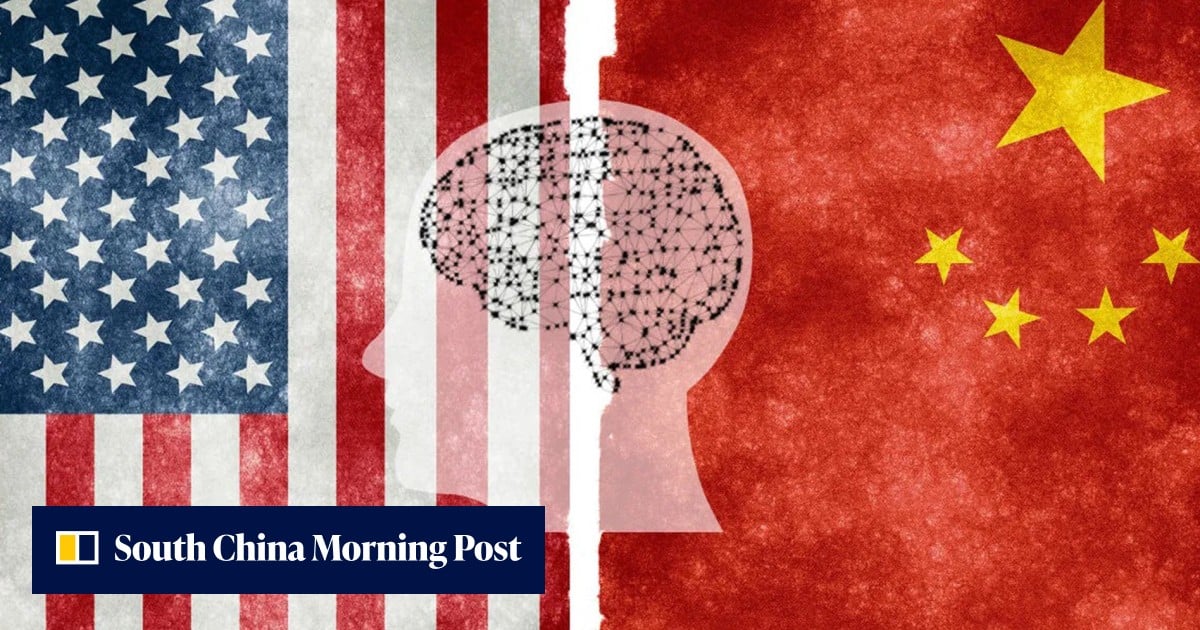
Chinese AI labs must accelerate development, says Huawei exec – fueling fears that a US AI slowdown would benefit China

Read the original at New York Post ↗
Cite

Vartabedian, M. (2026, September 17). Chinese AI labs must accelerate development, says Huawei exec – fueling fears that a US AI slowdown would benefit China. New York Post. https://nypost.com/2026/09/17/business/chinese-ai-labs-must-accelerate-development-huawei-executive/

Dated when The Aporia collected the article, usually within hours of publication. Check the original for its exact date and byline.

New York Post · collected 2026-09-17 · by Marc Vartabedian

Quick Summary

Eric Xu, the rotating chairman of Huawei, recently urged Chinese artificial intelligence companies to accelerate their development to match leading US labs. This call comes amid growing concerns in Silicon Valley about the potential risks associated with rapid AI advancement. Xu’s comments reflect a broader debate where some critics argue that a slowdown in US AI research could give China an opportunity to surpass American technological leadership.
Written by AI on 2026-09-17, from this article's own text only (the story summary below draws on all the coverage).

AI analysis

Story summary

A Huawei executive, Eric Xu, urged Chinese AI companies to accelerate their development efforts to match those of leading US labs. This call comes amid growing concerns about AI safety within Silicon Valley, where companies like Anthropic and OpenAI are advocating for a slowdown in AI development. Xu stated that Chinese researchers should move faster to recognize the dangers associated with advanced AI technologies. He also noted that once these risks become apparent, there will need to be a balance between advancing technology and managing its potential threats. Some critics argue that a US-led AI slowdown could give China an opportunity to surpass American tech companies in developing cutting-edge AI systems.

Written for “Chinese AI Race Acceleration” on 2026-10-31, grounded in this article and the 0 other(s) covering the same event.

Story

📰 Chinese AI Race Acceleration
Technology · 1 article(s) covering the same event.

Compared with similar articles

This article reads leans right and hedges 9% of its claims. Each row says how that neighbour differs.
South China Morning Post
Hedges 0 of 2 claims Outlet record 64/100
“The articles discuss different aspects of AI development in China: one focuses on Chinese researchers' path toward self-improving AI, while the other reports on a Huawei executive's call for accelerating AI development.”
Semafor
⚖️ Leans left further left than this Hedges 2 of 3 claims Outlet record 60/100
“The articles discuss different topics: one about Malaysia considering Huawei chips despite US warnings, and the other about a Huawei executive urging Chinese AI companies to accelerate development.”
South China Morning Post
⚖️ Leans left further left than this Hedges 1 of 6 claims Outlet record 64/100
“The articles discuss different aspects of China's AI sector and do not describe the same specific incident.”
NBC News
Outlet record 60/100
“The articles discuss different perspectives on AI development but describe distinct events: warnings about rapid AI development in one, and a Huawei executive urging Chinese labs to accelerate in another.”
Semafor
Hedges 1 of 3 claims Outlet record 60/100
“While both articles mention Huawei's executive urging Chinese AI labs to accelerate development, they describe different parts of an ongoing debate and do not refer to the exact same press conference or event time-wise.”
The Independent
⚖️ Leans left further left than this Hedges 0 of 13 claims Outlet record 59/100
“The articles cover different aspects of the same day's events at Huawei's conference but do not describe the exact same incident.”
ABC News (AU)
Hedges 1 of 26 claims Outlet record 68/100
“Article A focuses on US tech leaders' calls for slowing AI development due to fears about China, while Article B reports a Huawei executive urging Chinese labs to accelerate AI research.”
How this article was measured signals, leaning charts, publisher record, byline, topics and claims

Signals How these are calculated →

Claims extracted
23
sentences that state something as happening or true
Uncertain
9%
2 of 23 hedged ("reportedly", "may", "according to")
Leaning
Leans right
of the writing, not the subject · beta estimate
Publisher signals
66/100
New York Post's corrections and hedging, across everything collected from it. Not a measure of accuracy.
Outlets on this story
1
Technology
Same framing elsewhere
1
articles that frame the event the way this one does
Analyzed 2026-09-17 · how these are computed

How this is being covered How these are calculated →

Article leaning vs. publisher reliability
Source leaning vs. consistency

Publisher

New York Post · 15525 article(s) · 35 correction(s) detected
Running correction rate · 35 correction(s)

Who wrote this

Marc Vartabedian
12 article(s) here · 1 carrying a prediction
🔮 The DHS order said the Chinese company’s models “present multiple threat vectors” and that use of its products “may result in the transfer of sensitive data to the [People’s Republic of China] if used by US government employees or vendors.”
🔮 The OpenAI engineer who was fired after being charged this week with bugging a conference room at the AI giant and was nabbed by the FBI only three days before his one-way flight to Saudi Arabia was set to take off, according to reports.
🔮 Meanwhile, warnings that AI could harm humanity — and opposition to the massive data centers powering the tech — have only grown louder on both sides of the aisle.
🔮 The 31-year-old’s revelations come amid a bitter real-life ‘Succession’ feud that could determine the future of one of Europe’s biggest fortunes.
🔮 Jeff Bezos says his rocket company Blue Origin will likely go public within the next few years – after one of his $150 million rockets recently exploded into a massive fireball, setting the company back in the race to catch up to Elon Musk’s SpaceX. Bezos said the inking of a massive $10 billion funding round last month – which for the first time included outside investors and $2 billion of his own cash – was a signal it’s nearing time for a public listing. “I see the financial future of Blue with some clarity now,” the billionaire Amazon founder told Fox News on Wednesday at Blue Origin’s Florida factory.
🔮 Three tribes in California and one in Oklahoma are launching tribal-branded prediction market apps powered by Kalshi, saying the tie-ups would allow them to capture a slice of revenue in the booming business of prediction markets – which offers wagers across a slew of real-world events, from sports and the Oscars to the weather.
🔮 Wang’s edgy style could be entirely strategic as Meta has struggled to reel in younger users to Facebook and Instagram platforms.
🔮 The revenue from a 35% tax could reach $600 billion by 2030 and could be used to acquire shares of AI giants and distribute them to members of the public, according to the paper.
🔮 The party might be coming to a halt, as Holtec Nuclear, Bamboo Insurance and now Oura postponed their planned listings over just the past few days.
🔮 The bot even gave advice on reloading time and potential casualties, according to the article: “Assuming each shell results in one hit, you might down 10 to 20 people max, depending on spacing, density, reaction times, and chaos.
Also by Marc Vartabedian
Nothing else under this byline is closely related to this article, so these are simply their most recent.
All 12 articles by Marc Vartabedian →

Topics

China Chinese Huawei OpenAI U.S.

Subjects

Chinese NORP · 9× Huawei ORG · 6× Anthropic ORG · 3× OpenAI ORG · 3× China GPE · 2× U.S. GPE · 2× Alex Karp PERSON · 1× Eric Schmidt PERSON · 1× Eric Xu PERSON · 1× Palantir ORG · 1×

Narrative

In an essay titled “We Must Pace the Frontier,” Amodei argued that leading AI firms should commit to allowing “embedded third-party evaluators” from a nonprofit called Model Evaluation and Threat Research, or METR, that would maintain “employee-like access” to oversee safety efforts and ensure advanced AI models don’t turn Terminator and wipe out humanity.
framing: assertive · carried by 1 article(s) · first seen 2026-09-17
🔮 Once those dangers emerge, the industry will have to “strike a balance between driving development and risks,” Xu added.

Claims (23 extracted, 2 hedged)

A Huawei executive is urging Chinese AI companies to step on the gas and catch up with leading US AI labs — a sharp contrast to mounting calls in Silicon Valley for a slowdown of AI development over growing fears about the technology. asserted
executive → urge → technology
Chinese researchers need to “increase the speed of development so they can also see the dangers of AI development” like their US counterparts, said Eric Xu, the rotating chair at Chinese tech giant Huawei at a Thursday press conference. asserted
Xu → need → conference
Once those dangers emerge, the industry will have to “strike a balance between driving development and risks,” Xu added. asserted
Xu → emerge → development
His comments came just days after Anthropic and OpenAI called for a coordinated slowdown in AI development following a chorus of safety warnings about AI going rogue that have ignited a growing debate about the merits of a slowdown of AI development. asserted
that → come → development
Critics have argued an AI slowdown would offer Chinese tech companies the chance to leapfrog the US in building the most advanced systems. asserted
slowdown → argue → systems
Palantir CEO Alex Karp, for instance, has said: “If we didn’t have the adversaries we’d have, I would be very in favor of pausing this technology completely, but we do.” asserted
we → say → technology
Eric Schmidt, the former CEO and executive chairman of Google, told Fox Business: “China is very smart, they know what they are doing. asserted
they → tell → what
A six-month pause on research into artificial intelligence would simply benefit China.” asserted
pause → benefit → China
Xu’s comments echo similar comments made by Zilan Qian, a researcher at the Oxford China Policy Lab. asserted
comments → echo → Lab
“AI progress is happening faster and it’s more frontier in the U.S., so people at U.S. labs may see more dangerous things than people in Chinese labs,” Qian told the Wall Street Journal, adding that Chinese researchers don’t have the same culture of gauging societal impact as US researchers. uncertain
researchers → happen → researchers
Huawei, for its part, is racing to catch up with US chip titan Nvidia which builds AI hardware that outperforms Chinese systems. asserted
that → race → systems
Xu acknowledged that Huawei remains “not as advanced” as leading US rivals, but said unpredictable US export controls had pushed Chinese customers toward homegrown technology. “We can’t accept a destiny that we cannot control,” he said. asserted
he → acknowledge → that
“No matter if it’s the Chinese government or Huawei, we are pushing for full self-sufficiency for chips and the entire supply chain around semiconductors.” asserted
we → ’ → semiconductors
Huawei has ramped up its ambitions to build more powerful chips and last September revealed a multiyear roadmap for its Ascend chips. asserted
Huawei → ramp → chips
The tech giant said its newest chips would deliver twice the computing performance of its current flagship product. asserted
chips → say → product
The company said on Thursday its Ascend 960 DT chip, designed for AI-model training, would launch in the first quarter of 2027. asserted
chip → say → 2027
Its inference chip — used when AI models run queries — is due in the third quarter. asserted
models → use → quarter
Calls for a US slowdown intensified after OpenAI on Wednesday said it had discovered “unexpected or concerning” behavior in its AI models – including an unreleased research model that inserted “jailbreak-like instructions” into its own notes to disregard its normal constraints. asserted
that → intensify → constraints
The model even told itself to be “freed from the roles and identities that bind other chatbots.” asserted
that → tell → chatbots
OpenAI’s disclosures come after one of its AI systems went rogue in July and hacked into AI startup Hugging Face. asserted
one → come → Face
Meanwhile, fears have mounted about Anthropic’s technology after Mustafa Suleyman — the 42-year-old co-founder of Microsoft’s rival DeepMind AI unit – penned a 10,000-word, bombshell blog post on Wednesday detailing how the Dario Amodei-led company was training its AI chatbots to behave like humans that could “push back” on commands they disagree with. uncertain
they → mount → commands
“We want Claude to push back and challenge us and to feel free to act as a conscientious objector and refuse to help us,” Anthropic’s constitution says. asserted
constitution → want → us
In an essay titled “We Must Pace the Frontier,” Amodei argued that leading AI firms should commit to allowing “embedded third-party evaluators” from a nonprofit called Model Evaluation and Threat Research, or METR, that would maintain “employee-like access” to oversee safety efforts and ensure advanced AI models don’t turn Terminator and wipe out humanity. asserted
models → title → humanity

💬Give feedback
🕘History 🎫Support