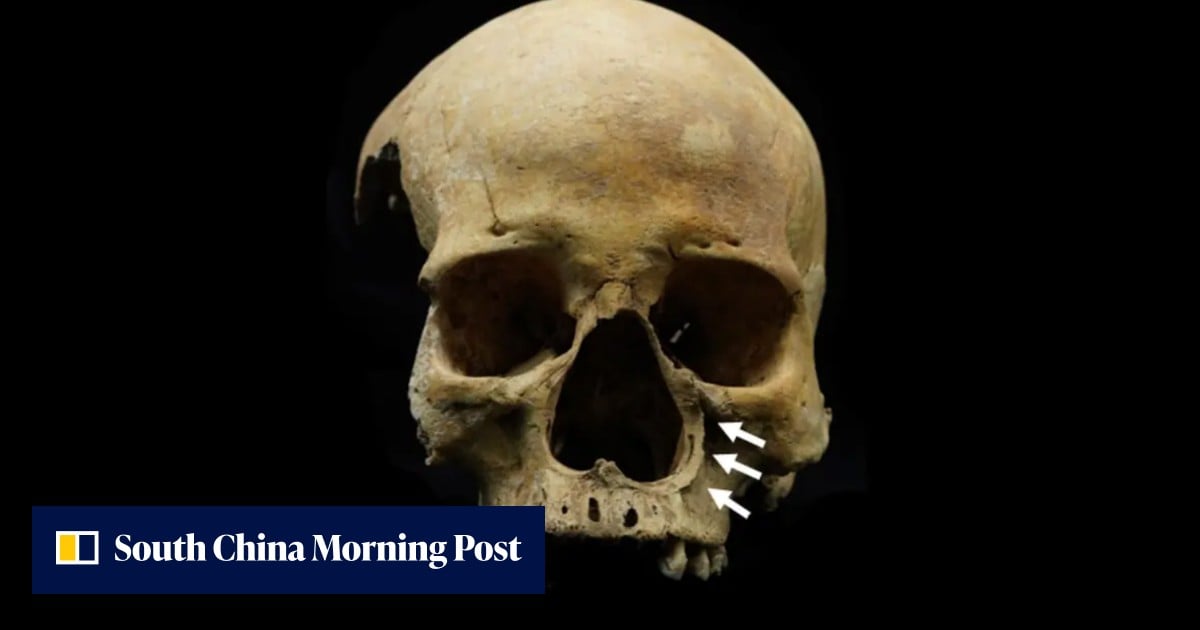
Photo via South China Morning Post

Chinese scientists find first evidence of ancient nose-chopping punishment for cattle thieves

Read the original at South China Morning Post ↗
Cite

McSpadden, K. (2026, September 19). Chinese scientists find first evidence of ancient nose-chopping punishment for cattle thieves. South China Morning Post. https://www.scmp.com/news/people-culture/trending-china/article/3368074/chinese-scientists-find-first-evidence-ancient-nose-chopping-punishment-cattle-thieves?utm_source=rss_feed

Dated when The Aporia collected the article, usually within hours of publication. Check the original for its exact date and byline.

South China Morning Post · collected 2026-09-19 · by Kevin McSpadden

Quick Summary

Chinese scientists have discovered physical evidence supporting ancient nose-chopping punishments for cattle theft, previously known only from historical records. The finding involves a female skeleton from between 1298 and 1404 CE, which shows signs of nasal amputation, aligning with the notorious "five punishments" from the Xia dynasty (2070–1600 BCE). This discovery provides the first concrete proof of this severe penalty in archaeological findings.
Written by AI on 2026-09-19, from this article's own text only (the story summary below draws on all the coverage).

AI analysis

Story summary

Chinese scientists have discovered the first physical proof of ancient nose-chopping punishments for cattle theft in China. The female skeleton, dated between 1298 and 1404, shows evidence of nose amputation, which was one of the brutal "five punishments" used during the Xia dynasty (2070 BC–1600 BC). Historically documented but never before physically confirmed, this severe penalty underscores the gravity attached to cattle theft in ancient Chinese society. The research team from China and the US published their findings, marking a significant breakthrough in understanding historical penal practices.


Written for “Ancient Punishment Discovery China” on 2026-10-30, grounded in this article and the 0 other(s) covering the same event.

Story

📰 Ancient Punishment Discovery China
Other · 1 article(s) covering the same event.

Compared with similar articles

Nothing to compare against. No article is close enough to this one for the pipeline to have linked or judged the pair.
How this article was measured signals, leaning charts, publisher record, byline, topics and claims

Signals How these are calculated →

Claims extracted
6
sentences that state something as happening or true
Uncertain
17%
1 of 6 hedged ("reportedly", "may", "according to")
Leaning
not political
takes no side on a contested political question
Publisher signals
64/100
South China Morning Post's corrections and hedging, across everything collected from it. Not a measure of accuracy.
Outlets on this story
1
Other
Same framing elsewhere
1
articles that frame the event the way this one does
Analyzed 2026-09-19 · how these are computed

How this is being covered How these are calculated →

Article leaning vs. publisher reliability
Source leaning vs. consistency

Publisher

South China Morning Post · 3417 article(s) · 6 correction(s) detected
Running correction rate · 6 correction(s)

Who wrote this

Kevin McSpadden
3 article(s) here · 1 carrying a prediction
🔮 Ming-era (1368–1644) emperors could have upwards of 9,000 consorts, ostensibly to ensure an heir.
🔮 While domestication of rice was crucial in southern China, it was millet that ruled the North, laying groundwork for birth of the country Rice may be the most universal ingredient in the world, serving as a cornerstone of the diet for billions in Asia.
🔮 Under the rule of the King of Qin (247 BC–221 BC), severed noses accumulated like mountain peaks, and carts overflowed with amputated feet Stealing someone’s cattle is a serious crime, and in many places, the thief would end up in jail.
Also by Kevin McSpadden
Nothing else under this byline is closely related to this article, so these are simply their most recent.

Topics

China Chinese

Subjects

Chinese NORP · 2× China GPE · 1× the King of Qin PERSON · 1×

Narrative

A team of researchers from China and the US recently announced the finding of a female skeleton dated between 1298 and 1404 (from either the Yuan or Ming dynasties) that showed clear evidence of nose removal as part of a criminal sentence.
framing: assertive · carried by 1 article(s) · first seen 2026-09-19
🔮 Under the rule of the King of Qin (247 BC–221 BC), severed noses accumulated like mountain peaks, and carts overflowed with amputated feet Stealing someone’s cattle is a serious crime, and in many places, the thief would end up in jail.
2026-09-19 · South China Morning Post
Chinese scientists find first evidence of ancient nose-chopping punishment for cattle thieves · assertive framing

Claims (6 extracted, 1 hedged)

Chinese scientists find first evidence of ancient nose-chopping punishment for cattle thieves asserted
scientists → find → thieves
Under the rule of the King of Qin (247 BC–221 BC), severed noses accumulated like mountain peaks, and carts overflowed with amputated feet Stealing someone’s cattle is a serious crime, and in many places, the thief would end up in jail. asserted
thief → sever → jail
However, ancient Chinese justice could result in a truly horrific form of mutilation: the amputation of the nose. uncertain
justice → result → nose
This harsh consequence has been well-documented by historians as one of the infamous “five punishments” from the penal system of the Xia dynasty (2070 BC–1600 BC). asserted
consequence → document → dynasty
Until now, no physical evidence of this punishment had been discovered. asserted
evidence → discover → punishment
A team of researchers from China and the US recently announced the finding of a female skeleton dated between 1298 and 1404 (from either the Yuan or Ming dynasties) that showed clear evidence of nose removal as part of a criminal sentence. asserted
that → announce → sentence
💬Give feedback
🕘History 🎫Support