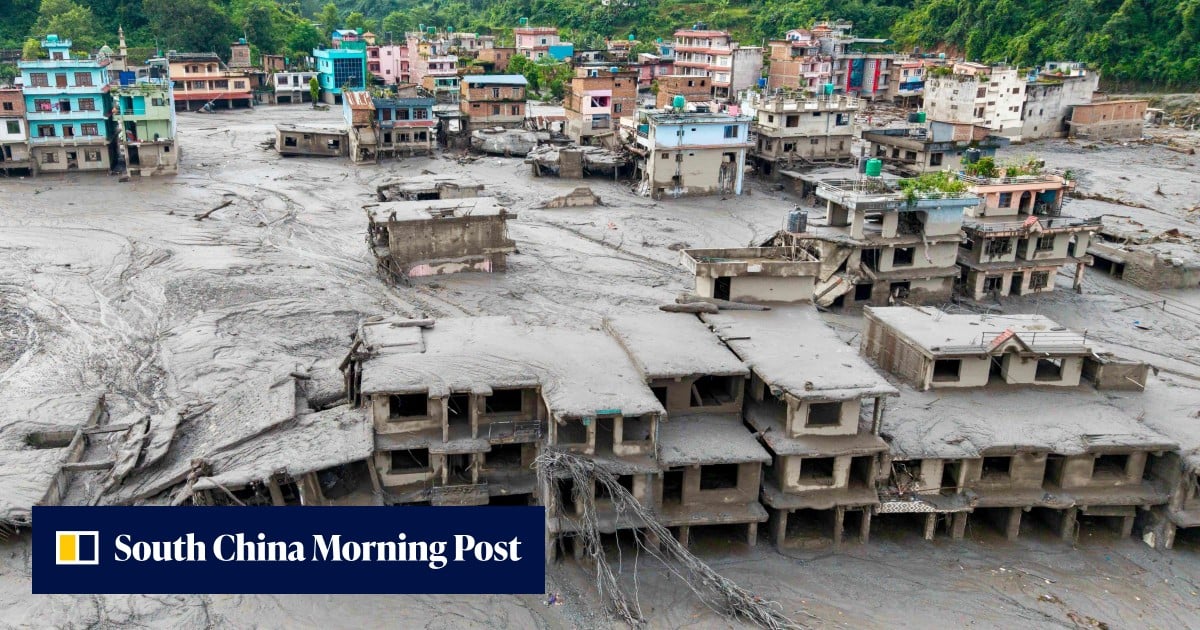
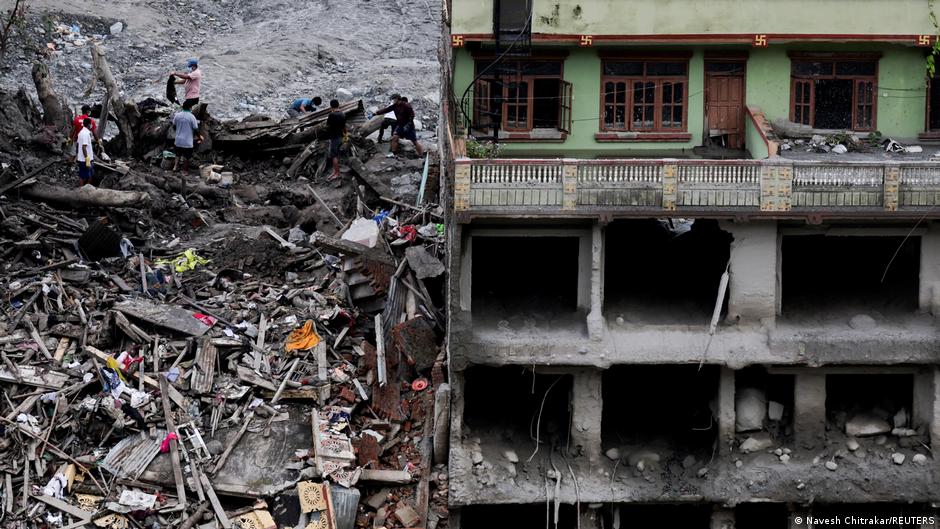
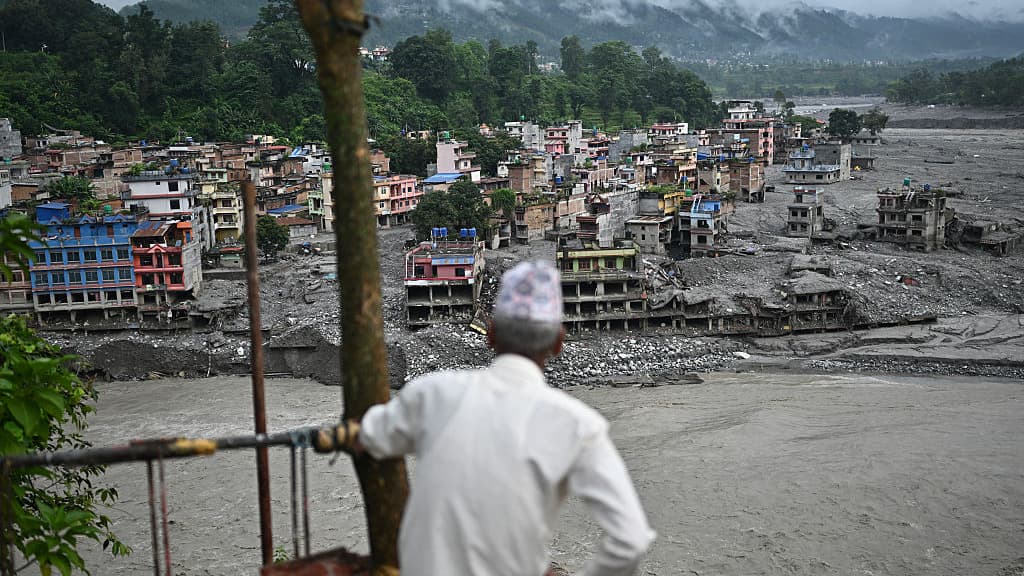
On the morning of August 26, the Himalayan landscape above Nepal’s Rasuwa district changed in minutes.
asserted
landscape → change → minutes
A mass of ice and rock broke loose high in the mountains and sent a violent surge of water, mud and debris down the Lhende Khola River.
asserted
mass → break → River
The torrent travelled through valleys, swept away settlements and infrastructure and eventually reached the Nepal-China border.
asserted
torrent → travel → border
What followed was not simply a flood.
asserted
followed → follow → ?
By mid-September, more than 1,400 people had been reported dead and at least 6,000 remained missing in Nepal and across the border in Tibet.
asserted
6,000 → report → Tibet
Twelve hydropower plants were destroyed, while roads, bridges and homes were buried or washed away.
asserted
roads → destroy → ?
The scale of the destruction has left scientists and disaster managers confronting a difficult question: How do you warn communities about a disaster whose trigger may occur high above them, in terrain that is difficult to monitor and where there may be only minutes to react?
uncertain
that → leave → terrain
Basanta Raj Adhikari, director of the Centre for Disaster Studies at Tribhuvan University in Kathmandu, described the event to Al Jazeera as unprecedented in size, affected area and mechanism.
asserted
Adhikari → describe → size
His estimate suggested that the energy involved was greater than that released by the Hiroshima atomic bomb, a comparison intended to illustrate the scale of the physical forces involved rather than suggest that the event was equivalent to a nuclear explosion.
uncertain
event → suggest → explosion
For scientists who study the Himalayas, the disaster demonstrated how quickly an event originating in a remote, high-altitude environment can become a regional catastrophe.
asserted
event → study → environment
The warning problem
A warming climate is altering glaciers, snow cover, permafrost and high-altitude lakes.
asserted
climate → warm → glaciers
At the same time, roads, hydropower projects, tourist facilities and settlements have pushed deeper into mountain valleys.
asserted
roads → push → valleys
That combination is creating a new risk landscape in which one hazard can trigger another.
asserted
hazard → create → another
An avalanche can block a river.
asserted
avalanche → block → river
A blocked river can form a temporary lake.
asserted
river → block → lake
A sudden release can become a debris flow.
asserted
release → become → ?
That debris can destroy a road or bridge, block another river and create another flood downstream.
asserted
debris → destroy → flood
The August disaster in Nepal showed how quickly such a sequence can unfold.
asserted
sequence → show → Nepal
It also exposed a weakness in the way early-warning systems are often designed.
asserted
systems → expose → way
Many systems are built around a particular hazard: rainfall, river level or glacial lake outburst flood.
asserted
systems → build → hazard
But the Himalayas do not always respect those categories.
asserted
Himalayas → respect → categories
In July, the International Centre for Integrated Mountain Development, or ICIMOD, warned that a below-normal monsoon should not be interpreted as a safer one.
asserted
monsoon → warn → one
“The biggest misunderstanding is that less seasonal rainfall means lower flood risk,” said Saswata Sanyal, a disaster risk reduction specialist at ICIMOD.
asserted
Sanyal → mean → ICIMOD
“A drier monsoon can still be a dangerous monsoon,” he added, warning that seasonal averages cannot capture the cloudbursts capable of producing catastrophic flooding in mountain valleys.
asserted
averages → add → valleys
The Nepal disaster went a step further.
asserted
disaster → go → ?
Scientists have been examining an ice-rock avalanche and other possible processes that temporarily obstructed the river system before releasing a destructive surge.
asserted
that → examine → surge
ICIMOD has described the event as an ice avalanche rather than a conventional glacial lake outburst flood, while other scientists have examined the role of local seismic activity and other high-altitude processes.
asserted
scientists → describe → activity
That distinction matters.
asserted
distinction → matter → ?
A warning system waiting for rainfall or a rising river may not provide enough time when the real trigger happens several kilometres upstream and above the line of sight of the communities below.
uncertain
trigger → wait → communities
Thousands of kilometres away, scientists studying Kashmir’s Himalayas are seeing another part of the same problem.
asserted
scientists → study → problem
A study published in the Journal of Glaciology this year mapped 155 glacial lakes above 2,500 metres (8,200ft) across the Himalayas in Indian-administered Kashmir.
asserted
study → publish → Kashmir
The researchers found that the area of ice-contact proglacial lakes – bodies of water that form directly against the margin of a melting glacier, trapped by moraine ridges, bedrock basins, or ice dams – had increased by 26 percent between 1992 and 2024.
asserted
that → find → 1992
Five lakes were classified as having very high susceptibility to glacial lake outburst floods.
asserted
lakes → classify → floods
An outburst from those lakes, the researchers found, could threaten several thousand buildings, 15 major bridges, roads and a hydropower project.
uncertain
researchers → find → buildings
More significantly, the study warned that hazards could occur in chains, with an upstream lake outburst potentially triggering secondary events downstream.
uncertain
outburst → warn → events
For Irfan Rashid, a glaciologist and associate professor at the University of Kashmir who co-authored the study, the implications extend beyond individual lakes.
asserted
implications → co → lakes
Rashid recently told Al Jazeera that without action, the melting, thinning, and destabilisation of glaciers, seasonal snow cover, and permafrost along the Hindu Kush-Himalayas system would increase, and water shortages could become a major problem across the Upper Indus, Ganga and Brahmaputra basins by the end of the century.
uncertain
shortages → tell → century
That is why the Nepal disaster resonates in Kashmir.
asserted
disaster → resonate → Kashmir
The landscapes are different, the rivers are different and the individual hazards may differ.
uncertain
hazards → differ → ?
But the underlying problem is increasingly similar: Communities living downstream of a rapidly changing high-altitude environment may have little time to respond when something breaks loose above them.
uncertain
something → underlie → them
…and 67 more, not listed.
 The Aporia